Key Takeaways
- The $55.7B U.S. physical therapists industry is growing, but consolidation by PE-backed chains is raising the competitive bar for independent practices.
- Clinical quality alone does not determine which practices grow. Differentiation, visibility, and authority are the real growth levers.
- PT practices that build recognizable brand authority and diversify beyond physician referrals outperform peers on patient volume and retention.
- Content marketing, local search dominance, patient education, and authority distribution work as compounding systems, not one-time tactics.
- Authority is built in layers: visibility earns attention, patient education builds trust, consistent content compounds over time, and reviews accelerate decisions.
- The AuthorityLogix five-system framework gives practices a structured path from anonymous to authoritative in their local market.
- Practices with a documented brand position convert more inquiries and retain more patients than those competing solely on location and insurance.
Physical therapy practice authority growth is the defining competitive challenge for independent clinic owners in 2026 — and most practices are approaching it without a system. The U.S. physical therapists industry is projected to reach $55.7 billion in revenue in 2026, per IBISWorld, with BLS projecting 12% employment growth for physical therapists from 2025 to 2035. That demand should translate to full schedules and rising revenue for every practice.
Instead, the practices capturing disproportionate patient volume are the ones that have built recognizable authority in their local markets — not necessarily the ones with the best clinicians or the most years in operation. Clinical quality earns the visit, but authority is what earns the search.
Private equity-backed chains now operate hundreds of locations across dozens of states. FYZICAL alone disclosed over 500 franchise locations across more than 45 states as of 2025. Independent practices face a consolidating competitive environment where brand recognition, digital presence, and multi-channel patient acquisition matter more than ever. The practices that grow through this pressure share a common trait: they have stopped relying exclusively on physician referrals and built diversified authority systems that generate patient volume on their own terms.
This blueprint maps the five authority and growth systems every PT practice needs. It covers what competitive differentiation actually looks like in physical therapy, how to build a brand position that outlasts any individual referral relationship, and how to layer the visibility, trust, and distribution systems that compound over time. This is not a collection of marketing tips. It is a structured approach to building a practice that patients find, trust, and choose — consistently.
Why Physical Therapy Practice Authority Growth Requires More Than Clinical Excellence
Physical therapy practices often compete on factors that patients cannot evaluate before they book: clinical quality, technique, and hands-on skill. Those things matter enormously for retention and word-of-mouth — but they are invisible to a prospective patient conducting a local search or comparing two clinics their physician mentioned. What that patient can evaluate are the signals of authority: reviews, online presence, educational content, website depth, and how clearly a practice articulates what it does and who it serves. For a deeper treatment of this topic, see the
acquisition playbook.
The
Edelman Barometer found that confidence in making health decisions has declined significantly, with a 10-point year-over-year drop globally. Healthcare providers are now competing with peers, content creators, and AI tools for patient attention and trust. The practices that earn trust before the first visit — through content, credentials, and consistent visibility — have a structural advantage over those that expect clinical outcomes alone to drive growth.
Prompt Health’s 2026 Practice Growth Index, drawn from a survey of more than 550 outpatient rehab practices nationwide, found that high-growth practices distinguished themselves through operational infrastructure — consistent, repeatable systems that compound over time. The practices with the strongest growth had patient acquisition channels beyond physician referrals and had invested in brand visibility before they needed it.
The Physician Referral Dependency Problem
The majority of PT practices still depend on physician referrals for the bulk of their new patient volume. That model is structurally fragile. Physicians move, retire, and shift their referral patterns. Insurance panel changes alter relationships overnight. Hospital employment of physicians increasingly channels referrals toward affiliated PT departments. Practices built entirely on referral dependency have no patient acquisition engine they control.
The acquisition playbook covers the mechanics of building diversified acquisition channels in detail. The relevant point here is strategic: authority growth is what makes every other patient acquisition channel more effective. A practice with strong local visibility, a robust educational library, and a recognizable brand converts referrals better, generates more direct-access patients, and retains more of both.
What Differentiation Actually Means for PT Practices
In most local physical therapy markets, practices offer overlapping services, work with similar insurance panels, and achieve comparable clinical outcomes. Branding creates meaningful differentiation by establishing a unique personality, clinical position, and authority in the minds of patients and referral sources — as the PT Referral Machine framework describes. Without deliberate positioning, patients and referral sources cannot articulate why they chose one practice over another beyond proximity and availability.
Meaningful PT practice differentiation operates on three levels. The first is specialty positioning: building visible expertise in a condition area or patient population that makes a practice the recognized go-to for that segment. The second is educational authority: owning the information environment around the conditions and treatments the practice handles. The third is reputation depth: a volume and consistency of patient reviews, community presence, and clinician profiles that make the practice feel established and trustworthy before anyone calls. To diagnose this issue in your own practice, use the PT Authority Gap Assessment →.
Long-term practice growth rests on the trust patients place in your clinicians. The Physical Therapy Patient Education & Clinical Authority Guide covers how practices build that trust before the first visit.
Clinical Authority Guide →
Building a Physical Therapy Practice Authority Growth Brand Position
A brand position is not a logo or a tagline. For a physical therapy practice, it is the answer to a single question a prospective patient or referral source is asking: why this practice, not the one two blocks away? Without a documented and consistently communicated answer to that question, every marketing effort operates at reduced efficiency — because the message has nowhere specific to land.
Effective PT brand positioning combines three elements: a clearly defined patient population, a visible clinical focus area or approach, and a consistent content voice that reinforces both. Practices that specialize — in sports rehabilitation for competitive athletes, in pelvic floor dysfunction, in pediatric developmental conditions, in concussion management — consistently outperform generalist practices on both marketing efficiency and patient acquisition cost.
The American Board of Physical Therapy Specialties reports more than 45,000 therapists hold board certification in one of ten recognized specialty areas. That credentialing infrastructure exists precisely because differentiation through demonstrated expertise has market value.
Competitive Positioning in a Crowded Local Market
Physical therapy competitive positioning begins with understanding what your market already has and where the gaps are. A practice located in a metro area with multiple large hospital-affiliated PT departments faces a different competitive environment than one serving a suburban market with a single competitor. The analysis that matters: which patient populations are underserved, which condition areas lack a recognized local authority, and which referral relationships are not being cultivated by established players.
This is the work that the Authority Gap Assessment is designed to surface — the specific gaps between where a practice’s authority currently sits and where it needs to be to win in its market. The competitive landscape analysis that precedes positioning decisions is not generic market research; it is a precise mapping of what competitors do well, what they communicate poorly, and where a differentiated practice can take ground. For the full specialty framework, visit the
PT Industry Hub.
Niche specialization is the highest-leverage positioning move available to an independent PT practice. Independents often prosper by specializing and becoming the go-to in a specific niche, which can support premium pricing and fend off competition. A clinic that becomes the recognized authority on vestibular rehabilitation in its region can attract referrals from neurologists and ENTs who previously sent patients elsewhere, and build a content library that captures search traffic no generalist competitor is targeting.
Brand Authority vs. Brand Recognition
Brand recognition means people know your practice exists. Brand authority means people trust your practice’s expertise before they have met you. The distinction matters because recognition is built through advertising and presence, while authority is built through demonstrated knowledge and consistent value delivery over time. For a PT practice, authority is the more durable asset — and the one that compounds.
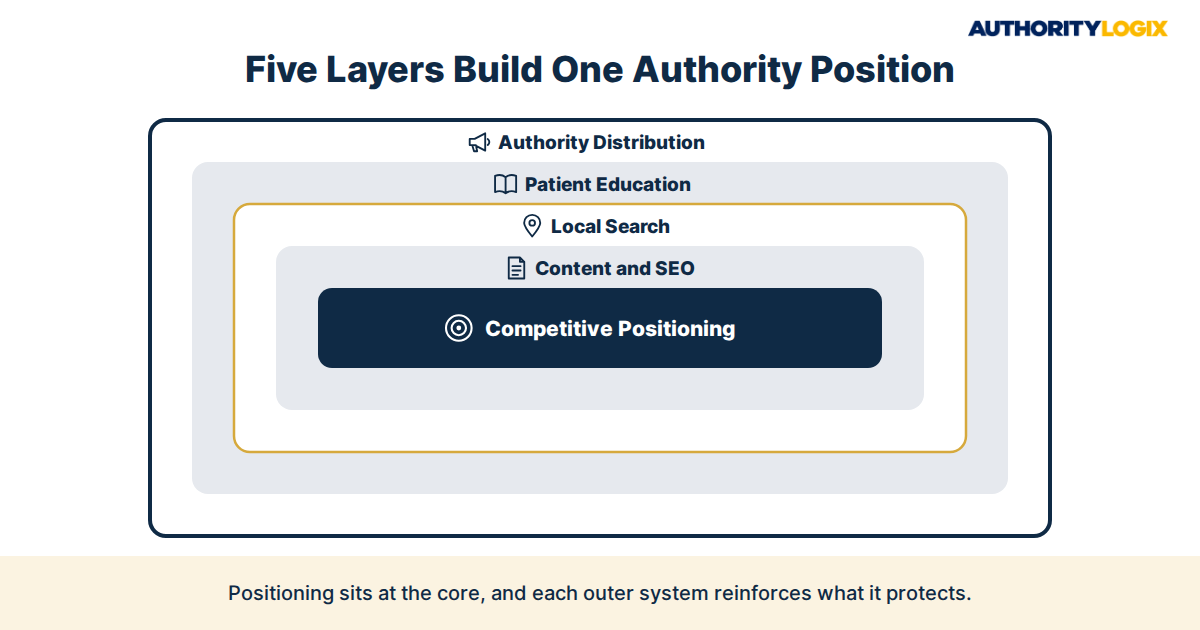
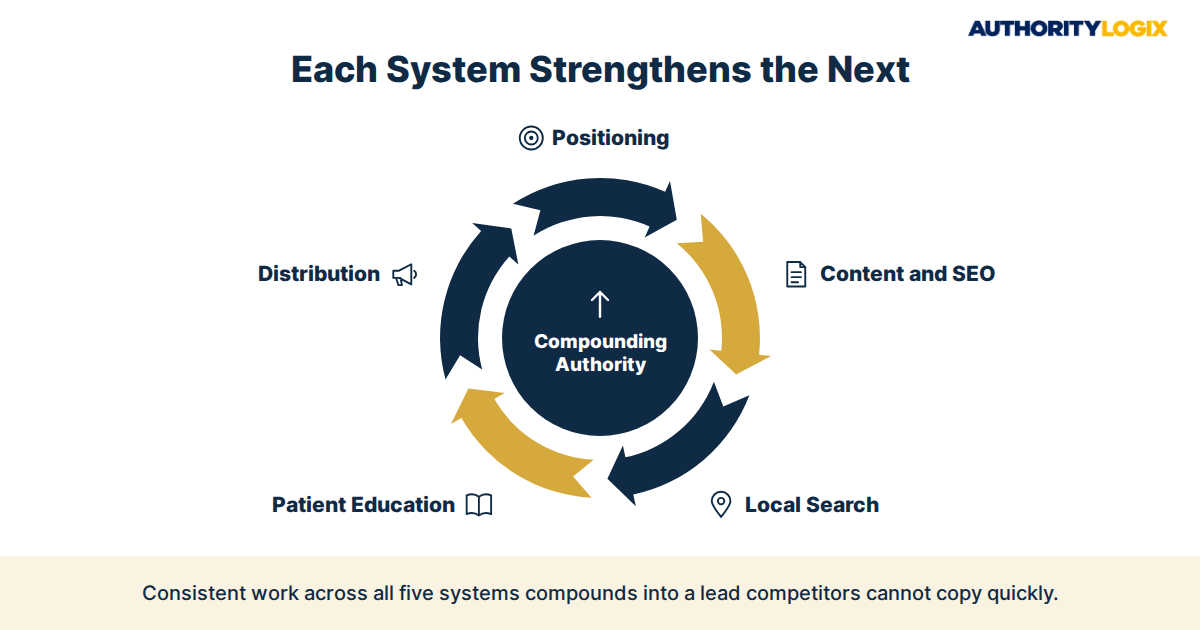
The PT Industry Hub at AuthorityLogix describes the five-system framework that builds this kind of compounding authority: Content Systems, Local Search and Clinician Authority, Educational Hub Development, Lead Generation Systems, and Authority Distribution. Each system reinforces the others. A practice with strong content generates more local search visibility. Better local visibility brings more patients into the educational content ecosystem. A deeper education library converts more inquirers into booked evaluations. The systems are not independent tactics — they are an interconnected growth engine.
The 5 Physical Therapy Practice Authority Growth Systems
Authority is not built by any single marketing activity. It is the cumulative output of consistent, coordinated systems that each do a specific job. The five systems below map directly to how patients discover, evaluate, and choose a physical therapy practice.
System 1: Competitive Positioning and Brand Identity
Every other system depends on this one. Before a practice invests in content, local search, or distribution, it needs a defined position: who it serves best, what it specializes in, and what consistent message it will carry across every patient touchpoint. This includes the practice name and visual identity, the clinical focus areas featured on the website, and the language used in everything from the homepage headline to the Google Business Profile description.
Practices that document their brand position and train staff to articulate it consistently convert more inquiries than those that leave positioning to chance. The message a patient hears when they call should match what they read on the website, which should match what they see in reviews, which should match what their physician told them. Brand consistency is a trust signal — and in healthcare, trust signals directly influence booking decisions. For a deeper treatment of this topic, see the
content playbook.
System 2: Content and SEO Authority
Content marketing generates about three times more leads than traditional marketing at 62% less cost, per Demand Metric. For PT practices, content authority means owning the search results for the conditions, treatments, and patient questions relevant to their practice. The content playbook covers the full architecture of a PT content system. Content is not a blog — it is a permanent asset that works 24 hours a day, capturing patients at every stage of their decision process — from initial symptom research through treatment comparison through provider selection.
A PT content system that compounds over time includes condition pages, service pages, educational articles, and a patient FAQ structure that captures voice search and AI overview traffic. Practices that combine schema markup, attributed authorship, primary source citations, and answer-first content structure improve their odds of being cited in AI search results — an advantage that grows in value as AI-generated search overviews become the default entry point for patient research.
System 3: Local Search and Clinician Authority
Organic search drives a large share of new patient website sessions for health and wellness practices, making search visibility a dominant patient acquisition channel for most PT clinics. The local visibility guide covers Google Business Profile optimization, map pack ranking factors, and citation management in detail. Within the authority growth blueprint, local search and clinician authority serve two distinct but related functions: they determine whether a practice gets found, and they determine whether the practice is perceived as credible once found.
Clinician authority — the visible expertise of the therapists behind the practice — is a component of local search authority that most PT practices underinvest in. Google’s E-E-A-T (Experience, Expertise, Authoritativeness, Trustworthiness) framework evaluates the demonstrated expertise of the people behind healthcare content. Clinician bio pages that document credentials, specialty certifications, clinical experience, and published content are not just branding assets — they are SEO infrastructure that affects how Google ranks the practice’s pages.
The clinician authority system at AuthorityLogix addresses both dimensions: the technical and citation-based work that improves map pack rankings, and the clinician credentialing content that builds the authoritativeness signals Google uses to evaluate health content. For a deeper treatment of this topic, see the
local visibility guide.
System 4: Patient Education and Clinical Authority
Patient education is simultaneously the most trust-building and most neglected authority system in PT marketing. The education guide establishes the framework for building an educational hub that converts prospective patients. Practices that explain conditions, set treatment expectations, and answer patient questions before the first visit reduce cancellations, improve intake efficiency, and generate stronger patient reviews — because patients arrive prepared and leave with their expectations met.
Patient education content can deliver strong returns over time because the same assets keep attracting and informing prospective patients. The mechanism is straightforward: a patient who has read condition-specific educational content from a practice before booking is more likely to arrive, less likely to cancel, more likely to complete the episode of care, and more likely to refer others. Education does not just build trust; it builds the patient behavior patterns that drive revenue.
System 5: Lead Generation and Authority Distribution
The first four systems build authority. This system distributes it. Lead generation convert the visibility and trust built by content, local search, and patient education into booked evaluations. Authority distribution takes the practice’s expertise and positions it across channels beyond the practice website: syndicated content, external citations, community media coverage, and third-party platforms that expand the geographic and demographic reach of the practice’s authority signals.
The compounding dynamic matters here. A practice that invests consistently in all five systems over 18 to 24 months builds an authority position that is extremely difficult for a new competitor to replicate quickly. Each piece of content is a permanent asset. Each review adds to a cumulative rating volume. Each external citation strengthens domain authority. The practices that out-compete PE-backed chains in their local markets do so through this kind of compounding depth — not through outspending.
Physical Therapy Competitive Positioning in the 2026 Market
The competitive landscape for physical therapy practices has shifted materially in the last three years. Private equity consolidation has accelerated: FYZICAL alone reported more than 620 locations across 46 states as of early 2025, and sponsor-to-sponsor platform recapitalizations have become common. Independent practices still deliver the majority of outpatient PT services in the U.S. — and the practices that have built genuine local authority are holding their ground and growing. For the related AuthorityLogix implementation framework, see
clinician authority.
The APTA Private Practice 2025 annual conference surfaced a consistent theme across sessions: winning practices are those that have moved beyond commodity positioning and built marketing and brand infrastructure that works independent of any single referral relationship. The practices with the strongest growth records had invested in digital presence, content systems, and differentiated positioning before they felt competitive pressure — not in response to it.
How Independent Practices Out-Position Larger Competitors
Independent PT practices have structural advantages that corporate chains cannot easily replicate: clinician continuity, community relationships, personalized care, and the ability to build a specific niche reputation that a diversified chain cannot credibly claim. A 30-location regional chain cannot authentically position itself as the hyperlocal expert in vestibular rehabilitation for a single ZIP code. An independent clinic can — and when it does, it owns that position in a way the chain cannot match.
The competitive positioning moves that give independent practices the highest leverage are: specialty niche selection, clinician authority building, and local search dominance — achieving map pack presence and high organic rankings for condition and location keywords that corporate competitors target with paid ads. None of the three requires a marketing budget larger than a corporate chain’s.
PT Brand Authority Strategy: Building Over Time
Brand authority in physical therapy is not built in a quarter. The practices with the strongest authority positions in their markets have been producing patient education content, collecting reviews, and maintaining their Google Business Profile consistently for two to four years. That time horizon is not a disadvantage — it is a competitive moat. A new entrant, whether a corporate chain or a new independent, cannot compress three years of consistent authority building into three months.
Consistent investment in authority building — not intensive bursts followed by neglect — is the pattern that produces durable competitive position. An organization that publishes two high-quality educational articles per month for three years builds more authority than one that publishes daily for three months and stops. Healthcare content marketing requires exactly this kind of sustained commitment to compound effectively.

Physical Therapy Practice Authority Growth: Measurement and Long-Term Strategy
Authority growth is measurable — but the metrics that matter are different from the vanity metrics most marketing dashboards surface. The numbers that signal genuine authority growth for a PT practice are: organic search impressions and local ranking positions for condition and location keywords; Google Business Profile action rates (calls, direction requests, website clicks); review volume and composite rating trends; educational content time-on-page and return visit rates; and new patient attribution by channel — specifically the percentage arriving through organic search, direct access, or self-referral rather than physician referral. For a deeper treatment of this topic, see the education guide.
Practices that track these metrics quarterly build a compound picture of authority trajectory over time. The benchmarks that matter are not month-over-month blips but directional trends across 6 to 12 month windows.
The 90-Day Authority Launch Framework
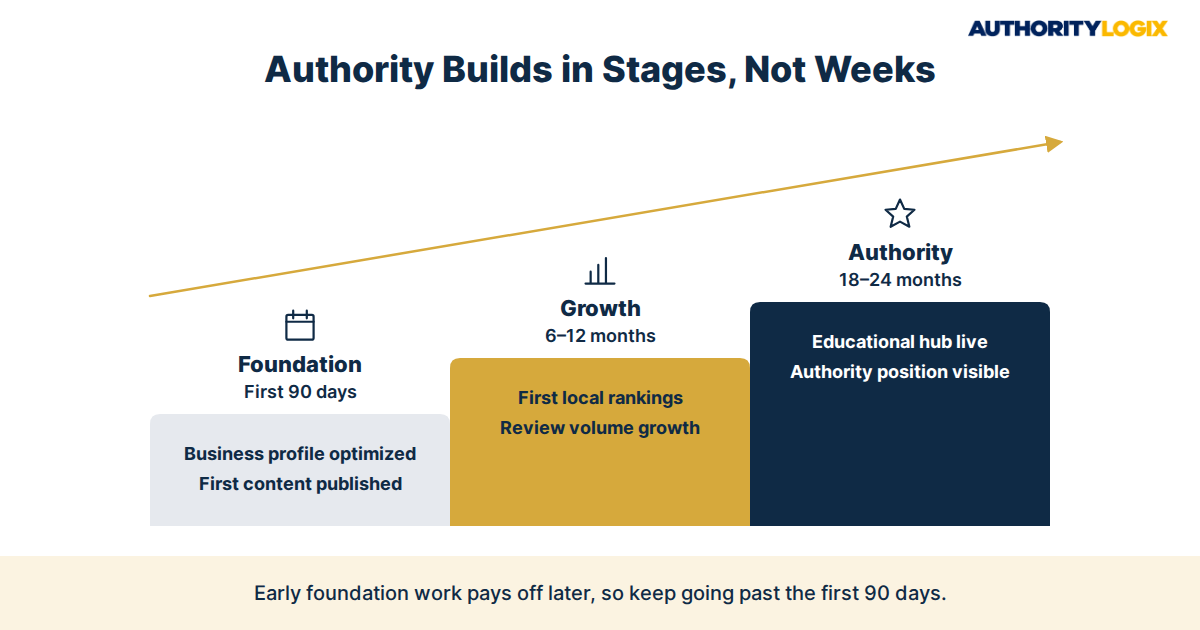
For practices starting from a limited digital presence, the first 90 days should accomplish: a fully optimized Google Business Profile with complete category selection, photo library, and review request process in place; a competitive analysis that identifies the top three keyword targets for condition and location content; and the first two to four pieces of educational content published and indexed. That foundation is what every later phase of the growth plan builds on.
Practices that treat the first 90 days as foundation-laying — not results-harvesting — set up correctly for the 12-month window where authority growth becomes measurable. The mistake most practices make is abandoning the effort at month three because rankings have not moved. Rankings move after consistent content production, technical optimization, and review collection have built the signals that Google needs to evaluate authority. Twelve months of consistent effort is where the differentiation becomes visible.
Multi-Location Physical Therapy Practice Authority Growth
PT practices with multiple locations face a specific challenge: each location needs its own local authority, while the brand needs coherent positioning across all of them. The approach that works is local autonomy within brand consistency. Each location maintains its own Google Business Profile, builds its own review volume, and produces some location-specific content. The brand architecture — the positioning, the visual identity, the patient education content — is shared and consistent across locations.
The PT resources at AuthorityLogix cover the full range of growth strategies relevant to PT practices at every stage — from single-location clinics building their first content system to multi-location practices standardizing authority across markets. For the related AuthorityLogix implementation framework, see
Lead generation.
Practice-Owner FAQ: Physical Therapy Practice Authority and Growth
How long does it take to see results from authority building?
Meaningful ranking improvements for competitive condition and location keywords typically appear in the 6 to 12 month window with consistent content production and technical optimization. Google Business Profile improvements — more profile views, more calls, more direction requests — can appear sooner, often within 60 to 90 days of completing a full GBP optimization. The compounding growth effects on patient volume are most visible at 12 to 24 months of sustained effort.
Should a practice niche down if it currently sees a broad range of patients?
Yes — with an important qualification. Niching down means building visible authority in a specific condition area or patient population, not refusing to treat patients outside that niche. A practice can continue serving a broad patient base clinically while building its marketing, content, and positioning around a defined specialty focus. The specialty focus drives acquisition; the broad clinical capability serves the patients who arrive through multiple channels. Most high-growth independent practices operate this way.
How does authority building help compete against hospital-affiliated PT clinics?
Hospital affiliation creates volume and brand recognition, but it does not create depth of patient trust or local niche authority. Independent practices consistently outperform hospital-affiliated clinics in patient experience ratings and in the conditions where specialized expertise matters most. A hospital system cannot credibly claim to be the hyperlocal authority in vestibular rehabilitation or post-ACL athletic recovery the way a specialized independent clinic can. Niche authority, combined with local search dominance and patient education depth, is the most effective counter-positioning available to independent practices.
What is the most important first step for a practice that has done no authority building?
Google Business Profile optimization. It is the single highest-ROI authority investment available to a PT practice that controls nothing else — because it directly affects whether the practice appears when high-intent patients search for physical therapy in their area. A fully optimized GBP (correct categories, complete service descriptions, active photo library, review request process in place, regular posts) can improve map pack visibility within weeks. Content and educational hub development follows once the GBP foundation is solid.
How do we measure whether authority building is working?
Track organic search impressions and keyword ranking positions quarterly for your primary condition and location targets. Track GBP action rates monthly — calls, direction requests, and website clicks from the profile. Track review volume and composite rating. Track new patient channel attribution, specifically the percentage arriving through organic search and self-referral versus physician referral. A practice with improving scores across all four of these dimensions is building authority that will compound into patient volume over the 12 to 24 month window.
Is content marketing cost-effective for a small private practice?
Yes — and increasingly so relative to paid alternatives. Content marketing generates about three times more leads than traditional marketing at 62% less cost, per Demand Metric. For a small practice with limited marketing budget, the return-on-investment from educational content — which compounds over time as permanent search assets — dramatically exceeds the return from paid search or paid social, which stop the moment spend stops. The tradeoff is time horizon: content requires patience across a 6 to 12 month window before compound effects become visible. For the full specialty framework, visit the PT resources.
Building Physical Therapy Practice Authority Growth That Lasts
Physical therapy practice authority growth is not a marketing campaign. It is a long-term competitive investment in the systems that make a practice visible, credible, and the obvious choice for patients who need what it offers. The practices that build these systems early — before competitive pressure makes it urgent — end up with an authority position that competitors cannot easily replicate and that compounds in value with every piece of content, every review, and every patient education resource added.
The framework described in this blueprint — competitive positioning, content and SEO authority, local search and clinician authority, patient education, and authority distribution — distinguishes the practices in any given market that grow consistently from those that plateau or decline. Each system addresses a specific dimension of how patients find, evaluate, and choose a physical therapy practice. Together, they build the kind of authority that makes physician-referral dependence optional rather than existential.
The Insight Articles in the Practice Growth and Authority library go deeper on each dimension: from competitive authority analysis to differentiation strategy, from brand building without competing on price to the 90-day authority launch framework. Each article connects directly back to the systems described in this blueprint and advances the practice’s understanding of what authority growth requires in their specific market context. The PT resource library is organized to support that ongoing learning systematically.
The competitive environment for physical therapy practices is getting more challenging, not less. The practices that will thrive over the next decade are the ones investing now in the authority systems that compound over time — not the ones waiting for the environment to become favorable before they act.
Ready to build the authority infrastructure that makes your practice the obvious choice in your market?
Work With Us →