


Key Takeaways
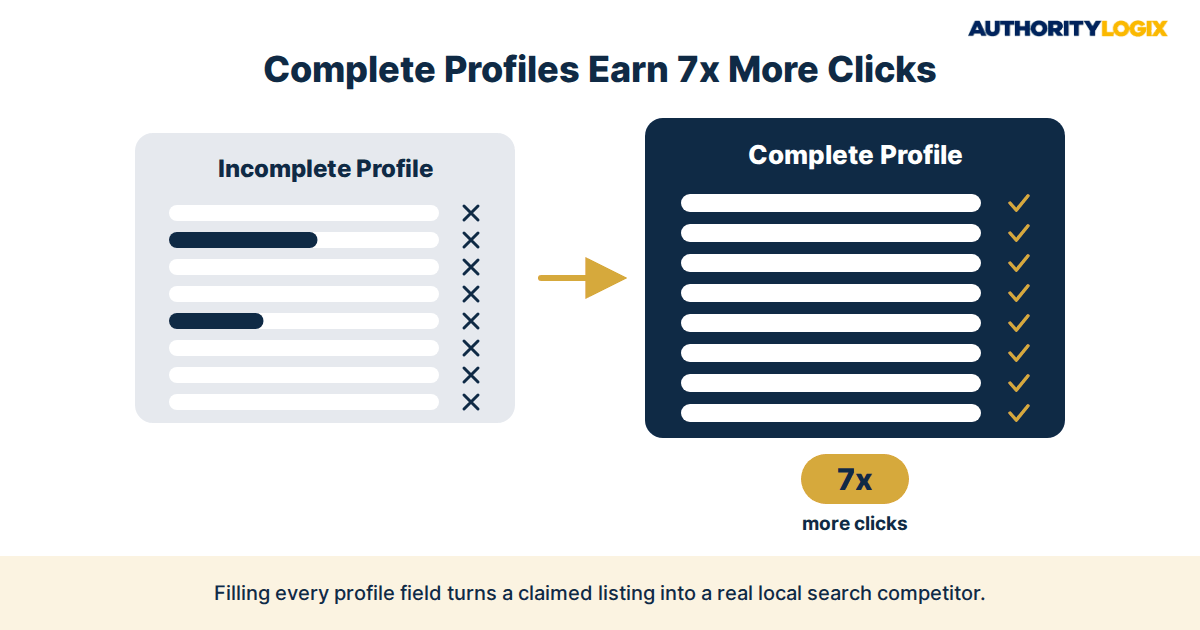
- A fully optimized Google Business Profile mortgage lender listing makes customers 70% more likely to visit than an incomplete profile, per Google — yet a meaningful share of local businesses have not even verified their listing.
- GBP signals account for 32% of local pack ranking weight, per Whitespark’s 2026 study, making the Google Business Profile the single highest-leverage tool in a mortgage company’s local SEO infrastructure.
- 84% of GBP searches are discovery searches — borrowers who were not searching for the lender by name but found them through a category or product search, per BrightLocal.
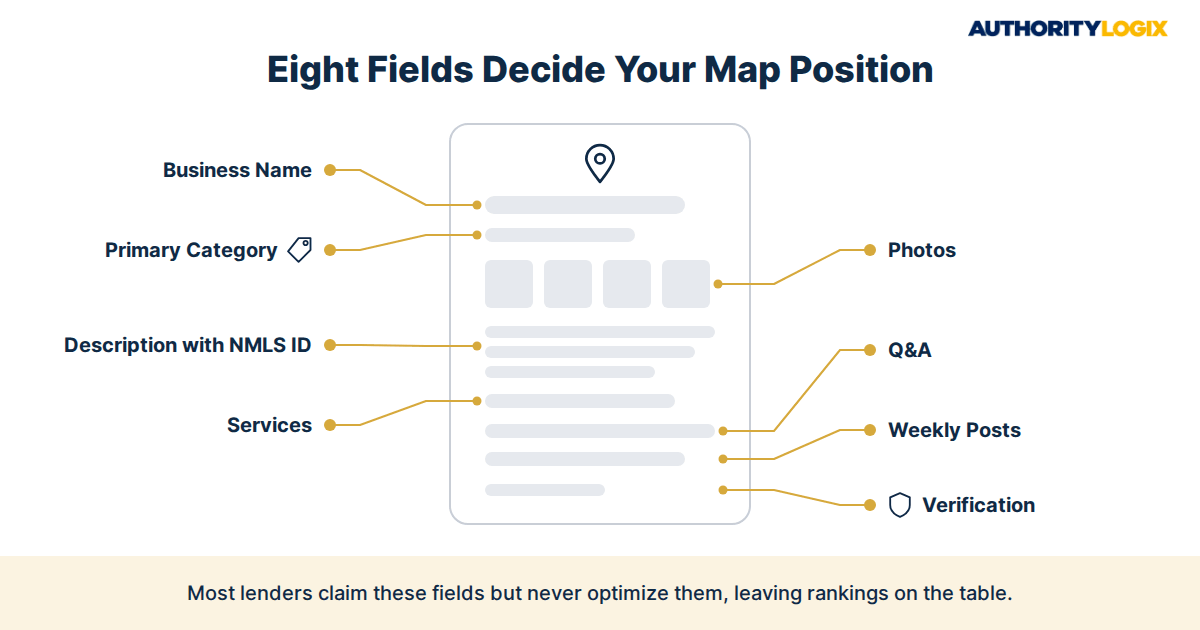
- The setup most loan officers skip is not the initial claim — it is the optimization that turns a claimed profile into a Map Pack competitor: primary category, NMLS ID, services list, Q&A, photos, and weekly posts.
- Businesses with large review counts are far more likely to appear in the Local Pack than businesses with only a handful — and 74% of consumers look for reviews from the last three months, per BrightLocal’s 2026 survey.
- A Google Business Profile mortgage lender listing is not a one-time setup. It is a managed asset that requires weekly attention to maintain the ranking position it earns.
Table of Contents
Why the Google Business Profile Mortgage Lender Setup Determines Map Pack Position
The Google Business Profile mortgage lender listing is the front door of local search — and most loan officers have left it half-built. A borrower searching “DSCR lender near me” or “mortgage broker Brooklyn” is shown three results in the Map Pack before they see a single organic website result. The lender whose profile is complete, actively managed, and supported by a consistent review velocity appears in those three positions. The lender who claimed their profile two years ago and has not touched it since does not. The authority guide documents how the same credibility signals that rank a GBP listing also convert the borrower who finds it — the two outcomes are built by the same infrastructure.
The data on GBP impact is specific. According to the GBP Help Center, customers are 70% more likely to visit and 50% more likely to consider purchasing from a business with a complete profile. BrightLocal’s Google My Business Insights Study found that the average GBP listing receives about 1,260 views per month — but that 84% of searches are discovery searches, meaning borrowers who were not looking for the lender by name. They were searching a category or product and the GBP profile surfaced. A lender invisible in discovery search is invisible to 84% of its potential local traffic, regardless of how good its website is.
The setup gap is not the initial claim. Every loan officer knows to claim their GBP listing. The gap is the optimization that happens after the claim — the primary category selection, the NMLS ID in the description, the services list, the Q&A section, the photo library, and the weekly posting cadence. Each of these is a ranking signal Google’s local algorithm evaluates. Each one the lender skips is a position handed to a competitor who did not skip it. The search statistics on borrower behavior make the cost of that gap concrete — the majority of borrowers evaluate lenders through search before any direct contact.
The Financial Services SEO Playbook covers the full local search infrastructure for mortgage companies — from GBP optimization through content architecture, citation building, and review systems.
The Google Business Profile Mortgage Lender Optimization Checklist
The content systems infrastructure that supports a mortgage company’s website connects directly to GBP performance — Google’s local ranking algorithm evaluates the linked website as part of the profile’s overall relevance and prominence scores. But the profile itself must be built correctly first. The optimization checklist covers eight components that most loan officers either skip entirely or complete only partially.
The Core Profile Fields in a Google Business Profile Mortgage Lender Setup
1. Business Name — Exact Legal Name Only. The GBP business name must match the name on the NMLS Consumer Access record exactly. Google cross-references GBP data against regulatory databases for financial services entities, and a mismatch between the GBP name and the NMLS filing is a trust signal failure. Keyword-stuffing the business name — “Smith Mortgage Company — Best DSCR Lender NYC” — violates Google’s guidelines and can result in profile suspension. Legal business name only, matching regulatory records.
2. Primary Category — The Most Critical Relevance Signal. The primary category is the single most influential relevance signal in the Google Business Profile mortgage lender setup. It tells Google what type of business this is and which search queries it should appear for. “Mortgage Lender” is correct for most independent lenders and DSCR originators. “Mortgage Broker” is correct for brokerage operations. Selecting a generic category like “Financial Services” or “Financial Institution” suppresses the profile for the specific high-intent queries — “mortgage lender near me,” “DSCR loan [city]” — that produce funded loans.
Secondary categories extend the profile’s relevance to additional query types. A DSCR lender can add “Real Estate Agency” or “Investment Service” as secondary categories to capture adjacent local search queries from real estate investors. Secondary categories do not carry the same ranking weight as the primary category, but they broaden the query footprint without diluting the primary signal.
3. Business Description — NMLS ID, Products, Markets. The GBP description is the only free-text field in the profile where a mortgage company can place keyword signals directly. A well-optimized description for a Google Business Profile mortgage lender listing covers four elements: the specific loan products offered (DSCR, FHA, VA, jumbo, non-QM), the geographic markets served by borough, city, or county, the NMLS ID with the label “NMLS #[number],” and years of operation or a credibility statement. The description is capped at 750 characters — every word should earn its place. The keyword signals in a GBP description also contribute to AI search citations — AI systems increasingly draw on GBP data when surfacing local financial service providers.
The NMLS ID in the description serves dual purposes. It is a compliance signal for NMLS licensing display requirements under the SAFE Act, and it is an E-E-A-T trust signal that Google’s quality raters evaluate when assessing financial services profiles. A mortgage company whose GBP description includes its NMLS ID is verifiable in a way that a competitor without it is not. That verifiability is a prominence signal that feeds into Map Pack ranking. The authority distribution system covers how NMLS credential display integrates across every channel — GBP, website, content, and schema markup.
4. Services List — Every Loan Product as a Separate Entry. The GBP services section allows mortgage companies to list individual loan products with names and descriptions. Each service entry is an additional relevance signal for product-specific local queries. A DSCR lender that has listed DSCR Loans, Non-QM Mortgages, Investment Property Loans, Bridge Loans, and Commercial Mortgages as individual services with brief descriptions appears for a broader set of high-intent local searches than a lender whose services section is empty. The financial services hub covers how the services list connects to the broader content architecture that builds topical authority across the website.
The Ongoing Management Signals That Keep a GBP Listing Active
5. Photos — Minimum 10, Updated Regularly. GBP profiles with more than 100 photos receive 520% more calls and 1,065% more website clicks than the average business, according to BrightLocal’s Google My Business Insights Study. For a mortgage company, photo content should include the office exterior and interior (for location verification), headshots of the loan officers with name and NMLS ID in the photo description, branded team photos, and any community involvement or industry event documentation. Photo recency matters independently — a profile with recent photo uploads signals active management to Google’s local ranking algorithm. The lead generation system documents how an actively managed GBP photo library supports the conversion rate of borrowers who find the profile through local search.
6. Q&A Section — Seed It First. The GBP Q&A section is the most overlooked and most mismanaged component of the Google Business Profile mortgage lender setup. It is publicly editable — anyone can submit a question, and anyone can submit an answer. A mortgage company that has not proactively seeded its Q&A section with accurate, compliance-reviewed questions and answers has created an open field for incorrect, misleading, or damaging content to appear in its official profile. The compliance risk alone makes Q&A management a required operational step, not an optional optimization. GBP optimization sits within the broader local SEO system — NAP consistency, citation building, and review velocity all reinforce what the GBP profile signals to Google.
The correct approach is to pre-populate the Q&A section with 8 to 12 questions that borrowers actually ask during the decision process: what loan types are available, what the minimum credit score requirements are, what the DSCR ratio requirement is, what markets the lender serves, what the typical closing timeline is, and how to contact the loan officer. Each answer should be compliance-reviewed to the same standard as marketing copy — UDAAP prohibitions on misleading statements apply to GBP Q&A content. The finance content service includes compliance review of GBP content as part of the standard workflow.
7. Weekly Posts — The Active Management Signal. GBP posts signal active profile management to Google’s local ranking algorithm. Businesses that post weekly on GBP tend to see more website clicks and direction requests than businesses that post monthly. Weekly post content does not need to be elaborate — a rate update, a loan product explainer, a market data point, or a link to a new resource article satisfies the signal while providing genuine value to borrowers who find the profile. The content system integrates GBP posting into the content distribution workflow so posts are produced alongside the other publishing activity, not as a separate task.
8. Verification — The Step That Unlocks Everything. A GBP profile that has not been verified by Google cannot appear in the Map Pack — full stop. Yet a meaningful share of local businesses still have not claimed or verified their profiles. For a mortgage company, verification requires confirming the business address through one of Google’s verification methods: postcard, phone, video, or instant verification for eligible businesses.
A DSCR lender or mortgage broker operating as a service-area business — without a physical office open to the public — must configure the profile as a service-area business rather than a location-based business, which changes both the verification process and how the profile displays in Maps. The educational hub covers the service-area business configuration for mortgage companies that operate primarily remotely or in multiple markets without a public-facing office.
| GBP Component | Setup Requirement | Ranking Signal Type | Most Commonly Skipped |
|---|---|---|---|
| Business Name | Exact legal name matching NMLS record | Trust / E-E-A-T | No (usually correct) |
| Primary Category | Mortgage Lender or Mortgage Broker | Relevance | Partially — wrong category selected |
| Description | 750 chars: products, markets, NMLS ID | Relevance + Prominence | Yes — generic or empty |
| Services List | One entry per loan product with description | Relevance | Yes — usually empty |
| Photos | Minimum 10, updated monthly | Prominence + Engagement | Yes — 1–2 photos only |
| Q&A | 8–12 pre-seeded compliance-reviewed Q&As | Relevance + Trust | Yes — almost universally skipped |
| Weekly Posts | One post per week minimum | Active Management Signal | Yes — sporadic or none |
| Verification | Verified via Google’s process | Required — no Map Pack without it | Yes — many remain unverified |
Not sure how your Google Business Profile mortgage lender listing stacks up against the full optimization standard? The FS Authority Gap Assessment identifies the specific gaps.
Review Management: The GBP Signal That Compounds Over Time
A fully optimized Google Business Profile mortgage lender listing earns its Map Pack position in part through review signals — and loses it when those signals go stale. Whitespark’s 2026 Local Search Ranking Factors survey attributes roughly 20% of local pack ranking weight to review signals, making reviews the second most influential factor after GBP signals.
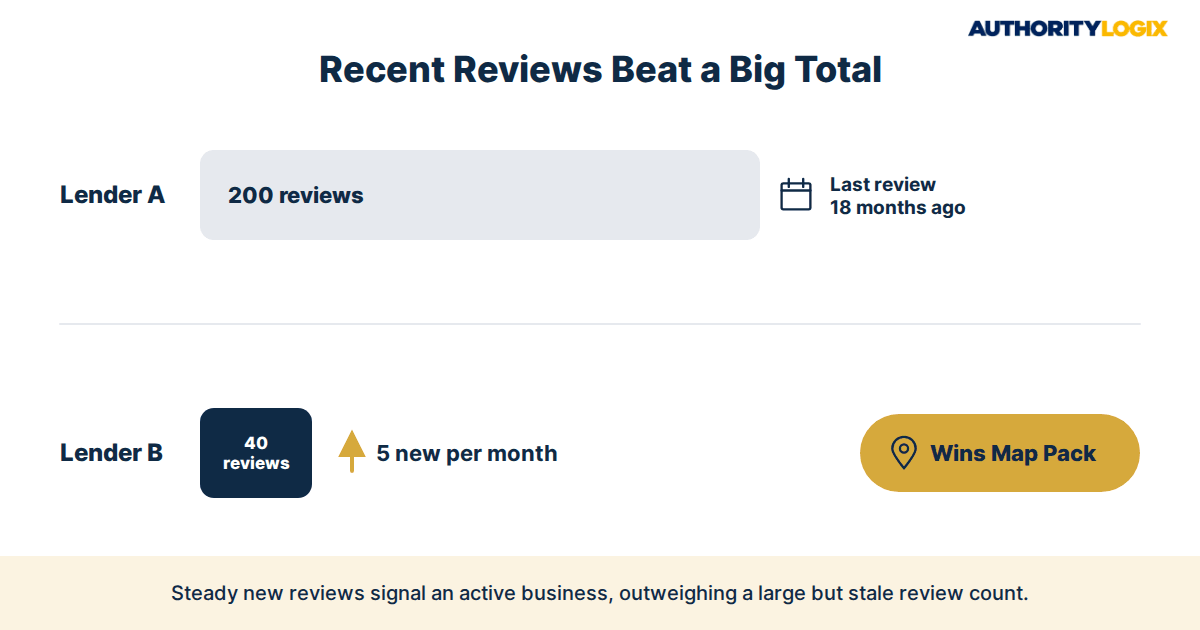
But review signals are not static: Google weights review recency heavily, meaning that a lender with 200 lifetime reviews and no new reviews in 18 months is losing ranking position to a competitor with 40 reviews and 5 new reviews per month. GBP review signals and NMLS credential links are also core E-E-A-T Trustworthiness components — Google evaluates them for YMYL financial content ranking.
For mortgage companies, the review request process requires compliance attention. A post-close email or text that asks for a review must comply with TCPA consent requirements for electronic communications, must not instruct the borrower to leave a review on a specific platform in some states, and must not request that the borrower describe specific financial outcomes, rates received, or savings achieved — which could constitute a testimonial claim subject to FTC Endorsement Guide compliance. The growth playbook covers how review velocity compounds with authority infrastructure over the 18-to-24-month timeline that produces durable Map Pack position.
What Most Loan Officers Get Wrong About GBP Setup
The setup errors that suppress Google Business Profile mortgage lender Map Pack rankings are consistent across the industry. The same four mistakes appear in audit after audit — and each one is correctable once identified.
Treating verification as optimization.
Claiming and verifying a GBP profile is the baseline — it is the condition for Map Pack eligibility, not the path to Map Pack position. Most loan officers stop at verification and consider the GBP task complete. The optimization that produces ranking position — primary category, services list, NMLS description, photo library, Q&A, weekly posts — has not begun. A verified but unoptimized profile competes for Map Pack position with one hand tied.
Using the wrong primary category.
Selecting “Financial Services” or “Bank” as the primary category for an independent mortgage company or DSCR lender is one of the most common and consequential setup errors in the Google Business Profile mortgage lender optimization process. The primary category determines which queries the profile is eligible to appear for. A lender categorized as “Financial Services” is not eligible for “mortgage lender near me” queries in the way a lender categorized as “Mortgage Lender” is. The primary category cannot be corrected passively — it must be deliberately updated, and the ranking recovery after correction takes 30 to 60 days to register. The what we do audit process identifies category errors as the first check in every GBP review.
Leaving the Q&A section unmanaged.
An unmanaged Q&A section is not neutral — it is an active risk. Competitors, dissatisfied past clients, or simply uninformed members of the public can submit questions and answers to a GBP profile without the business owner’s approval. For a mortgage company, an incorrect answer in the Q&A section about loan terms, rates, or qualification requirements is a potential UDAAP issue if it creates a misleading impression. Mortgage companies must audit their Q&A section monthly, pre-populate it with compliance-reviewed content, and monitor it for new submissions. See how we build for how GBP Q&A management integrates into the standard content production workflow.
Posting inconsistently or not at all.
GBP post frequency is a measurable ranking signal. A profile that posts weekly consistently outperforms one that posts in bursts followed by months of silence. The active-management signal Google reads from posting cadence is binary in practical effect: a profile that is being actively managed and one that is not are evaluated differently by the local ranking algorithm. The fix is not complicated — it is a weekly task that requires 10 to 15 minutes and produces a measurable difference in profile impressions and click-through rates. The why it works proof-of-concept demonstrates how consistent GBP management integrates with a broader content system to produce compounding local authority.

Want your Google Business Profile set up the way most loan officers skip, so local borrowers find you first?
Maintaining the Google Business Profile Mortgage Lender Listing as a Managed Asset
A Google Business Profile mortgage lender listing is not a one-time setup. It is a managed asset that degrades without active maintenance and compounds with it. Google periodically updates profile information from third-party data sources — which can overwrite a lender’s carefully optimized description, hours, or category with incorrect data from an external directory. A lender who built a strong GBP profile and stopped monitoring it may find, months later, that Google has updated their category, changed their hours, or merged their profile with a duplicate listing.
None of these changes arrive with a notification. The educational hub documentation covers how GBP monitoring integrates with the broader local SEO maintenance workflow. If your firm is ready to build and maintain this infrastructure, work with us is the starting point.
The maintenance schedule for a Google Business Profile mortgage lender listing has four cadences. Weekly: one new post, review of any new Q&A submissions, response to any new reviews within 24 hours. Monthly: photo library update, services list review for any new products or discontinued offerings, profile data audit against the canonical NAP record. Quarterly: full profile audit including category verification, description refresh, service area configuration review, and duplicate listing check. Annually: competitive audit comparing the profile’s performance metrics against the top-3 Map Pack competitors in the primary market. This is what we do as a standard maintenance component in every local SEO engagement — because the infrastructure that earns a Map Pack position must be maintained to hold it.
| Maintenance Task | Cadence | Why It Matters |
|---|---|---|
| New GBP post | Weekly | Active-management signal; keeps the profile current |
| Q&A audit and response | Weekly | Compliance risk control; prevents incorrect content from appearing |
| Review response | Within 24 hours of each review | Ranking signal + conversion signal; 35% more revenue for businesses replying to 25%+ of reviews |
| Photo library update | Monthly | Active-management signal; recency of photos tracked by algorithm |
| Full profile data audit | Quarterly | Prevents Google overwrites from corrupting optimized fields |
| Competitive audit vs Map Pack | Annually | Identifies ranking threats before positions are lost |
The GBP Position That Cannot Be Bought With Ad Spend
The Google Business Profile mortgage lender Map Pack position is one of the few competitive advantages in local search that cannot be purchased directly. Local Services Ads appear above the Map Pack — but they are labeled as ads, they stop when the budget stops, and they do not strengthen the organic Map Pack position. The Map Pack itself is earned through the optimization and management infrastructure documented in this guide — the same infrastructure that feeds the lead generation pipeline once Map Pack position is established: correct primary category, complete services list, NMLS-credentialed description, active photo library, managed Q&A, weekly posts, consistent review velocity, and a maintained citation footprint that reinforces every other signal.
Most mortgage companies in any given local market have not completed this build. The primary category is wrong or generic. The description is two sentences with no NMLS ID. The services list is empty. The Q&A section has never been touched. There are six reviews, none from the past year. This is not a description of a bad lender. It is a description of a credible lender who has not built the infrastructure that makes the market see their credibility.
Learn more through the AuthorityLogix proof-of-concept before deciding whether to build. That incomplete build is the source of the credibility gap. Newer competitors who built GBP and local SEO infrastructure first now hold Map Pack positions that take months of consistent work to displace.