


Key Takeaways
- DSCR lender authority marketing is not about brand awareness — it is about being the lender brokers call first because they already trust your expertise.
- Non-QM securitization hit record volume in 2025, with investor-purpose loans making up about half of record third-quarter issuance — brokers who have more DSCR lender options than they can fully evaluate use authority signals to make selection decisions.
- Brokers choose wholesale DSCR partners based on program clarity, responsiveness, and demonstrated expertise — not rate sheets alone.
- The lenders building educational content infrastructure now are accumulating the authority compound that makes them the default call when a DSCR file lands on a broker’s desk.
- BKDSCR.com — built in the NYC outer-borough DSCR investment niche — demonstrates exactly what a DSCR educational platform looks like when it is built to rank, educate, and convert.
- Authority compounds. Rate competitiveness resets every quarter. The DSCR lenders who build content infrastructure build an asset that works after business hours.
Table of Contents
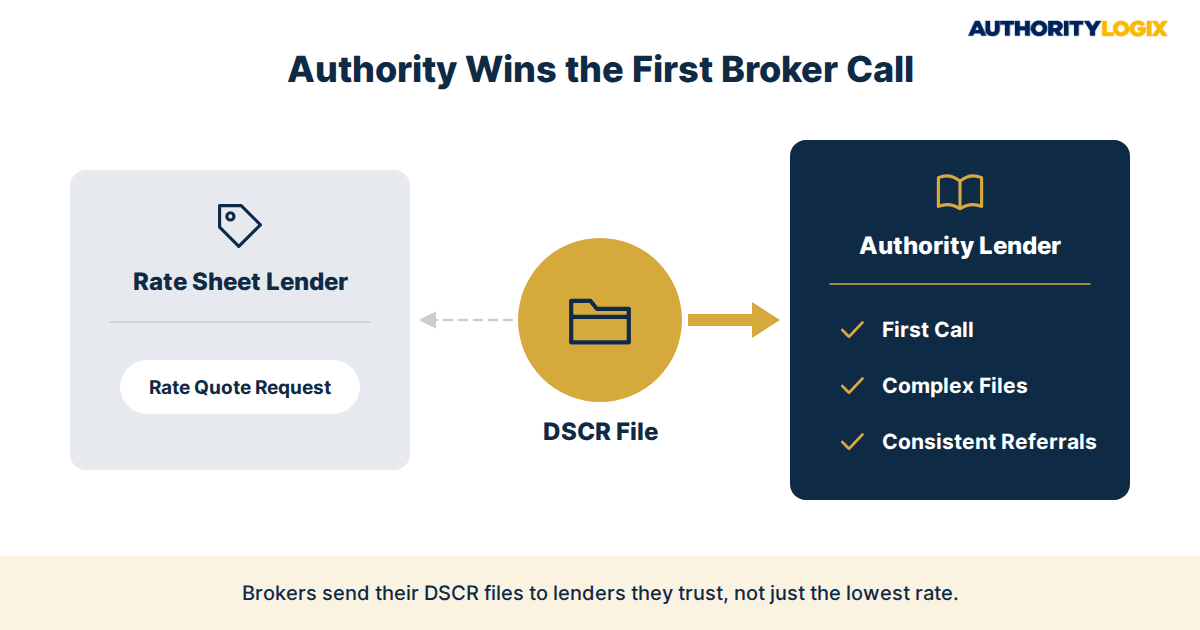
DSCR lender authority marketing brokers trust starts with one reality: a broker working in the non-QM space has more wholesale DSCR lender options than they have time to evaluate. The visibility infrastructure framework for financial services firms makes clear that visibility is infrastructure — and for DSCR lenders, that infrastructure determines which lenders get the first call, the complex file, and the referral relationship, and which lenders get a rate quote request once a quarter.
Non-QM securitization reached record volume in 2025, with DBRS Morningstar reporting a record $20 billion in third-quarter issuance — about half of it investor-purpose loans — according to Scotsman Guide. The pipeline is there. The brokers are active. The competition among DSCR lenders for broker relationships is the constraint — and that competition is won by authority, not by rate.
The full authority-building framework for financial services firms — including DSCR lenders competing for broker relationships — is in the authority guide.
The Broker Selection Problem Every DSCR Lender Faces
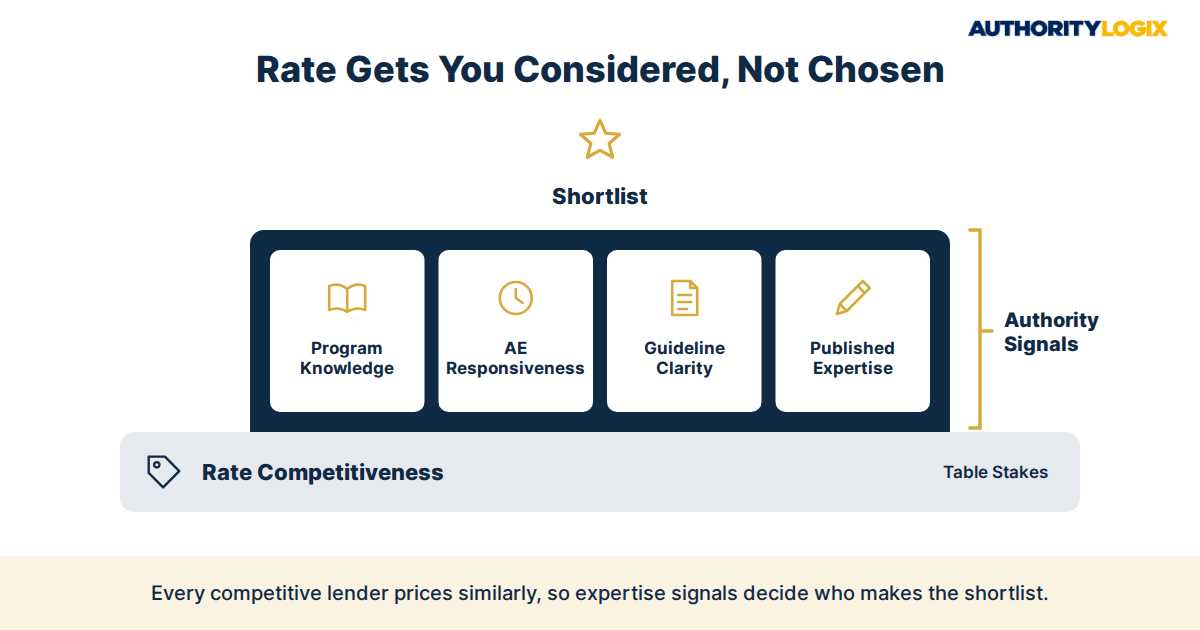
A mortgage broker with an active DSCR pipeline has a shortlist. Not every lender they are approved with. A shortlist — three to five names they call first, whose guidelines they know, whose account executives respond within the hour, and whose programs they trust enough to present to a client without pre-confirming every overlay. Getting onto that shortlist is the whole game for a wholesale DSCR lender.
The FS industry hub serves mortgage companies, DSCR lenders, and financial services firms facing this exact dynamic. For DSCR lenders specifically, the shortlist problem is structural: brokers triage their lender panel constantly, and the lenders who stay on the shortlist are not always the ones with the best rate — they are the ones who have made themselves easiest to trust, easiest to work with, and most useful when a complex file arrives.
What Brokers Actually Evaluate When Building Their DSCR Lender Panel
Rate is table stakes. Every competitive DSCR lender prices within a band that brokers can work with. The differentiation that determines shortlist position is authority — the perception that this lender knows their product, can explain it, can help close a difficult file, and will not create problems in underwriting that the broker has to explain to their client. That perception is built before the first file is submitted. It is built by what a lender publishes, how they educate, and whether brokers encounter their content when they are looking for answers.
The content systems that produce that perception are not complicated — but most DSCR lenders have not built them. They rely on account executive relationships, rate flyers, and broker approval portals. Those tools maintain existing relationships. They do not build new ones with brokers who have never submitted a file.
Why Brokers Choose DSCR Lenders Who Publish Educational Content
A broker researching DSCR guidelines for a specific scenario — short-term rental income, foreign national borrower, sub-1.0 DSCR program — runs a search. The lender whose educational content answers that question is not just generating organic traffic. They are demonstrating program expertise at the exact moment the broker needs it. That demonstration is more persuasive than any rate sheet because it proves the lender understands their own product well enough to teach it.
The search statistics on how mortgage professionals find lender information confirm what every account executive already knows intuitively: brokers do not wait for a rep to call them. They research independently. The lender whose published content appears when a broker is researching owns that first impression — before any rep-to-broker conversation happens.
The Content Types Behind DSCR Lender Authority Marketing Brokers Trust
Not all content produces the same authority signal. For DSCR lenders competing for broker relationships, three content types outperform everything else: guideline explainers that cover specific scenarios in plain language, case study breakdowns of how a specific deal type closed, and market data that helps brokers understand where DSCR demand is concentrating. Each of these demonstrates expertise. Each gives a broker a reason to bookmark the lender’s resource section and return to it.
For lenders serving broker markets in specific geographies, local SEO infrastructure reinforces that authority in local search. Brokers active in specific markets search for DSCR lender options with geographic context, and lenders with local visibility capture those searches before competitors who rely solely on national brand recognition.
The Content Infrastructure That Converts Broker Relationships Into Pipeline
A DSCR lender’s broker-facing content infrastructure has four layers. Each layer serves a different stage of the broker relationship — from initial discovery through active pipeline submission. The lenders who build all four create a system where broker relationships compound. The lenders who build none rely entirely on account executives and rate flyers, which produce transactional volume but not durable pipeline.
| Infrastructure Layer | What It Does | What It Produces for the Lender |
|---|---|---|
| Educational Resource Hub | Guideline explainers, scenario walkthroughs, program comparisons organized by topic | Organic search traffic from brokers researching DSCR scenarios; authority signal that lender knows their product |
| GBP + Local Authority | Optimized Google Business Profile, map pack visibility for relevant search terms | Local broker discovery before the first AE outreach; credibility validation when brokers check the lender’s online presence |
| Finance Content Publishing | Regular publishing on DSCR market data, non-QM trends, scenario analysis | Consistent broker touchpoints that build familiarity; email list growth from brokers subscribing for guideline updates |
| Authority Distribution | Content syndicated to industry platforms, broker channels, and AI citation sources | Brand presence beyond the lender’s own domain; AI search citation eligibility when brokers use AI tools to research lenders |
The GBP setup for a DSCR lender is not just a borrower-facing tool — it is a credibility signal brokers check when evaluating whether to add a lender to their panel. A lender with a fully optimized profile, current business hours, and recent posts signals operational credibility. A lender with an unclaimed or abandoned profile signals the opposite.
The finance content layer is where most DSCR lenders underinvest. Account executives can explain guidelines on a call. Published content explains them when the broker is researching at 9pm before a client meeting. The lender whose content is there at 9pm owns that relationship moment. The one who relies on AE availability does not.
A full educational hub for a DSCR lender organizes that content by scenario type, property type, and borrower profile — the same way a broker thinks when evaluating whether a file fits a lender’s program. When the organization of the lender’s educational content mirrors how brokers think about their files, the lender becomes easier to work with before the first submission.
Not sure where your firm’s broker-facing authority infrastructure stands? The FS Authority Gap Assessment maps the gaps.
How DSCR Lender Authority Compounds Over Time
A DSCR lender that publishes consistently for 18 months has a fundamentally different market position than one that started 18 months later. The earlier lender has 18 months of indexed content, 18 months of broker search impressions, and 18 months of email subscribers who receive guideline updates. That accumulated authority does not reset when a competitor launches a new rate special. It compounds.
The same dynamic that makes AI search authority compound for financial advisors applies to DSCR lenders: the content infrastructure built today is what AI platforms draw on when brokers query those systems for lender recommendations. A lender whose educational content is indexed, cited, and structured for machine-readable extraction will be surfaced by AI tools. A lender whose only digital presence is a broker portal and a rate matrix will not.
The E-E-A-T guide covers the credibility signals Google’s quality raters evaluate for financial content — the same signals that determine whether a DSCR lender’s educational content ranks for the queries brokers actually run. Lenders whose content meets E-E-A-T standards with named authorship, credential attribution, and compliance-reviewed copy rank above lenders whose content does not, regardless of which lender has the lower rate.
BKDSCR.com — the AuthorityLogix proof-of-concept built in the NYC outer-borough DSCR investment niche — demonstrates what this infrastructure looks like at full build: 18 pillar pages, 7 interactive investor tools, 48 SEO-optimized blog posts, a 35-page lead magnet, and full authority distribution. Zero paid ads. Built to rank, educate, and generate inbound leads in a competitive market. That build is the model.
Building the DSCR Broker Inbound Pipeline: The Sequence That Works
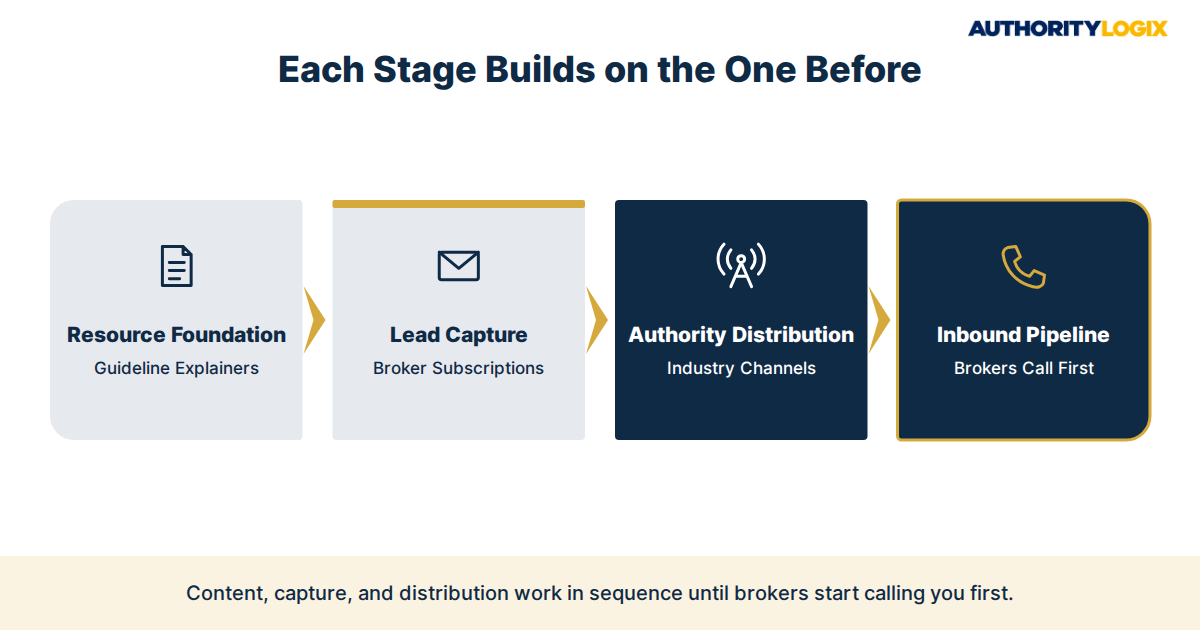
DSCR lender authority marketing for brokers is a build sequence, not a campaign. Campaigns produce temporary volume. A build produces compounding pipeline. The sequence that produces durable broker inbound starts with the educational layer and ends with the distribution layer — with each piece reinforcing the one before it.
Stage one is the resource foundation: guideline explainers organized by scenario, published on the lender’s own domain with proper schema markup and named author attribution. The lead generation layer converts that traffic — broker contact forms, guideline update subscriptions, and scenario inquiry tools all capture broker intent at the moment of research.
Stage two is the distribution layer. A DSCR lender’s educational content needs to reach brokers who are not yet searching the lender’s domain. That requires a structured lead generation system that pushes content through broker-facing channels — LinkedIn publishing, industry newsletters, broker association content partnerships, and AI citation building. The lenders appearing in those channels are building broker familiarity before any direct outreach occurs.
What Most Lenders Get Wrong About DSCR Lender Authority Marketing Brokers Trust
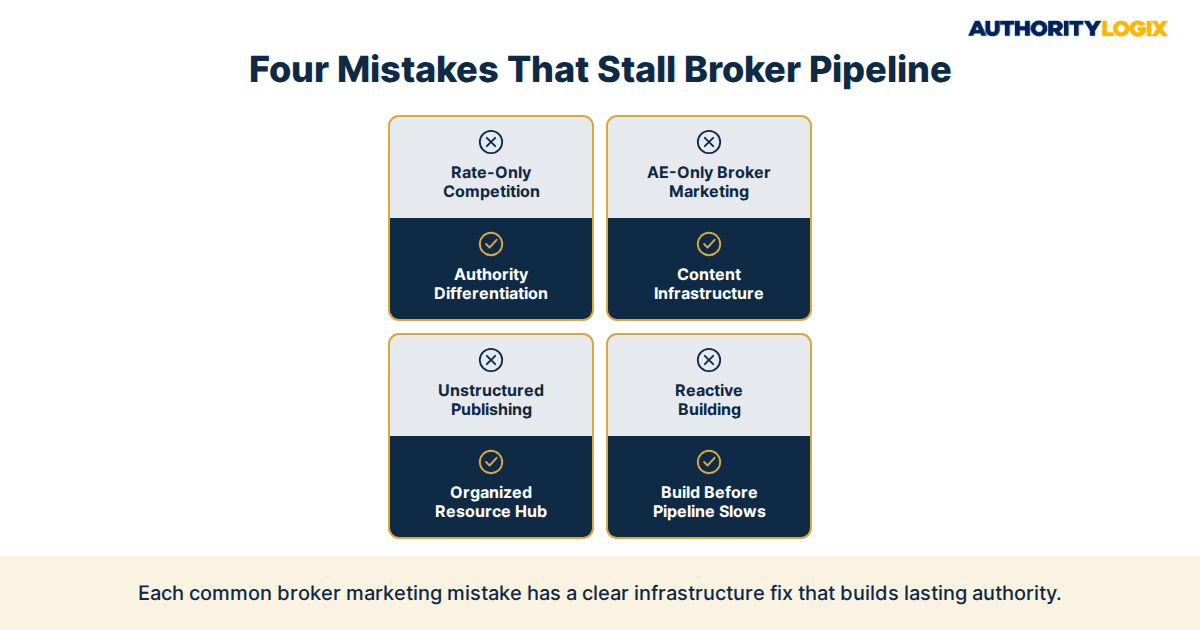
Mistake 1: Competing exclusively on rate
Rate competitiveness is necessary but not sufficient. A broker with five equally-priced DSCR lenders on their panel chooses based on something else — AE relationship, program clarity, submission experience, or authority. Lenders who compete only on rate have no answer when a competitor matches them on price. Lenders who have built authority have a differentiated position that rate matching cannot erase.
Mistake 2: Treating broker marketing as an AE function only
Account executives build relationships with brokers they already know. Content builds relationships with brokers who have never submitted a file. A lender whose only broker marketing strategy runs through the AE team caps its broker reach at the size of the AE network. A lender with a content infrastructure reaches every broker who runs a relevant search — a market that dwarfs any individual AE’s relationship network.
Mistake 3: Publishing without structure
A collection of blog posts is not a resource hub. A resource hub is organized content that a broker can navigate to find the answer to their specific scenario question. Lenders who publish without organizing — no category structure, no scenario-based navigation, no internal linking that guides the broker from one question to the related one — produce content that ranks for nothing and converts no one. The authority distribution layer only compounds what is already organized and indexed. Structure comes before distribution.
Mistake 4: Waiting for the pipeline to slow
The right time to build broker authority infrastructure is not when broker submissions slow down. By that point the lender is already behind — and the lender who started building 18 months earlier now holds the shortlist position they are trying to recover. The credibility gap between lenders who built early and those who built late is structural. It does not close overnight.
Frequently Asked Questions About DSCR Lender Authority Marketing
How do DSCR lenders attract more brokers without hiring more account executives?
By building content infrastructure that attracts broker attention before any AE outreach. A DSCR lender whose educational content ranks for the scenarios brokers research gets discovered independently — the broker finds the lender, not the other way around. That inbound dynamic scales without headcount because published content reaches every broker who runs a relevant search, not just those in an AE’s existing network.
How long does it take for DSCR lender authority content to produce broker pipeline?
Educational content in a competitive non-QM category typically begins generating organic broker traffic between months 4 and 7 of consistent publishing. Meaningful pipeline from that traffic — brokers who found the lender through content and submitted their first file — typically appears between months 8 and 14. The compounding effect accelerates after month 12 as domain authority accumulates and more broker searches return the lender’s content as the answer.
What is the relationship between DSCR lender content and broker trust?
A broker who has read a lender’s guideline explainer before submitting a file already trusts the lender’s program expertise. They have evaluated the lender’s knowledge independently, before any sales interaction. That pre-submission trust translates to smoother file management, fewer underwriting surprises, and higher likelihood of repeat submissions. The growth playbook for financial services firms covers how that trust compounds into long-term broker relationships that generate referrals, not just transactions.
Can a DSCR lender build broker authority without a large content team?
Yes. The AuthorityLogix model is built for financial services firms that need infrastructure, not headcount. The work with us page outlines how that engagement works — the lender provides the program expertise, AuthorityLogix builds the infrastructure that makes that expertise visible to brokers at the moment they are searching for a lender who understands their scenario.
Ready to turn broker relationships into an inbound pipeline with authority marketing brokers trust?
The Lender Brokers Call First: What DSCR Lender Authority Marketing Brokers Trust Looks Like
The DSCR market is large enough that broker relationships are not zero-sum — but broker shortlist positions are. A broker who has six DSCR lenders on their approved panel calls the same two or three for every file. The other three get rate quote requests once a quarter and nothing else. The difference between first call and rate quote is authority — the accumulated trust that comes from being the lender whose content a broker has read, whose guideline explainers they have bookmarked, and whose program expertise they already understand before the file lands.
Volume without infrastructure is just noise. A DSCR lender who produces educational content without organizing it into a resource hub, who distributes content without a system, who publishes without building topical authority — produces content that does not compound. Infrastructure is what makes each piece of content work harder than the last.
The honest answer is that most DSCR lenders already have the program expertise that would make compelling educational content. The guidelines are deep, the scenarios are specific, and the knowledge that closes complex files is exactly what brokers are searching for. What most lenders lack is the infrastructure that makes that expertise visible at the moment a broker needs it — and that is the build AuthorityLogix delivers.