


Key Takeaways
- A financial services authority 90 day growth plan sequences the build — foundation first, content second, distribution third — so each phase creates what the next one needs.
- Google’s own guidance on hiring an SEO puts the window for implementing improvements and seeing benefit at four months to a year, which makes the first 90 days a build phase, not a results phase.
- Ahrefs found that only 1.74% of newly published pages reached Google’s top 10 within a year, so the order you build in matters more than how much you publish.
- The Kitces Report found that high-growth advisory firms draw only about a third of new-client revenue from referrals, compared with 80% for slower-growing peers.
- A sound financial services authority 90 day growth plan measures leading indicators — pages live, pages indexed, first search impressions — before it measures leads.
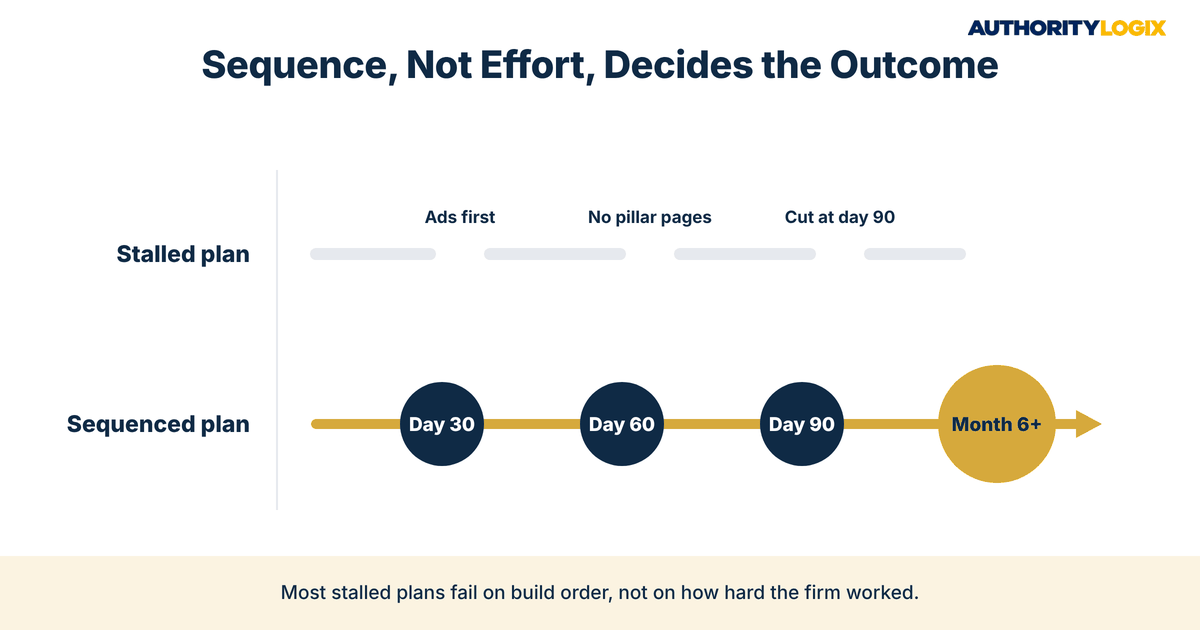
- Most stalled plans fail on sequence, not effort: content gets published before the foundation exists to hold it.
Table of Contents

Why a Financial Services Authority 90 Day Growth Plan Beats a Year of Guesswork
A financial services authority 90 day growth plan exists for one reason: most lenders and advisors have spent years earning credibility that the market still cannot see. You have the licenses, the closed loans, and the reputation inside your network — and outside it, a prospect searching for exactly what you do finds someone else. That distance between earned trust and visible trust is the credibility gap, and it does not close by posting more often.
The problem with most growth efforts is not effort. It is order. A firm hires a writer, publishes a dozen posts, and six months later has little to show for it — because the posts had no pillar structure, no hub, and no distribution. Volume without infrastructure is just noise. A financial services authority 90 day growth plan replaces that guesswork with a build order in which each 30-day phase creates what the next one needs.
The data explains why sequence matters. Ahrefs studied 1.3 million keywords and found that the average page ranking in Google’s first position is about five years old, and that only 13.7% of top-10 pages are less than a year old. In a separate sample of new pages, just 1.74% reached the top 10 within a year. For a financial services authority 90 day growth plan, that means the clock starts the day the foundation goes live — not the day the first blog post goes up.
Google’s own guidance points the same way. In its video on hiring an SEO, Google’s Maile Ohye said that firms usually need four months to a year to implement improvements and start seeing the benefit. That is not a reason to wait; it is a reason to start with the pieces that compound, the core argument of the authority guide. A financial services authority 90 day growth plan does not produce the finished result. It produces the conditions that make the result possible.
Each phase maps to a specific system — content, finance content, educational hubs, lead generation, and authority distribution — and the full set sits on our financial services hub. What follows is the order we build them in, and why it holds up for mortgage companies, DSCR lenders, and advisory firms alike.
The Financial Services Growth Playbook explains how lenders, advisors, and firms build authority that keeps growing long after the first 90 days.
Days 1–30: Mortgage Authority Building Roadmap Foundations
The first month of any mortgage authority building roadmap is the least visible phase and the most important one. Nothing built in days 1 through 30 will generate a lead on day 31. It gives Google, AI search tools, and prospects a clear answer to three questions: who you serve, what you know, and why they should trust you.
Most firms skip this phase because it looks like setup work. It is — the same way a foundation is setup work for a building. Month one of a financial services authority 90 day growth plan is where you choose the topics you will own and build the structural pages every later article links back to.
What a Financial Services Authority 90 Day Growth Plan Builds in Month One
- A positioning statement that names your niche, your market, and the client you serve best.
- Three to five core topics drawn from the questions prospects ask before they ever call.
- An author page with licensing, years in the business, and verifiable credentials.
- A clean site structure where every service page and resource sits under a logical parent.
- A claimed and completed Google Business Profile with consistent name, address, and phone data.
- Basic tracking: Google Search Console, analytics, and a lead-source field on every form.
The structural core of month one is a small set of pillar pages — long, comprehensive pages that each own one major topic and act as the parent for every related article you publish later. A DSCR lender might build one on qualifying with rental income and one on portfolio refinancing; an advisory firm might build one per life event it specializes in. Each page targets a primary search phrase and leaves room for a dozen supporting pieces beneath it.
Those pillars then sit inside an educational hub — a library sorted by topic rather than publish date, showing a prospect at a glance that you have covered their question. A blog feed buries last month’s work; a hub keeps it working. Compliance review belongs in month one of a financial services authority 90 day growth plan too: settle disclosure language and approval workflow now, so month two moves without bottlenecks.

Days 31–60: Advisor Authority First 90 Days of Content
With the foundation live, the second month turns to publishing. Most advice on advisor authority first 90 days tells you to post daily across every platform. That produces activity, not authority. Days 31 through 60 of a financial services authority 90 day growth plan should produce a smaller number of deeper pieces, each written to answer a specific prospect question and each linked to the pillar page it supports.
This matters because of the referral ceiling that most advisory practices and mortgage shops eventually hit. The Kitces Report’s 2026 marketing study of 506 advisors, as covered by Financial Planning, found that 88% of practices use client referrals — but high-growth firms drew only about a third of new-client revenue from referrals, compared with 80% for slower-growing peers. The fastest-growing firms simply stopped depending on referrals alone.
The same study measured what each marketing tactic costs per dollar of new revenue. SEO came in at about $0.45, close to client referrals at $0.34, while social media came in at $4.88 — the least efficient tactic measured. That spread is why a financial services authority 90 day growth plan spends month two on search-focused content, not a busier social feed.
Pressure to publish more is real. HubSpot’s 2026 State of Marketing research, drawn from more than 1,500 marketers, found that 83.5% expect to produce more content this year, and 73% say their budgets face more scrutiny than before. More output under tighter budgets is where unsequenced publishing fails.
A Realistic Month-Two Publishing Load
For most firms that means two to four substantial articles of 1,500 words or more, plus one lead capture asset such as a checklist. The work runs through content systems built around your expertise: a recorded interview, a compliance-approved outline, a draft, and a publish date. You stay the expert without becoming the writer.
This is the point where a financial services authority 90 day growth plan reveals whether month one was done properly. If the pillar pages exist, every new article has a parent and a hub. If not, each article is an orphan competing alone — which is how firms end up with 40 posts and no rankings.
Not sure which of the three phases your firm has already covered — and which it skipped? The FS Authority Gap Assessment shows where your visibility infrastructure stands and what to build first.
Days 61–90: Lender Authority Growth Timeline for Distribution
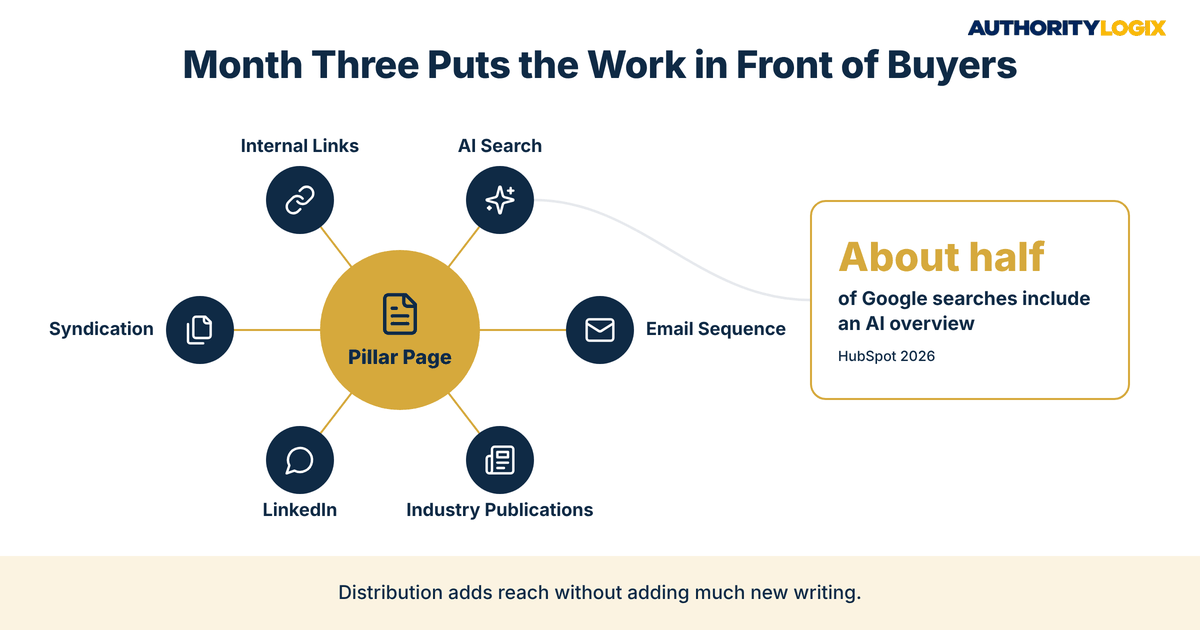
The third month is where most plans quietly lose momentum. On any realistic lender authority growth timeline, days 61 through 90 are about distribution: putting the work from months one and two in front of the people and platforms that confer trust. A financial services authority 90 day growth plan without distribution leaves good pages waiting for Google to decide they matter.
Distribution starts on your own site. Every article published in month two should link to its pillar page, and every pillar page should link down to the articles beneath it — the internal structure covered in depth in the SEO playbook. From there, the work moves outward: syndication of your strongest pieces, LinkedIn summaries of each article, and outreach to the publications your prospects already read.
Distribution now has a second audience. HubSpot’s 2026 research reported that about half of Google searches now include an AI overview, and that about half of consumers use AI-powered search. Those systems pull answers from sources they can verify, which favors firms with consistent credentials and structured pages over firms with one well-designed homepage.
This is also the month to turn your best material into formats that travel. A single pillar page on DSCR qualification can become a short guide, a LinkedIn article, and an email sequence —finance content repurposed with intent rather than rewritten from scratch. Within a financial services authority 90 day growth plan, month three should add reach without adding much new writing.
Measuring What a Financial Services Authority 90 Day Growth Plan Should Produce
Measurement is where honest expectations matter most. Given Google’s four-months-to-a-year window and the Ahrefs data on how slowly new pages rise, a financial services authority 90 day growth plan should not be judged on closed loans or new households by day 90. It should be judged on whether the infrastructure exists, is indexed, and is starting to register in search.
A Day 30, 60, and 90 Scorecard for a Financial Services Authority 90 Day Growth Plan
The scorecard below tracks leading indicators — the signals that show a content system is working before revenue shows up. In a financial services authority 90 day growth plan, a missed early checkpoint usually explains a weak later one.
| Checkpoint | What Should Exist | What to Measure |
|---|---|---|
| Day 30 | Positioning, three to five pillar pages, hub structure, author credentials, completed Google Business Profile | Pages live and submitted in Google Search Console; tracking installed |
| Day 60 | Two to four supporting articles linked to pillars; one lead capture asset | Pages indexed; first search impressions; first email sign-ups |
| Day 90 | Distribution running: syndication, LinkedIn summaries, complete internal links | Impression trend; branded searches; inquiries tagged by source |
| Months 4–12 | The financial services authority 90 day growth plan becomes a steady publishing rhythm | Rankings for pillar topics; organic leads; cost per new client |
Lagging indicators still need a day-one baseline. The Kitces Report put the average advisory firm’s client acquisition cost at $2,551 per new client and its marketing spend at about 7% of annual revenue. Record your own numbers now, so that when authority distribution starts pulling in organic inquiries, you can compare cost per client by channel.
Attribution is the piece most firms leave out. HubSpot’s research named measuring marketing ROI as the top challenge marketers face, cited by 33% of respondents. A lead-source field on every form and intake call solves most of that for a small firm, at no cost.
Financial Services Authority 90 Day Growth Plan Mistakes That Stall Momentum
Most stalled plans share a short list of causes. None of them is a lack of effort; each one is a sequencing or expectation error that a financial services authority 90 day growth plan is designed to prevent.
Mistake: Starting with ads or bought leads instead of infrastructure
Buying leads or running ads before the foundation exists sends paid clicks to a site that cannot convert them. When the spend stops, the visibility stops. Sustainable lead generation comes from pages that capture interest on their own; paid media works best later, on a system that already converts.
Mistake: Publishing before the pillar pages exist
Articles without a parent page compete alone and rarely rank. Build the pillars in month one, even if they feel unfinished, and refine them later.
Question: How much of the principal’s time does a 90-day plan require?
Plan on two to three hours a week in month one and less after that, mostly interviews and approvals. Turning that limited time into published, compliant pages is what we do for financial firms, because the expertise has to come from you while the production does not.
Mistake: Judging the plan on day 90 revenue
Cutting a plan at day 90 because leads have not arrived discards the three months that make month six possible. Ahrefs found that most top-ranking pages are more than a year old, which is why how we build treats day 90 as the end of construction, not the end of the experiment. This is a system build, not a quick fix.
Question: Does a financial services authority 90 day growth plan work for a solo advisor or a small lender?
It does, with a smaller scope. A solo practitioner might build three pillar pages instead of five and publish two articles in month two instead of four, but the order stays the same. A narrow niche often lets three well-built pages cover most of what local prospects search.
Want a 90-day plan that builds authority you can measure? We’ll lay out the sequence and build it with you, week by week.
Why Your Financial Services Authority 90 Day Growth Plan Sets the Compounding Curve
BKDSCR.com, the AuthorityLogix proof-of-concept in the NYC outer-borough DSCR market, followed this order. It was built with 18 pillar pages, 7 interactive investor tools, and 48 SEO-optimized blog posts, with zero paid ads, in under 18 months — and the pillar structure came before the posts. Each piece was built to feed the lead system behind it, so every visitor had somewhere logical to go next.
That build is the clearest evidence of why it works for firms in regulated, trust-driven markets: prospects research for weeks before they call, and the firm with the most organized answers earns the first conversation. A financial services authority 90 day growth plan does not shortcut that research period. It puts your firm in front of it.
The honest assessment is this: most lenders and advisors already have the expertise to win in search, and most of them will never sequence the build that makes the market see it. If you are ready to spend the next 90 days on foundation, content, and distribution in that order, work with us to map your first phase. If not, the firms that start this quarter will simply be a quarter further ahead.