


Key Takeaways
- Physical therapist clinical expertise patient trust is built before the first appointment — through the credentials, certifications, clinical experience, and condition-specific content that a prospective patient evaluates when researching providers online.
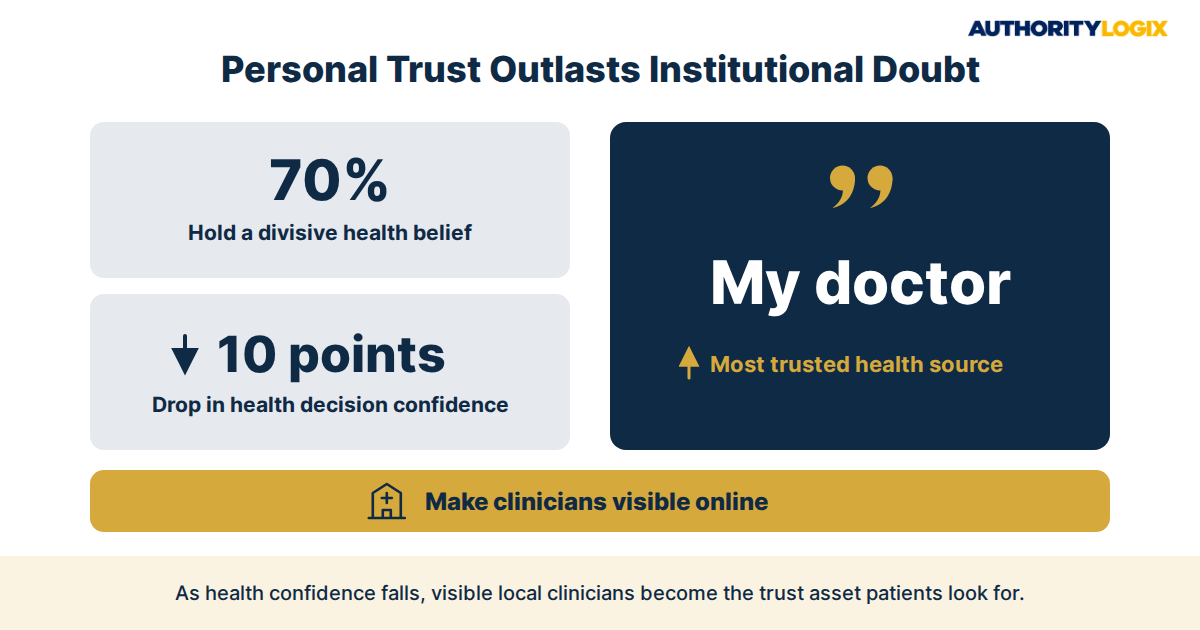
- The 2026 Edelman Trust Barometer Special Report on Trust and Health found that confidence in making health decisions has declined 10 points year over year, and 70% of people globally hold at least one divisive health belief — making the clinician’s credibility signals more important, not less, in a fractured information environment.
- Despite declining institutional trust, “my doctor” remains the single most trusted health information source in the 2026 Edelman data. Independent PT practices that make individual clinicians visible, credentialed, and accessible online capture that personal trust at the local level.
- Patients typically read multiple reviews and visit several sites before choosing a provider. The clinician bio page is what patients read after the reviews — it is the decision moment, not the introduction.
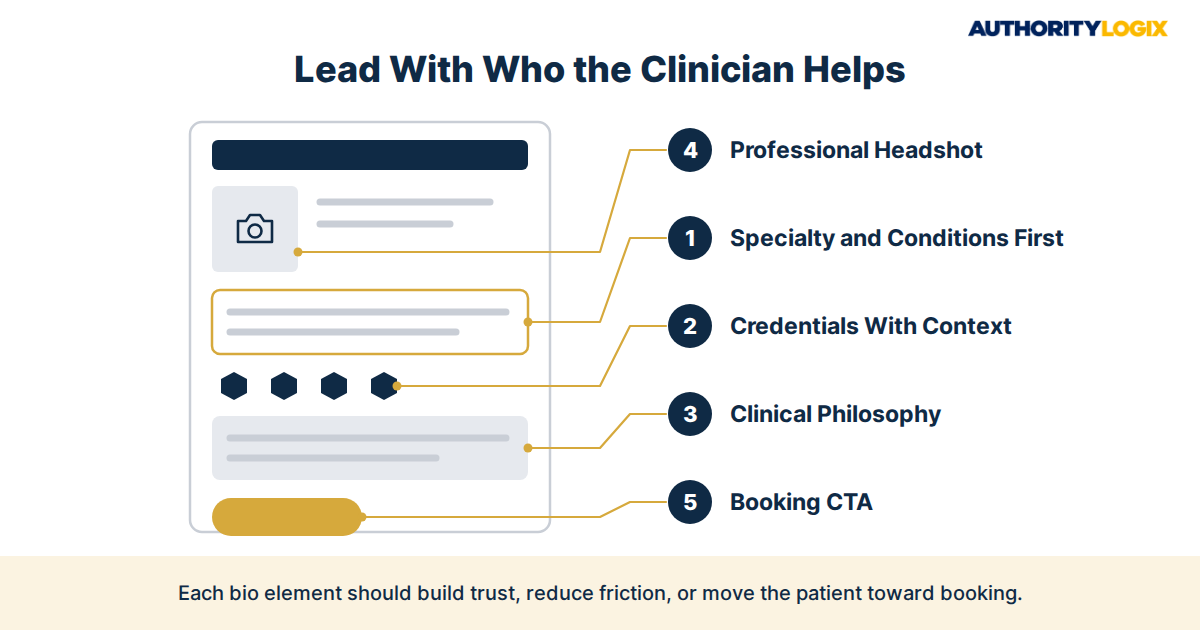
- A converting clinician bio opens with specialty and conditions treated — not with a credentials dump. Credentials validate the trust that condition-specific content and patient-facing language establish first.
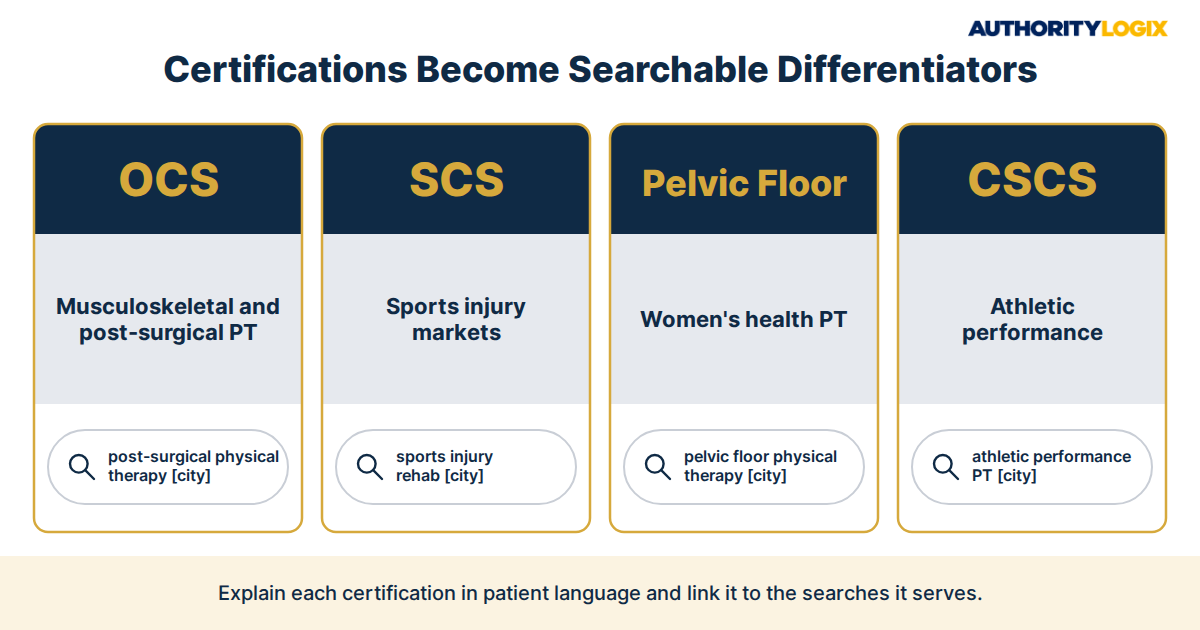
- Specialty certifications — OCS, SCS, CSCS, pelvic floor certifications, McKenzie Method — differentiate a clinician from every other DPT in the local market when explained in patient language and connected to specific conditions.
- Consistent representation across the practice website, GBP profile, APTA directory, and health system directories is a trust prerequisite — patients cross-check, and inconsistent credentials across platforms quietly cost bookings.
Table of Contents
Physical therapist clinical expertise patient trust is earned before the first appointment — through what a prospective patient finds when they research the clinician online. The degree is earned in school. The specialty certifications are earned in continuing education. The trust is earned through how those credentials, that clinical experience, and that expertise are made visible, accessible, and patient-facing on the practice’s online presence.
This article covers the specific mechanisms through which PT clinicians can translate clinical expertise into the online trust signals that drive patient decisions. The clinical authority guide covers the full authority building framework — this article focuses specifically on the clinician-level trust signals that convert prospective patients before the first visit.
The Physical Therapist Clinical Expertise Patient Trust Environment Practices Operate In
The Edelman 2026 report on Trust and Health found that confidence in making health decisions has declined 10 points year over year — a sharp single-year drop. 70% of people globally hold at least one of six divisive health beliefs. Patients are navigating a fractured information environment in which credentialed experts, uncredentialed social media creators, peer networks, and AI tools all compete for influence over health decisions.
Despite this fragmentation, Edelman’s 2026 data found that “my doctor” remains the single most trusted health information source. For independent PT practices, the individual clinician is the trust asset. A practice that makes its clinicians visible, credentialed, and accessible online transfers that high trust to the practice’s clinicians before the first appointment. The acquisition playbook covers the full patient acquisition system that clinician trust feeds into.
The implication for content strategy is clear: individual clinician visibility is not a vanity project — it is a patient acquisition mechanism. A prospective patient researching PT practices in a local market is making a trust evaluation based on what they can find about the specific people who will treat them. Practices that make credentials, specialty certifications, clinical philosophy, and condition-specific expertise visible and accessible win the evaluation.
The 2026 Edelman data also found that communication style matters alongside credentials — to win over people with doubts, the most important step is first understanding them and their life situation. The educational hub system is the content infrastructure that makes clinician expertise accessible at scale — organizing condition content, clinician bios, and patient education resources into a knowledge library patients can navigate on their own terms.
Explore the Physical Therapy Patient Education & Clinical Authority Guide — the cornerstone resource for this category.
Building the Physical Therapist Clinical Expertise Patient Trust Bio Page That Converts
The clinician bio page is where the trust decision happens. It is what patients read after reviews have passed the initial filter — it is not the introduction to the practice, it is the decision moment. Every element of the bio page should either build trust, reduce friction, or move the patient toward booking.
Open With Specialty: Physical Therapist Clinical Expertise Patient Trust Fundamentals
A converting bio opens with who the clinician is for — the specialty, the conditions treated, and the patient population they work best with — before presenting the credentials that validate that expertise. Credentials belong in the bio — but they validate trust that condition-specific language and patient-facing framing establish first. The patient journey guide maps the specific questions patients are trying to answer at each research stage — the bio must answer the right questions in the right order.
List Credentials With Context
“OCS (Orthopedic Certified Specialist) — a board certification held by roughly 18,000 physical therapists nationwide” is more persuasive than “OCS” as a standalone abbreviation. Every credential listed in a clinician bio should be accompanied by enough context for a non-clinician to understand what it means. The same principle applies to fellowship training, residency completion, and specialty certifications. The content playbook covers how specialty certifications become condition-specific content that ranks for the searches of patients who need that expertise.
Include a Clinical Philosophy Statement
A clinical philosophy statement — a brief, genuine description of how the clinician approaches patient care — answers an implicit question that credentials alone cannot: “What will it be like to work with this person?” A patient evaluating multiple clinicians for the same condition will use the clinical philosophy statement as a differentiator when credentials and experience are similar.
Consistent Representation Across Platforms
A clinician bio that appears on the practice website but differs from what appears on the GBP profile, the APTA directory, and local health system directories is a trust liability. Patients cross-check. Every platform where the clinician appears should carry the same credential set, the same professional headshot, and the same specialty descriptions. The local search system covers the full platform presence that consistent clinician representation requires — including GBP profile, directory listings, and the local search signals that make clinician credentials visible across all touchpoints.
Not sure how your clinicians’ expertise is showing up online?
Using Condition-Specific Content to Demonstrate Clinical Expertise
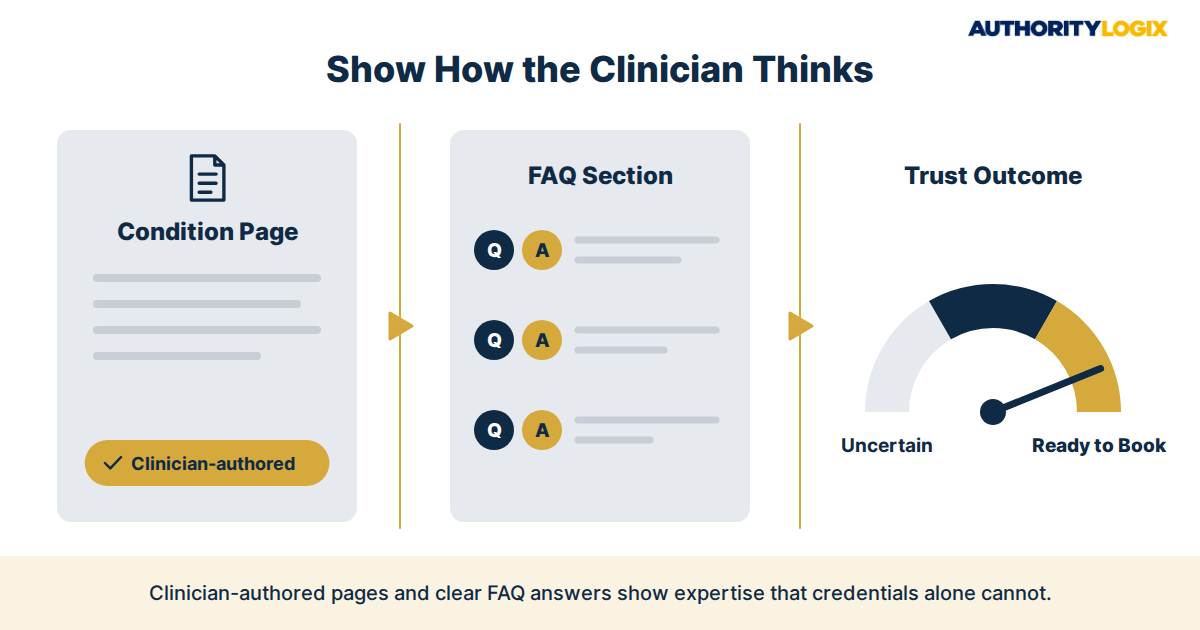
A clinician bio establishes who the physical therapist is and what they are qualified to treat. Condition-specific content demonstrates how they think about and approach specific clinical challenges — which is a deeper and more persuasive trust signal. Every condition the practice treats at high volume should have a dedicated condition page authored by a named clinician, with the authorship attribution connecting the condition content to the clinician’s credentials. The educational hub system provides the architecture for organizing condition content into a permanent knowledge library that builds topical authority over time.
Write in Patient Language, Not Clinical Jargon
Clinical expertise demonstrated through patient-accessible language is more persuasive than expertise demonstrated through jargon. The clinician who can explain a complex condition clearly and accurately — without oversimplifying or using clinical shorthand — is demonstrating the communication skill that patients value alongside clinical competence. The condition content guide covers the writing principles that make condition pages both clinically accurate and genuinely readable at patient level.
FAQ Content as a Clinical Expertise Signal
FAQ content — structured answers to the specific questions patients have before and during PT — is one of the most effective ways to demonstrate clinical expertise at the patient-facing level. A clinician who can anticipate the questions a patient with a specific condition will have and answer them clearly is demonstrating the depth of clinical experience that reassures patients they are in the right hands. The patient FAQ guide covers the full FAQ content strategy, including question categories, AI Overview structure, and deployment across the practice’s online presence.
Specialty Certifications as Patient-Facing Trust Differentiators
Specialty certifications are the most underutilized clinical authority asset in independent PT practice marketing. The practices that convert the most patients from credentials into bookings treat specialty certifications as patient-facing differentiation: they explain what each certification means, why it matters for specific conditions, and which patients are most likely to benefit from that expertise. The authority distribution system amplifies specialty certification content through channels that build the external citations and inbound links that reinforce the Authoritativeness dimension of E-E-A-T.
The patient-facing explanation of a specialty certification should answer three questions: what does this certification train the clinician to do, which conditions or patient populations is this expertise most relevant for, and why does having this certification matter compared to seeing a PT without it. The acquisition playbook covers the full acquisition system that specialty certification content feeds — from search rankings through patient conversion.
A practice that treats its specialty certifications as patient-facing differentiation — not just line items on a credentials page — captures the patients who are specifically searching for that expertise. The lead generation system connects specialty certification content to the lead capture and nurture infrastructure that converts that interest into booked evaluations.
Frequently Asked Questions
How detailed should a clinician bio be?
A converting clinician bio runs 200 to 400 words — enough to establish specialty, list key credentials with context, convey clinical philosophy, and include a clear booking path. Every line should build trust, reduce friction, or move the patient toward booking. The clinical authority guide covers the full E-E-A-T framework that bio page elements feed into — including how clinician bios connect to condition pages, FAQ content, and the practice’s broader authority signals.
Should clinicians write their own condition pages?
The clinician should contribute the clinical perspective, specific treatment approach, and patient-facing explanation — the content that demonstrates first-hand experience and genuine expertise. A content writer can structure and format that input for readability and SEO optimization. The authorship line should name the clinician with their credentials. A condition page written entirely by a content writer without clinician input lacks the first-hand Experience signal that Google’s YMYL standards require.
How often should clinician bios be updated?
Clinician bios should be audited at a minimum annually — and updated immediately any time a credential changes, a certification is earned, a professional affiliation changes, or a clinical focus area shifts. Listing a fellowship or hospital affiliation that is no longer current is a trust liability. The local search system covers the full platform presence that requires consistent clinician information — including GBP profiles, directory listings, and health system directories where patients cross-check credentials.
Which specialty certifications matter most for patient trust?
The certifications that matter most for patient trust are the ones most relevant to the conditions the practice treats at high volume. OCS is the highest-recognition credential for general musculoskeletal and post-surgical PT. SCS differentiates in sports injury markets. Pelvic floor certifications are the primary differentiator in women’s health PT. CSCS adds credibility in athletic performance contexts. McKenzie Method designation is recognized by patients familiar with back pain treatment. The PT industry hub demonstrates how specialty certification content connects to the full five-system framework — content, local search, patient education, lead generation, and authority distribution.
Ready to make your clinicians’ credentials visible enough to win the trust evaluation patients make online?