Key Takeaways
- Questions patients ask physical therapist before booking fall into four consistent categories: condition and treatment, logistics and scheduling, credentials and specialization, and direct access and referrals. A practice whose website answers all four categories removes the friction that costs it bookings from patients who are ready to commit.
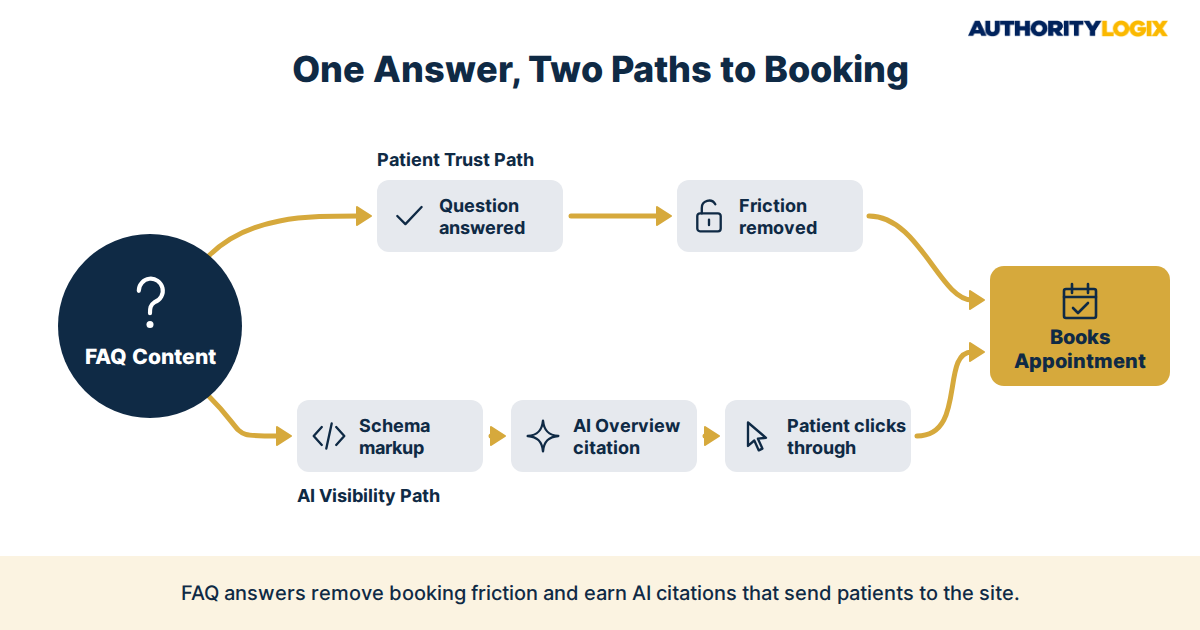
- Pages with well-structured FAQ sections give answer engines such as Google AI Overviews, Gemini, and Perplexity clean question-and-answer content to cite.
- AI Overviews are now the most trusted section of Google search results for healthcare queries, preferred by 37% of patients over organic results (20%) and the local map pack (13%), per rater8 report.
- The FAQ page is the most underutilized SEO asset on most PT practice websites. Patients searching “do I need a referral for PT in [state]” or “how long does physical therapy take” are in provider-selection mode — a practice whose FAQ answers these questions converts these searchers into patients.
- Per Searchlab’s 2026 healthcare marketing statistics, 82% of patients research providers online before booking, and the average patient visits 5.4 websites during that research. A practice whose FAQ content answers every question removes the hesitation that costs it bookings.
- FAQ content written in patient language — not clinical terminology — earns both patient trust and search rankings. The practice whose FAQ answers patient-language questions in plain, honest language earns the ranking and the trust.
- A converting FAQ page answers every legitimate question a prospective patient has before committing to a first appointment — including the uncomfortable ones about cost, insurance, time commitment, and what happens if PT does not work.
Questions patients ask physical therapist before booking are more predictable than most practices realize — and the practices that answer them on their websites are better positioned to convert research-phase visitors into scheduled evaluations. Every question a prospective patient cannot answer on a practice’s website is a reason to keep looking, to visit another clinic’s website, or to abandon the evaluation entirely.
This article covers the four question categories that patients consistently ask before choosing a physical therapist, why answering them on the practice website converts patients and earns AI Overview citations, and how to build a FAQ content strategy that compounds over time. The clinical authority guide covers the full E-E-A-T content framework — this article focuses specifically on FAQ content as a patient acquisition and AI visibility tool.
Questions Patients Ask Physical Therapist Practices: Why FAQ Content Is an Acquisition Asset
Most PT practices treat FAQ content as a secondary page — something to populate after the homepage, service pages, and condition pages are built. This sequence misunderstands the role FAQ content plays in the patient’s decision process. FAQ content serves patients who are still deciding — patients who have found the practice, are evaluating it, and are looking for answers to specific questions before they commit.
Pages with well-structured FAQ sections give answer engines such as Google AI Overviews, Gemini, and Perplexity clean question-and-answer content to cite. AI Overviews are now the most trusted section of Google search results for healthcare queries — 37% of patients trust them more than organic results or the local map pack. The
content playbook covers the full content architecture that FAQ pages fit into — pillar pages, condition pages, and structured FAQ content working as a coordinated system.
The search demand for pre-appointment questions is substantial and high-intent. Patients searching “how long does physical therapy take,” “do I need a doctor referral for PT,” or “does insurance cover physical therapy” are in provider-selection mode. They have a specific practical question standing between them and a booking. The practice whose website answers that question directly earns the ranking and removes the friction that would otherwise send them to a competitor.
82% of patients research providers online before booking, and the average patient visits 5.4 websites during that research. A practice with comprehensive FAQ content becomes the last website a patient visits before booking — because it has answered every question they had. The
lead generation system connects FAQ content to the conversion infrastructure that turns answers into scheduled evaluations — including booking CTAs, intake forms, and the follow-up sequences that confirm appointments.
Explore the Physical Therapy Patient Education & Clinical Authority Guide — the cornerstone resource for this category.
Clinical Authority Guide →
The 4 Categories of Questions Patients Ask Physical Therapist Practices Before Choosing
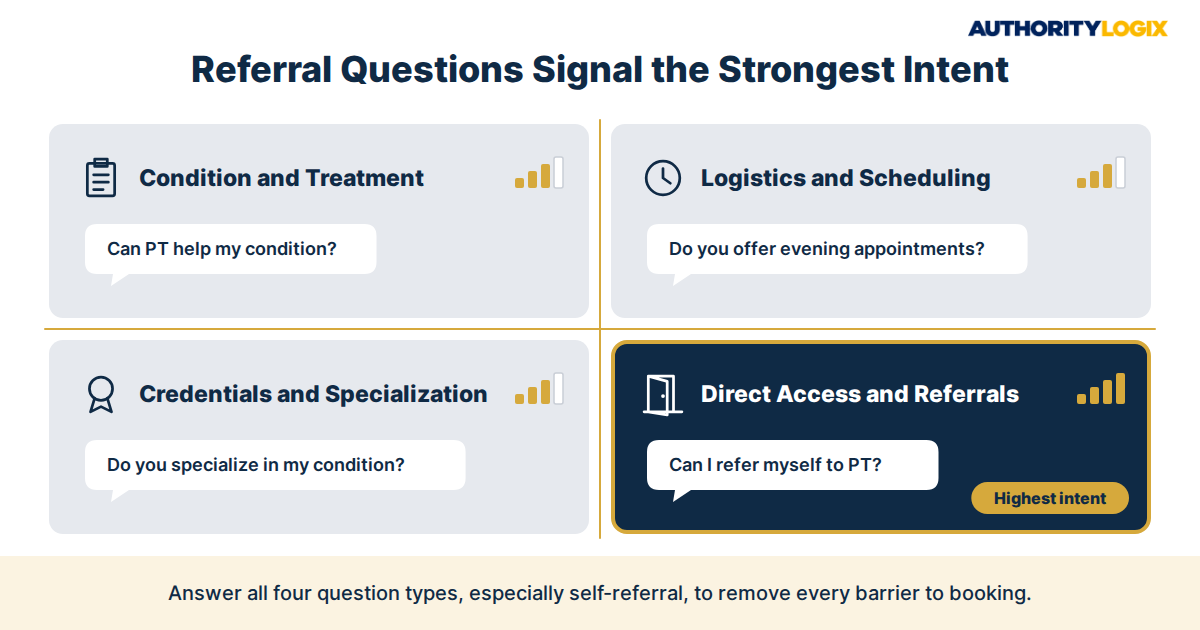
Patient questions before choosing a physical therapist fall into four consistent categories regardless of the specific condition, geographic market, or patient demographic. A PT practice whose website comprehensively addresses all four categories has built the FAQ infrastructure that converts research-phase visitors at every stage of their decision process.
Category 1 of Questions Patients Ask Physical Therapist Practices — Condition and Treatment
Condition and treatment questions are the most clinically substantive questions patients ask — and the most valuable from a trust-building perspective. “Can physical therapy help my condition?” “How long will my recovery take?” “Will physical therapy be painful?” A practice whose FAQ answers these questions with condition-specific, clinician-attributed content is demonstrating both clinical expertise and patient-facing accessibility simultaneously. The
educational hub system structures condition-specific FAQ content into a permanent knowledge library that builds topical authority over time.
Category 2 — Logistics and Scheduling Questions
Logistics questions are the practical barrier questions — the ones that stand between a patient who wants PT and a patient who books an appointment. “How long does a physical therapy session last?” “What should I wear?” “Do you offer evening appointments?” “Is there parking?” These questions are conversion-critical. A patient who cannot easily find answers to logistics questions will assume the clinic is hard to deal with. The
local search system covers GBP Q&A pre-population — the fastest way to get logistics FAQ answers in front of patients at the provider-selection moment.
Category 3 — Credentials and Specialization Questions
Credentials and specialization questions reflect a patient who is actively evaluating whether a specific practice or clinician has the expertise to treat their specific condition. “Do you specialize in my condition?” “Will I see the same therapist at each visit?” “What certifications do your therapists have?” These questions deserve specific, credentialed answers — not generic assurances. The
clinician trust guide covers the bio page construction and credential presentation strategy that gives patients the specific information they need to make this evaluation.
Category 4 — Direct Access and Referral Questions
Direct access and referral questions are the most underserved question category in PT FAQ content — and the highest-intent category from a patient acquisition perspective. “Do I need a doctor’s referral for physical therapy?” “Can I refer myself to PT?” As of 2026, all 50 states allow some form of direct access to physical therapy, per APTA — but only 41% of the general population knows a physical therapist can treat patients without a physician referral, per APTA’s 2025 consumer perceptions report. The
acquisition playbook covers the direct-access patient acquisition strategy that this FAQ category feeds.
How to Write Physical Therapy FAQ Content That Converts and Ranks
The structure and writing style of a PT FAQ page determine whether it converts patients and earns search and AI visibility — or simply exists as an undiscovered page on the practice website.
Answer the Question First
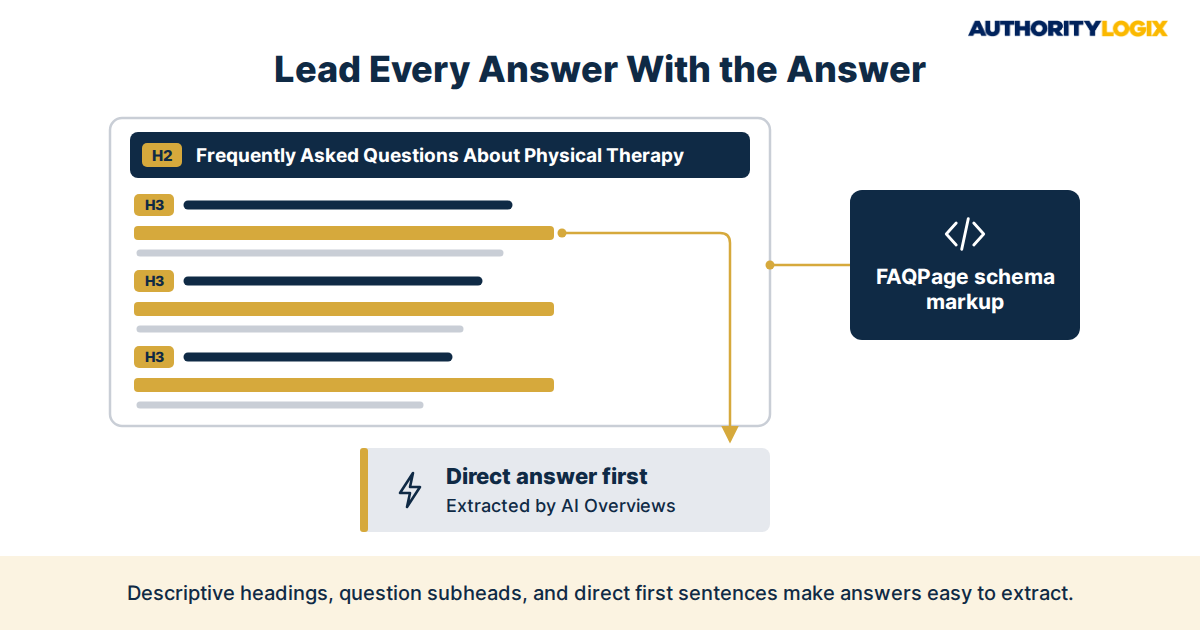
Every FAQ answer should begin with a direct, clear answer to the question — not with a preamble, a caveat, or a qualification. This direct-answer-first structure is also the format that Google AI Overviews and voice search assistants extract for featured answers. The
local visibility guide covers how structured content earns visibility across both traditional and AI search — including the schema markup and heading hierarchy that signals FAQ structure to Google.
Use Patient Language, Not Clinical Terms
FAQ answers written in clinical terminology fail the patient who is asking the question in plain language. A patient asking “will physical therapy hurt?” will not find a FAQ answer titled “Pain Management During Rehabilitative Therapy” and feel like their question was answered. Patient-language titles earn patient-language search rankings and build trust through honest, clear communication.
Include the Uncomfortable Questions
The FAQ questions most practices avoid are the ones that build the most trust when answered honestly. “What if physical therapy doesn’t work for my condition?” “What are the risks of physical therapy?” A practice that answers these questions directly signals that it is willing to have transparent conversations about the realities of PT. The
patient education guide covers how honest, patient-facing content builds the E-E-A-T trust signals that YMYL rankings require.
Structure for AI and Search Extraction
A
FAQ structure that works well for AI Overview citations uses a descriptive H2 heading like “Frequently Asked Questions About Physical Therapy” with each individual question formatted as an H3 below it. Generic “FAQ” headings produced weaker citation results. Adding FAQPage schema markup signals to Google’s systems that the content is structured Q&A. The content playbook covers the full technical structure — heading hierarchy, schema markup, and internal link architecture — that makes FAQ pages rank and earn AI citations simultaneously.
Deploying FAQ Content Across the Practice’s Online Presence
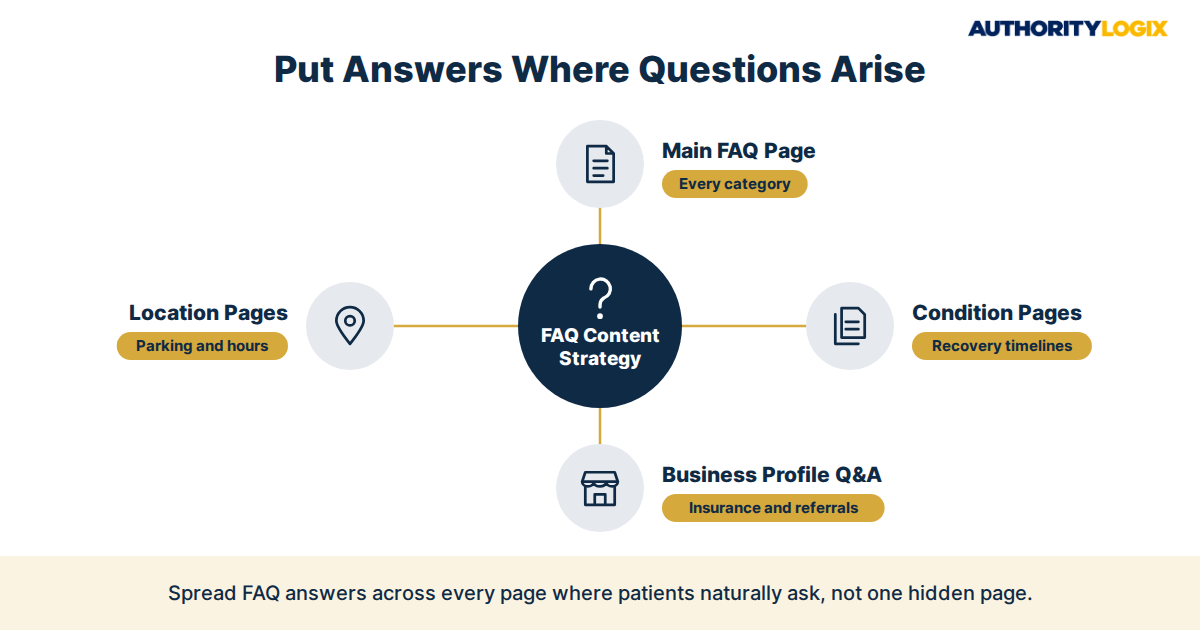
A standalone FAQ page is a starting point, not a complete FAQ content strategy. The most effective PT FAQ content strategy distributes answers across the practice’s website in the locations where patients are most likely to have those questions. The
PT industry hub connects all five systems — content, local search, patient education, lead generation, and authority distribution — into the coordinated presence that makes FAQ content compound in value over time.
Condition Page FAQs
Every condition page should include a condition-specific FAQ section — typically four to six questions specific to that condition and treatment. Condition-page FAQs earn eligibility for condition-specific AI Overview citations, which are increasingly common for “how long does [condition] recovery take” searches. The
condition content guide covers the full condition page structure — including how condition-specific FAQ sections connect to the broader page content and earn topical authority.
GBP Q&A Section
Google Business Profile’s Q&A section allows practices to pre-populate the most common patient questions directly on the GBP profile — where patients are actively evaluating the practice. Pre-populating insurance, referral, and scheduling questions with direct answers means patients can get those answers without leaving the GBP profile. The
authority distribution system covers how GBP content — including pre-populated Q&A — is part of the broader authority signal system that Google reads across multiple platforms.
Location Page FAQs
Location pages benefit from location-specific FAQ content that answers the practical questions most relevant to patients at that specific clinic — parking, hours, which therapists work at that location. The
growth blueprint covers how location pages, condition pages, and FAQ content work together as a compound authority asset that grows in value as the practice’s online presence matures.
Frequently Asked Questions
How long should a PT FAQ page be?
A PT FAQ page should be comprehensive enough to answer every legitimate question a patient has before booking — without padding. In practice, that means 15 to 30 questions organized into clear categories, with concise but complete answers running 50 to 150 words each. The acquisition playbook covers the full conversion infrastructure that FAQ content supports — including how FAQ answers connect to booking CTAs and the patient evaluation workflow.
Should the FAQ page be a standalone page or embedded on other pages?
Both. A standalone FAQ page allows Google to index and rank the content specifically, and allows patients to find comprehensive answers in one place. Condition-specific and location-specific FAQ content should also be embedded on the relevant condition pages and location pages. Cross-linking between the standalone FAQ page and condition-page FAQ sections creates an internal link network that strengthens both.
How often should the FAQ page be updated?
The FAQ page should be reviewed and updated at minimum quarterly — and immediately any time a policy changes, a new insurance plan is added, clinic hours change, or a new clinician joins the practice. Outdated FAQ content is a trust liability: a patient who calls based on a FAQ answer and finds the information is wrong will not book.
Do FAQ pages actually rank in search results?
Yes — FAQ pages rank for two distinct search opportunities. First, they rank organically for the long-tail question queries patients type directly into Google. Second, they earn eligibility for Google AI Overview citations, featured snippet placements, and People Also Ask inclusions. A well-structured FAQ page with FAQPage schema markup earns both types of visibility simultaneously. The local search system covers how FAQ content integrates with the practice’s local search presence — including GBP signals and location-specific content that Google uses to match FAQ answers to local patient queries.
Ready to answer the questions patients ask before they choose a physical therapist, on pages built to rank?
Work With Us →