


Key Takeaways
- The financial firm authority gap is the distance between a firm’s real expertise and what borrowers and clients can actually find about it online.
- Firms with similar products get different lead volumes because, when services overlap, the market decides on visibility and trust.
- The CFPB found that three out of four mortgage borrowers applied with only one lender or broker, so being found and trusted first matters.
- Kitces research found high-growth advisory firms got about a third of new client revenue from referrals, versus roughly 80% at slower-growing peers.
- Backlinko found the top three Google results capture 54.4% of clicks, which turns lender online presence variation into lead variation.
- Closing the financial firm authority gap takes connected infrastructure — findability, proof, conversion, and distribution — not more posting.
Table of Contents

The financial firm authority gap is the distance between how much expertise a lender or advisor has and how much of it the market can actually see. Two mortgage companies can offer the same loan programs at similar rates, and two advisory firms can hold the same credentials, yet one fills its calendar with inbound inquiries while the other waits on referrals. You may already know your firm is as capable as the competitor showing up everywhere online. The difference is rarely talent.
Most owners describe the problem as a marketing issue, but it is closer to a structural one — a close relative of the credibility gap that keeps qualified firms from being chosen. This article breaks down what causes the financial firm authority gap, why it shows up differently for mortgage companies, advisors, and lenders, and what it takes to close it without guessing.
What Causes the Financial Firm Authority Gap
Start with the market’s view of you. A borrower or prospective client who does not already know your name sees only what search results, review platforms, and AI assistants surface — and most financial firms give those systems very little to work with. Credible but invisible is the most common state in this industry: years of closed loans and long client relationships, with almost none of it published where a stranger can find it.
The pattern is not unique to finance. In the Content Marketing Institute’s 2026 B2B trends survey of 1,015 marketers, only 12% rated their marketing highly effective, and 24% named differentiating from competitors as a top content challenge. The same CMI research found that 40% of marketers struggle to create content that prompts a desired action — the exact failure point behind the financial firm authority gap.
Five Layers Behind the Financial Firm Authority Gap
When firms with similar services and very different lead volumes are compared side by side, the difference almost always traces back to five layers. Each one is buildable, and each one gets stronger when it connects to the others.
- Findability — whether your firm appears for the searches borrowers and clients run before they ever call anyone.
- Proof — whether the reviews, credentials, and published expertise a stranger finds confirm that you are the safe choice.
- Conversion — whether a visitor has a clear, low-friction next step that turns interest into a conversation.
- Distribution — whether your expertise travels beyond your own website to the platforms your market already uses.
- Connection — whether those four layers feed each other or sit in separate silos run by different vendors.
Firms that close the gap do not necessarily do more of any single thing. They build the trust layer deliberately, following the kind of sequence laid out in the authority guide, and then connect it to search and conversion so every new asset strengthens the others.
That connected view matters because the financial firm authority gap is cumulative. A firm that is weak in one layer can often compensate, but a firm missing three or four layers is effectively absent from the market it serves. Our financial services hub shows how those layers fit together for mortgage companies, DSCR lenders, and advisory firms.
The Financial Services Growth Playbook shows how firms turn a financial firm authority gap into a growth system built on infrastructure rather than ad spend.
Mortgage Companies Authority Gap Explanation: Same Products, Different Results
Here is the mortgage companies authority gap explanation in plain terms: the products are nearly identical, so the market decides on visibility and trust. Rate sheets, loan programs, and closing timelines overlap heavily across lenders in any given metro. When the product cannot separate one firm from another, the borrower’s first impression does the deciding — and that first impression now happens online.
That first impression carries real weight. The CFPB’s mortgage shopping research found that three out of four borrowers applied with only one lender or broker, and 70% relied a lot on lenders or brokers for information. Whoever a borrower finds and trusts first often becomes the only lender they seriously consider, which makes the financial firm authority gap a pipeline problem before it is a branding problem.
AI search is widening the distance. BrightLocal’s Local Consumer Review Survey 2026 found that 45% of consumers had used AI tools for local business recommendations, up from 6% a year earlier, and 97% read reviews for local businesses. Assistants and review platforms favor firms with deep, consistent, published expertise, so lenders who built that layer early pull further ahead each quarter.
Over time, that head start turns into a competitive moat. A lender with two years of published guides, reviews, and local pages is hard to catch, because every new competitor has to rebuild the same depth from zero while the leader keeps adding to it.
The firms that win this comparison usually have one asset the others lack: a structured educational hub that answers borrower questions before the first call. It does the explaining loan officers would otherwise repeat on every phone call, and it gives search engines and AI tools a reason to cite the firm. For lenders, the financial firm authority gap is rarely a skills difference — it is a published-knowledge difference.

Advisor Visibility Difference Explanation: Infrastructure, Not Talent
The advisor visibility difference explanation follows the same logic with different inputs. Advisors compete on trust, credentials, and fit, so prospects look for evidence of all three before they reach out. When two planners have similar designations and service models, the one whose thinking is visible online tends to get the first meeting.
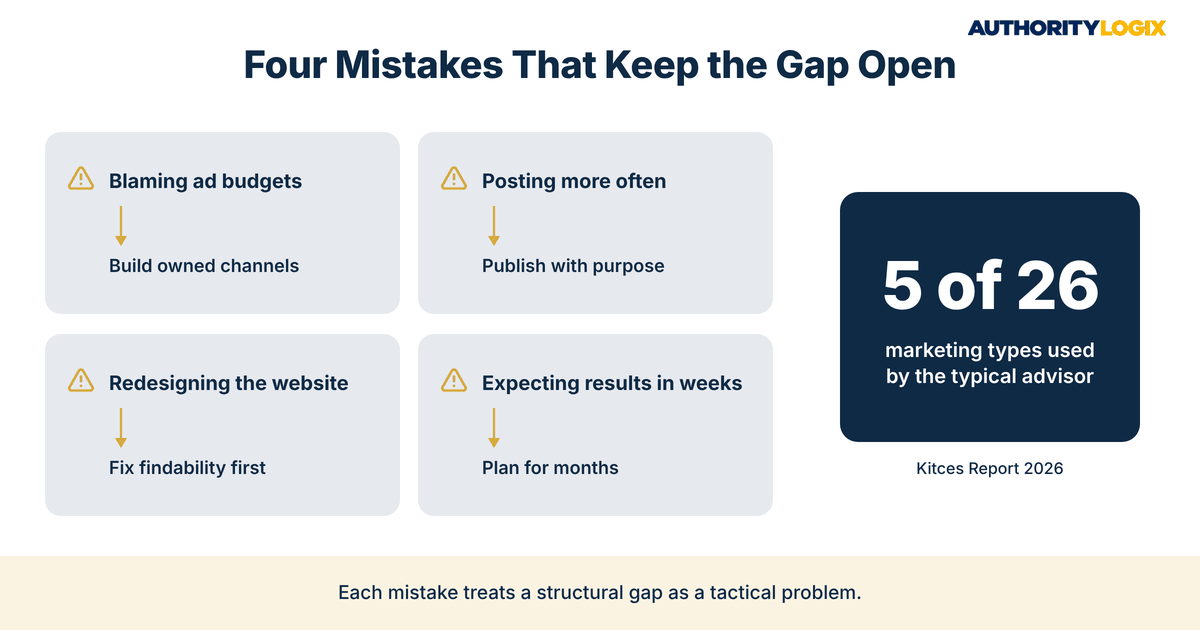
The Kitces Report on how financial planners market their services, based on a 2026 survey of 506 advisors, shows how lopsided the typical approach is. Client referrals were used by 88% of practices, while only 32% used SEO and 27% published a blog. The typical advisor deployed just 5 of the 26 marketing types the report identified.
Growth tracked with that mix. High-growth firms received only about a third of their new client revenue from referrals, while slower-growing peers relied on referrals for roughly 80%. In the same research, SEO cost 45 cents per dollar of new revenue, one of the more efficient channels measured. Your referral network is a ceiling, not a foundation.
Why the Financial Firm Authority Gap Widens Over Time
Published expertise behaves differently from referrals. A strong article written today can keep earning visits for years, which is why firms that commit to long-term rankings see the financial firm authority gap widen in their favor while referral-only peers stay flat. A referral, by contrast, produces one introduction and then has to be earned again.
None of this requires an advisor to become a full-time writer. It requires content systems that turn existing expertise — client questions, planning frameworks, market commentary — into compliance-reviewed assets on a repeatable schedule. The talent is already there; the infrastructure is what is missing.
Not sure how wide the financial firm authority gap is between your firm and the competitors winning your market?
Lender Online Presence Variation and What It Costs
Lender online presence variation is easy to see once you search your own market the way a borrower would. Some firms show up in the map pack, in organic results for program-specific questions, and in AI answers. Others appear only for their own brand name, if at all.
Position matters more than most owners assume. Backlinko’s analysis of about 4 million Google results found that the first organic result earns a 27.6% average click-through rate, and the top three results capture 54.4% of all clicks. A firm on page two is not competing for most of that demand, no matter how strong its service is.
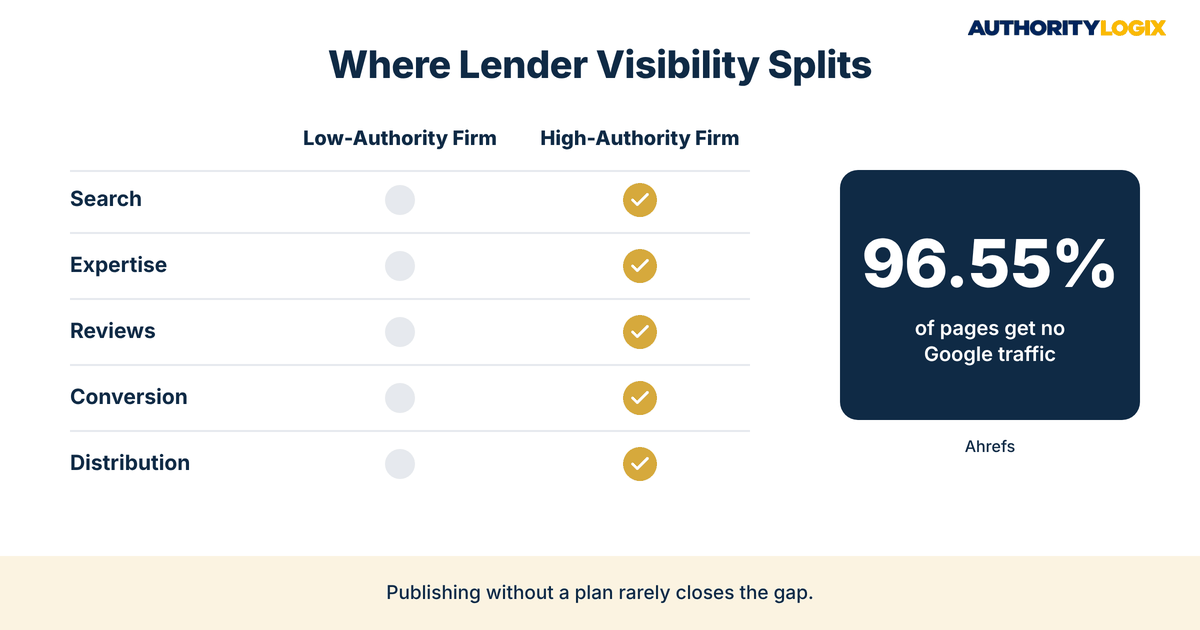
Publishing alone does not fix it. Ahrefs found that 96.55% of the roughly 14 billion pages in its study received no organic traffic from Google, usually because they targeted no real search demand or earned no links. What separates those pages from the ones that rank is the planning covered in the SEO playbook: real keywords, clear page structure, and internal links that tell search engines what the firm knows.
Measuring the Financial Firm Authority Gap in Your Market
A simple side-by-side comparison shows where lender online presence variation actually comes from. Score your firm and two competitors with similar services on each layer below.
| Layer | Low-Authority Firm | High-Authority Firm | What the Gap Costs |
|---|---|---|---|
| Search visibility | Ranks for its brand name only | Ranks for program and local questions | Borrowers who search never see the firm |
| Published expertise | A few thin service pages | Guides, FAQs, and calculators | Search and AI tools have nothing to cite |
| Reviews and proof | Few or outdated reviews | Steady, recent reviews | Prospects choose the better-reviewed competitor |
| Conversion path | Contact form only | Clear assessment or consult offer | Visitors leave without a conversation |
| Distribution | Website only | LinkedIn, syndication, and media | Expertise never reaches new audiences |
Most firms that score poorly have the expertise to fill every row. What they lack is finance content written for borrowers and clients rather than for other industry professionals, published consistently enough to register with search engines. Closing the financial firm authority gap starts with the rows where the costs are highest.
Closing the Financial Firm Authority Gap With Connected Infrastructure
Closing the gap is a sequence, not a campaign. Firms that try to catch up by buying ads or posting more often usually find the financial firm authority gap returns the moment they stop. Ad-driven visibility disappears when spending ends, while published infrastructure keeps working.
The foundation is a documented content system that maps topics to the questions your market actually asks, assigns each piece a job, and links every asset back to the service pages that convert. That structure is the difference between a library and a pile of posts.
BKDSCR.com, the AuthorityLogix proof-of-concept in the NYC outer-borough DSCR niche, was built this way: 18 pillar pages, 7 interactive investor tools, and 48 SEO-optimized blog posts, with zero paid ads, in under 18 months. It was built in a live competitive market to show how the financial firm authority gap closes when every page has a defined role.
Once the library exists, it needs reach, which is where authority distribution comes in. Each asset is extended into LinkedIn, syndication, and media placements so the firm’s expertise appears in more places than its own website, and search engines, AI tools, and prospects start encountering the same name repeatedly.
For regulated firms, every layer runs through compliance review. That adds a step but not a barrier: educational material that explains processes, terms, and decision factors — without rate promises or individualized advice — is exactly what closes the financial firm authority gap safely.
What Firms Get Wrong About the Financial Firm Authority Gap
Most firms that try to close the gap make one of a handful of predictable mistakes. These are the questions lenders and advisors ask most often after trying something that did not work.
Is the gap just a sign that competitors spend more on marketing?
Sometimes, but spending rarely explains the whole difference. The Kitces data shows high-growth advisory firms relying less on referrals and more on channels they control, and a well-built lead generation system turns those channels into a predictable pipeline instead of one-off spikes.
Will posting more often on social media close the gap?
Not by itself. Posts that do not connect to a website, a content library, and a clear next step generate activity rather than client conversations. Publishing with purpose means each post points back to an asset that keeps working after the feed moves on.
Can a new website fix the financial firm authority gap?
A redesign improves the experience for visitors you already have, but it does little for visitors who never find you. That is why our summary of what we do starts with search, content, and distribution, and treats the website as one part of the system rather than the whole of it.
How long does it take to see the gap narrow?
Expect months, not weeks. Search engines need time to crawl, evaluate, and trust new content, and the first measurable movement usually appears in rankings and impressions before it shows up in leads. The sequence behind how we build plans for that timeline from the start, so firms know what to measure at each stage.
Is the gap a problem only for small firms?
No. Large lenders and multi-advisor firms often have wider gaps, because their expertise is spread across dozens of people whose knowledge never gets published. The financial firm authority gap is about what the market can see, not how large the firm is.
Want to close the authority gap between your firm and the competitors prospects choose? We’ll find it and build the fix.
The Financial Firm Authority Gap Is Structural, So Is the Fix
Firms with similar services get different lead volumes because the market rewards what it can see. Once the trust and visibility layers exist, the lead system turns that attention into booked conversations instead of anonymous visits.
This is a long build, and it has to fit inside compliance rules, busy schedules, and a market that does not change overnight. The reason it is worth doing is simple, and it is why it works for the firms that commit: every published asset keeps working after it goes live, so each quarter starts from a higher base than the last.
The honest assessment is that most lenders and advisors already have the expertise their market should see. The financial firm authority gap is the missing infrastructure underneath it, and it does not close on its own. If you want that infrastructure built around your markets and your compliance requirements, the next step is to work with us.