


Key Takeaways
- Financial firm referral dependence visibility is the gap between the reputation you have earned inside your network and what qualified prospects outside it can find when they search.
- Referrals from clients, friends, and family still produce 54.2% of new advisor clients, according to Cerulli — but a Ficomm Partners study found only 17% of people under 44 required a referral to hire an advisor.
- B2B buyers are nearly 70% through their decision before they engage a seller, according to 6sense research reported by Demand Gen Report, so the shortlist forms where you cannot see it.
- Referred prospects still search your name, and BrightLocal’s 2026 survey found 97% of consumers read reviews for local businesses.
- Closing the financial firm referral dependence visibility gap is an infrastructure build — educational content, distribution, and capture — that strengthens referrals instead of replacing them.
- Strong financial firm referral dependence visibility means a stranger can find, evaluate, and trust your firm without ever meeting someone in your network.
Table of Contents
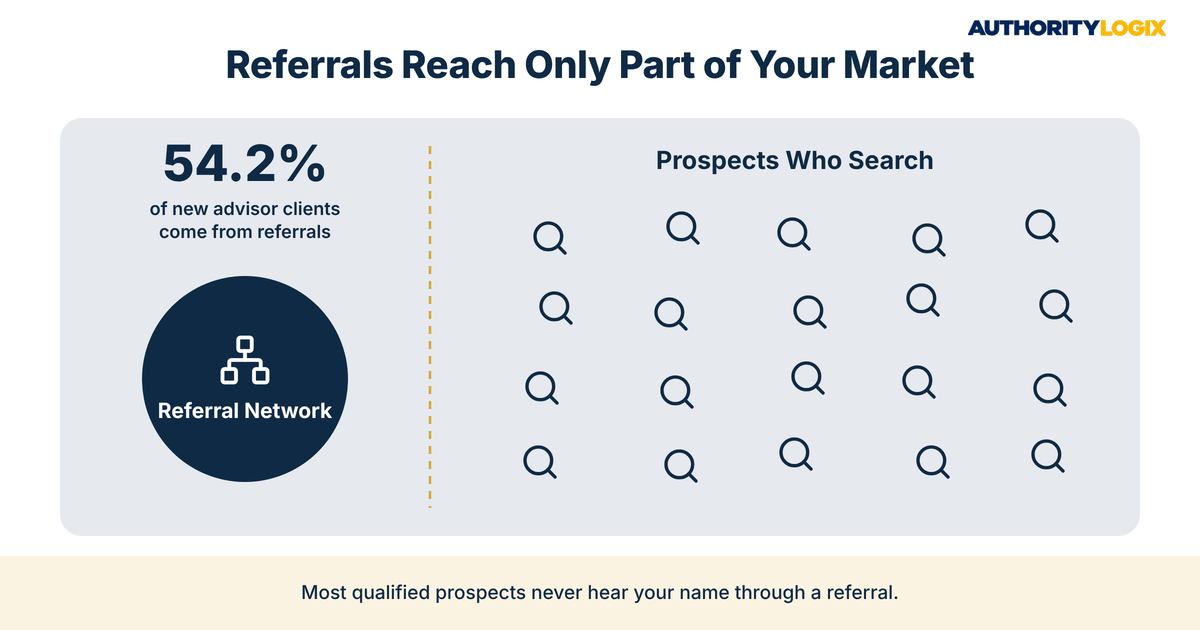
Financial firm referral dependence visibility is the problem most established lenders and advisors never measure: the market inside your referral network knows exactly who you are, and the market outside it has no idea you exist. You have spent years earning trust one client at a time. That trust travels through introductions, but it does not travel through search results, AI answers, or review platforms unless something carries it there. This is the credibility gap in its plainest form — real expertise that only a small circle can see.
The qualified prospects you never get referred to are not a small segment. They are most of your addressable market — business owners new to your area, investors who do not know anyone who knows you, and younger clients who would rather search than ask. Every one of them is choosing a firm right now. Without a deliberate plan for financial firm referral dependence visibility, they are choosing someone else.
Why Financial Firm Referral Dependence Visibility Breaks Down Outside Your Network
Referrals work because they transfer trust. Cerulli’s U.S. Advisor Metrics 2025 report found that 54.2% of new advisor clients come from referrals by clients, friends, or family, and another 13.9% come from centers of influence such as CPAs and attorneys. Those numbers explain why many firms see no reason to change, and they explain the risk: when two-thirds of growth flows through other people’s relationships, your pipeline is capped by how many people those relationships reach.
Search does not inherit that trust automatically. A prospect who types a question about DSCR loans, retirement income, or jumbo financing into Google is not looking for your name — they are looking for an answer, and the firm that publishes the clearest answer earns the first impression. That is the core argument of the SEO playbook: visibility is earned topic by topic, not transferred from reputation. Financial firm referral dependence visibility suffers because referral-built firms rarely publish anything a stranger could find.
Credible but invisible is the honest label for most referral-built firms. The expertise is real, the client relationships are real, and the digital footprint is a homepage, a bio, and a contact form. Mapping a firm against the five systems on our services hub usually shows the same pattern: strong word of mouth, almost no searchable content, and no mechanism to capture a prospect who arrives cold.
Ask a simple diagnostic question: if a qualified prospect in your market searched the three questions your clients ask most often, would your firm appear for any of them? For most referral-built firms the answer is no. That single test measures financial firm referral dependence visibility more accurately than any traffic report, because it shows whether a stranger can reach you without an introduction.
The Financial Services Authority Guide explains how lenders and advisors turn earned credibility into trust signals that prospects outside their network can see.
Advisor Beyond Referrals Visibility: Where Qualified Prospects Are Lost
Advisor beyond referrals visibility is where the generational math turns against referral-only firms. A Ficomm Partners study cited by InvestmentNews in 2025 found that only 17% of people under 44 required a referral to hire an advisor, compared with 60% of investors over 60. The same research found that 57% of younger clients chose their advisor through digital channels, yet only 29% of advisory firms currently make those channels a priority.
The Generational Shift Behind Financial Firm Referral Dependence Visibility
The firms most exposed are the ones whose clients are aging. Your best referral sources were introduced to you twenty years ago, and the people they know look a lot like them. As that network retires, the referral ceiling drops lower each year, and the next generation of clients is not waiting for an introduction. They are reading, comparing, and shortlisting firms on their own.
InspereX’s 2025 Advisor Pulse Outlook Survey of 829 advisors shows how this plays out in practice. In InspereX’s 2025 Advisor Pulse Outlook Survey, 76% of advisors said they had gained new clients through unsolicited referrals that year, yet prospecting and marketing made up only 15% of their workload. That combination is comfortable until referral volume slips, and then there is nothing underneath it to protect financial firm referral dependence visibility.
Closing the gap starts with answering the questions prospects ask before they ever contact a firm. Topics such as how fee-only planning differs from commission models, what a DSCR ratio measures, or how to compare lender turn times belong in an organized educational hub rather than scattered across a blog. Structured that way, each answer builds advisor beyond referrals visibility for the next stranger who asks the same question.
The firms that act on this early gain a lasting advantage. Every answer published today keeps working for the prospects who search next year, which is why financial firm referral dependence visibility rewards the firms that start before their referral volume declines rather than after.

The Mortgage Referral Ceiling Authority Problem and What It Costs
Mortgage referral ceiling authority is the measure of how far a lender’s reputation reaches beyond the agents, builders, and past clients who already send business. For most mortgage companies, the answer is not far. Referral partners can only introduce you to the borrowers they personally meet, and they are often introducing those same borrowers to two or three other lenders they like.
Buyer research points the same direction. According to 6sense research reported by Demand Gen Report, B2B buyers are nearly 70% of the way through their decision before they engage a seller, they initiate first contact 80% of the time, and 81% already have a preferred vendor when they reach out. Prospects weighing a large financial decision tend to follow a similar pattern: by the time they call, the shortlist is set.
That is the real cost of weak financial firm referral dependence visibility. You are not losing deals you competed for — you are absent from decisions you never knew were happening. Firms that build organic leads through search and education show up during that early 70% of the process, while referral-only firms wait for a phone call that increasingly goes elsewhere.
Purchased leads do not fix financial firm referral dependence visibility, because they arrive already shopping several competitors. The alternative is publishing infrastructure where each article, calculator, and guide maps to a stage of the prospect’s research. Built through deliberate content systems, that infrastructure raises mortgage referral ceiling authority whether or not a referral partner remembers your name this month.
If a lender closes most of its loans from five referral partners and one changes firms, much of the pipeline leaves with that person. Strong financial firm referral dependence visibility spreads that risk across hundreds of search queries instead of a handful of relationships, and that protects mortgage referral ceiling authority when partnerships change.
Not sure how far your firm’s financial firm referral dependence visibility reaches? The FS Authority Gap Assessment shows where prospects lose sight of you and what to build first.
Lender Referral Network Limits in a Search-First Market
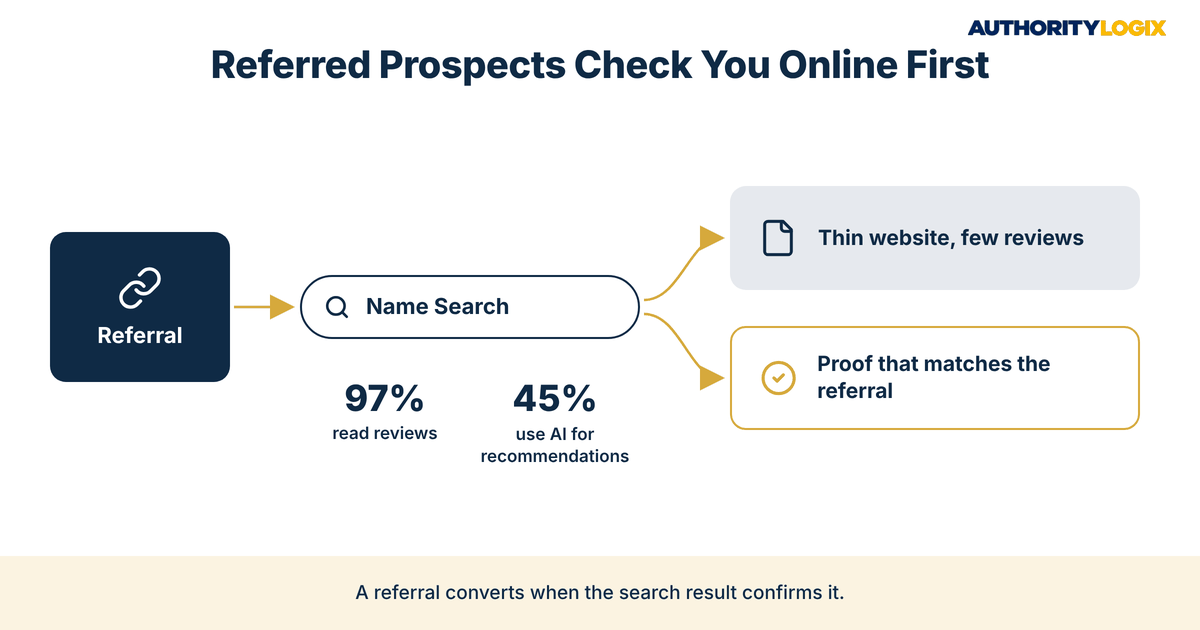
Lender referral network limits become obvious the moment a referred prospect does what nearly everyone now does: they search your name. BrightLocal’s Local Consumer Review Survey 2026 found that 97% of consumers read reviews for local businesses and 47% will not use a business with fewer than 20 reviews. A warm introduction that lands on a thin website and six reviews loses momentum before the first conversation.
AI search adds another layer. The same BrightLocal survey found that 45% of consumers now use AI tools such as ChatGPT for local recommendations, up from 6% the year before. Those tools answer from published material, so a firm with nothing published gives them nothing to cite. Financial firm referral dependence visibility now has to cover AI answers as well as search results.
The fix is not more posting. It is compliance-aware finance content written from the firm’s real expertise — how you underwrite, how you plan, what clients ask in the first meeting. That material gives search engines and AI platforms something specific to surface, and it gives referred prospects proof that matches what their friend told them.
For financial firm referral dependence visibility, structure matters as much as substance. Articles need to connect to pillar pages, service pages, and conversion points so each one reinforces the others instead of competing for attention. A documented content system turns individual pieces into an architecture that pushes past lender referral network limits month after month.
Review the gaps honestly before choosing what to build. A firm with strong reviews but no educational content has a different problem from a firm with content but no reviews. Financial firm referral dependence visibility improves fastest when the build starts with the weakest layer that prospects actually encounter first.
Building Financial Firm Referral Dependence Visibility That Strengthens Referrals Instead of Replacing Them
The goal is not to abandon referrals. Referrals remain the highest-trust channel most firms have, and this infrastructure helps them convert, because the referred prospect finds a firm that looks as credible online as it is in person. Financial firm referral dependence visibility improves when every referral lands on proof instead of a placeholder.
Distribution is the second half of the build. Published expertise needs to reach syndication networks, industry publications, and LinkedIn audiences so prospects encounter your name in more places than your own website. That is the job of authority distribution, and it is what puts a firm in front of qualified prospects who have never met anyone in its network.
Capture is the third piece. A prospect who reads three of your articles still needs a reason and a way to raise a hand — a planning checklist, a deal analyzer, a scheduled consultation. Connecting those offers to the content is what a working lead system does, and it is how visibility turns into client conversations you can track.
A Visibility Scorecard for Referral-Dependent Firms
Use the scorecard below to judge your financial firm referral dependence visibility today. Each row compares a referral-only firm with one that has built visibility beyond its network.
| Visibility Layer | Referral-Only Firm | Firm With Visibility Infrastructure |
|---|---|---|
| Name search | Homepage, bio, a handful of reviews | Reviews, articles, and profiles that confirm the referral |
| Question search | Not present | Educational answers ranking for prospect questions |
| AI answers | Nothing to cite | Published expertise AI tools can reference |
| Distribution | Word of mouth only | Syndicated articles and LinkedIn positioning |
| Capture | Contact form | Lead magnets and tools tied to content |
| Financial firm referral dependence visibility | Limited to the network | Reaches prospects who were never referred |
BKDSCR.com, the AuthorityLogix proof-of-concept in the NYC outer-borough DSCR niche, was built on exactly this layering: 18 pillar pages, 7 interactive investor tools, and 48 SEO-optimized blog posts, with zero paid ads. It was designed so investors who had never been referred could find it, evaluate it, and reach out on their own.
What Referral-Dependent Firms Get Wrong About Visibility
Most referral-reliant firms have heard the visibility case before. These objections come up most often.
Is a strong referral network enough to keep growing?
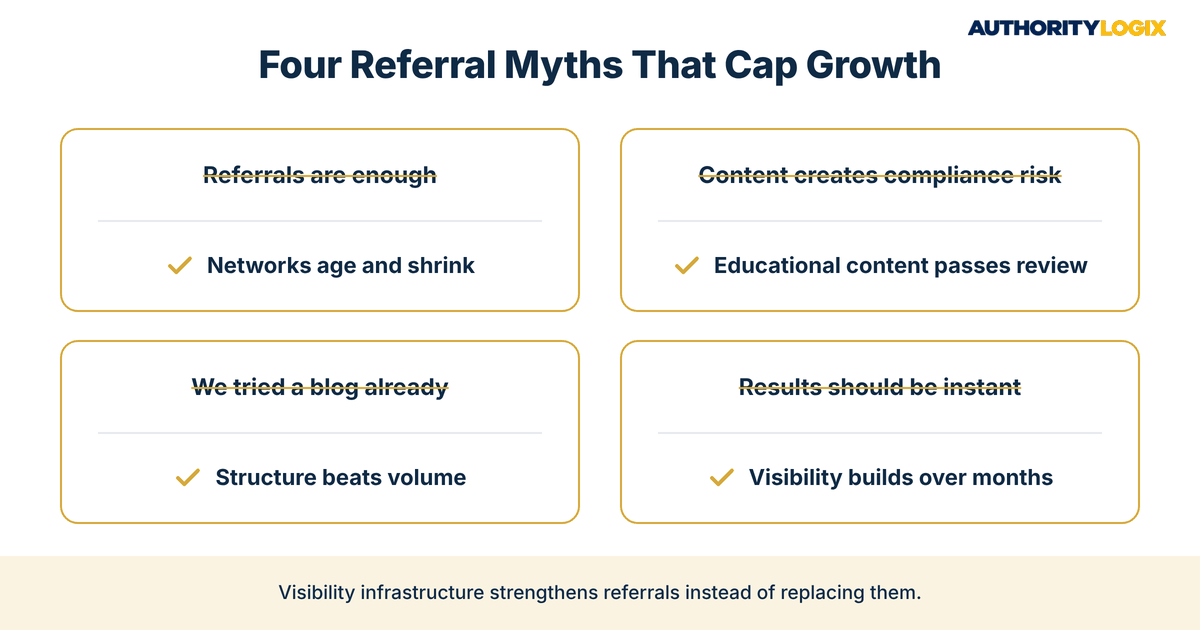
For a while, yes — until the network ages, a key partner retires, or a competitor with a stronger search footprint starts winning the referred prospects who check online first. Financial firm referral dependence visibility matters because referrals and search now work together. Firms that add inbound lead generation alongside referrals are diversifying the pipeline rather than abandoning what already works.
Won’t publishing content create compliance problems?
Compliance-aware content is educational by design: it explains concepts, processes, and questions to ask, without making recommendations or promising outcomes. Firms that route content through their normal review process can publish every month. Building that review step into the workflow is part of what we do from the first engagement.
We tried a website and blog before. Why would this be different?
Most failed attempts were volume without structure — posts with no keyword mapping, no internal linking, and no distribution. Those pieces were published and then forgotten. Seeing how we build in sequence, foundation first, then content architecture, then distribution, explains why structured builds behave differently from isolated posts.
How long before visibility beyond referrals shows up?
Search visibility builds over months, not weeks, and no one can honestly guarantee a ranking or a lead count. What changes quickly is the referred prospect’s experience, because proof is in place the day it publishes. Broader financial firm referral dependence visibility gains follow as content accumulates and earns trust from search engines.
Ready to rely less on referrals? We’ll build visibility that brings prospects to you.
Your Referral Network Is a Ceiling, Not a Foundation
That line is not an argument against referrals. It describes what happens when referrals are the only channel: growth stops at the edge of the people who already know you. The growth playbook lays out how firms build past that edge without giving up the relationships that got them here.
Financial firm referral dependence visibility is a structural question, not a talent question. Firms that close the gap do it by building educational content, distribution, and capture that keep working while they sit in client meetings. The evidence behind why it works comes from a live build in a competitive market, not a theory.
None of this replaces the relationships you have built. It makes sure the market outside your network can see the same firm your clients already trust. Financial firm referral dependence visibility is the difference between a firm known by a few hundred people and a firm a qualified stranger can find on the first search.
The honest answer is that most referral-dependent firms already have the expertise their next hundred clients are searching for. The missing piece is infrastructure that lets those prospects find it before they find someone else. If you are ready to build it, work with us is the place to start that conversation.