


Key Takeaways
- A financial services keyword strategy starts with the words borrowers, investors, and clients actually type — not the product names your firm uses internally.
- Pew Research Center found Google users clicked a traditional result in 8% of visits when an AI summary appeared, versus 15% of visits without one.
- Wealthtender’s 2025 study found 96% of high-income households would research an advisor online even after receiving a referral.
- Semrush’s 2025 AI Overviews research shows commercial and transactional searches now trigger AI answers far more often than they did in January 2025.
- In a financial services keyword strategy, every target term needs one dedicated page, labeled by intent stage, so your own pages never compete against each other.
- A financial services keyword strategy is infrastructure: research, page mapping, internal links, and distribution working as one system.
Table of Contents
Why Financial Services Keyword Strategy Starts With the Searcher
A financial services keyword strategy decides whether the borrower, investor, or client looking for exactly what you offer ever finds your firm. You may have twenty years of closed loans or managed portfolios behind you, yet the mortgage search statistics show that most borrowers begin with a search bar long before they call anyone. If the words they type never appear on your site, your experience never enters the conversation.
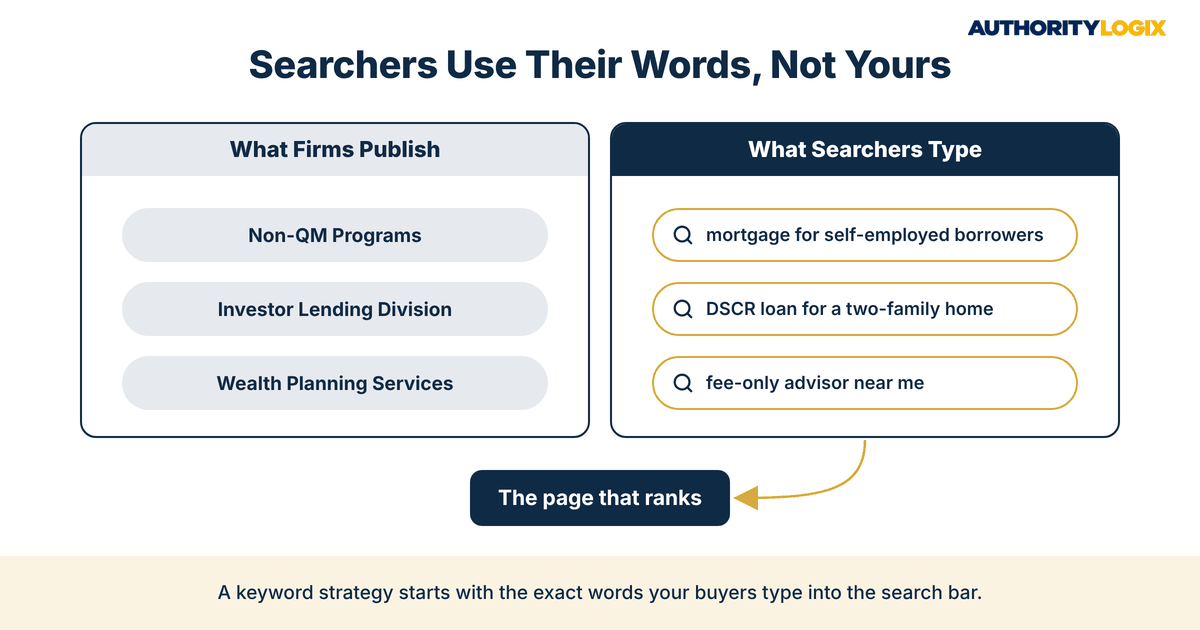
That is the credible but invisible problem in its plainest form. Most firms build their websites around their own vocabulary — product names, internal program labels, and compliance-approved taglines. Borrowers do not search that way. They type “how to qualify for a mortgage with 1099 income” or “DSCR loan for a two-family in Queens,” and they click whoever answers that exact question first. A financial services keyword strategy closes that gap by starting with the searcher’s words and building every page around them.
What a Financial Services Keyword Strategy Actually Includes
A working financial services keyword strategy has four parts: the research that finds the real terms, the intent label on each term, the page assigned to each term, and the internal links that connect those pages. Skip any one of them and the other three underperform. The search foundation behind all four parts is laid out in the SEO playbook, which covers site structure before a single keyword gets assigned to a page.
The strategy also has to fit the business lines a firm actually runs. A mortgage company, a DSCR lender, and a fee-only advisory practice each attract a different searcher with different questions, and the AuthorityLogix financial services hub is organized around those distinct buyers for exactly that reason. The keyword list follows the buyer, never the other way around.
Keyword research feeds every layer of a publishing system. The Financial Services Content System shows how a financial services keyword strategy becomes pages, posts, and links that work together.
Mortgage Keyword Research 2026: What Has Changed for Lenders
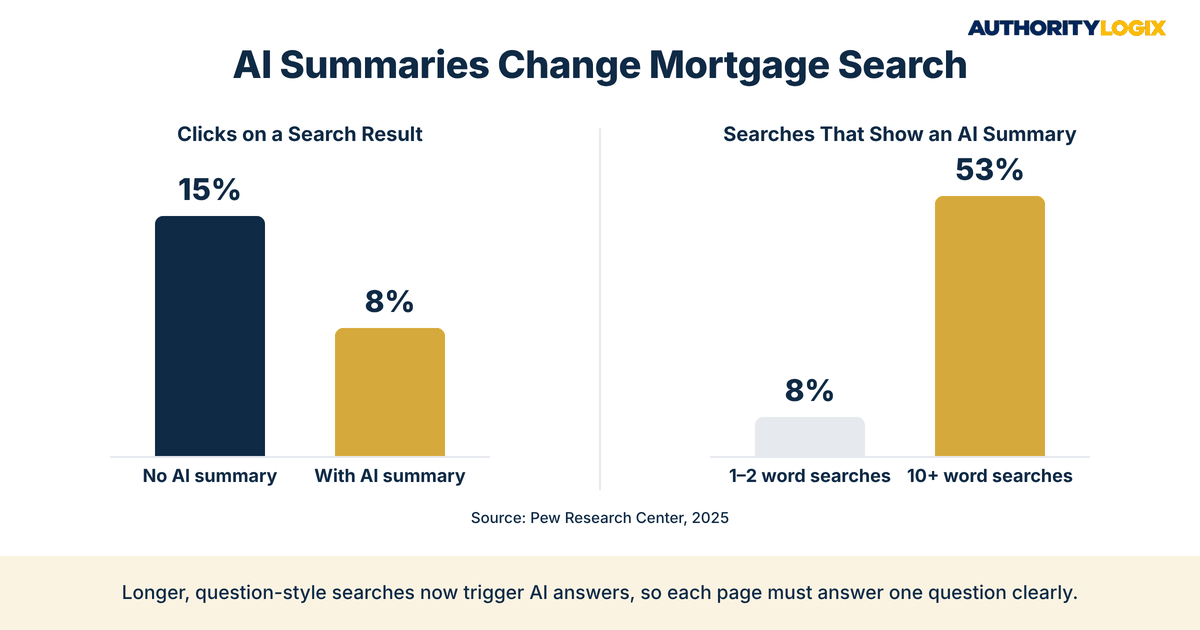
Mortgage keyword research 2026 looks different from the keyword lists most lenders built five years ago. Searches are longer, more conversational, and more likely to be answered on the results page itself. Pew Research Center tracked real browsing behavior in 2025 and found that only 8% of one- or two-word Google searches produced an AI summary, compared with 53% of searches ten words or longer and 60% of searches phrased as questions.
The click cost of that shift is real. In the same Pew study, users clicked a traditional search result in 8% of visits when an AI summary appeared, versus 15% of visits without one, and they ended their browsing session more often after reading a summary. Google’s John Mueller added another wrinkle at Search Central Live in 2025, noting that roughly 15% of the queries Google sees each day are brand new — so no keyword tool will ever show you the complete list.
How a Financial Services Keyword Strategy Adapts to AI Answers
The practical answer for any financial services keyword strategy is depth over volume. A firm that publishes one thin page per broad term loses to a firm that builds topic clusters around pillar pages, each supported by articles that answer the long, specific questions searchers now type. Google and AI tools both favor the site that covers a subject completely, because that site is the safest source to show or cite.
This is where the structure of the site matters as much as the words on it. An organized educational hub groups every answer by topic, so a borrower who lands on one question finds the next three without going back to Google. For mortgage keyword research 2026, the goal is no longer a single ranking — it is owning the whole cluster of questions around a loan type, a market, or a borrower situation.
Advisor Keyword Targeting by Intent Stage
Advisor keyword targeting is where a financial services keyword strategy gets specific to wealth firms, and it starts with one question: what does this searcher want right now? Semrush groups search intent into four types — informational, navigational, commercial, and transactional — and each type calls for a different kind of page. A prospect typing “what does a fiduciary advisor do” is still learning, while a prospect typing “fee-only financial advisor near me” is already choosing.
The intent split matters even more for advisors, because a referral rarely replaces the search. Wealthtender’s 2025 study of 500 households earning $100,000 or more found that 96% would research an advisor online even after a referral, 83% want to check reviews or awards, and 72% would visit the advisor’s website. Nearly half of those households — 49.8% — plan to use search engines such as Google or Bing in their search.
The answer layer is moving as well. According to the 2025 AI Overviews study published on the Semrush blog, the share of AI Overview queries that were informational fell from 91.3% in January 2025 to 57.1% by October, while commercial queries rose to 18.57% and transactional queries to 13.94%. AI answers are no longer limited to definitions — they now appear where buyers compare options and decide.
Wealthtender also found that 25.4% of those households plan to use AI tools such as ChatGPT or Gemini when searching for an advisor, which makes AI search visibility part of advisor keyword targeting rather than a separate project. The pages that get cited are the ones that answer one question clearly, show the advisor’s credentials, and point to deeper material.
The Four Intent Stages Every Financial Services Keyword Strategy Should Label
- Informational — questions and definitions, answered by guides and educational articles.
- Navigational — searches for your firm or your name, answered by a strong homepage, about page, and review profile.
- Commercial — comparisons and “best” searches, answered by comparison pages and program pages.
- Transactional — ready-to-act searches, answered by contact, application, and booking pages.
Assigning intent is what turns a keyword list into a publishing plan. When every term carries a stage label, the content systems behind the site know which format to produce, which page each piece belongs on, and which next step to offer the reader. Without the label, firms publish whatever feels timely and wonder why nothing connects.
Not sure which searches your firm is missing? The FS Authority Gap Assessment shows where your financial services keyword strategy has gaps and which pages to build first.
Lender Search Term Strategy Mapped to Real Pages
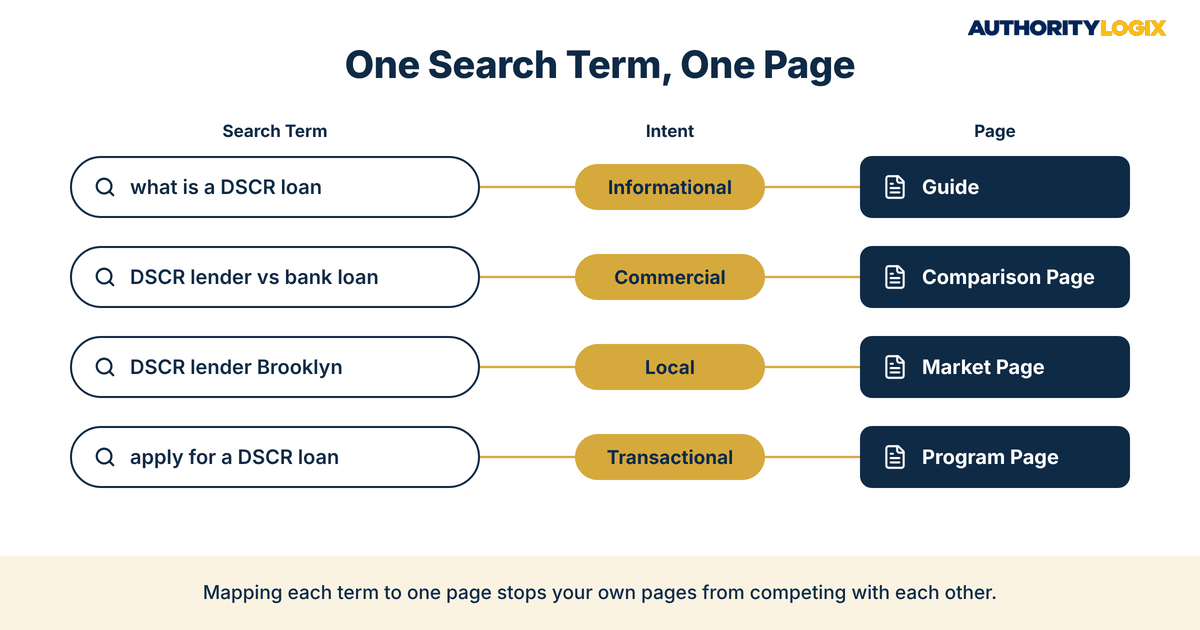
A lender search term strategy breaks down the moment two pages chase the same phrase. When a DSCR program page, a blog post, and the homepage all target “DSCR loan,” Google has to guess which page matters, and it often ranks none of them well. Inside a financial services keyword strategy, the fix is a keyword map: one primary term per page, with supporting terms assigned to the articles that feed it.
| Search Term | Intent Stage | Page That Should Rank |
|---|---|---|
| “what is a DSCR loan” | Informational | Educational guide inside the DSCR topic cluster |
| “DSCR loan requirements” | Informational | Requirements article linked to the program page |
| “DSCR lender vs bank loan” | Commercial | Comparison page |
| “DSCR lender Brooklyn” | Commercial, local | Market page plus Google Business Profile |
| “apply for a DSCR loan” | Transactional | Program page with a clear application path |
| “[firm name] reviews” | Navigational | Review profile and about page |
Each row in that map is a claim the firm has to back up. Search engines weigh trust heavily on financial topics, so the page that ranks for a lender search term strategy query also has to show who wrote it, what experience stands behind it, and why the reader should believe it. The trust signals covered in the authority guide — credentials, reviews, and real author bylines — are what let a mapped page hold its position.
Writing those pages is specialized work. A program page needs plain-language answers that stay inside compliance lines while still matching the exact phrase a borrower typed, which is the job of dedicated finance content rather than generic copywriting. Every page in the map gets written to its term, its intent stage, and its reader.
BKDSCR.com, the AuthorityLogix proof-of-concept in the NYC outer-borough DSCR niche, was built on a financial services keyword strategy of exactly this kind. Its 18 pillar pages and 48 blog posts each target a distinct set of investor searches, and the platform ranks for competitive DSCR and NYC real estate terms with zero paid ads. The map came first, and the writing followed it.
Keep the map in one shared document that lists every term, its intent stage, its assigned page, and the date the page was last reviewed. When a new topic idea comes up, check the map before anyone starts writing — if the term already belongs to a page, the new piece either supports that page or gets dropped. That single check prevents most of the overlap that quietly drags rankings down on financial sites.
Turning Keyword Rankings Into Qualified Inquiries
Rankings only matter if the right people click and then take a next step. A financial services keyword strategy that targets nothing but high-volume informational terms can produce plenty of visits and very few conversations. The better test is whether each ranking page moves the reader one stage closer to contacting you.
That means every informational page carries a path forward — a calculator, a checklist, a related program page, or a consultation offer that fits the question just answered. Under a connected lead system, each ranking page becomes an entry point into a sequence rather than a standalone article. A borrower reading about rental income qualification should see the next logical page before thinking about returning to Google.
Why Distribution Strengthens the Keyword Plan
New pages on a young domain rarely rank for competitive terms on their own. Syndicated articles, earned mentions, and consistent profiles across the web give search engines and AI tools outside evidence that a firm is a real authority on the topics its financial services keyword strategy targets. That outside layer is what authority distribution adds, and it is often the difference between a page stuck on page three and a page that reaches the first screen.
Measure the result by inquiries, not visits. Track which pages produce calls, form fills, and booked consultations, then expand the clusters that convert and prune the ones that only attract browsers. A financial services keyword strategy gets sharper every quarter it is measured this way, because each review shows which buyer questions actually turn into conversations.
Financial Services Keyword Strategy Mistakes Firms Keep Making
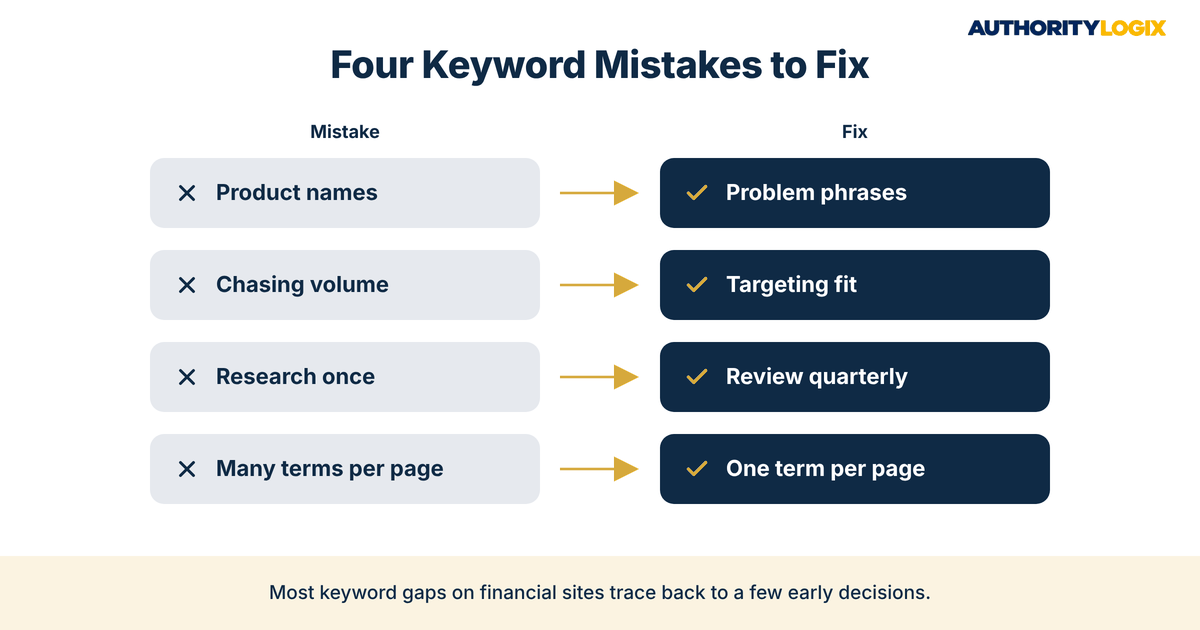
Most financial services keyword strategy problems on lender and advisor sites trace back to a handful of early decisions. Each one is fixable, but only after someone names it. These are the mistakes and questions that come up most often when firms review their own search footprint.
Mistake: Targeting the product name instead of the problem
Firms target “non-QM loans” because that is what the product is called internally. Borrowers search “mortgage for self-employed with bank statements” instead. The firm that writes for the second phrase earns the inquiry, and the lead generation pipeline behind it fills with people who have already described their own situation.
Mistake: Chasing volume over fit
A broad national term is rarely worth more than a narrow term searched by investors in your exact market. Specific searches signal that the searcher has already narrowed the field, which is why a financial services keyword strategy built on fit usually produces fewer visits and more conversations. Pew’s finding that long queries trigger AI summaries most often also means those specific pages need to be the clearest answer available anywhere.
Mistake: Doing keyword research once
Search behavior keeps moving — Google’s own estimate is that about 15% of daily queries are new — so a financial services keyword strategy built three years ago is already missing terms. Firms that review rankings and search terms every quarter catch new questions early. That review is part of what we do at the start of every engagement and on a set schedule after launch.
Question: How many keywords should one page target in a financial services keyword strategy?
One primary term and a small group of close variations. A page built around one clear question can rank for many related phrasings, but a page built around five unrelated terms tends to rank well for none of them. The page-by-page sequence that follows from that rule is part of how we build every client site.
Question: Can a small firm compete with national lenders and robo-advisors?
On specific and local terms, yes. National brands win broad head terms, but they rarely publish the market-level and situation-level pages that a focused firm can own. Depth in a narrow niche is the most dependable route for a smaller firm to earn visibility against a bigger one.
Ready to target the searches that bring in clients, not just traffic? We’ll map the keywords and build the pages that win them.
Financial Services Keyword Strategy: Target What Buyers Search, Not What You Call It
A financial services keyword strategy is not a list sitting in a spreadsheet. It is the plan that decides which pages exist, what each one says, and how they connect, which is why the growth playbook treats search research as the starting point for long-term growth rather than a one-time project. Every piece has a job. Every piece feeds the next.
None of this requires gimmicks or promises about rankings. It requires knowing your buyers, writing to their real questions, and building pages in the right order — the same approach behind BKDSCR.com, and the reason the method is documented under why it works.
The honest assessment is that most lenders and advisors already know their buyers better than any keyword tool does. What is missing is the infrastructure that turns that knowledge into a financial services keyword strategy and a set of pages the market can find. If your firm is ready to build it, work with us is the place to start that conversation.