


Key Takeaways
- The mortgage company platform vs presence distinction comes down to one question: does your digital footprint produce borrower conversations when nobody on your team is touching it.
- A presence confirms you exist after someone else vouches for you. A platform is connected infrastructure that answers borrower questions, earns rankings, and generates inbound leads.
- J.D. Power’s 2025 U.S. Mortgage Origination Satisfaction Study found satisfaction runs 32 points higher when lenders reach borrowers before they start actively shopping — a stage only a platform reaches.
- BrightLocal’s 2026 Local Consumer Review Survey found 74% of consumers look for reviews written in the last three months, so a static listing reads as a stale firm — one of the clearest mortgage company platform vs presence signals.
- Ahrefs found 96.55% of pages get zero traffic from Google. Publishing without architecture is how most lender websites end up on the presence side of the mortgage company platform vs presence divide.
- Closing the mortgage company platform vs presence gap is a system build. No single page, post, or ad campaign closes it on its own.
Table of Contents

Mortgage Company Platform vs Presence: The Core Difference
The mortgage company platform vs presence question sounds like semantics until you look at where your last 20 borrowers actually came from. If most of them arrived through a realtor, a past client, or a builder relationship, your website is a presence — it confirms you exist after someone else has already vouched for you. Most experienced loan officers and lender principals sit inside that exact credibility gap, with strong reputations inside their network and almost no visibility outside it.
A presence is passive. It holds your logo, your NMLS number, a rate-quote form, and an About page that nobody outside your referral circle will ever find. A platform is active infrastructure: loan program pages built around real searches, an educational library that answers borrower questions before they call, reputation systems that stay current, and distribution that puts your expertise in front of people who have never heard your name. That is the mortgage company platform vs presence divide in short form — one waits to be discovered, the other is built to be found.
Here is how the mortgage company platform vs presence comparison looks across the six areas borrowers actually touch. Use it as a quick self-audit before reading further.
| Area | Presence | Platform |
|---|---|---|
| How borrowers find you | Only after a referral or a brand-name search | Through question searches, AI answers, and third-party mentions |
| What the site publishes | Static product pages and an About page | Program pages plus an organized educational library |
| Reviews and reputation | Claimed listing, sporadic reviews | Managed profile with recent, answered reviews |
| Off-site authority | Nothing beyond a few social profiles | Syndication, consistent citations, earned placements |
| Lead capture | One contact form | Guides, calculators, and follow-up sequences |
| When you stop working on it | Nothing changes, because nothing was producing | Existing pages keep earning visibility |
Search is where the divide shows up first, which is why the SEO playbook treats rankings as an output of infrastructure rather than a goal by itself. A lender with a presence ranks for its own brand name and little else. A lender with a platform ranks for the questions borrowers type in the months before they apply.
Credible but invisible is the condition most mortgage companies are in, and it is not a talent problem. The pattern holds across the lenders, DSCR specialists, and advisory firms covered on our services hub: 10, 15, or 20 years of experience paired with a website that has not produced a single unreferred inquiry in months. The expertise is real. The infrastructure to make the market see it is what is missing.
The Financial Services Authority Guide covers how lenders and advisors turn credibility they have already earned into trust signals the market can actually see.
What a Lender Digital Authority Platform Includes
A lender digital authority platform is not a bigger website. It is a set of connected components where each one does a specific job, and the site structure determines whether those components reinforce each other or sit in isolation. Get the architecture wrong and even strong pages compete with each other instead of building topical depth.
The Five Layers Behind Every Mortgage Company Platform vs Presence Comparison
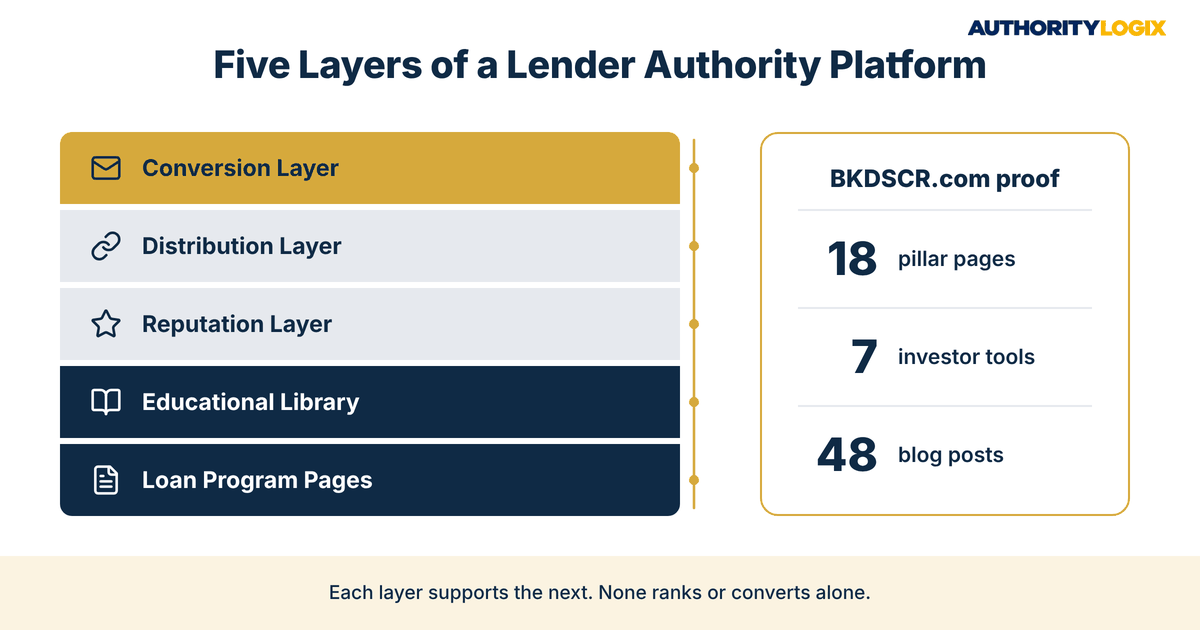
Every platform we audit or build comes down to the same five layers. A presence usually has one of them, sometimes two.
- Loan program pages — one per product, built around the searches borrowers actually run.
- Educational library — answers to the questions borrowers ask before they know which loan fits.
- Reputation layer — a managed Google Business Profile and a steady flow of recent reviews.
- Distribution layer — syndication and placements that carry your expertise beyond your own domain.
- Conversion layer — tools, guides, and forms that turn a reader into a conversation.
None of these layers works alone, and that is the part most lenders miss when they weigh mortgage company platform vs presence options. A rate page with no educational support has nothing to rank on, and an educational library with no conversion layer produces readers instead of borrowers. Building the layers together is what our content systems are designed to do, with every page assigned to a stage of the borrower journey.
BKDSCR.com, the AuthorityLogix proof-of-concept in the NYC outer-borough DSCR niche, is a working example of the mortgage company platform vs presence difference. It runs on 18 pillar pages, 7 interactive investor tools, and 48 SEO-optimized blog posts, built in under 18 months with zero paid ads. None of those pieces would rank on its own — the connected architecture is what lets them compound.
Mortgage Brand Authority Building Beyond the Website
Mortgage brand authority building happens mostly off your own domain. Borrowers validate a lender in Google results, review sites, AI-generated answers, and industry publications, and a presence offers them nothing to find in any of those places. J.D. Power’s 2025 U.S. Mortgage Origination Satisfaction Study found customer satisfaction is 32 points higher when lenders reach borrowers before they begin actively shopping, and it drops 64 points when the relationship starts at the application stage.
The search environment itself is shifting. HubSpot’s 2026 State of Marketing report, part of its ongoing HubSpot research program, notes that half of consumers now use AI-powered search and half of Google searches include an AI overview. In that environment, a lender that exists only on its own homepage is rarely the source those answers draw from.
This is where authority distribution separates the two sides of the mortgage company platform vs presence comparison. Syndicated articles, earned mentions, and consistent citations create the third-party signals that search engines and AI tools use to decide which mortgage companies deserve visibility. A presence has none of those signals, so it competes on brand searches alone.
Reviews are the other half of the off-site picture. BrightLocal’s 2026 Local Consumer Review Survey found 74% of consumers look for reviews written in the last three months, and 80% are more likely to use a business that replies to all of its reviews. Those signals stay current only when someone owns them, and they work hardest beside finance content that explains your process in plain language, written within the compliance limits your loan programs require.
Consider what a borrower sees when they search a lender’s name after a referral. With a presence, the results show a homepage, a sparse listing, and perhaps a dated social profile. With a platform, the same search returns educational articles, recent reviews with replies, and third-party mentions that confirm the referral was a good one. The mortgage company platform vs presence gap is visible on that single results page.
Not sure where your firm sits on the mortgage company platform vs presence spectrum? The FS Authority Gap Assessment shows which layers exist, which are missing, and what to build first.
Advisor Digital Platform Strategy for Lenders and Advisory Firms
An advisor digital platform strategy follows the same logic as a lender build, with one difference: advisory firms sell judgment, so the platform has to show judgment in public. Financial advisors, DSCR specialists, and mortgage companies all face the same mortgage company platform vs presence choice — keep a brochure site, or build an asset that earns trust before the first meeting.
Timing matters more than most firms expect. Pages built on sound architecture keep earning visibility for years, which is why long-term rankings come from infrastructure decisions made at launch rather than from a burst of posts in one quarter. Ahrefs’ search traffic study of roughly 14 billion pages found 96.55% get zero traffic from Google, most often because of no search demand, no backlinks, or a mismatch with search intent.
A presence publishes a blog. A platform publishes an educational hub — a structured library organized by topic, internally linked, and built around the questions your buyers ask in the weeks before they decide. The hub is what turns individual articles into topical authority, and topical authority is what search engines and AI tools reward.
What Compliance Changes in a Mortgage Company Platform vs Presence Build
Compliance review slows publishing, but it does not prevent a platform. Educational content that explains how a process works, what documents a borrower typically gathers, or how a DSCR ratio is calculated stays inside marketing and education without crossing into individual advice. The firms that build platforms treat compliance as a workflow step, not a reason to stay invisible.
That is the real advisor digital platform strategy lesson for lenders: the constraint is the same for every firm in your market. The ones who build inside it earn the visibility, and the ones who wait for a compliance-free version of the internet stay at presence indefinitely.

Mortgage Company Platform vs Presence: Which One Produces Pipeline
Visibility without a conversion path is a traffic report, not a pipeline. Every platform needs a lead system that turns a reader into a named contact through calculators, guides, consultation requests, and follow-up sequences that respect how long mortgage decisions take. A presence typically offers one contact form and hopes for the best.
J.D. Power’s 2025 data points the same direction: 79% of customers gave lenders top scores for useful guidance, and those customers were 2.3 times more likely to say they would definitely use the same lender again. Guidance delivered before the application, through a structured content system, is how a platform earns that score at scale. It also gives your loan officers better conversations, because borrowers arrive already understanding the basics.
The practical test of mortgage company platform vs presence is attribution. Count how many inquiries in the last 90 days came from someone with no prior relationship to your firm, no referral, and no past loan. If the answer is close to zero, you have a presence, no matter how polished the website looks.
A second test is what happens when your team gets busy. On the presence side of the mortgage company platform vs presence comparison, marketing stops the week loan volume spikes, and nothing published earlier is still working. On the platform side, articles published last year keep answering borrower questions while your loan officers close files. That is the operational difference most principals feel first.
Why Most Lenders Stop at Presence — and What They Get Wrong
Most mortgage companies do not choose to stay at presence. They stop there because the mortgage company platform vs presence gap is easy to underestimate and the early signs of a platform working take months to appear. These are the misreads we see most often.
Is a redesigned website the same as a platform?
No. A redesign changes how the presence looks without changing what it does. If the new site has the same five pages, the same contact form, and no plan for lead generation beyond waiting for referrals to check you out, the mortgage company platform vs presence gap has not moved.
Can we close the gap by posting more on social media?
Posting more adds activity, not infrastructure. Social posts fade from feeds within days, while a platform page can keep earning visibility for years. Sorting the two is a large part of what we do at the start of every engagement: map which assets will still be working a year from now and which will be gone by Friday.
Don’t strong referrals make a platform unnecessary?
Referrals are the clearest evidence that your expertise is real, and the clearest sign of a ceiling. Referred borrowers still search your name before they call, and BrightLocal’s 2026 survey found 31% of consumers will only use businesses rated 4.5 stars or higher. A thin presence adds friction at exactly the moment a referral needs reassurance.
How long does a mortgage company platform vs presence upgrade take to show results?
Longer than an ad campaign, and longer than most firms expect. Foundations come first, then content, then distribution, and each layer needs the one beneath it to perform. That sequence is how we build every platform, because skipping a layer is the most common reason a mortgage company platform vs presence upgrade stalls after six months.

Ready to turn a website into a real platform? We’ll build the connected pages, content, and profiles that make your mortgage company the obvious choice.
The Difference Between a Presence and a Platform
Every mortgage company already has a presence. The firms that pull ahead over the next few years will be the ones that treat their digital footprint as an asset with a build plan, which is the long view the growth playbook takes on how authority accumulates. The mortgage company platform vs presence decision is really a decision about whether your expertise stays private or becomes visible.
There is no shortcut through the layers, and no single tactic replaces them. BKDSCR.com was built in sequence — pillar pages first, then tools, then distribution — and that sequence is the clearest evidence of why it works in a live, competitive lending market. The model is not complicated, but it is unforgiving of skipped steps.
A useful first step is scoring your own firm against the six rows in the mortgage company platform vs presence table above. Most lenders find they sit on the presence side in five of them and hold a partial platform in one, usually reviews. That score is not a judgment of your expertise — it is a map of what still needs to be built.
The honest assessment is this: most mortgage companies in your market already have the experience, the loan knowledge, and the borrower relationships to own their niche. What they lack is the infrastructure that makes the market see it. If you want to map what that build looks like for your firm, start with our work with us page.