


Key Takeaways
- A real estate competitive authority analysis measures what the market sees online — content, rankings, links and reviews — not what you know.
- NAR’s 2025 Profile of Home Buyers and Sellers found that 88% of all home buyers used an agent or broker, so the contest is over which agent gets found first.
- Semrush’s competitor analysis guide recommends starting with around three to five competitors.
- Google says local results are mainly based on relevance, distance and popularity, and that more reviews and positive ratings can help local ranking.
- BrightLocal’s 2026 survey found 74% of consumers seek reviews written in the last three months.
- A real estate competitive authority analysis earns its keep only when it ends in a build order.
Table of Contents

What a Real Estate Competitive Authority Analysis Measures That a CMA Never Will
A real estate competitive authority analysis is the step most firms skip before they spend a dollar on content or a website rebuild. You know how to price a listing against comps and tell a seller what the block will bear. What you have probably never measured is how your firm compares to the competitors who appear when someone searches your market — the visibility question the local SEO playbook answers for the map pack.
A comparative market analysis tells you what a property is worth. A real estate competitive authority analysis tells you what your firm is worth to Google and to a stranger who has never heard your name. Both use the same discipline — gather comparable data, adjust for differences, reach a number you can defend — but they point at different assets.
This is the credible but invisible problem in measurable form. NAR’s 2025 Profile of Home Buyers and Sellers found that 88% of all home buyers used an agent or broker, and 91% of sellers used an agent. Nearly everyone hires a professional, so the question is which agent the market finds and trusts before the first call.
The Four Layers a Real Estate Competitive Authority Analysis Scores
A real estate competitive authority analysis scores four layers of visibility side by side for you and each competitor. Content depth covers how many useful, specific pages a firm has published about its market. Search position covers where each firm ranks for the queries that bring in business. Link and mention strength covers who else on the web points to the firm. Review signals cover volume, recency and replies.
None of those layers appears in a listing presentation, and all of them shape who gets the call. Our work across the real estate industry starts with a real estate competitive authority analysis for that reason: you cannot plan a build until you know what the firms ahead of you have built.
A real estate competitive authority analysis also exposes a pattern most owners suspect. The firm with the most closings is rarely the most visible, because closings happen offline and search rewards what is published. Firms that close that gap do it with content systems that turn existing expertise into pages, not with a bigger ad budget.
The Real Estate Authority Guide lays out the full authority framework a real estate competitive authority analysis measures you against — content, credibility signals and distribution working as one system.
How to Start a Broker Competitor Content Audit Without Paid Tools
A broker competitor content audit begins with a short list, not a spreadsheet of every brokerage in the county. Semrush’s expert-reviewed competitor analysis guide recommends analyzing around three to five competitors to start with (Semrush, May 2026). Five firms studied properly teach more than twenty skimmed.
Choose those competitors by search, not by reputation. The broker you lose listings to may be invisible online, while a newer team owns every query in your market. Run the searches your clients run — a neighborhood plus “real estate agent,” “sell my house” plus your town — and write down the names that keep coming back.
What to Record in a Broker Competitor Content Audit
Open each competitor’s website and click through every menu. Record these items:
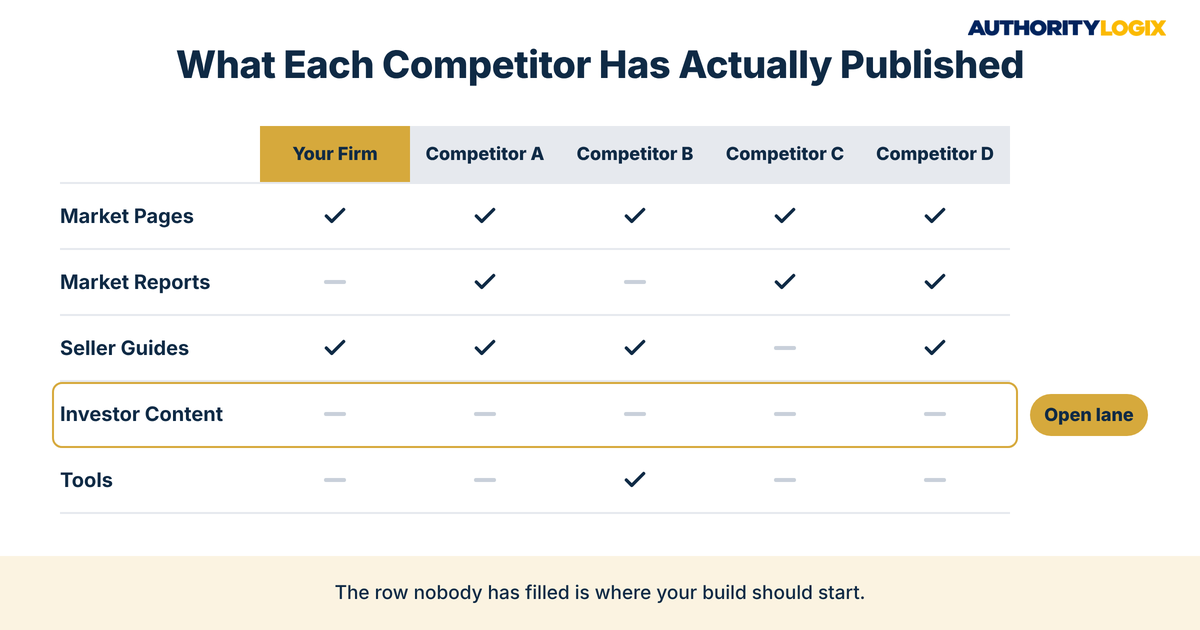
- Neighborhood or market pages, and whether each one says something only a local would know
- Market reports or monthly updates, with the date of the most recent one
- Buyer, seller and investor guides, and how deep each one goes
- Calculators, checklists or other tools that give visitors a reason to return
- Agent bio pages with real credentials and transaction detail
- A clear next step on each page — a form, a call path or a download
Score what you find honestly. A competitor with forty thin pages that swap the town name has less authority than one with eight pages written by someone who knows the streets. Note dates too, because a market report that stopped two years ago tells readers the firm stopped paying attention.
Watch what happens after the read. Most competitor sites stop at a contact form, which is the gap a connected lead generation system is built to close: content that answers a question, an offer that matches it and a follow-up path. Note which competitors have that path and which simply hope for a call.
Investor-facing material deserves its own column in a broker competitor content audit. Many brokerages publish buyer and seller guides but almost nothing for the landlord comparing rents across two neighborhoods, and well-built investor content is often the least contested ground in a market. If none of your competitors publishes it, your real estate competitive authority analysis has already found its first open lane.
Running an Agent Competitive SEO Analysis on Your Top Market Searches
An agent competitive SEO analysis moves from what competitors have published to where it ranks. Start with the searches that bring business in your market: neighborhood searches, seller questions, investor questions and the competing firms’ names. Keep that list beside the content audit inside one real estate competitive authority analysis.
Google is direct about local results. Its Business Profile help page says local results are mainly based on relevance, distance and popularity, and that prominence also depends on how many websites link to a business and how many reviews it has. Google adds that there is no way to pay for a better local ranking, so every position on your list was earned.
Three Result Types to Track in an Agent Competitive SEO Analysis
For each search, record three things: who appears in the map pack, who ranks in the organic results below it and whether a national portal sits above both. Search from inside your market in a private window, since distance shapes local results. Repeat the check monthly to track direction.
A real estate competitive authority analysis surfaces patterns quickly. One competitor may hold the map pack on reviews while ranking nowhere organically, and another may own educational queries with no map listing. The firm that holds both layers has a genuine competitive moat, usually built on the deepest content library rather than the biggest budget.
Educational queries deserve special attention in an agent competitive SEO analysis. Searches such as “what does a seller pay at closing” happen before a client picks an agent, and the firm with an educational hub answering them earns familiarity before the competition knows a prospect exists. Record which competitor answers each one.
Your own data belongs here too. Google Search Console’s Performance report shows clicks, impressions, click-through rate and average position for your site, and it can group that data by the search query users typed. Line those queries up against the competitor list to see where you sit near page one and where you are absent.
Not sure where your firm stands against the competitors who own your market’s searches? The RE Authority Gap Assessment benchmarks your content, rankings and reviews and shows which gaps to close first.
Real Estate Authority Benchmarking: Scoring Content, Links and Reviews
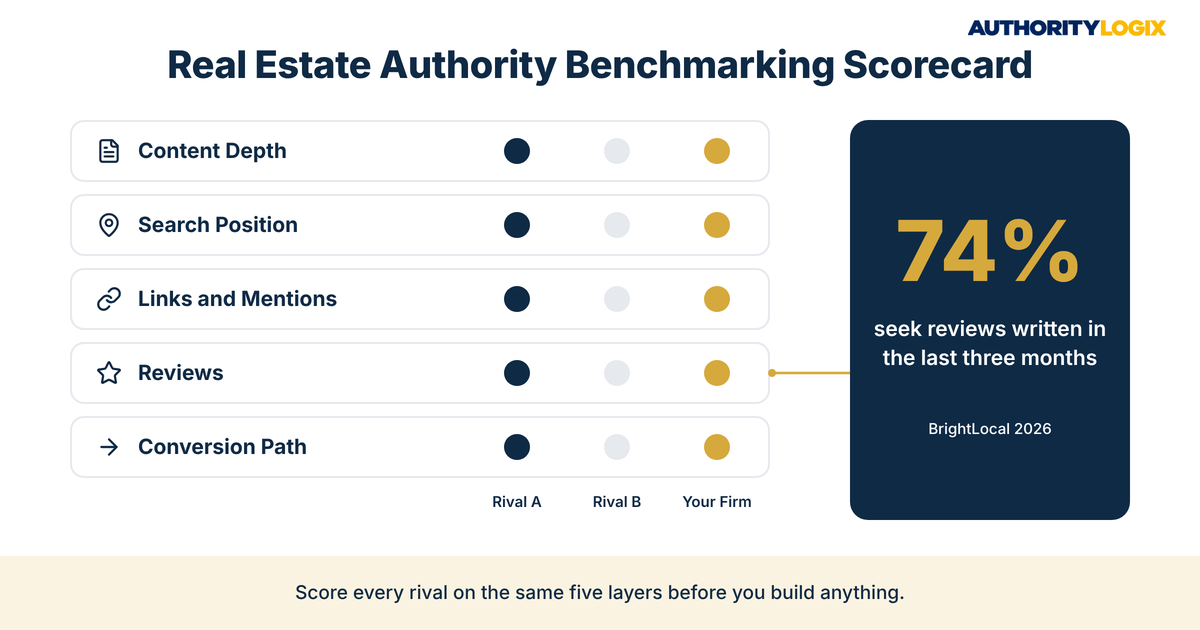
Real estate authority benchmarking turns your notes into a score you can compare across firms. Rate each competitor on each layer using one simple scale, then rate yourself just as honestly. The scorecard below is the core of a real estate competitive authority analysis.
| Layer | What to Measure | What a Strong Competitor Shows | Where an Open Lane Hides |
|---|---|---|---|
| Content depth | Market pages, guides, reports, tools | Specific local pages updated this year | Topics no rival has covered |
| Search position | Map pack and organic rank | Map pack plus page-one organic | Educational queries with weak answers |
| Links and mentions | Local media, associations, partners | Regular local and trade mentions | Outlets no rival uses |
| Reviews | Volume, recency, owner replies | Recent reviews with replies | Rivals with old or unanswered reviews |
| Conversion path | Offers and next steps | An offer matched to each page | Sites ending at a generic form |
Reviews are the easiest layer of a real estate competitive authority analysis to measure. BrightLocal’s Local Consumer Review Survey 2026, drawn from a panel of 1,002 US adults, found that 74% of consumers seek reviews written in the last three months and 47% won’t use a business with fewer than 20 reviews.
Weighting the Real Estate Competitive Authority Analysis Scorecard
The conversion row is where real estate authority benchmarking connects to revenue. Visibility that ends at a generic form leaks prospects, and the strongest competitors usually pair content with lead generation infrastructure that matches the offer to the question the reader arrived with. Score that row as carefully as the rankings.
Weighting depends on your timeline. A firm planning a two-year build should weight content depth, because it compounds, while a firm that needs listings this quarter may weight reviews first. Either way, the real estate competitive authority analysis score feeds a content system that decides what gets published, in what order and for which audience.
Links and mentions are the layer firms neglect most in a real estate competitive authority analysis. Google ties prominence partly to how many websites link to a business, and a competitor quoted in local news and trade outlets carries signals a website alone cannot. That outside presence comes from deliberate authority distribution, not from waiting for a reporter to call.
Turning a Real Estate Competitive Authority Analysis Into a Build Order
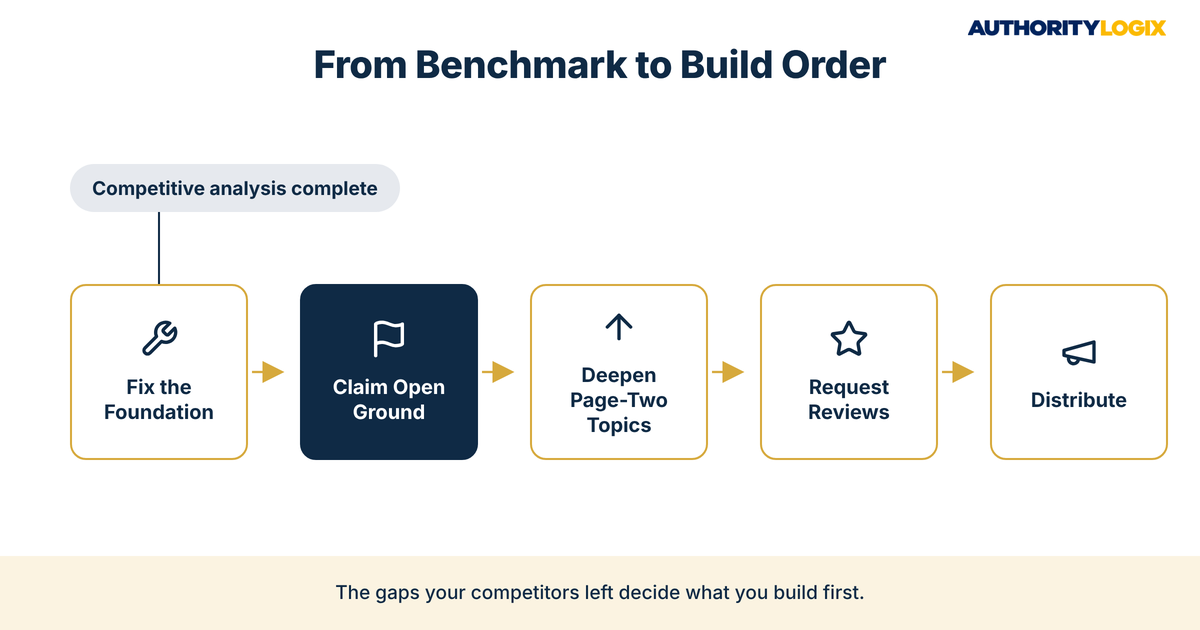
A real estate competitive authority analysis that ends in a binder changes nothing. The point is a build order — a ranked list of what to create, fix and distribute, set by where the gaps are widest and the competition is thinnest. Most firms find the order looks something like this:
- Fix what is broken first: an incomplete Business Profile, inconsistent firm details, pages with no next step
- Claim uncontested ground next: the content type none of your competitors publishes well
- Build depth where you already rank on page two, since those positions are closest to moving
- Start a steady review request process tied to every closing
- Add distribution once there is content worth citing
The sequence matters because each step feeds the next. Content built before the Business Profile is fixed sends visitors to a listing that undercuts it, and distribution built before the content exists has nothing to point to. The guides in our resource library are organized around the same progression, from getting found to growing the business.
Expect the national portals to appear on almost every query list. You will not outrank them on listing searches, and an honest real estate competitive authority analysis should say so plainly. The open lanes sit where portals stay generic — neighborhood knowledge, investor questions, local process — and the case for that approach is laid out in the guide to portal competition for local firms.
BKDSCR.com, the AuthorityLogix proof-of-concept in the NYC outer-borough DSCR niche, was built from exactly this kind of map. Its 18 pillar pages, 7 interactive investor tools and 48 SEO-optimized blog posts target the searches outer-borough investors run, and it generates inbound leads with zero paid ads. The build order came first, and the pages followed it.
What Firms Get Wrong When They Study Competitors
Most firms that attempt a real estate competitive authority analysis do it once, informally, and draw the wrong conclusions. The mistakes below come up most often, and each one undercuts the longer plan in the growth playbook because it aims the build at the wrong target.
Should we copy what the top-ranked competitor is doing?
Copying gives you a second-place version of someone else’s library. A real estate competitive authority analysis is meant to find what the leader has not built, because that is where a smaller firm can rank first.
Is the firm that wins the most listings our real competitor online?
Often it is not. According to NAR’s 2025 Profile of Home Buyers and Sellers, 66% of sellers found their agent through a referral or used an agent they had worked with before, so the listing leader may run almost entirely on relationships. Your search competitors are the firms that appear when someone outside those relationships starts looking.
Can we run the analysis once and be done?
Markets shift every season. A competitor who launches a neighborhood series or a review push can change the results in a few months, so repeat the real estate competitive authority analysis on a regular schedule and track direction rather than a single score.
Who should run a real estate competitive authority analysis?
The owner should set the competitor list and judge content quality, because nobody else knows the market as well. The repeat work — searches, scoring and turning gaps into a publishing plan — is part of what we do for firms that have the expertise but not the hours. Either way, the judgment stays with the person who knows the streets.
Ready to turn your competitive benchmark into the content, reviews and distribution that take the open lane in your market? Let’s build the authority your rivals left unclaimed.
The Honest Outcome: Most Markets Have an Open Lane
Run a real estate competitive authority analysis in almost any market and a similar picture appears. A few firms are visible, most are not, and even the visible ones leave whole categories of questions unanswered. The lane is open only to a firm willing to build into it.
A real estate competitive authority analysis starts a sequence, not a campaign. Benchmark first, fix the foundation, claim uncontested content and then distribute — the same order behind how we build authority platforms for real estate firms. Each finished piece keeps working after it is published.
The proof sits in a live market rather than a pitch deck, which is the honest case for why AuthorityLogix treats visibility as infrastructure. BKDSCR.com was built in under 18 months with AuthorityLogix’s own time and money, in a live, competitive DSCR market.
The honest answer is that most real estate firms already have the expertise their market is searching for. A real estate competitive authority analysis shows exactly where that expertise is missing from the screen, and what to build first so the market finally sees it.