


Key Takeaways
- The compliance concern that stops most mortgage companies from publishing content is legitimate — Regulation Z, Regulation N (MAP Rule), RESPA Section 8, UDAAP, and Fair Housing Act rules all apply to mortgage marketing. But the compliance problem is not a reason to stop publishing. It is a reason to build a content system with compliance embedded at the workflow level rather than applied inconsistently after the fact.
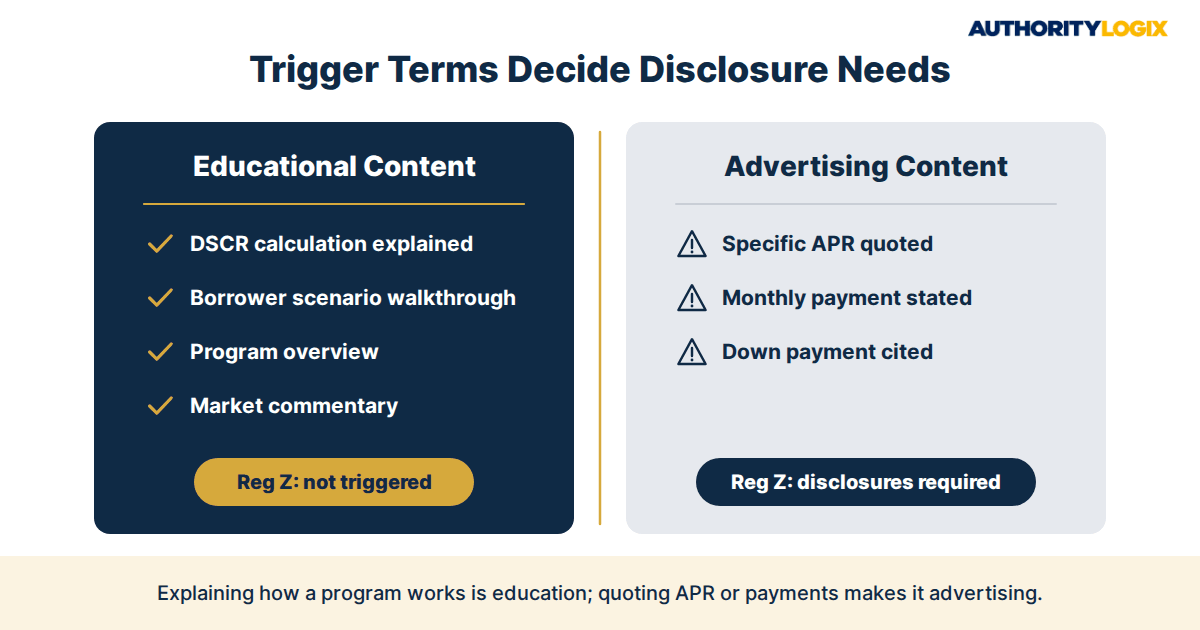
- The distinction between educational content and advertising content is the operational dividing line in mortgage content compliance. Educational content — scenario explanations, program overviews, market commentary, borrower guides — does not trigger the same disclosure requirements as advertised loan terms. Most mortgage companies conflate the two and either over-disclose on every piece of content or avoid publishing altogether.
- Regulation Z’s advertising trigger terms — specific mention of APR, monthly payment, down payment, or loan amount — are what require additional disclosures. An article that explains how DSCR is calculated without quoting specific rates, payments, or APR does not trigger Regulation Z advertising disclosure requirements.
- NMLS ID disclosure requirements and Equal Housing Lender/Opportunity logo requirements apply across most mortgage marketing content — these are non-negotiable and should be built into every content template as default elements, not added case-by-case.
- A compliance-aware mortgage content system has three non-negotiable layers: a pre-publication approval workflow, a content template library with compliance elements pre-embedded, and an audit trail that documents review for every published piece. Without all three, compliance is inconsistent — and inconsistency is where CFPB and state regulatory exposure lives.
- The mortgage companies publishing the most effective educational content in 2026 have solved the compliance problem by shifting from case-by-case compliance review to system-level compliance design. Every piece of content starts from a template built for compliance. The review catches edge cases, not fundamentals.
Table of Contents

Mortgage content compliance system is the operational answer to the question most mortgage companies cannot answer clearly. What are we actually allowed to publish, and how do we make sure every piece of content is reviewed before it goes live? The regulatory environment for mortgage marketing content is genuinely complex. Regulation Z, Regulation N (the MAP Rule), RESPA Section 8, UDAAP, the Fair Housing Act, and state-level disclosure requirements all carry real enforcement risk. But complexity is not the same as impossibility. The companies that have solved this problem have not solved it by consulting legal counsel on every blog post.
They have solved it by building a content system where compliance requirements are embedded at the workflow level. In the templates, the classification process, and the approval workflow — rather than applied inconsistently after content is already written. The SEO playbook for financial services firms identifies educational content as the primary organic traffic driver. The compliance system is what makes that content publishable at scale without legal exposure.
The CFPB’s compliance resources are the authoritative source for mortgage marketing requirements — and reading them carefully reveals something the compliance-averse mortgage company typically misses: the regulatory concern is with advertising that is misleading, deceptive, or omits required disclosures. Educational content that explains how mortgage programs work, describes borrower scenarios, or provides market context does not carry the same risk profile as advertised loan terms with specific rates, payment amounts, and APR. Understanding that distinction is the first step in a functional mortgage content compliance system.
The authority guide covers why published expertise is the primary trust-building mechanism for mortgage companies competing for borrower and broker attention. This article covers the compliance infrastructure that makes that publishing possible — the classification framework that distinguishes educational from advertising content, the template system that embeds compliance elements by default, and the approval workflow that makes review fast enough to support a consistent publishing cadence.
The complete publishing framework — compliance-aware content architecture, topic clustering, and distribution — is in the Financial Services Content System.
Why Compliance Stops Most Mortgage Companies From Publishing — and Why That Is the Wrong Response
The most common compliance response in mortgage content marketing is avoidance: publish nothing that might require review, or publish only content so generic that it carries no regulatory risk and therefore no competitive value. Both responses produce the same outcome — a mortgage company that is invisible online, ceding the organic search and authority-building opportunity to competitors who have solved the compliance problem. The FS industry hub covers the economic cost of digital invisibility for financial services firms; for mortgage specifically, a lender with no published content has no organic search presence, no educational authority, and no mechanism to reach borrowers or brokers before a competitor does.
Avoidance is also a misreading of the regulatory environment. The CFPB, FTC, and state regulators focus enforcement on content that is misleading, makes specific false claims about loan terms, uses trigger terms without required disclosures, or violates fair lending rules. A mortgage company that publishes an educational article explaining how DSCR loan coverage ratios are calculated. Without quoting specific rates, payment amounts, or APR — is not producing the type of content that generates regulatory enforcement actions.
It is producing the type of content that builds borrower and broker trust. The credibility gap between mortgage companies that publish and those that don’t is real and widening. The publishing companies are building Google authority, AI citation eligibility, and broker mindshare that the non-publishers cannot recover without building their own content infrastructure.
The Compliance Framework Every Mortgage Content System Must Address
A mortgage content compliance system must address five regulatory frameworks. Each has a different risk profile and a different set of content requirements. Understanding which frameworks apply to which types of content is the foundation of a functional system — and the knowledge that most mortgage companies are missing when they default to avoidance. The search statistics on mortgage borrower behavior show that the content borrowers find most useful — scenario walkthroughs, program explainers, qualification guides — is exactly the content that carries the lowest regulatory risk when structured correctly.
| Regulation | What It Governs | Content Risk Level | Key Requirement |
|---|---|---|---|
| Regulation Z (TILA) | Advertising accuracy; disclosure of credit terms | High if trigger terms present; low for educational content | If trigger terms (APR, payment, rate, down payment) appear, full disclosures required |
| Regulation N (MAP Rule) | Prohibits misleading mortgage advertising claims | Moderate — applies when claims about program features are made | No misleading comparisons, false claims, or misrepresentations about loan terms |
| RESPA Section 8 | Anti-kickback rules; co-marketing restrictions | High for co-marketing; low for independent educational content | No referral fees or marketing arrangements that constitute kickbacks |
| UDAAP | Unfair, deceptive, or abusive acts and practices | Moderate — applies to any claim that could be misleading | All claims accurate; no omissions that create false impressions |
| Fair Housing Act / ECOA | Non-discrimination in advertising and lending | Applies to all content — no targeting or exclusions based on protected class | Equal Housing Lender/Opportunity logo required; no discriminatory language or targeting |
| NMLS Requirements | Identifier disclosure in advertising materials | Applies to marketing content — company and LO NMLS IDs required | NMLS ID displayed clearly and conspicuously on all advertising materials |
The content systems that support compliant mortgage publishing treat each of these frameworks not as individual checklists to complete for each piece of content, but as design parameters that shape every content template from the start. NMLS IDs and Equal Housing logos are embedded in every template by default. Trigger term guardrails are built into the writing guidelines so authors know to avoid specific rate, payment, and APR quotes in educational content. UDAAP review focuses on whether any claim could be misread as misleading — a fast review when the templates are already structurally sound.
What Compliant Mortgage Content Actually Looks Like
Compliant mortgage content is not watered-down, hedge-everything, say-nothing content. The most effective compliant mortgage content is specific, scenario-based, and educational. It explains how programs work, what borrowers need to qualify, how decisions are structured, and what market conditions mean for specific investor or borrower types. None of that requires trigger terms. None of it requires specific rate or payment quotes. And all of it is the type of content that builds Google authority, earns AI citation, and converts borrowers and brokers who find it through search.
The lead magnet strategy for mortgage companies is built entirely on this type of content. A DSCR qualification checklist, a borrower scenario guide, or a program overview document is educational by nature and drives lead capture. And carries no Regulation Z advertising risk because it does not quote specific loan terms.
The practical dividing line is the Regulation Z trigger term. If content mentions a specific APR, a specific monthly payment amount, a specific loan-to-value ratio, or a specific down payment percentage, it triggers Regulation Z advertising disclosure requirements. And those disclosures must be clearly and conspicuously presented. If content explains how those terms work, what factors influence them, and how a borrower should think about them without quoting specific numbers, the advertising trigger is not activated.
A mortgage company that understands this distinction can publish substantive, scenario-specific educational content on a consistent cadence without generating Regulation Z exposure. The educational hub architecture that organizes this content by scenario cluster. DSCR investors, self-employed borrowers, first-time buyers, refinance candidates — produces the depth and topical authority that Google’s E-E-A-T evaluation rewards for financial content.
The Approval Workflow That Makes Compliant Publishing Sustainable
Compliance review at the case-by-case level is unsustainable at a publishing cadence of 4–8 pieces per month. When compliance review requires a full legal consultation for each piece of content, the cadence collapses to one or two pieces per quarter — not enough to build meaningful topical authority or consistent organic traffic. The E-E-A-T guide covers why Google requires consistent, attributed, in-depth financial content to build the trust signals that produce organic rankings — and consistency requires a review process fast enough to support consistent publication, not a bottleneck that slows publishing to a trickle.
The Classification and Authoring Steps in a Mortgage Content Compliance System
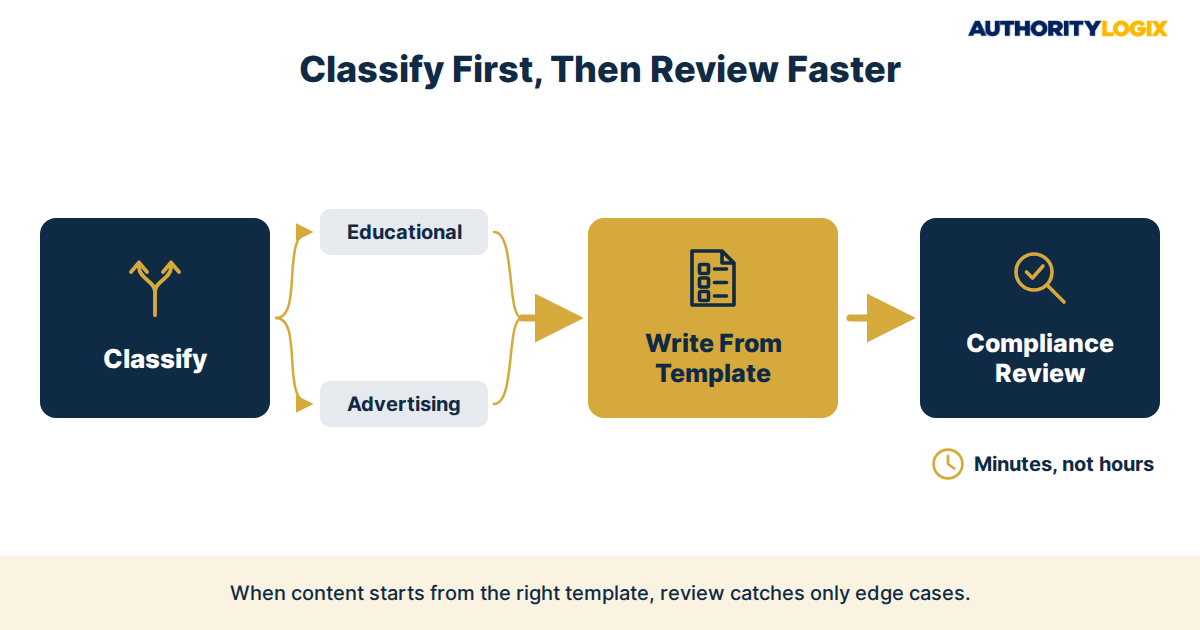
A functional mortgage content approval workflow has three steps. Step one is classification: every piece of content is classified as educational or advertising before writing begins. Educational content — scenario walkthroughs, program explainers, market commentary, borrower guides — follows the educational content template and undergoes a compliance checklist review. Advertising content — any piece quoting specific rates, payments, APR, or loan terms — follows the advertising content template with required disclosures embedded. Step two is author-level compliance: writers follow the template and the trigger term guidelines, so compliance elements are in place before the review stage.
The Review Step in a Mortgage Content Compliance System
Step three is compliance review: the reviewer checks for trigger terms in educational content, accuracy of any claims, NMLS ID and Equal Housing Lender presence, and UDAAP risk. When templates are structurally sound, this review takes minutes, not hours. The lead generation infrastructure that depends on a consistent stream of new content cannot function if the approval workflow is a bottleneck.
Not sure where your mortgage company’s current content compliance infrastructure stands? The FS Authority Gap Assessment identifies the gaps in your publishing system.
Distributing Compliant Content Without Creating New Compliance Risk
Distribution channels for mortgage content — website, LinkedIn, email, syndication — each carry their own compliance considerations, and a content system must account for them. The most common distribution compliance error is repurposing content across channels without verifying that the channel-specific requirements are met. A blog article that is compliant as a website resource may require additional disclosure treatment when distributed as a LinkedIn post if the platform’s character limits push required NMLS ID language off-screen.
An email newsletter that links to educational content carries different compliance requirements than an email promoting a specific rate or product offer. The lead funnel architecture that distributes content across channels needs to account for these requirements at the distribution layer, not only at the content creation layer.
LinkedIn posts by NMLS-licensed loan officers are regulated marketing materials — not personal social media content. NMLS ID must appear clearly. Equal Housing Lender or Opportunity designation must be present or the post must link to a profile or page where it appears. Claims about program availability, rates, or borrower qualifications must comply with the same standards as any other advertising material. The finance content layer that produces LinkedIn-ready content for mortgage companies builds these requirements into the LinkedIn content template the same way they are built into the blog article template — so distribution does not require a separate compliance review for each social post.
What Most Companies Get Wrong About Their Mortgage Content Compliance System
They treat compliance as a publication gate, not a design parameter
A mortgage company that writes content first and then submits it for compliance review has built compliance into the wrong step of the process. When compliance review catches a structural problem — trigger terms in educational content, missing NMLS ID, UDAAP risk in a claim — the entire piece requires rewriting. The review becomes a bottleneck and a source of conflict between marketing and compliance teams. The growth playbook for mortgage companies that publish consistently treats compliance as a design parameter: templates are built correctly, writers know the rules before they write, and review catches only the exceptions.
They conflate educational content with advertising — in both directions
Some mortgage companies treat all content as advertising and apply full disclosure treatment to every borrower scenario article — producing over-disclosed, legally cautious content that is useless as educational material and performs poorly in organic search. Others treat all content as educational and fail to add required disclosures when specific rates, payments, or loan terms appear. Both errors are problems. The authority marketing framework for DSCR lenders illustrates the correct approach: program explainers, scenario walkthroughs, and coverage ratio guides are educational; rate sheets, payment comparisons, and advertised loan offers are advertising. The classification must happen before the first word is written.
They do not maintain an audit trail
CFPB examination and state regulatory audit processes require mortgage companies to demonstrate that their marketing materials were reviewed and approved. A mortgage company that cannot produce documentation of who reviewed a specific piece of content, when it was reviewed, and what compliance determination was made is exposed in examination — even if the content itself is compliant. The AI search architecture that builds mortgage company content authority over time depends on a consistent, documented publishing history. The audit trail is not just a compliance requirement — it is a demonstration of the organized, systematic content infrastructure that differentiates credible publishing from ad hoc posting.

Want a content compliance system that lets your company publish without legal risk?
Building a Mortgage Content Compliance System That Produces Results
The mortgage companies publishing the most effective content in 2026 are not publishing despite the compliance environment — they are publishing within it, with a system designed to make compliance the starting point rather than the bottleneck. That system starts with the classification framework, is reinforced by compliant content templates, is maintained by a lightweight approval workflow, and is documented through an audit trail. The organic leads framework makes the business case: the content infrastructure this system produces generates inbound leads that close at a far higher rate than purchased leads — and it does so continuously, from the same initial content investment, without any per-lead cost.
AuthorityLogix’s proof-of-concept platform BKDSCR.com demonstrates this system operating in a live CFPB-supervised lending market. The 18 pillar pages and 48 SEO-optimized blog posts on the site are built on an educational content framework — scenario-specific, program-accurate, trigger-term-free — that has generated organic rankings and inbound engagement without any regulatory exposure. Every piece of content was built to the educational content standard that keeps Regulation Z trigger terms out of educational copy and keeps compliance elements embedded in every published asset. The authority distribution layer that amplifies this content — LinkedIn posts, email sequences, syndication — runs from the same compliant templates, so distribution does not introduce new compliance risk with each new channel.
The compliance problem in mortgage content marketing is real, but it is a solvable systems problem — not a reason to avoid publishing entirely. The companies that have built the system are accumulating compounding authority that the non-publishers cannot shortcut. When you’re ready to build, work with us is the starting point.