Key Takeaways
- A physical therapy patient acquisition pipeline built on direct access, local search, and patient education gives independent practices a reliable new-patient source that physician referrals alone cannot guarantee.
- As of July 2025, all 50 states, DC, and the US Virgin Islands allow some form of direct access to physical therapy — making patient-initiated inquiries a scalable acquisition channel for every practice in the country.
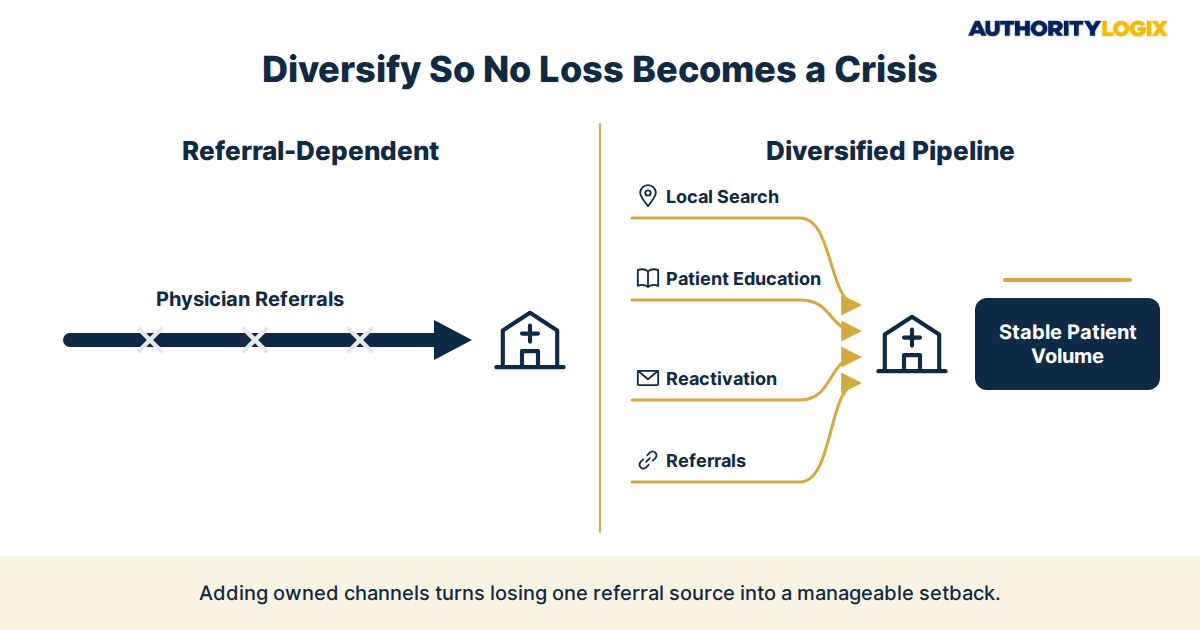
- Practices that depend on referrals for 70% or more of new patients are one physician retirement, one hospital affiliation, or one insurance change away from a significant revenue disruption.
- Organic search drives a large share of new patient website sessions for health and wellness practices — making local search optimization the highest-ROI owned acquisition channel available to most PT practices.
- The pipeline framework covered here — visibility, education, conversion, reactivation — operates in parallel with physician referrals, not instead of them. The goal is a practice that no single referral disruption can destabilize.
- Patient reactivation campaigns targeting former patients who completed care generate booked evaluations at near-zero incremental cost — and are consistently the fastest route to immediate new-patient volume.
A physical therapy patient acquisition pipeline built beyond physician referrals is not a contingency plan — it is the competitive foundation that separates practices with predictable patient volume from those that wait for the phone to ring. Physician referrals are valuable. They will continue to be part of every healthy PT practice’s patient mix. But they are not a system the practice controls, and they are not a foundation the practice can scale on its own terms.
The acquisition playbook frames the five systems that give PT practices a patient pipeline they own — local search, patient education, direct-access marketing, conversion optimization, and reactivation. This article goes deeper on the strategic case for building beyond referrals and the specific mechanics each pipeline component requires.
APTA confirmed in July 2025 that all 50 states, DC, and the US Virgin Islands now allow some form of direct access to physical therapy services — a milestone that makes patient-initiated acquisition both legally available and strategically urgent for every practice in the country. Practices that have not built the infrastructure to capture direct-access patients are leaving that segment to competitors who have, even though APTA confirms direct access is now available nationwide.
For a deeper treatment of this topic, see the acquisition playbook. It walks through the full pipeline this article only summarizes.
Why Physician Referral Dependence Is a Structural Business Risk
Physician referral dependence concentrates revenue risk in relationships the practice does not own. A referring orthopedic surgeon retires. A primary care group joins a hospital system with an affiliated PT department. An insurance panel change redirects referral patterns. Any of these events — common, unpredictable, and accelerating with consolidation — can remove 15 to 30 new patients per month from a practice overnight. Practices tracking this metric can also review the
educational hub for additional benchmarks.
The US physical therapy market is highly fragmented, with the 50 largest companies capturing only 29% of revenue per ResearchAndMarkets’ 2022 U.S. physical therapy clinics report — a market that private equity is actively consolidating. As PE-backed chains build affiliated referral networks, independent practices that rely heavily on physician referrals face a structural erosion of that channel over time. The
content systems provides additional context on this topic.
The Referral Concentration Problem
Referral concentration risk is measured by the percentage of new patients coming from any single source. A practice where three referring physicians account for 60% of new evaluations has significant concentration risk — the loss of one relationship could reduce monthly volume by 20%. Practices with healthy acquisition resilience typically have no single referral source representing more than 15% of new patient volume.
Building owned channels does not require reducing physician referral volume. The goal is to grow total patient acquisition so that referrals represent a smaller share of a larger total — not to replace a valuable channel with a different one. The growth blueprint covers how referral diversification integrates with the broader competitive positioning strategy for independent PT practices.
What Physician Referrers Actually Evaluate
Referral relationships are also competitive. Referring physicians are not passive partners — they research the practices they send patients to. A practice with a strong online presence, credentialed clinician bio pages, positive patient reviews, and condition-specific educational content systems gives referring physicians the confidence to refer consistently. A practice with a thin website and minimal online authority is at risk of losing referrals to better-positioned competitors, even without any change in clinical quality. For the related AuthorityLogix implementation framework, see lead generation systems.
This means that the same infrastructure that builds direct-access patient acquisition — local search visibility, patient education content, review volume — also protects and strengthens existing physician referral relationships. Building owned acquisition channels is not a tradeoff with referral development. The lead generation system addresses both simultaneously.
The Physical Therapy Patient Acquisition Playbook is the cornerstone resource for this category, covering every stage of a pipeline that does not depend on physician referrals.
Acquisition Playbook →
The Direct-Access Opportunity Every PT Practice Now Has
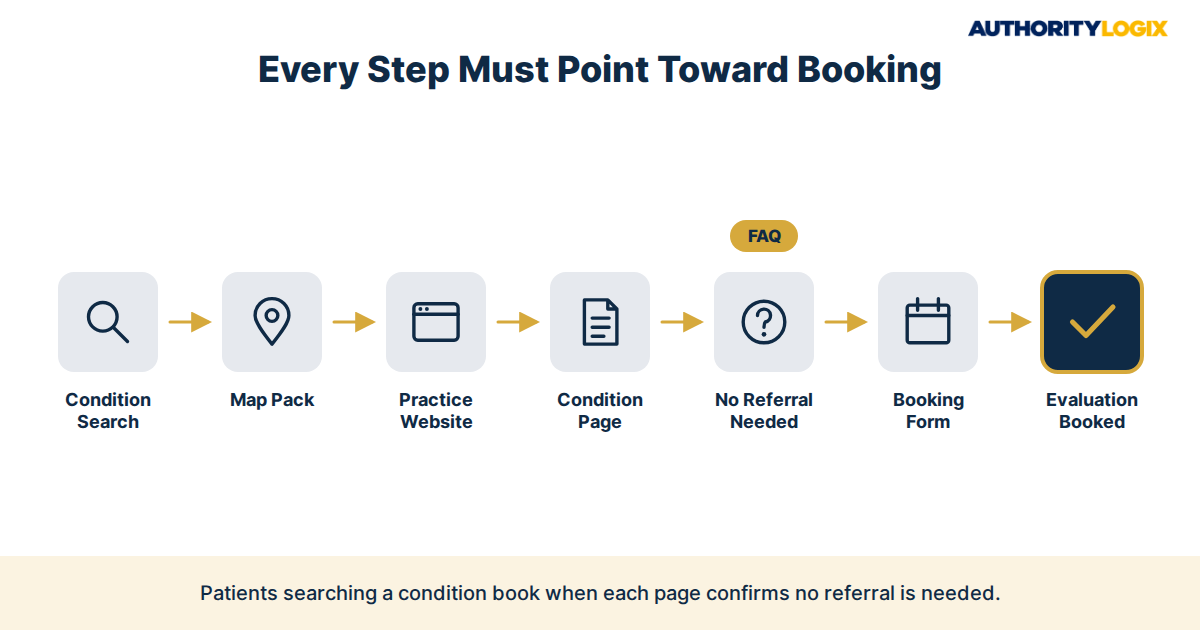
The July 2025 APTA milestone — direct access in every US jurisdiction — is not just a legal development. It is a market signal. Patients are increasingly aware that they can contact a physical therapist directly for musculoskeletal complaints, sports injuries, and recurring pain conditions without first seeing a physician. The practices positioned to capture that demand are the ones whose websites appear when patients search for answers to their specific condition questions.
Condition and location searches are how direct-access patients find PT practices. “Physical therapy for lower back pain near me,” “PT for rotator cuff injury in [city],” “physical therapist for knee pain without referral” — these queries represent patients who are actively researching a provider and ready to book. The practices that appear for these searches consistently generate patient inquiries without physician intermediaries. The local visibility guide covers the full local search system that captures this demand.
The Conditions Where Direct Access Is Highest
Not all condition areas have equal direct-access search volume. The highest-demand direct-access conditions — those where patients most actively self-refer — are lower back pain, shoulder injuries, knee pain, sports rehabilitation, and pelvic health. Practices that build condition-specific content, landing pages, and GBP signals around these areas capture the largest share of direct-access searches in their market. How practices convert that visibility into booked direct-access evaluations is covered in the direct-access patient generation guide. For a deeper treatment of this topic, see the
local visibility guide.
Post-surgical conditions — ACL reconstruction, total knee replacement, rotator cuff repair — have lower direct-access search volume but remain important for referral relationship marketing. Practices that publish educational content about post-surgical rehabilitation send a credibility signal to the orthopedic surgeons and sports medicine physicians whose referral relationships are most valuable. The education guide covers how condition content serves both direct-access acquisition and referral relationship reinforcement simultaneously.
Communicating Direct Access to Patients
Many patients do not know they can see a PT without a referral. APTA’s 2025 State of Direct Access report identifies patient awareness as one of the primary barriers to direct-access utilization even in states with unrestricted access. Practices that prominently communicate direct access availability — on their homepage, in GBP posts, in condition page content, and in patient FAQ pages — capture patients who would otherwise wait for a physician referral they do not actually need.
APTA’s 2025 report identifies consumer awareness as a primary barrier to direct-access utilization — making patient-facing communication one of the highest-impact, lowest-cost actions a practice can take. A simple homepage statement — “No referral needed to start physical therapy. Call to schedule your evaluation directly.” — combined with a GBP post explaining direct access and a FAQ page answer on “Do I need a doctor’s referral for PT?” creates multiple touchpoints where prospective patients learn they can self-refer. These are low-cost, high-impact additions that require no additional media spend.
Building a Physical Therapy Patient Acquisition Pipeline That Compounds
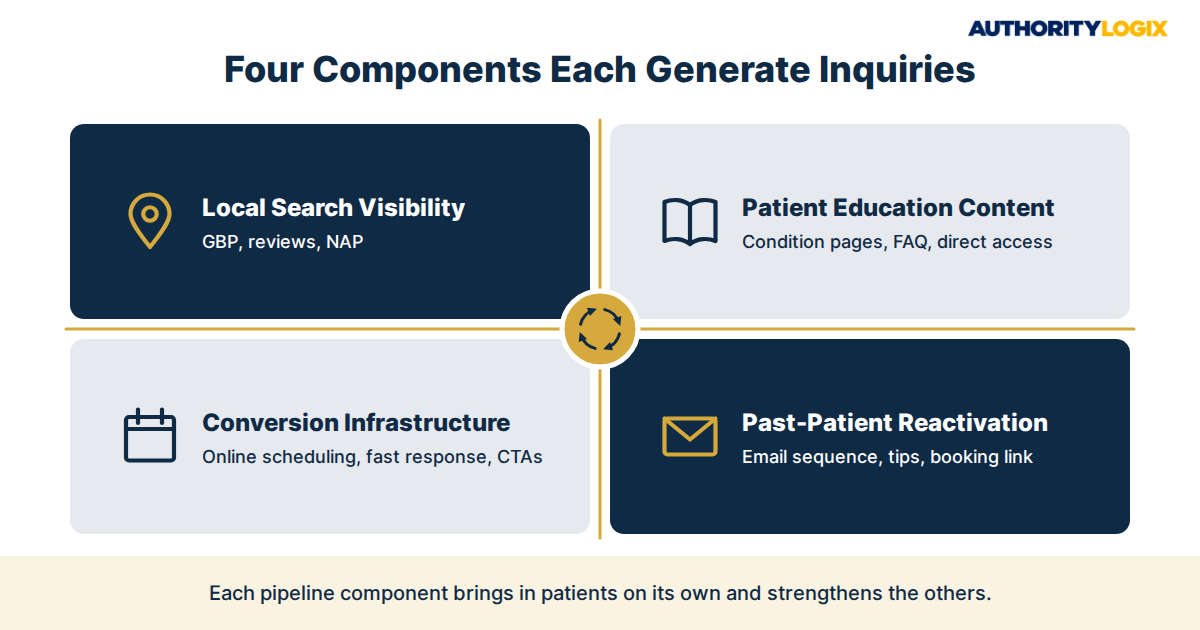
A patient acquisition pipeline is not a single channel — it is a coordinated set of channels that each generate patient inquiries and reinforce each other’s effectiveness. The four pipeline components that produce the most consistent results for independent PT practices are: local search visibility, patient education content, conversion infrastructure, and past-patient reactivation. Each component compounds over time and feeds the others.
Physical Therapy Patient Acquisition Pipeline Component 1: Local Search Visibility
Organic search drives a large share of new patient website sessions for health and wellness practices — a benchmark the local visibility guide uses as the baseline for local search ROI comparisons. For most PT practices, local search is already the largest single source of new patient inquiries — and the majority are running it at a fraction of its potential because their Google Business Profile is incomplete, their review volume is low, or their NAP data is inconsistent across directories. For a deeper treatment of this topic, see the
direct-access patient generation.
The foundational local search investment — completing the GBP, correcting NAP consistency, systematizing review generation — produces measurable results within 60 to 90 days and compounds indefinitely. A practice that generates two to four new Google reviews per week, maintains an active posting cadence, and keeps its GBP complete builds a local search position that becomes progressively harder for new competitors to displace. The local search service builds and manages this infrastructure systematically.
Physical Therapy Patient Acquisition Pipeline Component 2: Patient Education Content
Patient education content captures the specific searches patients make when they are researching their condition and looking for a provider. A condition page on lower back pain rehabilitation that ranks for “physical therapy for lower back pain near me” generates qualified patient inquiries at zero incremental cost per visitor — and it continues generating those inquiries for months or years after publication. The content playbook maps the keyword strategy that makes each condition page a compounding acquisition asset.
Patient education content also serves AI search eligibility. Healthcare queries trigger Google AI Overviews 89% of the time, per BrightEdge. Practices with well-structured FAQ sections, credentialed clinician attribution, and cited clinical data are significantly more likely to earn AI Overview citations than those with generic, unattributed content. AI citation eligibility is now a direct patient acquisition factor — not a future consideration.
Pipeline Component 3: Conversion Infrastructure
Conversion infrastructure is the system that turns a website visitor or GBP profile viewer into a booked evaluation. It includes: online scheduling or a prominent phone number above the fold on every condition page, a HIPAA-compliant short-form contact form that takes under 60 seconds to complete, same-day response to inquiry submissions, and clear booking calls to action on every page that captures high-intent traffic. For a deeper treatment of this topic, see the
education guide.
Patients increasingly expect a fast response to a healthcare inquiry — a standard the lead generation system is designed to meet through automated inquiry routing and response protocols. A practice that generates 20 GBP profile actions per month but responds to inquiries 24 to 48 hours later is losing a significant share of those potential evaluations to competitors with faster response systems. Conversion infrastructure is not marketing — it is operations. But it is the part of the acquisition pipeline most often overlooked when practices optimize for visibility without also optimizing for response.
Pipeline Component 4: Past-Patient Reactivation
Past-patient reactivation is consistently the fastest pipeline component for generating immediate patient volume. Former patients who completed an episode of care in the past 12 to 36 months and have not returned represent a qualified patient database — people who already trust the practice, know the location, and have experienced the clinical quality firsthand.
A three-email reactivation sequence that leads with a useful clinical tip, follows with a personal check-in, and closes with a direct booking invitation typically generates booked evaluations within the first week of sending — a framework documented in the
PT industry hub‘s practice growth resources. How practices reduce overreliance on physician-referred volume is covered in the reducing referral dependence guide. How practices reduce overreliance on physician-referred volume is covered in the reducing referral dependence guide.
Reactivation campaigns cost almost nothing to execute and require no new patient acquisition spend. They are the most ROI-efficient pipeline component available to any practice with an existing patient database. A practice running one reactivation campaign per quarter generates consistent evaluation bookings from a source most competitors have not systematized. For a deeper treatment of this topic, see the
reducing referral dependence.
FAQ: Building a PT Patient Acquisition Pipeline Beyond Referrals
How long does it take to see results from a diversified pipeline?
The reactivation campaign produces results within the first week of sending. GBP optimization improvements appear in profile views and actions within 30 to 60 days. Organic search visibility for condition pages develops over 6 to 12 months. The full compounding effect — where all four pipeline components are reinforcing each other — becomes visible in the 12 to 18 month window. The acquisition playbook maps the 90-day launch sequence that builds the foundation fastest.
Do direct-access patients complete their full course of care?
Direct-access patients who arrive informed — having read the practice’s educational content before their first visit — complete care at higher rates than patients who arrived with low pre-visit expectations. Patient education that sets realistic timelines, explains the role of home exercise adherence, and demystifies the treatment process before the first appointment reduces early dropout. The education guide covers the specific pre-visit education content that improves episode completion rates.
Should PT practices stop investing in physician referral relationships?
No. Physician referral relationships remain a valuable patient acquisition channel and should continue to be cultivated. The goal of pipeline diversification is not to replace physician referrals — it is to ensure that the loss of any single referring relationship is a manageable setback rather than a revenue crisis. The most resilient practices run all channels simultaneously. The authority gap assessment benchmarks the practice’s current channel mix and identifies the acquisition gaps most worth closing first.
What is the most cost-effective first step for a practice with no owned pipeline?
Complete the Google Business Profile in full and launch the past-patient reactivation campaign simultaneously. The GBP optimization is free and produces measurable local search improvements within 60 days. The reactivation campaign requires only email platform access and produces booked evaluations within the first week. Together, these two actions generate new patient volume with zero media spend — creating the cash flow that can fund the longer-horizon content and local SEO investments. Practices that combine GBP optimization with patient education tend to outperform single-channel competitors in local search.

Building a Patient Acquisition Pipeline That Works Without Waiting for Referrals
The physical therapy patient acquisition pipeline that compounds over time is built on four owned components — local search visibility, patient education content, conversion infrastructure, and past-patient reactivation — that together generate patient inquiries the practice controls. Each component can be started immediately, at low or zero incremental cost, with measurable results within weeks to months depending on the channel. For the full specialty framework, visit the PT resources hub.
The Insight Articles in the Patient Acquisition library go deeper on every pipeline component — from GBP optimization and direct-access marketing to patient reactivation sequences, conversion page design, and condition-specific landing pages. The PT resources hub organizes the full library so practice owners can move directly to the specific acquisition challenge they are solving today.
Physician referrals will always be part of a PT practice’s patient mix. But a practice whose patient volume depends on referral relationships it does not own is vulnerable to disruptions it cannot control. A diversified, owned patient acquisition pipeline makes the practice resilient — and makes growth a matter of systems, not of waiting. The
growth blueprint offers additional context on this area. The PT industry hub demonstrates how the five-system framework — content, local search, patient education, lead generation, and authority distribution — works together to keep that pipeline full.
Ready to build a predictable patient acquisition pipeline your practice owns, beyond physician referrals?
Work With Us →