

Key Takeaways
- The physical therapy authority flywheel is the compounding growth system in which each investment in visibility, patient education, clinical trust, and review generation reinforces every other investment — creating a self-amplifying loop that produces increasing returns from the same underlying infrastructure.
- Unlike paid advertising, the physical therapy authority flywheel produces patient inquiries that accelerate as the flywheel gains momentum. A practice 18 months into a consistent flywheel investment is earning the compounded output of 18 months of mutually reinforcing authority signals.
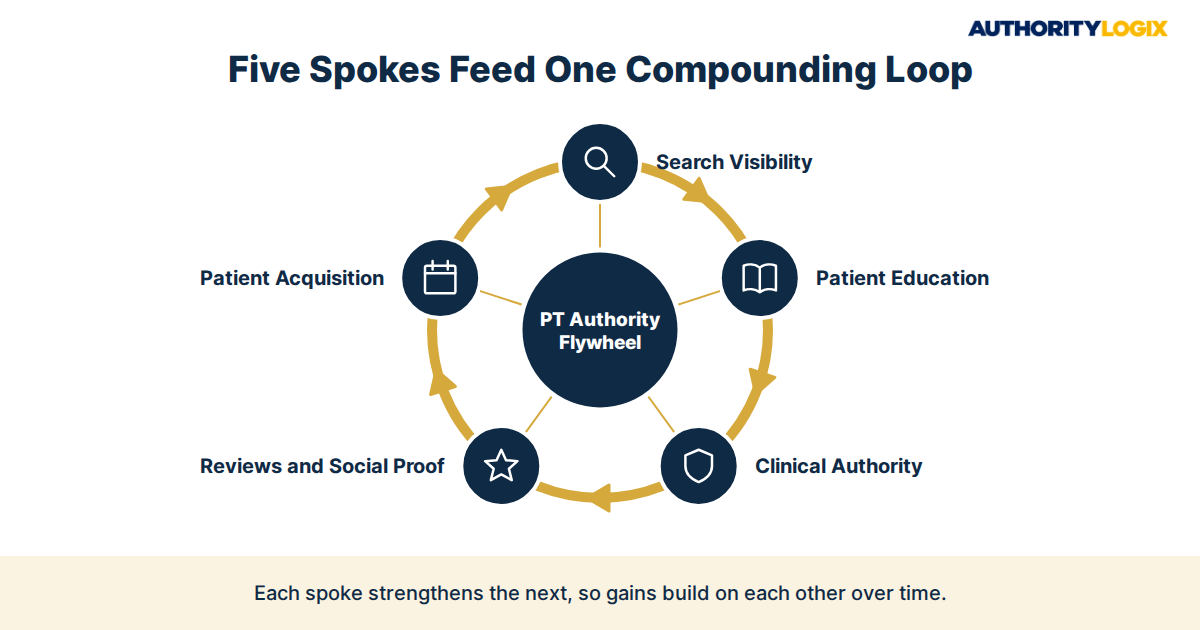
- The five spokes of the physical therapy authority flywheel: search visibility, patient education content, clinical authority signals, reviews and social proof, and patient acquisition systems.
- 89% of patients look for online reviews before booking with a new provider, per 2026 Forbes healthcare research — and the authority flywheel connects review generation to content authority and local search systems.
- 55% of patients have walked away from a provider based on what they read online, per rater8’s 2026 Patient Choice Report — a practice with strong search visibility but weak patient education and review content is not running a flywheel.
- The authority flywheel is not a campaign — it is a permanent operating system. Practices that run it for 24 months have a compounding patient acquisition engine that continues producing inquiries even when the practice is not actively adding new content.
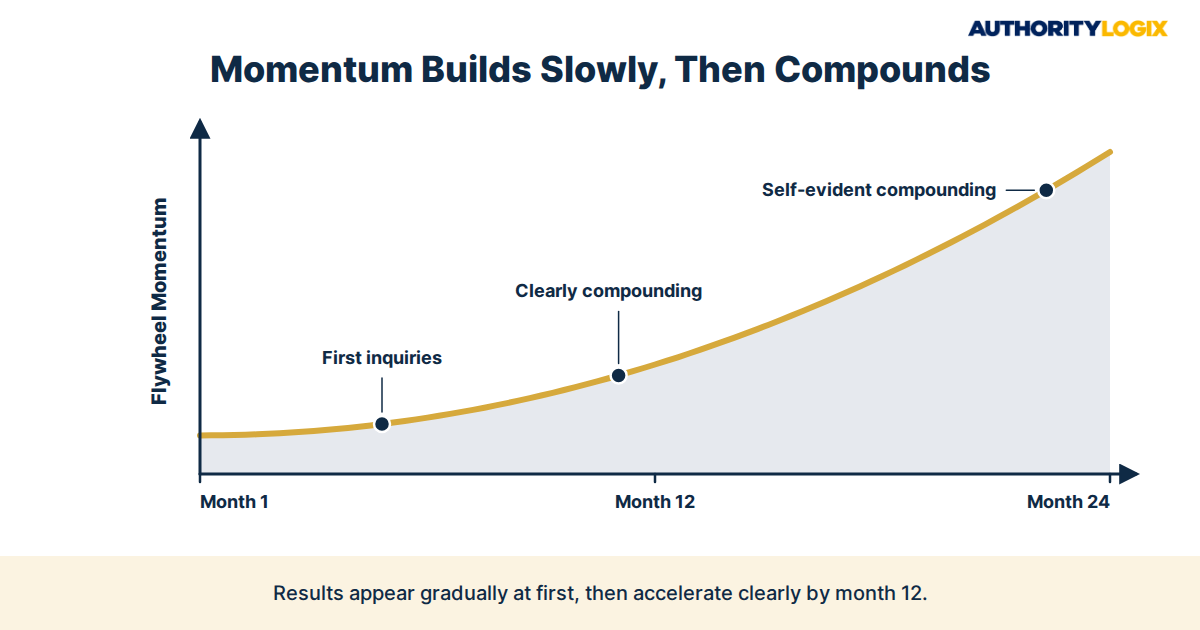
- The flywheel requires initial energy input to start spinning but generates increasing output per unit of energy input as it gains momentum — the same energy investment at month 18 produces significantly greater patient inquiry output than at month 3.
Table of Contents
The physical therapy authority flywheel is the compounding growth framework that explains why some PT practices produce accelerating organic patient acquisition results over 12 to 24 months while others invest in the same tactics and see stagnant returns. The difference is not the tactics — it is whether those tactics are connected into a system where each investment reinforces every other investment.
This article covers what the physical therapy authority flywheel is, what the five spokes are and how each feeds the others, and what the practical investment sequence looks like for a practice that wants to put the flywheel in motion. The acquisition playbook covers the full patient acquisition system — this article focuses on the flywheel framework that makes individual components compound rather than operate independently.
What Makes the Physical Therapy Authority Flywheel Different From a Marketing Campaign
A marketing campaign produces results proportional to its investment — stop spending, stop clicking. The physical therapy authority flywheel produces results disproportionate to its ongoing investment. The flywheel approach gains momentum with each rotation, compounding authority and visibility over time without proportional increases in spend. The visibility guide covers how local search visibility — the first spoke of the flywheel — is built and maintained as the compounding foundation.
The flywheel metaphor is also useful for understanding why inconsistent investment produces inconsistent results. The practice that maintains a consistent, modest investment in all five flywheel spokes outperforms the practice that makes large, sporadic investments in single spokes. The content playbook covers the content systems infrastructure that keeps the flywheel spinning consistently.
Explore the AuthorityLogix PT Practice Authority and Growth Blueprint for physical therapy practices.
Spoke 1 — Search Visibility
Search visibility is the first spoke of the physical therapy authority flywheel because it is the entry point for the compounding loop. Without it, the practice’s patient education content is not found, clinical authority signals are not seen, and the review profile is not encountered. The local search system builds the local search visibility component.
The keyword strategy article covers the condition search visibility component — the keyword research and mapping that identifies which condition queries the practice should target. Getting this mapping right is what keeps Spoke 1 feeding the rest of the flywheel.
Spoke 2 — Patient Education Content
Patient education content is the trust-building infrastructure that converts search visibility into patient confidence. Per healthcare marketing research, providers with education content tend to retain patients better — because the educational relationship that begins before treatment continues as an expectation during treatment. The educational hub organizes patient education content into the knowledge library architecture.
Spoke 3 — Clinical Authority Signals
Clinical authority signals are the E-E-A-T infrastructure that makes the practice’s patient education content credible to patients, search engines, and AI systems simultaneously. These signals compound over time: each new external mention reinforces entity authority, each new clinician bio page adds a new E-E-A-T anchor point. The authority distribution system amplifies clinical authority signals through external syndication.
How the Physical Therapy Authority Flywheel Compounds Into Physician Referral Credibility
Clinical authority signals that accumulate over time also build referral credibility with physicians who are evaluating PT practices as referral destinations. The pillar pages article covers how the pillar-cluster content architecture that builds AI Overview citations also builds the topical depth that earns physician referral credibility.
Spoke 4 — Reviews and Social Proof
Reviews and social proof are the peer validation infrastructure that converts the practice’s search visibility, patient education, and clinical authority signals into patient bookings. Per 2026 Forbes healthcare review research, 89% of patients look for online reviews before booking with a new provider. Reviews compound the flywheel in two directions: higher review volume improves map pack rankings (reinforcing Spoke 1), and specific clinical language in reviews reinforces condition-specific authority signals.
The lead generation system connects the review generation workflow to the full patient acquisition system, closing the loop back to new bookings. That closed loop is what makes the flywheel compound instead of resetting every month.
Spoke 5 — Patient Acquisition Systems
Patient acquisition systems are the conversion infrastructure that turns flywheel momentum into scheduled evaluations. Without conversion infrastructure — online booking, clear next-step CTAs, FAQ content — the first four spokes produce traffic that does not convert. The content systems built for PT practices include the conversion architecture that captures the patient acquisition momentum the flywheel’s first four spokes generate.
The Flywheel’s Return Loop — How Patient Acquisition Feeds Back Into Spoke 1
The patient acquisition system feeds back into Spoke 1 in three ways: acquired patients generate post-visit reviews (feeding Spoke 4 and Spoke 1), satisfied patients generate word-of-mouth referrals (a channel that does not depend on advertising), and positive-outcome patients become potential case study subjects. The PT industry hub demonstrates how the five-system framework maps to the five spokes of the authority flywheel.

Not sure which flywheel spokes your PT practice has fully activated?
How to Start the Physical Therapy Authority Flywheel
Starting the flywheel requires initiating all five spokes simultaneously. The practical starting sequence: Week 1 to 4, GBP optimization and citation audit (Spoke 1); Month 1, launch post-visit review request workflow (Spoke 4); Months 1 to 3, publish first 3 condition pages with named clinician authors (Spokes 2 and 3); Month 2, update all clinician bio pages (Spoke 3); Month 3, establish authority distribution workflow (Spoke 5 feedback loop). The authority guide covers the clinical authority infrastructure that makes each condition page eligible for AI Overview citation from its first month of publication.
Frequently Asked Questions
How long before the physical therapy authority flywheel produces visible results?
The first visible results — measurable improvement in map pack rankings, first condition page impressions in GSC, and increased review velocity — typically appear within 60 to 90 days. The first meaningful patient inquiry volume attributable to flywheel momentum typically appears between months 4 and 6. Clearly compounding results appear between months 9 and 12. The flywheel’s compounding trajectory becomes self-evident by month 18 to 24.
Can a solo PT practice run the authority flywheel?
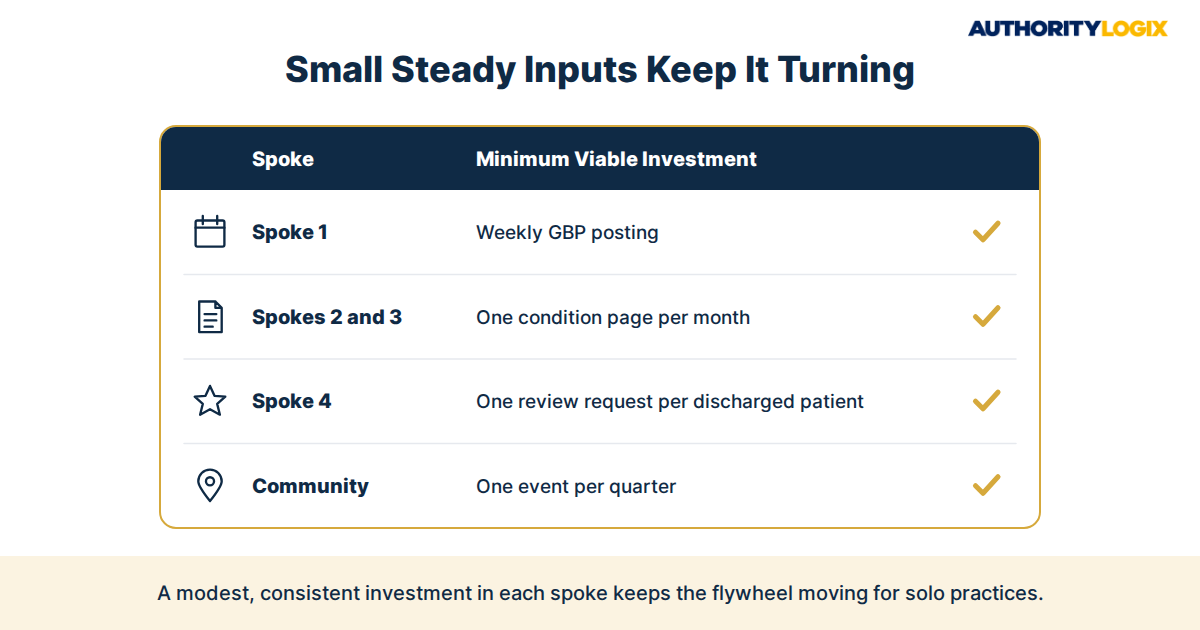
Yes — with a scaled-down spoke configuration. A solo PT practice running the minimum viable flywheel: one condition page per month (Spokes 2 and 3), one post-visit review request per discharged patient (Spoke 4), weekly GBP posting (Spoke 1), and one community visibility event per quarter. The content systems — already referenced above — built for PT practices include the solo-practice content workflow that makes the monthly condition page cadence achievable without a marketing team.
What stops the physical therapy authority flywheel?
Three things stop the flywheel: inconsistent content publication (Spoke 2 stalls), review velocity decline (Spoke 4 stalls), and conversion infrastructure gaps (Spoke 5 fails to capture momentum from Spokes 1 through 4). The most common failure mode is inconsistent content publication. The keyword strategy — already referenced above — article covers the keyword mapping process that pre-populates the content calendar with 12 to 24 months of condition page topics, removing the friction that causes publication to stall.
Ready to start the authority flywheel where visibility, education, trust and reviews feed each other?