


Key Takeaways
- Financial services email marketing delivers a 27.1% open rate and 2.4% click-through rate — both above the cross-industry average — according to Campaign Monitor benchmarks. The financial services audience is receptive to email when the content is specific, credentialed, and scenario-relevant.
- Email marketing returns $36 for every $1 spent, making it the highest-ROI digital channel available to financial services firms. The email list built from lead magnet captures is the most valuable marketing asset a firm owns — the only channel no algorithm controls and no vendor can reprice.
- Automated email sequences generate 320% more revenue than non-automated emails, according to Campaign Monitor. The sequence structure — not the individual email — is what produces client conversions from cold website traffic.
- A financial services email nurture sequence is not a drip campaign. It is a trust-building progression: each email delivers specific educational value tied to what the contact downloaded, moving them from engaged reader to qualified prospect to booked call at a pace the contact controls.
- Segmentation is the single most consequential lever in financial services email performance. Marketers report a 760% increase in email revenue from segmented campaigns — which means the DSCR investor nurture sequence and the retirement planning advisor sequence must be distinct, not variations on the same template.
- The sequence works only when traffic and lead capture are already in place. A financial services firm that sends nurture emails to a list of 50 addresses is not doing email marketing — it is doing outreach. The email list is a downstream asset; organic search and lead magnets are what fill it.
Table of Contents

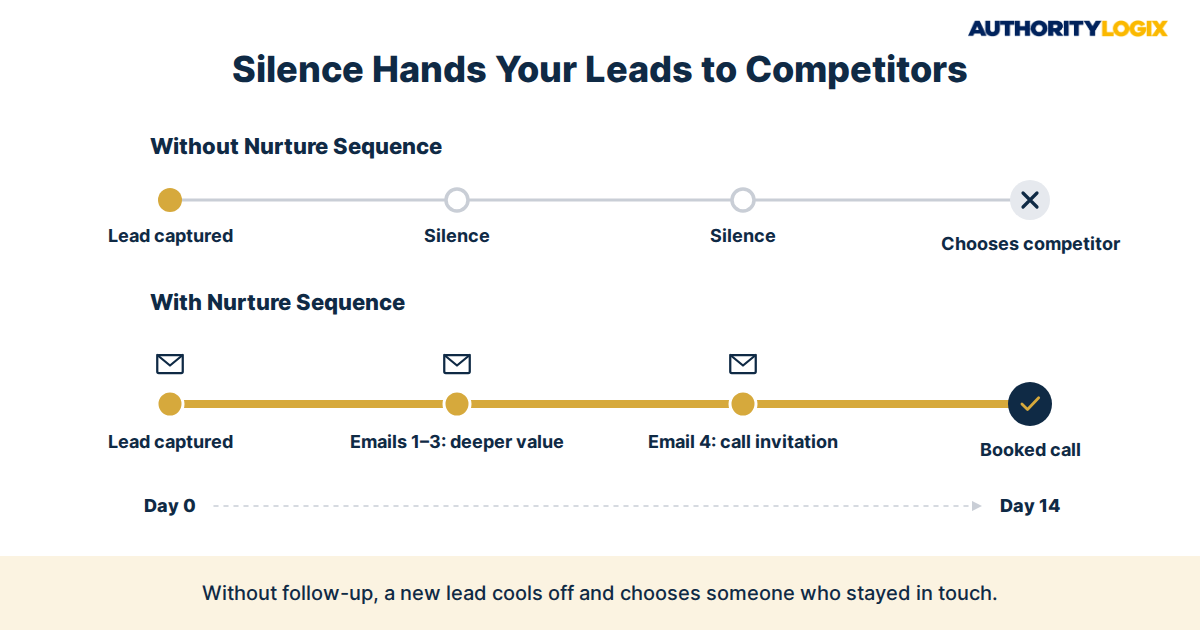
Financial services email nurture sequence is the mechanism that converts a downloaded DSCR checklist, a retirement planning guide. Or a mortgage scenario tool into a booked call — and ultimately into a client. Without a sequence, a lead magnet capture is a name on a list that goes nowhere. The contact downloaded something, found value, and moved on. They have no further reason to engage until the firm does something to maintain contact.
Most financial services firms do not do that something — they capture the email, send a confirmation, and then go quiet. The result is a list of addresses that never converts, a metric that measures downloads rather than revenue, and an asset that compounds toward nothing. The SEO playbook produces the traffic; the lead magnet captures the contact; the email nurture sequence is what converts that contact into a client relationship.
The numbers make the case plainly. According to Campaign Monitor, financial services email achieves a 27.1% average open rate and a 2.4% click-through rate — above cross-industry averages for both metrics. Email marketing delivers $36 in return for every $1 spent. Automated sequences generate 320% more revenue than non-automated campaigns. For a financial services firm with a list built from inbound lead captures, these numbers translate directly into client conversations — but only when the sequence structure is in place to drive them.
The authority guide covers the trust infrastructure that makes financial services clients willing to engage in the first place. This article covers the sequence itself — the email structure, timing, content approach, and segmentation logic that converts cold website traffic into clients through an automated nurture system that runs without requiring the firm’s principals to be personally present at every touchpoint.
The complete inbound pipeline framework — lead capture, email nurture, and the full conversion architecture — is in the Financial Services Lead Generation System.
Why Cold Website Traffic Doesn’t Convert Without a Nurture Sequence
Cold website traffic — visitors who arrive through organic search, LinkedIn posts, or syndicated content and have no prior relationship with the firm — does not convert to clients in a single visit. Financial services buying decisions are high-consideration: the prospect researches, evaluates multiple options, and makes a decision over days, weeks, or months depending on the complexity of the need. A mortgage company that captures a borrower’s email through a DSCR qualification checklist on Monday does not get a loan application by Wednesday. It gets an opportunity to stay present while the prospect continues their research — and the email nurture sequence is how that presence is maintained without AE hours or manual follow-up.
The FS industry hub covers the full economic picture of financial services inbound marketing. The conversion timeline for cold organic traffic in financial services typically runs 2–8 weeks from first contact to first conversation — which means a firm that does not stay in contact during that window loses the prospect to a competitor who does. The email nurture sequence is the infrastructure that automates that contact. Every email in the sequence keeps the firm present, demonstrates additional expertise, and moves the contact closer to a decision — without requiring anyone at the firm to manually track where each prospect is in the research process.
The credibility gap that separates firms with inbound infrastructure from those without it is most visible here. A financial firm whose only follow-up is a confirmation email and a monthly newsletter is competing against firms whose nurture sequences deliver scenario-specific content, establish credibility through specific proof points, and invite a conversation at the right moment in the prospect’s decision process. The firm that is present and useful during the research phase wins the first conversation — and the first conversation wins the client at a far higher rate than a cold first contact ever does.
Why Email Is the Right Channel for Financial Services Lead Conversion
Email has three properties that make it uniquely suited to converting financial services leads that no other channel replicates simultaneously. First, it is owned: the email list is an asset the firm controls directly — no algorithm changes its delivery, no platform modifies its reach, no vendor reprices its access. Second, it is direct: an email arrives in the prospect’s inbox, addressed to them, at a time of the firm’s choosing. Third, it is durable: a contact who has been on a financial services email list for six months and engaged with four or five pieces of educational content is a fundamentally different lead than someone who visited the website once.
The organic leads framework makes the conversion case clearly. Inbound leads tend to close at a much higher rate than outbound leads. And email nurture is what maintains the inbound relationship during the consideration period that separates the first contact from the first conversation.
The financial services audience’s email engagement metrics confirm the channel fit. Financial services emails achieve a 27.1% open rate — above the cross-industry average of 21.5%, according to Campaign Monitor — because recipients on a financial services email list have opted in for information that directly affects their money, their investments, or their financial future. They open it because the subject line is relevant to a specific scenario they are navigating. The content systems that power financial services email nurture are built around that scenario specificity: the DSCR investor sequence covers DSCR scenarios; the retirement planning sequence covers retirement scenarios; the mortgage borrower sequence covers purchase and qualification scenarios. Generic financial newsletters produce generic engagement. Scenario-specific sequences produce client conversions.
The Email Nurture Sequence Structure That Works for Financial Services
A financial services email nurture sequence has five emails sent over 10–14 days. Each email has a distinct job in the trust-building progression, and removing any email from the sequence — or collapsing two into one — degrades the conversion rate because the prospect skips a stage in the evaluation process. The lead magnet that triggered the sequence determines the content of every email: the topic, the depth, and the specific pain point addressed must all match what the prospect downloaded. A DSCR investor who downloaded a coverage ratio checklist does not want an email about retirement planning three days later.
The First Three Emails in a Financial Services Email Nurture Sequence
Email 1 — Deliver and Confirm (Day 0). The first email sends the resource the contact downloaded and confirms the content match. Subject line format: the specific resource name, not a generic “here’s your download.” Body: two or three sentences confirming what the resource covers and what the contact should expect in the sequence ahead. No pitch. No ask. This email has one job: deliver value immediately and signal that the following emails will also be worth opening. Welcome emails achieve an average open rate of 83.63% across industries, according to GetResponse — the subject line and sender name at this moment establish whether the contact will open subsequent emails in the sequence.
Email 2 — Deepen the Scenario (Day 2–3). The second email goes deeper on the specific problem the resource introduced — a follow-up article, a market data point, or a case framework that adds useful context to what the contact already read. This email is entirely educational. It makes no ask. Its job is to demonstrate that the firm’s expertise extends beyond the resource the contact downloaded and that the sequence is a source of genuine intelligence, not a drip toward a sales call. The educational hub architecture is the content library this email draws from — every article in the hub is a potential email 2, linked to the relevant scenario cluster.
Email 3 — Establish the Approach (Day 5–6). The third email introduces how the firm approaches the specific problem the contact has been reading about — not a capability statement, but a specific explanation of how the firm works with this exact client type. For a DSCR lender, this might be: “here is how we structure files for self-employed investors who own properties through LLCs.” For a financial advisor, it might be: “here is how we build retirement income plans for business owners who have irregular distributions.” The AI search authority that comes from published expertise is reinforced here: a firm that can point to specific published content in email 3 demonstrates depth competitors who have not published cannot match.
The Final Two Emails in a Financial Services Email Nurture Sequence
Email 4 — The Call Invitation (Day 8–10). The fourth email is the direct call invitation. It is framed around the prospect’s specific situation — not the firm’s services. “Based on what you downloaded and what we covered in the last few emails, if you’re working through [specific scenario], a 20-minute call would tell you whether our program is the right fit.” The ask is low-pressure, time-bounded, and specific.
It is not “schedule a consultation.” It is “here is a specific question we can answer in 20 minutes that will tell you whether it makes sense to go further.” The lead generation architecture that routes a call booking from this email directly into the firm’s calendar — no manual coordination — is what makes the sequence scalable across multiple contacts simultaneously.
Email 5 — The Follow-Up Resource (Day 14). The fifth email is sent to contacts who did not book from email 4. It delivers one more piece of educational content — a related article, a market update, or a scenario guide — and includes a soft repeat of the call invitation. “If the timing isn’t right, that’s fine — here is something else that might be useful. When you’re ready to talk, the link is below.” This email exits the sequence regardless of outcome: the contact either books or returns to the standard newsletter list. The broker pipeline framework applies this same five-email structure to broker audiences — the content differs, but the trust-building progression is identical.
| Timing | Job | Ask | |
|---|---|---|---|
| 1 — Deliver | Day 0 | Deliver resource + signal sequence value | None |
| 2 — Deepen | Day 2–3 | Add scenario context + extend expertise | None |
| 3 — Establish | Day 5–6 | Introduce firm’s specific approach | None |
| 4 — Invite | Day 8–10 | Issue scenario-specific call invitation | 20-minute call |
| 5 — Follow-Up | Day 14 | Last resource + soft repeat invitation | Call when ready |
Sequence Variations by Financial Services Audience
The five-email structure applies across all financial services audiences — but the content of each email must be specific to the audience and the scenario that triggered the download. A single generic nurture sequence deployed across every lead magnet capture is the most common email marketing failure in financial services: the contact who downloaded a DSCR calculator gets emails about retirement planning that have no relevance to their situation, and they stop opening. The sequence structure stays the same; the content is rebuilt for each audience segment. Marketers have reported a 760% increase in email revenue from segmented campaigns, according to Campaign Monitor — not because segmentation is magic, but because scenario relevance is what produces the open rates and click rates that drive conversions.
The finance content layer that supports sequence segmentation for financial services firms organizes content by audience and scenario — the same organizational logic that makes educational hubs rank in search also makes email sequences convert. A DSCR investor sequence pulls from DSCR scenario articles. A retirement planning sequence pulls from retirement income planning content. A mortgage borrower sequence pulls from purchase and qualification content. Each sequence sounds like it was written specifically for that contact — because it was drawn from content written specifically for that scenario.

Not sure where your firm’s email infrastructure stands relative to what a nurture sequence requires? The FS Authority Gap Assessment identifies the gaps.
Compliance and Tone in Financial Services Email Nurture
Financial services email operates in a compliance environment that shapes every element of sequence content — subject lines, body copy, disclosures, and the nature of any claims made. FINRA, CFPB, and NMLS regulations govern what licensed professionals can communicate in marketing materials, and email nurture sequences are marketing materials. The compliance guardrail for financial services email is the same as for all FS content.
Educational and marketing-focused, no investment outcome guarantees, no specific financial advice, no CFPB or NMLS violations. Every email in the sequence addresses marketing, visibility, or educational content — not regulated financial recommendations. The broker pipeline framework illustrates how this constraint is navigated in lender communications: program intelligence is educational; specific rate quotes and outcome guarantees are not.
The tone across all five emails in a financial services nurture sequence follows the same principle that governs all AuthorityLogix content: peer-to-peer, credibility-first, and zero hype. Financial services buyers — mortgage borrowers, DSCR investors, financial advisory prospects — are skeptical of marketing language. They have heard every pitch. What they have not heard is a lender or advisor who understands their specific scenario well enough to address it without being asked.
That specificity of tone is what produces the above-average open rates the financial services vertical achieves. The finance content infrastructure that produces compliant, scenario-specific email content for financial services firms is what enables this tone at scale. Every email sounds like it was written for this contact, not broadcast to a list.
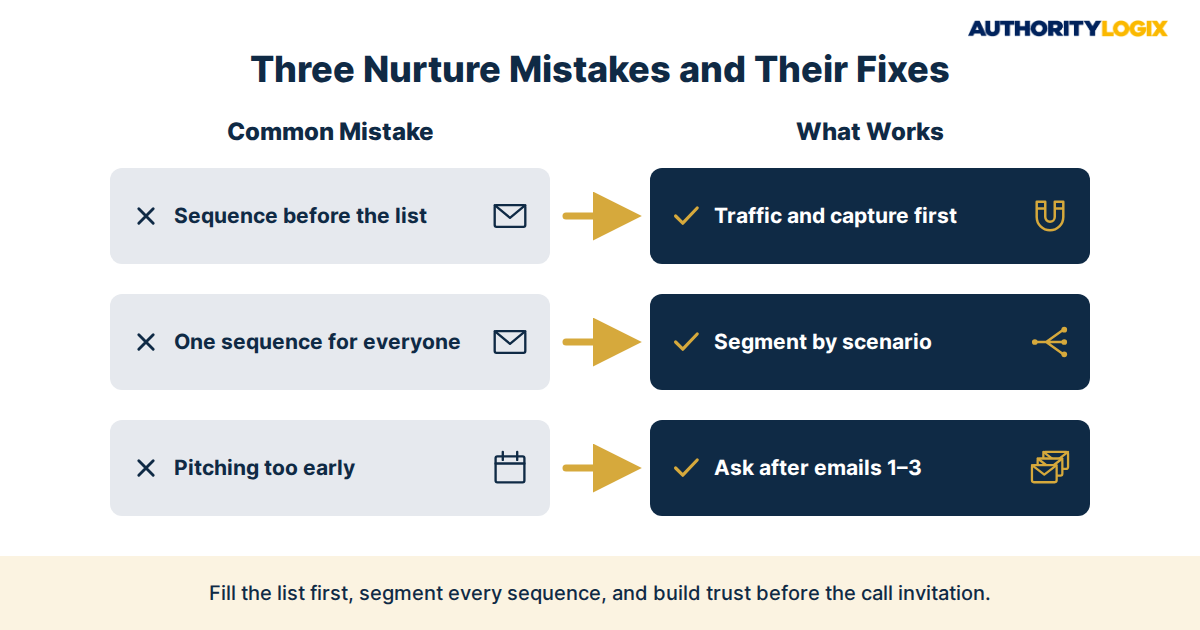
What Most Firms Get Wrong About Their Financial Services Email Nurture Sequence
They start with the sequence before they have the list
An email nurture sequence built for a list of 50 addresses is not email marketing — it is a manual outreach program. The sequence compounds in value as the list grows: 50 addresses becomes 500 becomes 5,000 as the SEO and lead capture infrastructure matures. The E-E-A-T guide covers the organic search infrastructure that drives qualified traffic to the lead capture pages that fill the email list. Sequence-first without traffic-and-capture-first is building a pipeline with no water source.
They send one sequence to every contact
A DSCR investor who downloaded a coverage ratio calculator and a retirement planning prospect who downloaded an income planning guide are not the same contact. Sending them the same sequence produces open rates that trend toward the generic average — not the above-average rates financial services firms earn with scenario-specific content. The authority marketing framework for DSCR lenders is built around scenario specificity for exactly this reason: the lender who sends a generic mortgage newsletter to DSCR investor contacts is demonstrating that they do not understand their audience — the opposite of the authority impression the content was meant to create.
They pitch too early
The single most common failure in financial services email nurture is issuing the call invitation in email 1 or email 2 — before the sequence has had a chance to build the trust that makes the invitation credible. A contact who downloaded a checklist and received two emails before being asked to schedule a consultation has not been nurtured — they have been pitched. The difference in conversion rates between sequences that pitch early and sequences that build through emails 1–3 before asking is significant. The content system that supplies emails 1–3 with scenario-specific educational content is what makes the delay between download and ask commercially productive rather than commercially wasteful.
Ready to build the email nurture sequence that turns cold traffic into clients?
Building Your First Financial Services Email Nurture Sequence: Where to Start
The fastest path to a working financial services email nurture sequence is to build one sequence first — for the lead magnet that currently generates the most captures — and operate it for 60–90 days before building the next. The first sequence teaches a firm how its specific audience responds to educational email at each stage of the trust progression: which email generates the most opens, which generates the most clicks, which produces the most call bookings. That data drives every subsequent sequence and every subject line iteration. The growth playbook for financial services firms treats the email list and its nurture infrastructure as a compounding business asset — not a monthly newsletter obligation.
The email sequence is one component of the full inbound system. The authority distribution layer — LinkedIn, syndication, multi-channel reach — is what keeps filling the list that the sequence nurtures. Without distribution, the list grows slowly. Without the sequence, the list produces nothing. Together, they build a client acquisition system that compounds: each new subscriber enters the sequence, each sequence completion produces either a booked call or a newsletter subscriber who might book later, and each month the list is larger and the sequence is more refined.
The honest answer for a financial services firm evaluating this approach: the sequence is the simplest part to build. The harder infrastructure — the traffic, the lead capture, the content library that feeds each email — is what most firms have not yet built. Start there. The sequence is what makes that infrastructure pay. When you’re ready to build it, work with us is the starting point.