


Key Takeaways
- Financial services content FINRA compliance is not the same as CFPB or NMLS compliance — the applicable regulatory framework depends entirely on the firm type. FINRA Rule 2210 governs broker-dealers and their registered representatives. The SEC Marketing Rule governs registered investment advisers. CFPB oversight applies to mortgage lenders and servicers. NMLS disclosure requirements apply to NMLS-licensed loan originators. The compliance mistake most firms make is not knowing which framework applies to them.
- Every piece of financial services content — website articles, social media posts, email newsletters, lead magnets, and downloadable guides — is a regulated communication for firms under FINRA or SEC supervision. FINRA Rule 2210 treats a LinkedIn post by a registered representative the same as a printed advertisement: it must be fair, balanced, and not misleading, and static content generally requires pre-approval by a registered principal before it goes live.
- The classification that matters most for financial services content compliance is educational versus promotional. Educational content that explains how financial concepts work, describes planning scenarios, or provides market context does not carry the same compliance burden as content that promotes specific investment products, projected returns, or advertised loan terms. Most financial services firms publish almost no educational content and wonder why they attract no organic traffic.
- M1 Finance was fined $850,000 by FINRA for influencer-generated content that contained unbalanced and misleading claims. The enforcement action targeted content that was promissory, exaggerated, and lacking required risk disclosures — not content that was educational, scenario-specific, and accurate. The compliance risk is not in publishing financial content. It is in publishing promotional claims without required disclosures.
- Recordkeeping is a non-negotiable compliance requirement for financial services content under both FINRA and SEC rules. All content distributed to 25 or more retail investors within a 30-day period must be retained for at least three years, with the first two years in an easily accessible format. A content operation without a documented approval trail and an archived content library is not compliant — regardless of whether the content itself is accurate.
- 41% of financial advisors have converted a social media lead into a client, according to Broadridge’s 2022 Financial Advisor Marketing Trends survey. The firms that are winning on content are not publishing despite the compliance environment — they are publishing within it, with systems designed to make compliance the starting point rather than the bottleneck.
Table of Contents
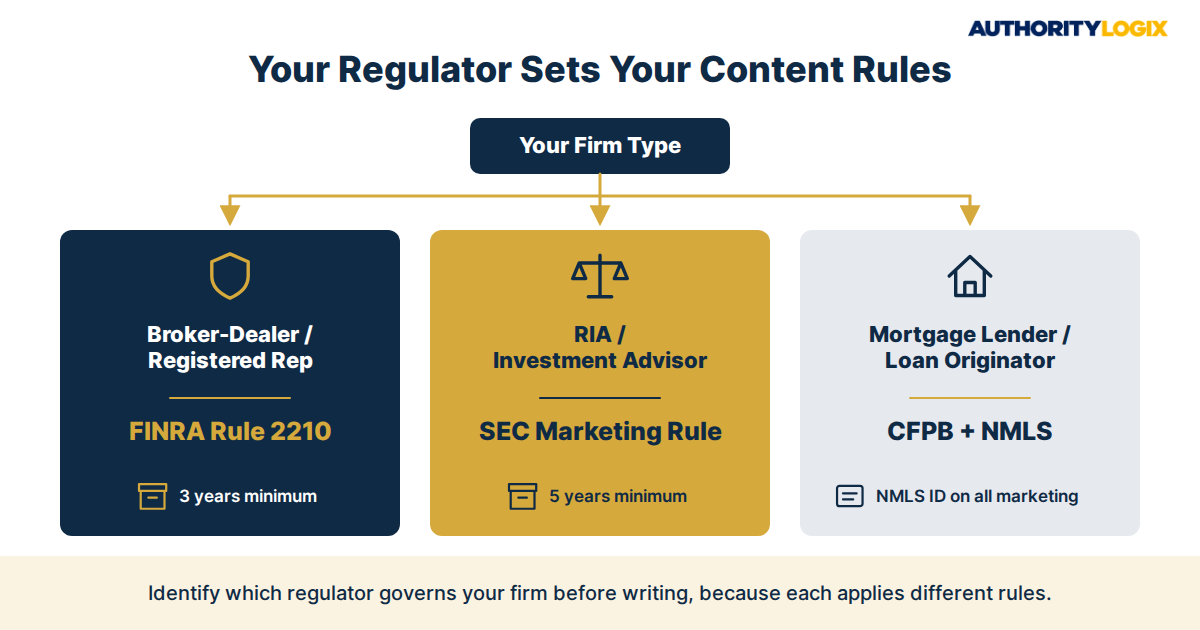
Financial services content FINRA compliance is the specific regulatory framework that broker-dealers and their registered representatives must follow when publishing any content that reaches the public. And it is one of three distinct compliance frameworks that financial services firms need to understand before publishing a single article, social post, or lead magnet. The compliance environment for financial services content is not monolithic: FINRA Rule 2210 applies to broker-dealers and registered representatives. The SEC Marketing Rule under the Investment Advisers Act governs registered investment advisers. And CFPB regulations — Regulation Z, Regulation N, RESPA, and UDAAP — govern mortgage lenders and loan originators, alongside NMLS disclosure requirements.
Each framework has different rules, different risk profiles for different content types, and different approval and recordkeeping requirements. Most financial services firms either don’t know which framework applies to their firm type or conflate multiple frameworks into a single compliance anxiety that stops them from publishing anything. The SEO playbook for financial services firms is built on published educational content — and this article provides the compliance framework that makes that publishing possible without regulatory exposure.
The business case for publishing compliant financial services content is not speculative. According to Broadridge’s 2022 Financial Advisor Marketing Trends survey, 41% of financial advisors have converted a social media lead into a client. The firms generating this business are not operating in a compliance-free zone — they are operating within the compliance framework, with content that is educational, accurate, appropriately disclosed, and approved through a documented workflow. The authority guide covers why published expertise is the primary trust signal for financial services firms. This article covers the regulatory framework that makes that expertise publishable without generating the enforcement exposure that compliance-averse firms fear.
The external authoritative source on financial services content rules is FINRA’s rules guidance — the primary reference for broker-dealers and registered representatives navigating Rule 2210 and supplemental advertising rules. This article summarizes the compliance framework for content production purposes; it is not legal advice, and financial services firms should work with compliance counsel for firm-specific guidance.
The complete publishing system — compliance-aware content architecture, approval workflow, and distribution — is in the Financial Services Content System.
Why Compliance Stops Financial Services Firms From Publishing — and Why That Is the Wrong Response
The compliance concern that stops most financial services firms from publishing content is not wrong — it is misapplied. The regulatory risk in financial services content is real, specific, and concentrated in promotional claims that are misleading, exaggerated, unbalanced, or unsubstantiated. FINRA’s $850,000 enforcement action against M1 Finance targeted influencer content that was promissory, misleading, and not fair or balanced — not content that was educational, scenario-specific, and compliant. The FS industry hub covers the economic cost of digital invisibility for financial services firms; the firms that stop publishing to avoid compliance risk are ceding organic search authority, AI citation eligibility, and referral partner mindshare to competitors who have solved the compliance problem.
The misapplication is treating all financial content as equivalent to a promotional advertisement. An article that explains how Roth IRA conversions work for high-income earners — without recommending a specific product, projecting specific returns, or omitting material risk information — is educational content. It is not the type of content that generates FINRA enforcement actions.
A social post that promises specific investment returns without risk disclosure is promotional content — and it is exactly the type of content that generates enforcement actions. The credibility gap between financial services firms that publish compliant educational content and those that publish nothing is the gap between firms that build compounding organic authority and firms that remain invisible to the clients they are trying to reach.

The Regulatory Framework by Firm Type
The first step in building compliant financial services content is identifying the correct regulatory framework for the firm’s specific activities and registration type. The search statistics on financial clients show that the questions borrowers and investors actually search are educational in nature — they want to understand how financial decisions work, not receive promotional solicitations. The compliance framework that governs the firm’s content does not prevent publishing answers to those questions; it defines how those answers must be structured, disclosed, and approved.
| Firm Type | Primary Rule | Key Content Requirements | Recordkeeping |
|---|---|---|---|
| Broker-Dealer / Registered Rep | FINRA Rule 2210 | Fair, balanced, not misleading. Static content pre-approved by registered principal. No performance projections. | 3 years minimum; first 2 years easily accessible |
| RIA / Investment Advisor | SEC Marketing Rule (IAA 206(4)-1) | Testimonials permitted with disclosures. No false or misleading statements. Performance data with required context. | 5 years minimum |
| Mortgage Lender / Loan Originator | CFPB (Reg Z, MAP Rule, RESPA, UDAAP) | Trigger terms require disclosures. NMLS ID on all marketing. Educational vs advertising classification determines treatment. | Varies by rule; 3 years for most advertising records |
| Dual-Registered (BD + RIA) | FINRA + SEC Marketing Rule | Both frameworks apply; stricter standard governs in conflicts. Single approval workflow covering both sets of requirements recommended. | 5 years (SEC standard) |
The content systems that support compliant financial services publishing build the correct framework requirements into the content templates and approval workflow from the start. That means the compliance check at review confirms the structural requirements are met, rather than identifying structural problems that require rewriting.
What Compliant Financial Services Content Looks Like
Compliant financial services content is educational, scenario-specific, accurate, and appropriately disclosed — not watered-down, vague, or hedge-laden to the point of uselessness. The most effective compliant content in financial services is the content that explains how things actually work. How sequence-of-returns risk affects a retirement portfolio with specific withdrawal rates, how a DSCR coverage ratio of 1.15 affects loan approval odds, how tax-loss harvesting interacts with long-term capital gains treatment, how non-QM lenders evaluate self-employment income documentation.
None of that content requires performance projections. None of it requires misleading claims. All of it is exactly the type of content that builds Google authority, earns AI citation, and converts prospective clients who arrive through search. The E-E-A-T guide covers why Google’s YMYL evaluation rewards this type of depth and specificity. And why it is also the type of content that presents the least compliance risk.
The practical compliance rules for educational financial content differ by framework but share a common principle: accuracy, balance, and no misleading implications. Under FINRA Rule 2210, the rule is that communications must be fair and balanced. Content that explains both how a strategy can benefit a client and what risks or limitations it carries is structurally compliant. Content that presents only the upside without acknowledging the downside is not. Under the SEC Marketing Rule, testimonials from current clients are now permitted if accompanied by required disclosures.
But endorsements from people who are not clients must be disclosed as paid promotions. Under CFPB rules, the trigger term framework applies: specific APR, payment amount, or loan term mentions require advertising disclosures. Educational content that explains how those terms work without quoting specific figures does not. The educational hub architecture that organizes financial services content by topic cluster and scenario is designed around these frameworks. Scenario-specific, educational, and structured to avoid the specific content types that generate enforcement exposure.
The Approval Workflow That Makes Compliant Publishing Sustainable
Why Post-Production Review Fails Financial Services Content FINRA Compliance
A financial services firm that writes content and then submits it for compliance review has built compliance into the wrong step of the production process. When the reviewer catches a structural compliance problem — a performance projection, a missing risk disclosure, an unbalanced claim — the content requires rewriting. The review becomes a bottleneck and a source of friction that reduces publishing cadence to the point where no topical authority builds. The compliance system article covers this in detail for mortgage content; the same principle applies across all financial services firm types: compliance as a post-production gate produces friction; compliance as a pre-production design parameter produces a sustainable workflow.
The Three-Step Financial Services Content FINRA Compliance Workflow
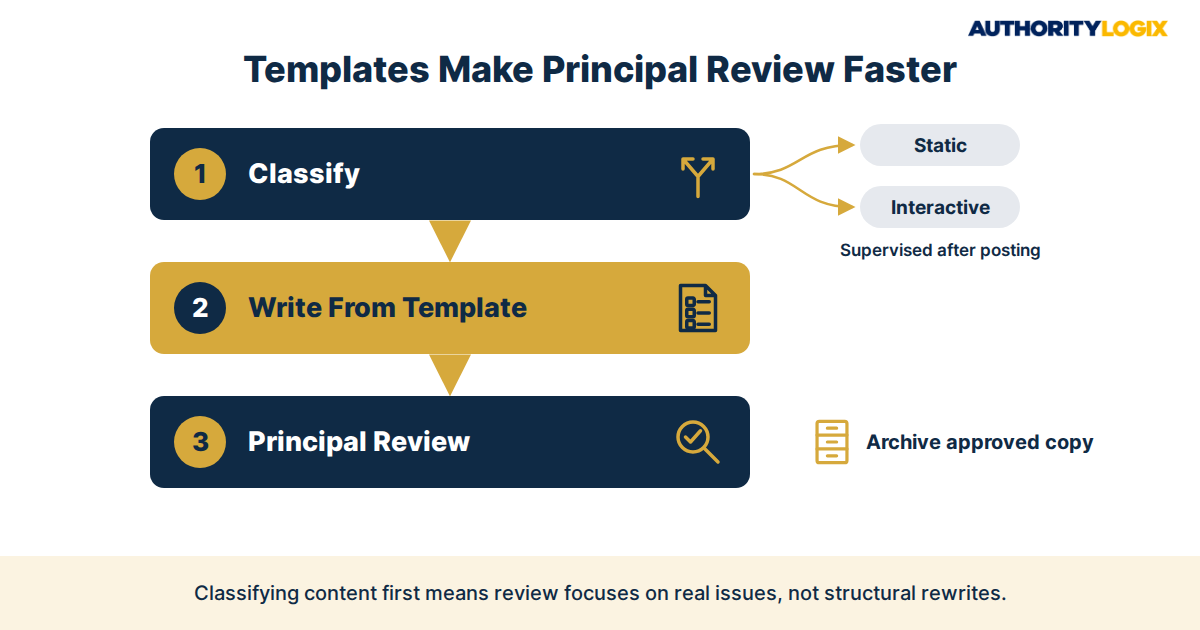
The three-step approval workflow for financial services content under FINRA Rule 2210 is: (1) classify the content as static or interactive, and as retail communication or institutional communication; (2) write from a pre-approved template that embeds the correct structural compliance elements for that content classification; (3) submit for registered principal review, which confirms that no trigger terms appear in educational content, no unsubstantiated claims are made, all required disclosures are present, and the content meets the fair and balanced standard. The review catches exceptions; it does not rebuild the content from scratch. The lead generation infrastructure that depends on a consistent stream of new educational content cannot function if the approval workflow is a bottleneck at the production level.
Not sure where your financial services firm’s current content compliance infrastructure stands? The FS Authority Gap Assessment identifies the gaps.
Distributing Compliant Content Across Channels
Distribution of compliant financial services content requires channel-specific compliance attention. Under FINRA Rule 2210, social media posts by registered representatives are classified as retail communications — static content like a scheduled LinkedIn post requires pre-approval by a registered principal before it goes live, the same as a printed advertisement. Interactive content — real-time comments, replies, live Q&A — is exempt from pre-approval but must be supervised after the fact under the firm’s written procedures. The pillar strategy for financial services content architecture produces a library of pre-approved educational articles; distributing links to those articles on LinkedIn does not require re-approval of the article — but the post copy itself is a new retail communication that requires principal sign-off.
Email newsletters distributed to more than 25 retail investors within a 30-day period are retail communications under FINRA Rule 2210 — they require pre-approval and retention in the compliance archive. The recordkeeping requirement applies to all content in the approved and distributed state: the firm must be able to produce the approved version of any content distributed in the past three years during a FINRA examination. The finance content infrastructure that supports compliant financial services publishing includes a content archive as a native component — not an afterthought — because the compliance audit trail is as important as the content itself.
What Firms Most Commonly Get Wrong About Financial Services Content FINRA Compliance
They apply the wrong regulatory framework to their content
A registered investment adviser who applies FINRA Rule 2210 to its content workflow is applying a framework designed for broker-dealers — a more restrictive standard than the SEC Marketing Rule that actually governs RIAs. The SEC Marketing Rule permits testimonials and endorsements from current clients with appropriate disclosures, which FINRA’s pre-2021 rules did not. An RIA that avoids testimonials because “FINRA doesn’t allow them” is operating under a misread of the regulatory landscape. The growth playbook for financial services firms identifies which framework applies to which firm type as the first compliance step — because applying the wrong framework either over-restricts compliant content or under-restricts content that requires different disclosures.
They treat recordkeeping as optional
Recordkeeping is not a best practice — it is a compliance requirement. Under FINRA Rule 2210, firms must retain records of all retail communications for at least three years, with the first two years in an easily accessible format. A FINRA examination that finds no content archive, no approval documentation, and no retention system is a compliance failure — regardless of whether the content itself was accurate. The authority marketing framework for financial services firms treats the compliance archive as permanent infrastructure — not a file cabinet that gets organized before examinations and ignored between them.
They confuse compliance with prohibition
The most expensive compliance mistake in financial services content is treating the regulatory framework as a prohibition on publishing rather than a framework for publishing correctly. The AI search dimension amplifies the cost of this mistake in 2026: financial services firms that stop publishing educational content to avoid compliance risk are also opting out of AI citation eligibility — because AI platforms cite the same type of deep, attributed, scenario-specific educational content that Google rewards. Every month a financial services firm spends not publishing compliant educational content is a month a competitor is compounding the organic and AI authority that becomes harder to recover from year over year.

Ready to publish authority content that stays within FINRA rules, with the compliance workflow built in?
Building a Financial Services Content FINRA Compliance Operation
The financial services firms publishing the most effective content in 2026 have built the same four-component compliance system regardless of their size. The correct regulatory framework identified and applied, compliant content templates built for each content type, a documented approval workflow that produces a sign-off trail for every distributed piece. And a compliance archive that retains every approved content item in retrievable form.
These four components together make the compliance system auditable, sustainable, and fast enough to support a publishing cadence that builds topical authority. The organic leads framework makes the business case. Compliant educational content generates inbound leads that close at a far higher rate than purchased leads. And it does so continuously from the same initial content investment, without any per-lead cost.
BKDSCR.com demonstrates this system operating in a live CFPB-supervised mortgage market. The 18 pillar pages and 48 blog posts on the site are built to the educational content standard — scenario-specific, trigger-term-free, NMLS-compliant, and credit-attributed — that generates organic rankings and inbound borrower engagement without any regulatory exposure. Every piece of content was reviewed against the CFPB’s educational content framework before publication and archived with review documentation. The authority distribution layer — LinkedIn posts linking to new articles, email broadcasts, syndication — is run through the same compliance review so distribution does not introduce new regulatory exposure with each new channel activated.
The compliance problem in financial services content marketing is real — but it is a solvable systems problem, not a prohibition on publishing. The firms that build the system are accumulating compounding organic and AI authority that the firms avoiding compliance review cannot shortcut. When you’re ready to build, work with us is the starting point.