


Key Takeaways
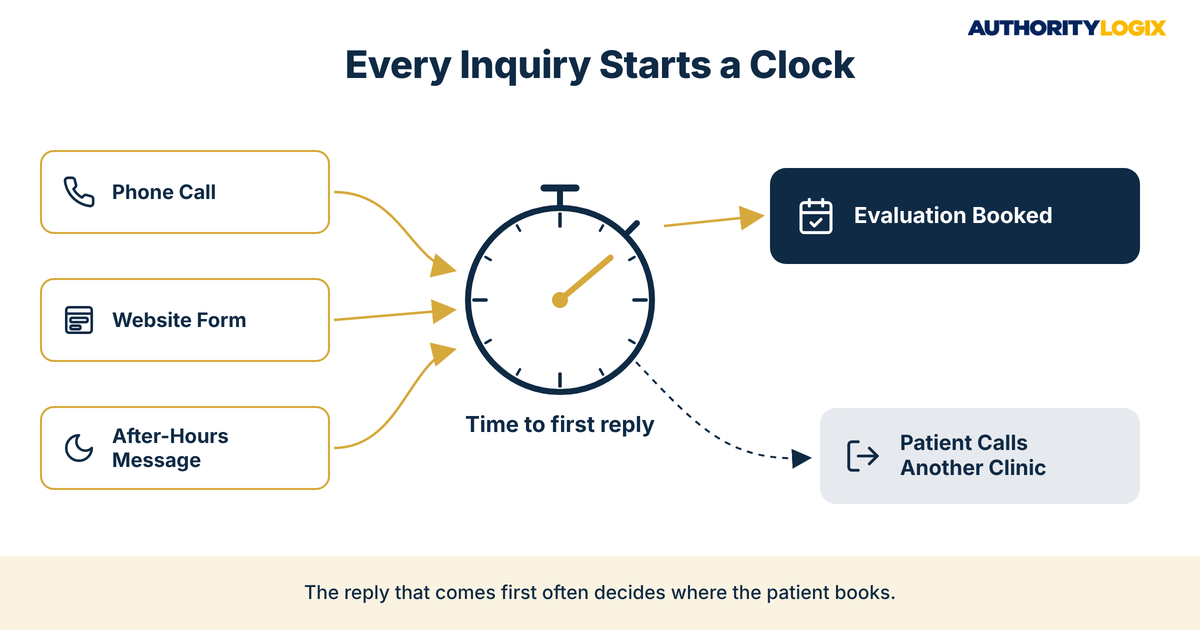
- Physical therapy speed to response patient acquisition is the time between a prospective patient reaching out and someone at your clinic replying, and it is often where a ready patient is lost.
- In the InsideSales and MIT lead response study first presented in 2007, calling back within 5 minutes instead of waiting 30 minutes increased the odds of making contact by 100 times.
- The same study found the ability to qualify or set an appointment went up by 21 times. It is general sales research, not healthcare data, but the pattern is hard to ignore.
- Physical therapy inquiry response speed usually breaks down in three places: missed phone calls, unanswered web forms, and after-hours messages.
- BrightLocal’s 2026 survey found 19% of consumers expect a business to respond to their review on the same day, up from 6%, a sign of how fast people now expect to hear back.
- Physical therapy speed to response patient acquisition is a front desk system, not a personality trait, and it only pays off when patients can find you first.
Table of Contents
Why Physical Therapy Speed to Response Patient Acquisition Gets Overlooked
Physical therapy speed to response patient acquisition is the stretch of time between a prospective patient reaching out and someone at your clinic replying, and most practices never measure it. You have spent years building clinical skill, earning physician trust, and getting found in your town — and then a voicemail from a ready patient sits until the next afternoon. By then, that person may already have booked with the next clinic on the list. Every stage of your acquisition pipeline can be working and still leak at this one step.
It gets overlooked because it is invisible on every report a practice owner reads. Visit counts, cancellation rates, and referral volume show up in the software, while the inquiry that never got a reply shows up nowhere. Physical therapy speed to response patient acquisition is the credible but invisible problem in miniature: the clinic is excellent, and the patient never finds out.
The issue grows as a practice reduces its dependence on physicians. Referred patients usually arrive with a script and a reason to call back, while direct-access patients are often still comparing options. Building a lead generation system brings more of those self-directed inquiries in, which makes physical therapy speed to response patient acquisition more important, not less.
Practice owners also tend to assume the front desk has it covered. The front desk is handling check-ins, insurance questions, and rescheduling at the same time, so new inquiries wait behind the people standing at the counter. That is why AuthorityLogix treats response handling as part of the infrastructure described on the PT industry hub, not as a front desk courtesy. Physical therapy speed to response patient acquisition needs an owner, a standard, and a way to measure it.
The Physical Therapy Patient Acquisition Playbook shows where physical therapy speed to response patient acquisition fits in the full pipeline, from the first search to the booked evaluation.
What the Data Says About PT Lead Response Time Conversions
A widely cited study on response speed does not come from healthcare. It comes from a lead response management study by InsideSales with Dr. James Oldroyd of MIT, first presented in October 2007 and built around sales leads. That age and that context matter, so read the numbers as a general pattern about how quickly interest fades, not as a physical therapy benchmark.
With that caveat stated, the findings are hard to dismiss. According to the InsideSales study, calling back within 5 minutes versus waiting 30 minutes increased the odds of making contact by 100 times, and the ability to qualify or set an appointment went up by 21 times. For PT lead response time conversions, the lesson is that the first half hour after an inquiry is not a neutral delay.
The same page describes sales reps who do not even attempt a first phone call for 24 to 48 hours. A clinic that returns web inquiries the next business day sits closer to that pattern than to the 5-minute standard, even if nobody on the team would describe the clinic as slow.
How to Read Older Sales Research in a Clinic Setting
Patients are not sales prospects, and nobody should treat a person in pain like a lead to be chased. But the behavior the study measured — interest that cools when no one answers — shows up in clinics too, which is why response delay is one of the conversion gaps worth checking first in a direct-access pipeline. PT lead response time conversions improve when a clinic treats the first reply as part of the patient experience, not as administrative overhead.
Measuring it is the first step. Track the time between each inquiry and the first human reply for a month, by channel, and the pattern usually becomes obvious. Building that measurement into the intake system is part of what we do, because physical therapy speed to response patient acquisition cannot improve while it stays unmeasured.

Where Physical Therapy Inquiry Response Speed Breaks Down: Phones, Forms and After-Hours
Physical therapy inquiry response speed rarely fails everywhere at once. It fails at specific handoffs, and each one has a different fix. Most clinics have three handoffs that decide physical therapy speed to response patient acquisition: the phone, the website form, and messages that arrive after closing.
The phone is still where many new patients start, and it is where response speed is most fragile. A front desk juggling a full waiting room will let new calls roll to voicemail, and a voicemail without a same-hour callback is an inquiry at risk. The listing that produced the call, covered in the local visibility guide, did its job; the clinic simply did not finish it.
Web forms are worse, because they feel handled the moment they are submitted. The message lands in a shared inbox that nobody owns, and the reply goes out tomorrow or later. Every form your local search work generates deserves the same urgency as a ringing phone, because the person who filled it out may be comparing clinics in the same browsing session.
After-Hours Inquiries and the Next-Morning Gap
Inquiries do not stop at closing time, because people often reach out after work. A message sent at 8 p.m. that waits until 10 a.m. the next day has sat for fourteen hours, and the patient has had the whole morning to book elsewhere. Physical therapy inquiry response speed after hours does not require a clinician on call; it requires an immediate acknowledgment and a clear next step.
That acknowledgment can be an automated text or email confirming the message arrived, explaining what happens next, and offering a booking link where online scheduling exists. It should never attempt clinical advice. It should tell the patient when a real person will follow up, and then make sure it happens. That follow-through is physical therapy speed to response patient acquisition after hours.

How PT Response Time Booking Rate Connects to Evaluation Bookings
PT response time booking rate is the share of new inquiries that become scheduled evaluations, viewed alongside how fast each inquiry got a reply. Most clinics track the booking rate or the response time, rarely both together. Put them side by side and physical therapy speed to response patient acquisition stops being a theory and becomes a number you can manage.
That pairing belongs on the same dashboard as new patient volume and referral mix. The growth blueprint treats measurement as part of long-term growth, because a practice that cannot see where inquiries are lost cannot fix the right thing. Slow replies to your most motivated inquiries show up quickly once the data is split by channel.
The inquiries themselves also come from somewhere. Condition pages, FAQs, and educational articles produced by your content systems generate many of the questions that land in the inbox, and someone who writes in after reading a condition page already knows something about how you work. A practice that invests in visibility and then answers slowly is paying to generate interest it does not collect.
Physical therapy speed to response patient acquisition is where those investments are either protected or wasted. A clinic does not need to answer every message in five minutes to improve; it needs to stop letting good inquiries wait a full day. Tracking PT response time booking rate monthly shows whether that is happening.
Not sure how fast your practice replies to new inquiries, or where they leak? The PT Authority Gap Assessment shows where your physical therapy speed to response patient acquisition process is losing patients and what to fix first.
Building a Physical Therapy Speed to Response Patient Acquisition Process Your Front Desk Can Run
A response process only works if it survives a busy Tuesday. That means it cannot depend on one dedicated coordinator who checks the inbox between patients. The order in how we build puts the capture and routing pieces in place before adding more visibility, so new inquiries always land somewhere with an owner.
The process itself is simple to describe. Every channel gets a named owner, a first-reply standard, and a fallback for when the owner is busy with a patient. Physical therapy speed to response patient acquisition improves when those three things are written down and reviewed every month.
What a Physical Therapy Speed to Response Patient Acquisition Standard Includes
| Channel | Owner | First-Reply Standard | Fallback |
|---|---|---|---|
| Phone calls | Front desk lead | Answer live during hours; return missed calls the same hour | Calls roll to a backup staff member |
| Website forms | Intake coordinator | Reply as soon as the form arrives during business hours | Alerts go to two people, not a shared inbox |
| After-hours messages | Automated acknowledgment, then intake coordinator | Instant confirmation; personal reply at opening | Morning queue cleared before scheduled patients arrive |
| Online booking requests | Front desk lead | Confirm the time slot the same day | Unconfirmed requests flagged at end of day |
| Profile and review messages | Practice manager | Reply within one business day | Weekly check of every profile inbox |
In physical therapy speed to response patient acquisition, the reply matters as much as its speed. A good first reply answers the obvious questions — whether a referral is needed in your state, which insurance you accept, what the first visit involves — and links to pages in your educational hub for anything longer. A fast, useful reply moves toward a booking; a fast, vague one just starts a back-and-forth.
Front desk scripts and reply templates should be written once, reviewed by a clinician for accuracy, and updated as policies change. The PT resource library includes guides on the pages those replies should point to, so staff are not writing explanations from scratch every time. Physical therapy speed to response patient acquisition gets easier when the answers already exist.

What Most PT Practices Get Wrong About Follow-Up (and What Inquiring Patients Expect)
Most clinics do not ignore inquiries on purpose. They make a few predictable assumptions about follow-up, and the questions below are the ones inquiring patients and practice owners raise most often about physical therapy speed to response patient acquisition.
How quickly should a clinic get back to me after I fill out a form?
There is no healthcare standard for this, but expectations are rising across local businesses. BrightLocal’s 2026 Local Consumer Review Survey found that 19% of consumers expect a business to respond to their review on the same day, up from 6%, and 32% want a response by the following day. Inquiries about care deserve at least that much urgency.
Is one call back enough?
Usually not. People miss calls from unknown numbers, so a single voicemail rarely closes the loop. A short sequence — a call, a text or email with a booking link, and a second attempt the next day — gives the patient several easy ways to respond without feeling chased. Polite persistence is part of physical therapy speed to response patient acquisition.
Should the front desk answer clinical questions on the first call?
No. The front desk should explain how the clinic works and get the patient scheduled, while clinical questions belong with a licensed clinician. What the website can do is answer the common non-clinical questions in advance, and the clinical authority guide covers how to build pages patients trust before they ever call.
Does a fast reply make up for a weak website?
Only partly. A fast reply saves the inquiries you already have, but the number of inquiries depends on whether patients find and trust your site in the first place. The page structure that generates those inquiries is covered in the content SEO playbook, and physical therapy speed to response patient acquisition protects them once they arrive.
Will automated replies feel impersonal to patients?
They can, if they pretend to be a person or say nothing useful. An honest automated confirmation that names the clinic, says when a real person will reply, and offers a booking link is a courtesy, not a shortcut.
Ready to build the inquiry capture, routing, and follow-up system that turns more calls and forms into booked evaluations? Let’s set up a physical therapy speed to response patient acquisition process your front desk can actually run.
The Honest Close: Fast Response Only Matters if Patients Find You First
Speed to response is a multiplier, not a source. It protects inquiries that already exist, but it cannot create them, and a clinic nobody can find has nothing to respond to. Visibility comes first: local search, condition content, and authority distribution that puts your clinicians in front of the people who will eventually reach out.
That is why physical therapy speed to response patient acquisition belongs inside a larger system rather than as a standalone fix. BKDSCR.com, the AuthorityLogix proof-of-concept in the NYC outer-borough real estate investment niche, was built on the same principle: 18 pillar pages and 7 interactive tools generate inbound leads with zero paid ads, and every page points the visitor to a clear next step. Visibility and capture were built together.
We build both halves because we have run them ourselves in a live market, which is the short version of why AuthorityLogix approaches patient acquisition the way it does. No one can promise a specific booking rate, and the right response process will look different in a single-location clinic than in a multi-site group.
The honest answer is that most practices are not losing patients because their care falls short. They lose some of them in the hours between an inquiry and a reply. Fix physical therapy speed to response patient acquisition, make sure patients can find you first, and the expertise you already have finally gets the chance to show.