


Key Takeaways
- A physical therapy link earning strategy wins links from local schools, clubs, employers, and health publishers by giving them something worth citing, not by paying for placement.
- Ahrefs’ search traffic study reports a clear correlation between the number of websites linking to a page and its traffic, though it notes correlation does not prove causation.
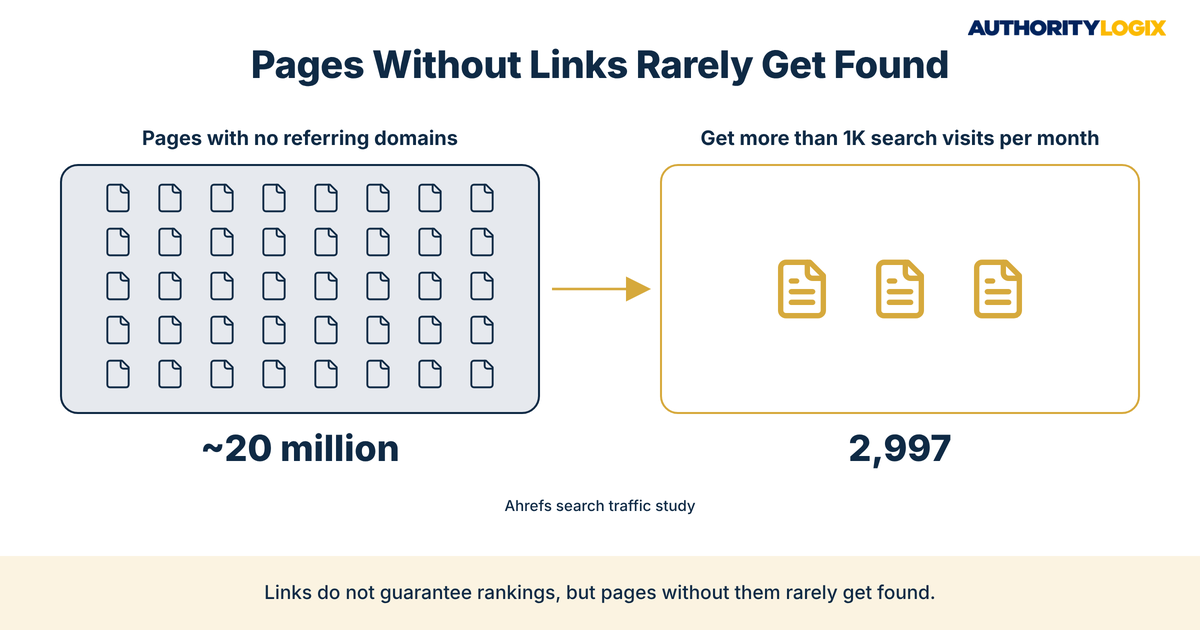
- Of roughly 20 million pages in Ahrefs’ index with no referring domains, only 2,997 get more than 1K search visits per month.
- Google’s spam policies list buying or selling links for ranking purposes as link spam, so paid backlinks can put a practice’s visibility at risk.
- Physical therapy link building content means assets other sites want to reference: condition guides, local injury-prevention resources, and clinician commentary.
- A physical therapy link earning strategy runs month by month on relationships the practice already has, and the links follow the reputation.
Table of Contents
Why a Physical Therapy Link Earning Strategy Beats Buying Backlinks
A physical therapy link earning strategy starts from a fact most practice owners already sense: the clinics that rank tend to be the ones other websites talk about. Your practice may treat many of the high school athletes in town, run the fall-prevention talk at the senior center every spring, and hold the respect of every orthopedic surgeon nearby, yet that reputation rarely shows up as links. The growth blueprint treats that gap as a growth problem, not a technical one.
The data explains why links matter. Ahrefs’ search traffic study reports a clear correlation between the number of websites linking to a page and its traffic, and of roughly 20 million pages in its index with no referring domains, only 2,997 get more than 1K search visits per month. Ahrefs is careful to say correlation does not imply causation, and that caution belongs in any honest physical therapy link earning strategy.
Google says plainly that it uses links as a signal when determining the relevancy of pages and to find new pages to crawl. That is why link sellers find so many buyers. It is also why Google’s spam policies define link spam as creating links to or from a site primarily for the purpose of manipulating search rankings, and list buying or selling links for ranking purposes as the first example.
A paid link is a rented signal with a penalty clause attached. An earned link comes from a school, club, employer, or publisher that chose to point its readers to you, and that choice is what a physical therapy link earning strategy is built to produce. Earned links also travel further, which is the job of authority distribution: putting your clinicians’ expertise in front of the sites and audiences most likely to cite it.
The Physical Therapy Content & SEO Playbook shows where a physical therapy link earning strategy fits in the larger content architecture, and which pages your earned links should point to.
What Makes Local Sites Want to Link to a PT Practice
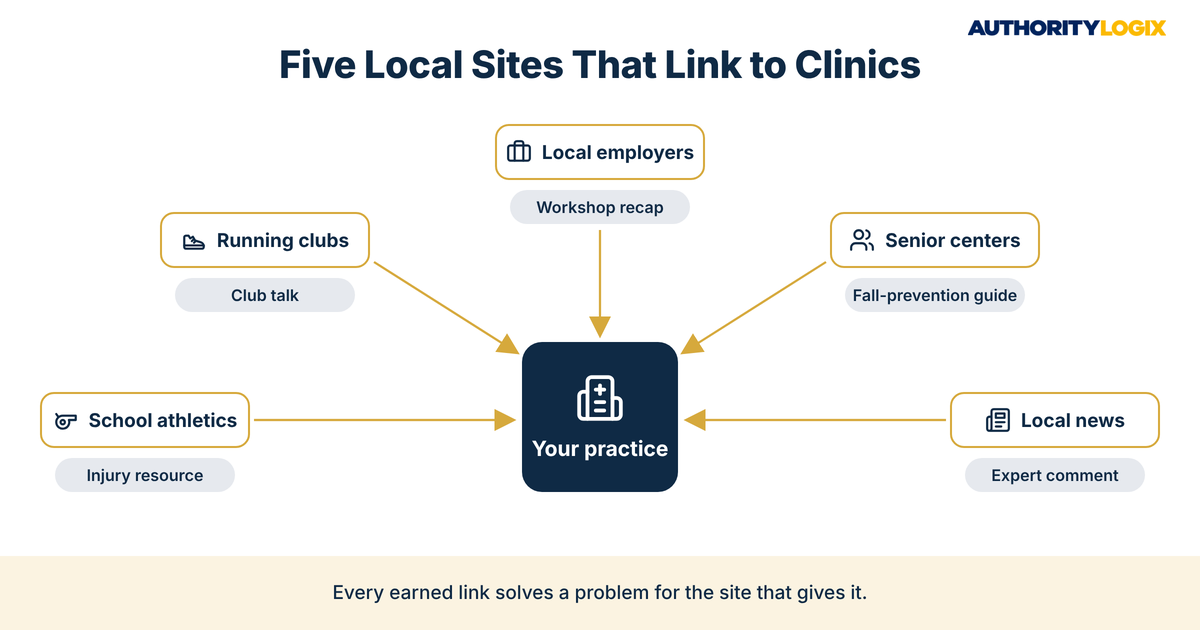
Local sites link for their own reasons, not yours. A youth soccer league links to a clinic that published its concussion return-to-play resource for coaches, an employer links to the practice that ran its ergonomics workshop, and a local news site links to the therapist it quoted on running injuries before the city marathon. In every case the link solved a problem for the site that gave it, which is the principle every physical therapy link earning strategy rests on.
That is the credible but invisible pattern again: the practice already does work worth citing, and the web simply has no record of it. Turning community standing into search visibility is the core of local authority positioning, and links are one of the clearest places that standing either shows up or disappears.
| Local Linking Site | Why It Would Link | What the Practice Offers |
|---|---|---|
| School athletic programs | Parents and coaches need trusted injury information | A sports injury resource page for coaches and families |
| Running and cycling clubs | Members ask about training and recovery | Clinician talks and a club resource page |
| Local employers | HR teams run wellness and ergonomics programs | Workshops with a recap page on your site |
| Senior centers and community groups | Programs need speakers and handouts | Fall-prevention talks with a downloadable guide |
| Local news and community blogs | Reporters need expert sources | A clinician available for comment with a bio page |
Each of those links also strengthens the local signals that help a clinic appear in nearby searches. Links from sites in your own town reinforce the location details your profile and pages already carry, a connection covered in the local visibility guide. A physical therapy link earning strategy that ignores geography wins links that rarely bring a patient through the door.
Your Google Business Profile and website still have to agree with each other for those links to count toward the right location. Consistent name, address, and phone details, location pages that name the towns you serve, and a profile that lists your services all belong to local search work. The links make that foundation stronger; they cannot replace it.
Physical Therapy Link Building Content: Assets Worth Citing
Physical therapy link building content is anything another site would rather point to than write itself. Most service pages do not qualify, because no outside site wants to send its readers to a sales page. What a physical therapy link earning strategy needs instead is content that is useful, specific, and clearly written by someone qualified to write it.
Condition guides are the most dependable asset in a physical therapy link earning strategy, because schools, gyms, and community sites regularly need a trustworthy page to send people to. A patient education library organized by condition gives those sites one place to link, and every guide in it can carry the clinician’s name and credentials. Guides should explain and educate in general terms and leave individual care decisions to an evaluation.
Physical Therapy Link Earning Strategy Assets That Get Cited
- Condition guides written for patients, with a named clinician author
- Local resources, such as a youth sports injury guide for area coaches
- Event recap pages for community talks and workshops
- Clinician bios built to support media and expert quotes
- Simple tools, such as a printable home-safety checklist
Those assets work best inside a structure built for them. An educational hub groups related guides, links each one to the matching service page, and gives outside sites a stable address that will still exist next year. A physical therapy link earning strategy that sends links to scattered blog posts loses much of their value when those posts are moved or deleted.
Authorship matters as much as the topic. A guide signed by a named therapist with listed credentials is far easier for a school or newspaper to cite than an unsigned page, and the signals described in the clinical authority guide make the page credible to the site considering the link. Physical therapy link building content without a visible expert behind it reads like marketing, and editors rarely link to marketing.
Not sure where your practice stands before starting a physical therapy link earning strategy? The PT Authority Gap Assessment shows which pages, profiles, and trust signals are weakest and what to build first.
A PT Organic Backlink Strategy Built on Community Relationships
A PT organic backlink strategy works best when it starts with relationships the practice already has. Most clinics are already connected to coaches, gym owners, employers, and community organizers through patients and staff, and a physical therapy link earning strategy simply makes those relationships visible online. Cold outreach to strangers is slower and less likely to land.
Start by listing every organization the practice has worked with in the last few years, from sponsorships to talks to shared events. The AuthorityLogix PT industry hub frames this as part of the same visibility system as your profile and pages, because the same relationships feed all three. For each organization, note whether its website already mentions you and whether that mention links to the right page.
Unlinked mentions are the easiest wins. A club that thanks your practice for sponsoring its race, or a school newsletter that names your therapist, is usually glad to add a link when asked politely and pointed to a useful page. A PT organic backlink strategy that starts with these requests builds momentum before any new content is written.
In a physical therapy link earning strategy, new relationships come from showing up with something useful. Offering a talk, a coaches’ clinic, or a workshop gives an organization a reason to write about the practice, and a recap page on your site gives it something to link to. That rhythm only holds when content systems turn each event into a page as a matter of routine, rather than relying on whoever has time that week.

Running a Physical Therapy Link Earning Strategy Month by Month
A physical therapy link earning strategy is a schedule, not a campaign. Links arrive slowly and unevenly, so the practice needs a rhythm it can keep for a year without anyone burning out. The plan below is a starting order, not a fixed rule, and it assumes the clinic is publishing educational pages at the same time.
| Month | Focus | What Earns the Link |
|---|---|---|
| Month 1 | Audit existing mentions and relationships | Requests to add links to unlinked mentions |
| Month 2 | Publish one local resource page | Outreach to the schools or clubs it serves |
| Month 3 | Host or join one community talk | Recap page linked from the host’s site |
| Month 4 | Prepare clinician bios for media | Expert quotes in local news and blogs |
| Month 5 | Add condition guides to the education library | Links from gyms, coaches, and community sites |
| Month 6 | Review which links arrived and why | Repeat what worked in the next cycle |
Each month builds on the last, and the review in month six matters as much as any outreach. Tracking which assets earned links and which did not tells you where to put the next quarter’s effort, and how we build these programs for clinics follows the same loop of building, measuring, and adjusting. A physical therapy link earning strategy that never reviews its results keeps repeating its weakest moves.
Can a PT Earn Backlinks Without Paying? What the Plan Requires
Can a PT earn backlinks without paying? Yes, but the price is time and consistency rather than money. The plan above needs regular attention from someone on staff, a clinician willing to speak or write, and a website with pages worth linking to, and practices that skip the content side usually stall early.
Keep a physical therapy link earning strategy clean as links arrive. Google’s spam policies treat excessive link exchanges, such as “link to me and I’ll link to you” arrangements, as link spam, along with low-quality directory or bookmark site links. A sponsorship that comes with a link is fine to accept, and Google’s policies say links bought for advertising or sponsorship are not a violation as long as they are qualified with a rel=”nofollow” or rel=”sponsored” attribute.
Every page that earns a link should also help the practice explain itself. The PT resource library is built on that principle: each article teaches something specific and connects to the pages around it. A physical therapy link earning strategy works the same way, because an earned link is only as useful as the page it lands on.

What Most PT Practices Get Wrong About Links, Seen Through a Patient’s Eyes
Patients never think about backlinks, but they see the results of a physical therapy link earning strategy every time they search. The questions below are the ones practice owners ask most, answered from the point of view of the patient who eventually finds, or does not find, the clinic.
Does a patient ever notice where a clinic’s links come from?
Not directly, but patients do notice where they meet the practice. A parent who finds your concussion guide on the team website, then sees your clinic in a local search, arrives with a level of trust no ad can buy.
Are directory listings enough for a physical therapy link earning strategy?
Directories help with consistent business details, but they rarely earn the kind of trust a patient feels from a school or club recommendation. A patient comparing clinics responds to proof that real local organizations rely on you, which is the same trust-first path the acquisition playbook maps from first search to first visit.
Should a practice pay for links if competitors do?
No. Paid links for ranking purposes are link spam under Google’s policies, and Google says sites that violate its policies may rank lower in results or not appear in results at all. A physical therapy link earning strategy is slower and keeps working.
What should an earned link lead to?
A page that helps the visitor take the next step. A coach who clicks through to your sports injury guide should find a clear way to request a screening or book an evaluation, and that path is the job of lead generation on the site. A link that lands on a dead end wastes the trust it carried.
How long until links make a difference?
There is no fixed timeline, and no one can honestly guarantee a ranking change. What a physical therapy link earning strategy controls is the steady supply of useful pages and real relationships that make links likely.
Ready to turn your community relationships into earned links that point patients to your best pages? Let’s build the link earning plan for your practice.
The Honest Take: Links Follow Reputation, Not the Other Way Around
Links are a record of reputation, not a substitute for it. The practices that earn the most links are usually the ones already doing the most visible work in their communities, and a physical therapy link earning strategy simply makes sure the web keeps track of it. Authority compounds.
Doing that consistently is where most practices fall short, because the clinicians who earn the reputation are also the ones treating patients all day. Building the pages, tracking the relationships, and asking for the links is what we do for PT practices that want their standing to show up in search.
AuthorityLogix tested this kind of infrastructure on its own build first. BKDSCR.com, in the NYC outer-borough DSCR real estate niche, grew to 18 pillar pages, 7 interactive investor tools, and 48 SEO-optimized blog posts with zero paid ads, and that experience shapes our approach to building visibility for clinics.
The honest answer is that most PT practices already have the relationships and expertise that earn links. What is missing is a physical therapy link earning strategy that turns that reputation into pages other sites want to cite, one month at a time.