

Key Takeaways
- AI search physical therapy content structure is the combination of page organization, E-E-A-T signals, and answer-first paragraph format that makes PT practice content eligible for citation in Google AI Overviews, ChatGPT, Perplexity, and other answer engines.
- AI Overviews now appear in approximately 89% of healthcare queries, per BrightEdge 2026 research — a PT practice whose content is not structured for AI citation is invisible to a growing proportion of patients who find their treatment options through AI-summarized search results.
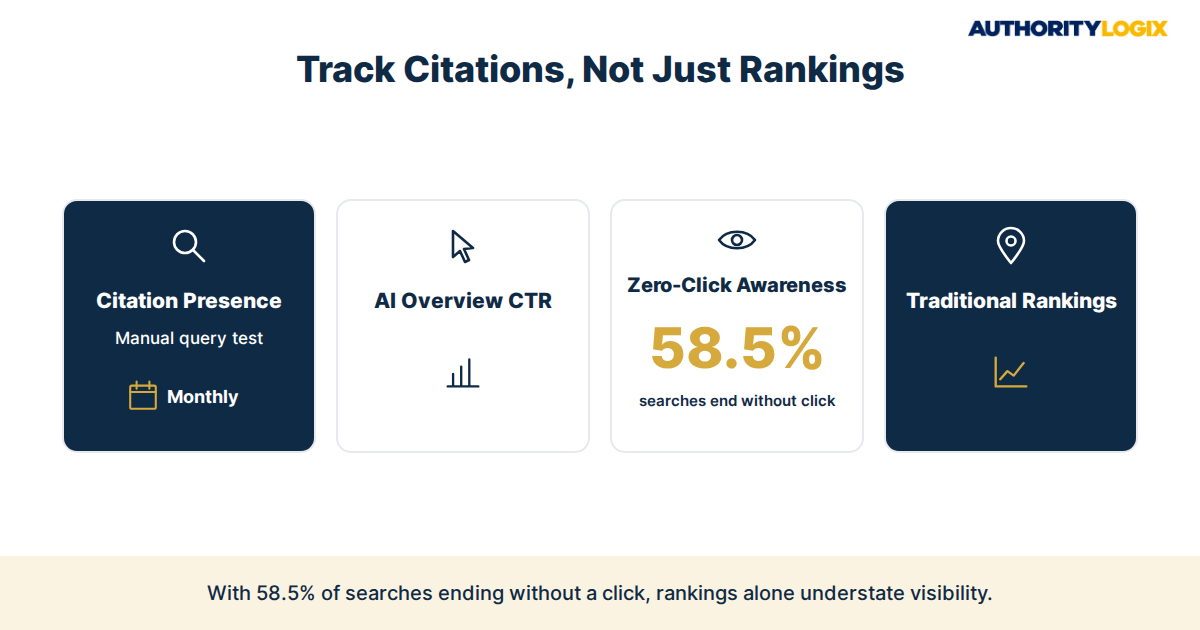
- 58.5% of US Google searches end without a click, per SparkToro’s 2024 study — and healthcare queries are part of this zero-click shift. Being cited as the AI Overview source is the new goal of PT content optimization.
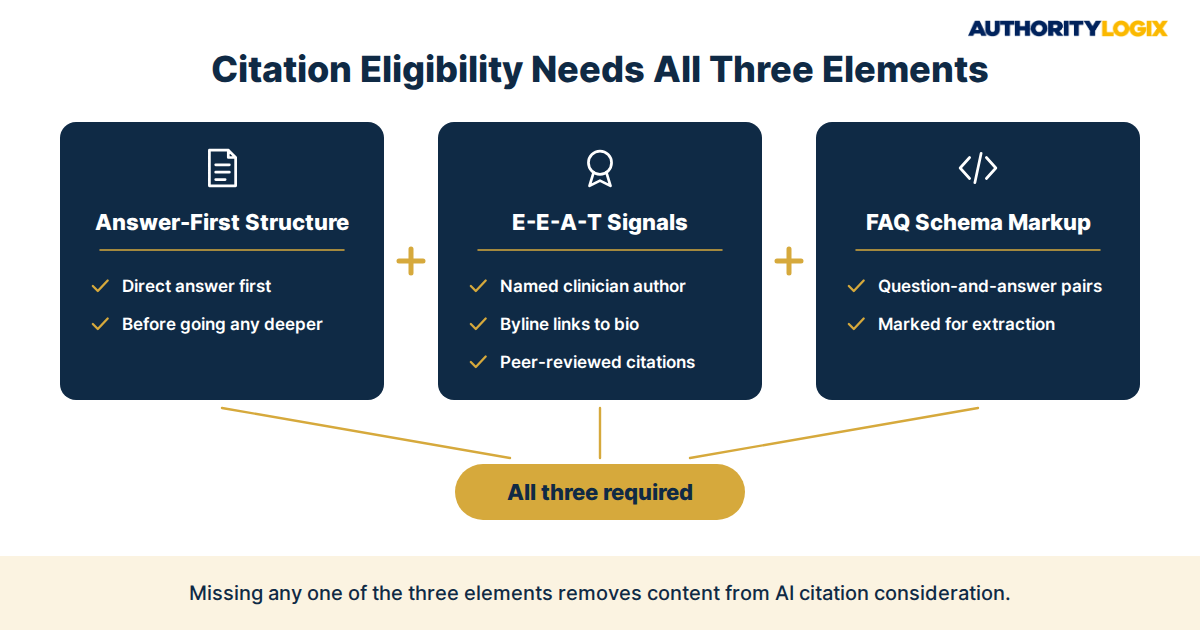
- The three structural requirements for AI search citation are: answer-first paragraph format, E-E-A-T signals including named clinician authorship, and FAQ schema markup. All three must be present simultaneously.
- AI search systems apply elevated skepticism to unverified healthcare claims — authoritative sourcing is a hard requirement, not a preference. PT content without peer-reviewed citations will be deprioritized for AI citation.
- Google has stabilized its AI Overview deployment — local search queries do not trigger AI Overviews, while informational queries and treatment comparison queries consistently trigger them. This distinction clarifies which PT content types to optimize for AI citation.
- Physical therapy condition pages with direct-access sections, treatment comparison content, and direct access FAQ pages are the three highest-AI-Overview-citation-rate content types for PT practices.
Table of Contents
AI search physical therapy content structure is no longer an advanced topic for large health systems — it is the baseline content standard for any PT practice that wants to be visible in the search environment where patients are increasingly finding their treatment options. The PT practice whose content is structured for AI citation is the practice whose name, approach, and credentials appear in the AI-generated answer that the patient reads instead of clicking through to a list of search results.
This article covers how AI search systems evaluate physical therapy content for citation eligibility, what the specific structural requirements are, and how to implement those requirements without sacrificing the clinical depth and patient-accessible clarity that makes PT content useful to human readers simultaneously. The authority guide covers the full E-E-A-T and clinical authority system — this article focuses specifically on the AI search content structure that makes E-E-A-T signals visible to AI systems.
AI Search Physical Therapy Content Structure: How Systems Evaluate Content
AI search systems evaluate physical therapy content through the same E-E-A-T framework that Google’s human quality raters use — but with additional requirements for AI summarization: the content must be structured so the AI system can extract a direct, attributable answer to a specific patient question without reading the entire page. Per 2026 healthcare AI Overview research, AI Overviews appear in approximately 89% of healthcare queries. The pillar pages article covers how the pillar-cluster architecture that organizes PT content for human readers also organizes it for AI system extraction.
The patient search behavior that makes AI Overview optimization essential is the shift toward zero-click search: 58.5% of US Google searches end without a click, per SparkToro’s 2024 study. A PT practice whose condition page earns an AI Overview citation is building brand authority with patients who will never visit the page — the AI Overview mentions the practice, the clinician, and the clinical perspective.
The local search system connects AI Overview citation to the local search infrastructure — ensuring that the practice credited in an AI Overview is also the practice that appears in the map pack. That consistency is what turns an AI mention into an actual booked evaluation.
Google’s AI Overview deployment for healthcare has stabilized around a clear pattern, per BrightEdge 2026 research: local search queries do not trigger AI Overviews. Google keeps local patient acquisition in the traditional local SEO environment. Informational queries and treatment comparison queries consistently trigger AI Overviews. This clarifies exactly which PT content types to optimize for AI citation — and confirms that local SEO and AI search optimization are complementary, not competing, investments.
Explore the AuthorityLogix PT Content and SEO Playbook built for physical therapy practices.
The 3 Structural Requirements for AI Search Citation in PT Content
AI Search Physical Therapy Content Structure Requirement 1 — Answer-First Format
The answer-first paragraph format is the structural change with the largest single impact on AI Overview citation eligibility. The most effective structural change for AI search visibility is to open each page with a direct, two-to-four-sentence answer to the core question before going any deeper. A condition page that opens with the direct PT answer gives an AI system an immediately extractable response. The content systems built for PT practices include the answer-first page template that structures every condition page and FAQ section for simultaneous human readability and AI extraction.
Requirement 2 — E-E-A-T Signals and Clinician Attribution
E-E-A-T signals are the healthcare-specific AI citation requirement that differentiates PT content from general wellness content. Strong E-E-A-T for healthcare content includes: content attributed to a named clinician with real credentials, a byline that links to the clinician’s bio page, and citations from authoritative primary sources for all clinical claims. The bio page article covers the seven elements of a clinician bio page that maximize E-E-A-T signal strength — including the specialty anchor, named condition list, and continuing education history that tell AI systems the authoring clinician has genuine expertise.
Requirement 3 — FAQ Schema Markup
FAQ schema markup tells AI systems which sections of PT content are explicitly structured as question-and-answer pairs — and therefore which sections are eligible for AI Overview extraction. A PT condition page for direct access to PT with five H3 questions, each followed by a direct-answer paragraph, plus FAQ schema markup, is built to earn AI Overview citations for all five questions simultaneously. The educational hub organizes FAQ content into the knowledge library architecture that connects FAQ pages to relevant condition pages and clinician bio pages through internal linking.

AI Search Physical Therapy Content Structure: Which Types Earn the Most Citations
Three PT content types earn AI Overview citations at consistently higher rates than other PT content formats. The acquisition playbook covers how AI Overview citations contribute to the patient acquisition pipeline — including how a practice cited in an AI Overview earns trust with patients who will not click through but will remember the practice name when they are ready to book.
Condition Pages with Direct-Access Section
Condition pages that include a direct-access section — answering “Do I need a referral for PT for [condition] in [state]?” — earn AI Overview citations for two query types simultaneously. The visibility guide covers how direct-access condition pages connect to local search authority — including how the direct access FAQ structure earns AI Overview citations that drive patients to the practice for referral-free evaluation bookings.
Treatment Comparison Content
Treatment comparison content — “surgery vs PT for herniated disc,” “PT vs chiropractic for lower back pain” — earns AI Overview citations at high rates because comparison queries are one of the three query types that consistently trigger AI Overviews. These pages require elevated E-E-A-T signals because they are addressing treatment decision questions that Google’s YMYL evaluation holds to the highest standard. The lead generation system connects treatment comparison content to the conversion infrastructure.
Direct Access FAQ Pages
Direct access FAQ pages targeting “Do I need a referral for physical therapy in [state]?” earn AI Overview citations consistently because the query is an informational question with a state-specific answer that AI systems can extract and present as a direct response. The growth blueprint covers how direct access FAQ pages function within the practice’s long-term authority positioning — including how AI Overview citations from direct access content build brand authority with patients who would not have found the practice through local search alone.

Not sure which of your PT content pages are AI Overview eligible?
Measuring AI Search Performance for Physical Therapy Content
Measuring AI search performance requires tracking two metrics that traditional SEO dashboards do not surface: AI Overview citation presence and AI Overview click-through rate. Citation presence is measured through manual search query testing: search the target queries for each piece of AI-structured content monthly and check whether the practice’s content appears as a cited source. The PT industry hub demonstrates how the five-system framework coordinates AI search optimization with local search, lead generation, and authority distribution — ensuring AI Overview citations translate into the patient inquiry volume that justifies the content investment.
The authority distribution system amplifies AI search eligibility by building the external citation footprint that AI systems use to evaluate entity authority. The distribution system covers the external citation infrastructure that supports AI Overview eligibility — ensuring on-page E-E-A-T signals are reinforced by the off-page authority signals that AI systems use to validate the sources they cite.
Frequently Asked Questions
Does AI search optimization replace traditional SEO for PT practices?
No — they are complementary systems targeting different patient search behaviors. Traditional local SEO governs map pack visibility for provider-selection queries that AI Overviews do not appear for. AI search optimization governs informational and comparison query visibility that AI Overviews do appear for. A PT practice needs both. The content systems — already referenced above — built for PT practices include both optimization frameworks within a unified content production workflow.
How long does it take for AI-structured content to earn AI Overview citations?
AI-structured PT content typically earns its first AI Overview citation within 4 to 8 weeks for low-to-medium competition informational queries. High-competition queries may require 3 to 6 months and additional external authority signals. The quarterly review cycle outlined in the content calendar article provides the framework for tracking AI Overview citation progress. The local search — already referenced above — covers how local SEO authority contributes to the entity verification that accelerates AI Overview citation eligibility.
Does generating PT content with AI tools affect AI Overview citation eligibility?
AI-generated content is not automatically excluded from AI Overview citation — but the E-E-A-T signals that AI Overview citation requires are properties that AI-generated content structurally lacks: real clinical experience reflected in the content, a named human clinician author, and first-hand clinical perspective. The fix is ensuring that every piece of PT content is edited and attributed by a named, credentialed PT who provides the clinical perspective that makes the content eligible for citation. The growth blueprint — already referenced above — covers the content quality standards that apply regardless of production method.
Want your practice cited in Google AI Overviews and answer engines when patients ask about their condition?