

Key Takeaways
- Physical therapy condition education content works hardest when it starts with the conditions your practice already treats every week, not the rare cases that feel more distinctive to write about.
- World Physiotherapy reports that 619 million people experienced low back pain in 2020 — 1 in 13 people — and that low back pain is the leading cause of disability globally.
- The World Health Organization reports that the knee is the most frequently affected joint in osteoarthritis, with a prevalence of 365 million.
- Scoring each condition on your own visit volume, local search demand, fit and intent turns guesswork into a clear physical therapy condition frequency content priority list.
- Each cluster of physical therapy condition education content needs a condition page, supporting articles and FAQ answers linked into one hub — a single blog post per condition is not enough.
- APTA’s 2025 report confirms patients in all 50 states have provisional or unrestricted direct access, so physical therapy condition education content can lead straight to an evaluation booking.
Table of Contents
Why Physical Therapy Condition Education Content Should Come Before Niche Topics
Physical therapy condition education content is the part of your website that answers the question a patient is actually asking: what is going on with my back, my knee or my shoulder, and who nearby can help. Most practices already have the clinical depth to answer that better than anyone in town. Your therapists explain these conditions dozens of times a week, and the educational hub on your website is where that expertise should live in written form.
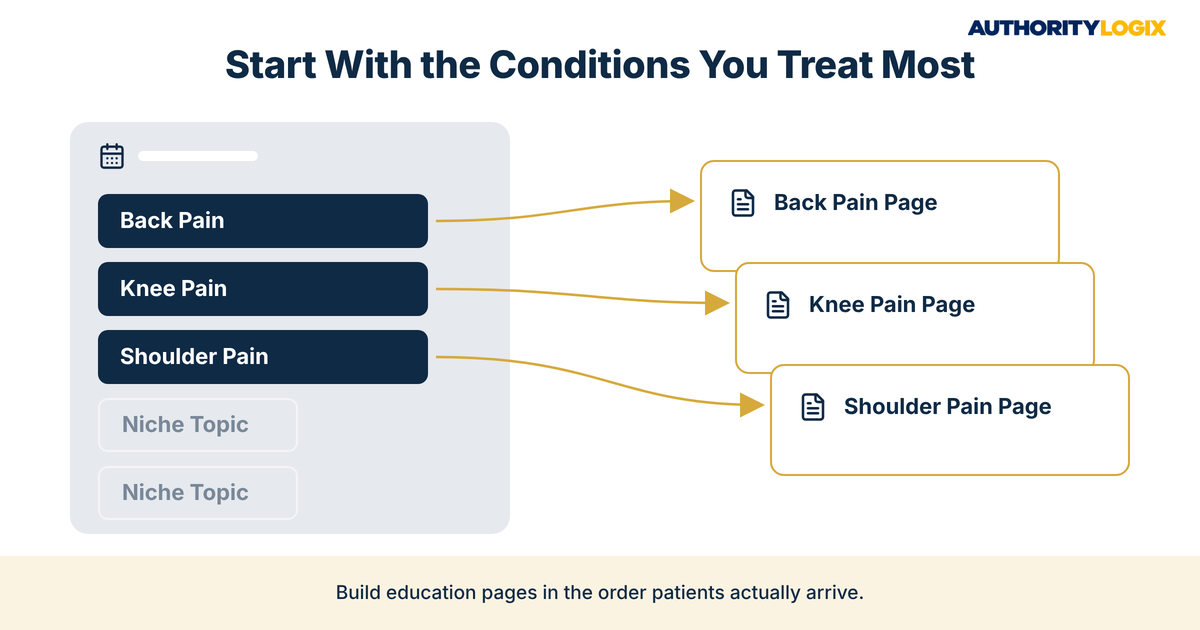
The problem is what gets published first. Many clinics start with niche topics — a rare tendon condition, a new technique, a conference recap — because they feel distinctive. Patients rarely search for those. They search for the common problems that fill your schedule, and when your physical therapy condition education content skips those, the practice stays credible but invisible to the people already looking for care.
Starting with volume also follows how search works. Pages about common conditions attract more searches, more internal links from the rest of your site and more chances to be the first clinic a patient reads. The structure underneath is laid out in the content SEO playbook, and condition coverage is the layer that sits on top of it.
There is a business reason too. Physician referrals still matter, but a practice that depends on a handful of doctors carries real risk. One referring doctor retires and the pipeline dries up overnight. Physical therapy condition education content is one of the few assets that brings patients in on their own schedule, which is why condition coverage sits at the center of the AuthorityLogix PT industry hub approach.
The Physical Therapy Patient Education & Clinical Authority Guide shows how physical therapy condition education content fits into the larger trust system — condition pages, clinician credentials and patient FAQs working together.
Ranking Conditions by Volume: Physical Therapy Condition Frequency Content Priority
A physical therapy condition frequency content priority list starts with a simple question: which conditions do patients bring through your door most often? Your scheduling and billing systems already hold the answer, summarized at the condition level with no patient details attached. Pull twelve months of evaluations, group them into broad condition categories and rank them. That ranked list, not a brainstorm, becomes the backbone of your physical therapy condition education content.
Outside data tends to confirm what the schedule shows. World Physiotherapy’s materials for World PT Day 2024, published 27 June 2024, state that 619 million people experienced low back pain in 2020 — 1 in 13 people — and that low back pain is the leading cause of disability globally. The World Health Organization’s 2023 osteoarthritis fact sheet reports that about 528 million people were living with osteoarthritis in 2019, and that the knee is the most frequently affected joint, with a prevalence of 365 million, followed by the hip and the hand.
Global numbers do not replace your own data, but they explain why back and knee problems top so many clinic lists. The search tools behind your keyword strategy show how often people in your area type each condition into Google, and that number belongs right next to your visit counts.
Scoring Physical Therapy Condition Education Content by Volume, Fit and Intent
Once you have both lists, score each condition on a few factors. Volume is how often you treat it and how often people search for it. Fit is how well it matches the patients you want more of — a sports-focused clinic will weigh running injuries differently than a practice built around older adults. Intent is how close the search sits to booking an evaluation.
- Volume — your evaluation counts plus local monthly search demand
- Fit — how closely the condition matches the caseload you want to grow
- Intent — whether searchers are researching symptoms or looking for a clinic
- Competition — how many local practices already cover the condition in depth
Intent matters most for local results. Someone searching for knee pain help near a specific town is closer to booking than someone reading about anatomy, and that is why your local search signals — the Google Business Profile, location pages and reviews — should point to the same condition pages your physical therapy condition education content builds. The score tells you what to write first. The local layer decides who sees it.

Building a PT Back Pain, Shoulder and Knee Content Strategy Around Real Searches
For most outpatient clinics, the top of the ranked list lands in the same three places. A PT back pain shoulder knee content strategy covers the conditions that fill a large share of most schedules, and it gives the website a clear structure patients can follow. The work is not writing three articles. It is building three connected clusters that answer the questions patients ask before, during and after they decide to book.
Real searches are rarely clinical. Patients type plain phrases — lower back pain when sitting, knee pain going down stairs, shoulder pain at night — and they want to know whether physical therapy is a reasonable place to start. Physical therapy condition education content that mirrors that language earns the click.
The volume problem is consistency. A practice owner who writes one strong back pain page and then stalls for six months has built a page, not a cluster. Well-run content systems fix that by turning the explanations your therapists already give every day into a steady publishing schedule that does not depend on spare time.
Each cluster should start from a condition page and grow outward. The format for those core pages is covered in the condition treatment content guide, while this article is about the order you build them in. Back pain usually comes first because of sheer demand, but your own data may put knee or shoulder ahead — and if it does, that is the list to follow for your physical therapy condition education content.
Not sure which conditions your website covers well and which it skips? The PT Authority Gap Assessment shows where your physical therapy condition education content has gaps and which cluster to build first.
PT Content by Condition Volume: What Each Core Condition Cluster Needs
Planning PT content by condition volume means matching the size of each cluster to the demand behind it. A condition that fills a large share of your evaluations deserves a full set of pages. A condition you see twice a month may need a single, well-built FAQ answer for now. The table below is a starting framework for physical therapy condition education content.
| Condition Cluster | Core Page | Supporting Content | Patient Questions to Answer |
|---|---|---|---|
| Back pain | One back pain condition page with a clear booking path | Articles on sitting, lifting and work-related back pain | Is physical therapy a good place to start? Do I need a referral? |
| Knee | One knee pain condition page covering common causes in plain terms | Articles on stairs, running and knee osteoarthritis education | What happens at the first visit? Who on the team sees knee patients? |
| Shoulder | One shoulder pain condition page | Articles on overhead work, sleep position and sports shoulder questions | How long is an evaluation? What should I bring? |
| Lower-volume conditions | A short FAQ answer inside the closest cluster | Added only after the core clusters of physical therapy condition education content are complete | Does the practice see this condition at all? |
Why Every Cluster Needs Links, Not Just Pages
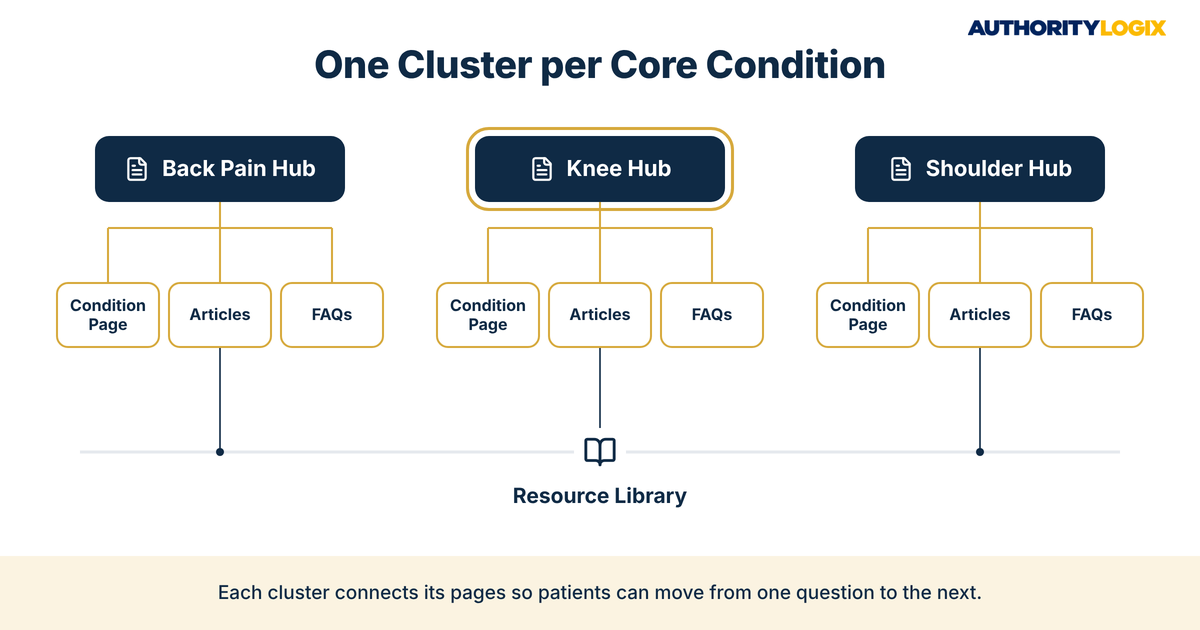
A cluster only works when its pages connect. The condition page links to every supporting article, each article links back, and the whole set feeds into your resource library so patients and search engines can move from one question to the next. Without those connections, even well-written physical therapy condition education content reads as a pile of separate posts.
The order of construction matters as much as the pages themselves. Build the condition page first, then the two or three supporting articles that answer the most-asked questions, then the FAQ answers. That sequence is at the core of how we build condition clusters at AuthorityLogix, and it means each new page strengthens the ones before it instead of competing with them.
The same structure is visible in AuthorityLogix’s own proof-of-concept. BKDSCR.com, built in the NYC outer-borough DSCR real estate niche, uses 18 pillar pages and 48 SEO-optimized blog posts organized around the questions investors search most, and it generates inbound leads with zero paid ads. Different industry, same principle: start with the highest-demand questions and build outward.
Turning Physical Therapy Condition Education Content Into Direct-Access Evaluation Bookings
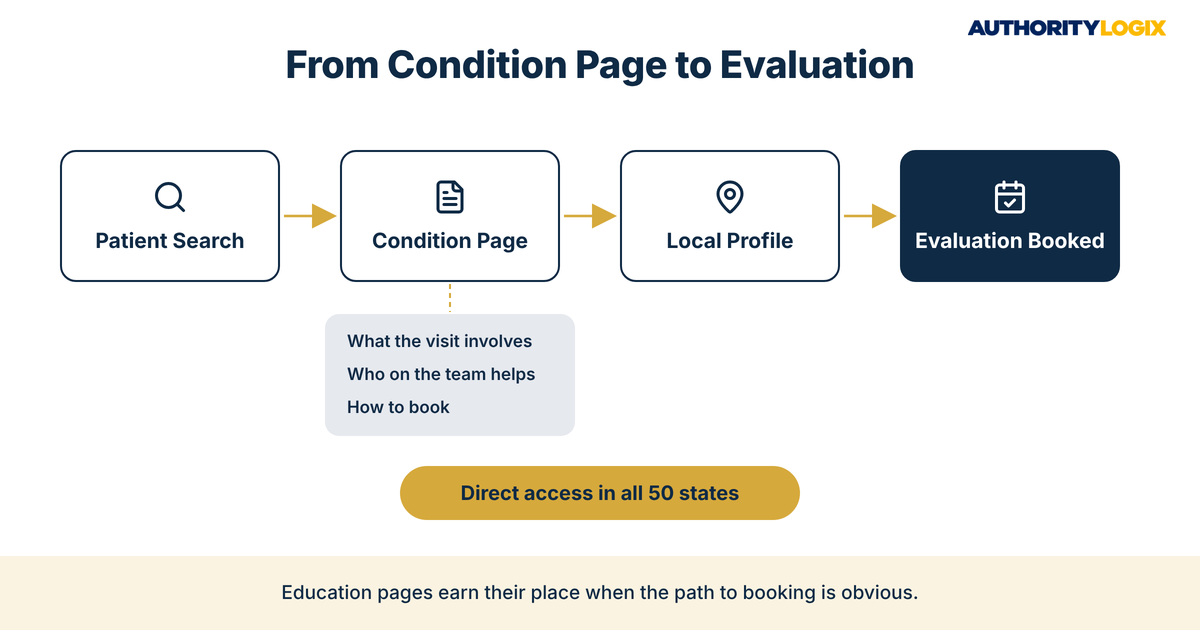
Education only pays off when it leads somewhere. According to APTA’s 2025 report on the state of direct access, patients in all 50 states, the District of Columbia and the U.S. Virgin Islands have either provisional or unrestricted direct access to physical therapist services for evaluation and treatment. A patient reading your back pain page can often book an evaluation without first seeing a physician, depending on the rules in your state.
Physical therapy condition education content should make that path obvious. Each condition page needs a plain explanation of what a first evaluation involves, who on your team works with that condition, and a booking option that does not require hunting. The full patient journey is mapped in the acquisition playbook, and the condition page is often where it starts. A practical condition page carries the same core pieces every time, so patients know where to look:
- A plain-language explanation of the condition in the words patients use
- What a first evaluation at your clinic involves
- The therapists on your team who focus on this condition
- Answers to the questions patients ask before booking
- A visible scheduling link and phone number
The capture point should match the reader’s stage. Someone comparing clinics wants a phone number and an online scheduling link. Someone still researching may prefer a short guide or a callback request, which is where lead generation systems earn their place by keeping early-stage readers connected until they are ready to book.
Local visibility completes the loop. A patient who finds your knee page through Google should see the same clinic name, address and reviews in the map results, and the local visibility guide explains how those signals reinforce each other. When physical therapy condition education content, the business profile and the booking path all agree, the patient has fewer reasons to keep searching. What the page should never do is promise a result — describe the evaluation and the team, not an outcome.
What Most PT Practices Get Wrong About Condition Content (and What Patients Ask First)
Most practices that struggle with physical therapy condition education content are not short on expertise. They are working from assumptions built for a referral-only era. These are the questions owners and patients raise most often.
Should we start with the conditions that make us look specialized?
Specialized topics have a place, but they work better once the core conditions are covered. A patient with a common problem is far more likely to be searching than one with a rare diagnosis, and physical therapy condition education content built on volume gives the specialized pages a base of authority to stand on.
Does a PT back pain shoulder knee content strategy ignore everything else?
No. It sets the order, not the limit. Once the three core clusters are complete, the same scoring method decides which condition comes next.
What does a patient want to read first on a condition page?
Patients usually want three things: whether physical therapy is a reasonable place to start, what the first visit involves, and whether they need a referral. Answer those in plain language near the top of the page and save the detail for further down.
Can we write physical therapy condition education content without making medical claims?
Yes, and you should. Describe the condition, the evaluation process and your team’s experience, and avoid promising recovery times or results. Physical therapy condition education content that explains rather than promises is easier to trust and easier to keep accurate.
Our therapists know these conditions best. Why bring in outside help?
Your therapists should own the expertise, but they rarely have time to own the publishing. That split — clinical knowledge from your team, structure and consistency from an outside build — is why AuthorityLogix works with practices that already have the credibility. The expertise never has to leave the clinic.
Ready to build physical therapy condition education content around the back, knee and shoulder conditions your practice treats most? Let’s map the clusters, condition pages and booking paths your clinic needs.
The Honest Order of Operations for a Small Practice
A small practice does not need fifty pages to start. It needs the right first few. Pull your evaluation data, rank your top conditions, build one complete cluster of physical therapy condition education content, and connect it to your business profile and booking path before moving to the next. The growth blueprint puts that sequence in the context of long-term practice growth.
Distribution comes after the foundation. Once a cluster is live, sharing it through local partners, professional profiles and community channels — the work of authority distribution — puts your physical therapy condition education content in front of people who were not searching yet. Publishing the same page in more places is not a substitute for building the cluster first.
The honest answer is that most physical therapy practices already have the clinical expertise patients are searching for. What is missing is the infrastructure that turns everyday explanations into physical therapy condition education content patients can actually find. If you want that built in the right order, what we do is designed for exactly that job. Start with the conditions you treat most, and everything else has something to build on.