


Key Takeaways
- Physical therapy free marketing works in local search because Google states there is no way to request or pay for a better local ranking.
- Google says local results are mainly based on relevance, distance and prominence, and a small practice can improve relevance and prominence with time.
- The practice in this article is a clearly labeled example scenario, with no invented rankings, percentages or patient counts.
- PT zero budget SEO comes down to a complete profile, a steady review habit, condition pages and local links.
- A 2023 Ahrefs study found that 96.55% of all pages in its index get zero traffic from Google, so physical therapy free marketing must earn links, not just publish.
- Physical therapy free marketing builds a foundation, and the practice still has to decide when that foundation needs a full system.
Table of Contents

Physical therapy free marketing is where most small practices start, because the budget is already spoken for by rent, payroll and software. You have therapists with real clinical depth and a loyal patient base, while a hospital network and a regional chain own the map results near you. The question is whether time and discipline can close a gap that money usually closes, and in local search they can close more of it than most owners expect.
This article walks through a clearly labeled example scenario. No real practice data sits behind it, and it invents no rankings, percentages or patient counts. It shows the order a no-budget practice would follow, why each step works, and where physical therapy free marketing runs out of road.
If you already spend money on visibility, none of this replaces a sound budget allocation plan. It answers a narrower question: what physical therapy free marketing can do this quarter with hours instead of dollars.
What Physical Therapy Free Marketing Can Realistically Accomplish
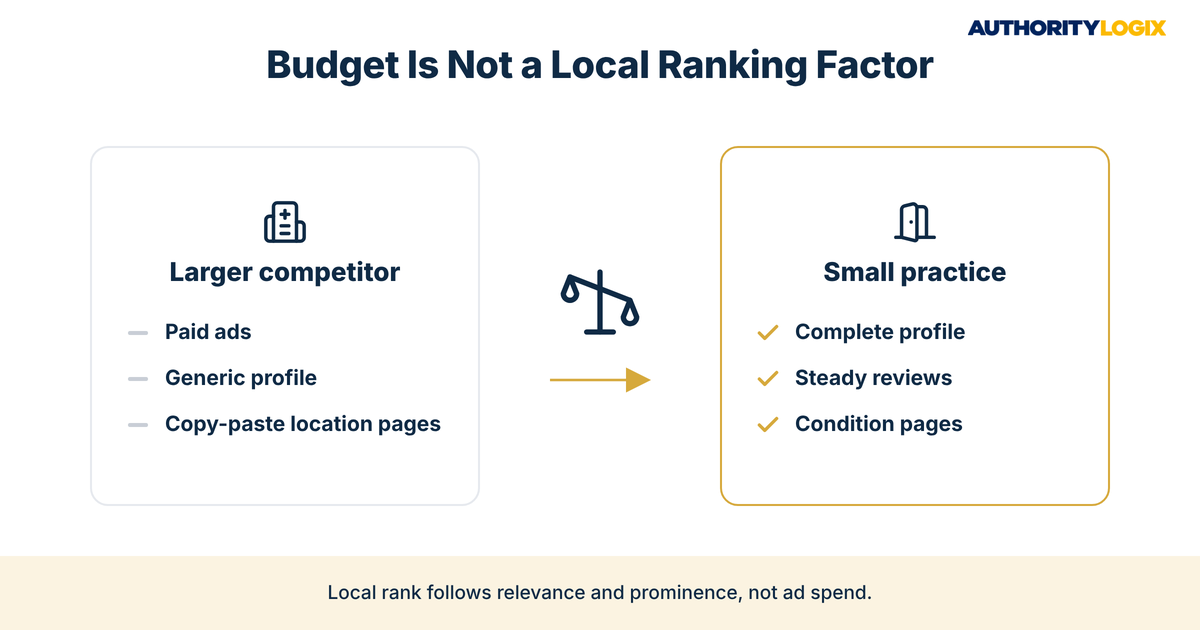
Start with what Google itself says. According to Google’s Business Profile help page on local ranking, local results are mainly based on relevance, distance and prominence, and there is no way to request or pay for a better local ranking. Whatever ad budget a larger competitor carries, it cannot buy a higher position inside the local results themselves.
Distance is fixed, because you cannot move your building closer to every searcher. Relevance and prominence are where physical therapy free marketing does its work. Relevance is how well your profile and pages match a search. Prominence, Google says, is how well-known a business is, based partly on how many websites link to it and how many reviews it has.
Realistically, physical therapy free marketing can make a small practice findable for the searches it deserves to win: the conditions it treats well, the neighborhoods it serves and the questions patients type before they book. It will not replace a full patient acquisition pipeline. What it can do is turn a practice that is credible but invisible into one that shows up when it should.
The Physical Therapy Local Visibility Guide lays out the full local search framework that physical therapy free marketing feeds into, from your profile and reviews to location pages and citations.
The Starting Point: A Small Practice Against Bigger Local Competitors
Consider an example: a two-therapist outpatient practice in a mid-sized suburb, with strong word of mouth and a referral base built on a handful of local physicians. Nearby sit a hospital-affiliated outpatient center and two locations of a regional chain, both with marketing teams and paid search budgets. In this example scenario, the small practice has a basic site, a Google Business Profile it never finished, and an owner who can protect one hour a week.
Competing with hospital-owned clinics on budget is a fight the small practice loses every time. The mistake is assuming local search is decided by budget at all. In this example, the owner’s first step is to read what the competitors’ profiles and pages actually say, before planning any physical therapy free marketing.
What the owner finds is a pattern many independent practices will recognize. The hospital center’s profile carries a description written for the whole health system. The chain’s location pages read like copies with only the address changed. Neither speaks to a specific condition, neighborhood or clinician, and thin signals are exactly what physical therapy free marketing can outwork.
The small practice, meanwhile, has assets it has never shown online: therapists with specialty training, years of patient trust and an owner who answers the same questions every week. That is practice authority in raw form. The work ahead is not to look bigger but to make what is already true visible.
PT Zero Budget SEO: Profile, Review, and Content Moves That Cost Time, Not Money
PT zero budget SEO is a short list of moves done in order and then repeated. In this example scenario, the owner starts with the profile, because Google says businesses with complete and accurate information are more likely to show up in local search results. That means the right primary category, every relevant service, accurate hours, real photos and a description that names the conditions treated.
Next comes a weekly rhythm on the profile. Short updates through Google Posts about a class, a seasonal topic or a clinician’s specialty keep it current. Google also says more reviews and positive ratings can help a business’s local ranking, so therapists ask satisfied patients to share their experience, and the owner replies to every review without confirming that the reviewer is a patient.
Physical Therapy Free Marketing Tasks for One Hour a Week
Physical therapy free marketing only works if it survives a busy clinic schedule. The table below shows how the example owner splits one protected hour each week.
| Physical therapy free marketing task | What it involves | Google local signal it supports |
|---|---|---|
| Profile update | One short post about a service, class or clinician specialty | Relevance |
| Review replies | A brief reply to every new review, with no patient details | Prominence |
| Review requests | A simple ask to recent patients who were happy with their visits | Prominence |
| Condition page | Write or improve one page about a condition the practice treats well | Relevance |
| Listing check | Confirm the name, address, phone and hours on one directory | Complete and accurate information |
The largest share of the hour goes to content, because the profile can only point to pages that exist. Each week the owner writes or improves one condition page in the plain words patients use. Every page follows the same content SEO structure: a clear question in the heading, a direct answer, the clinician who treats it and an easy way to book.
Pages alone are not enough. A 2023 Ahrefs study of around 14 billion pages found that 96.55% of all pages in its index get zero traffic from Google, and one of the main reasons it gives is that the page has no backlinks. That is why physical therapy free marketing needs a plan for earning links, not just a plan for publishing.
Earning Local Links Without Paying for Them
Local links come from relationships the practice already has: the high school athletic program, the running club, the community center and the chamber of commerce. In this example, the owner offers each one a guide, a talk or a quote for a story, and asks for a link to the relevant page. These are classic ways to market your physical therapy clinic offline, and each becomes a search signal once it ends in a link.
None of this sticks without a repeatable process. The owner keeps one list of pages, link prospects and review requests, and works through it every week. In a larger practice that list becomes formal content systems, while here it is a shared spreadsheet and one protected hour of physical therapy free marketing.
Not sure which local signals are holding your practice back? The assessment shows where physical therapy free marketing would make the biggest difference for your practice and what to fix first.
The Physical Therapy Outrank Competitors Playbook: Specificity Over Size
The physical therapy outrank competitors playbook rests on one idea: a large competitor is broad by design, and a small practice can be specific. Hospital systems write for every service line at once, and chains write templates for all of their locations. Neither can easily publish a page about one condition in one neighborhood, written by the therapist who treats it, and that is the opening physical therapy free marketing uses.
Where Larger Competitors Leave Gaps
In this example scenario, the owner looks for searches where the bigger players have nothing specific to show. Condition-and-place searches are the obvious gap, along with questions patients ask before they book: whether they need a referral, what a first visit involves and whether the practice handles their problem. Each answered question becomes a page the larger competitors have not written.
Those pages do a second job. Clear patient education content helps a searcher decide before they call, so the people who call arrive better prepared. The goal is never to give clinical advice or promise an outcome, only to explain what the practice treats, who treats it and what the next step looks like.
Specific content travels further when it is shared on purpose. The example owner sends each new page to partners and community groups that would care about it and posts a short version on the profile. That is authority distribution on a small scale, and it is how physical therapy free marketing earns the links and mentions that feed prominence.
Over months, those pages add up to an educational hub for the practice’s local area: condition pages, FAQs and clinician profiles that link to each other. Bigger competitors may still win the broad searches. The aim is to become the most relevant answer for the specific searches that match the practice’s strengths. Authority compounds.
AuthorityLogix proved the same principle on its own build. BKDSCR.com, a real estate investment education platform, carries 18 pillar pages, 7 interactive investor tools and 48 blog posts, and generates inbound leads with zero paid ads. It is not a physical therapy practice, but it shows what specific, connected content can do without an ad budget.

PT Small Practice Wins Worth Tracking Month by Month
PT small practice wins rarely arrive as a single jump. They show up as small changes each month, and tracking them keeps physical therapy free marketing going when progress feels slow. In this example scenario, no results are assumed, because the point is which measures to watch, not what they will show.
- How often the profile appears in local search and on the map
- Calls and booking requests that start from the profile
- New reviews each month and how many received a reply
- Searches where the practice now appears for a condition it treats
- New links earned from local organizations and partners
- New evaluations from patients who say they found the practice online
The last measure matters most. Every new patient should be asked how they found the practice, and the answer logged the same way every time. Once those answers point clearly to search, physical therapy free marketing has become the start of lead generation that does not depend on a single referring office.
Monthly review also shows when the work is plateauing. The most common physical therapy marketing fails at this stage are stopping after the first month and measuring nothing. If the profile is complete, reviews are steady and condition pages exist, yet new evaluations from search stop growing, the practice has reached the limit of one hour a week. That is where our process begins: an audit of what exists, then a plan for the next layer.

Physical Therapy Free Marketing FAQ: What Owners Ask
These are the questions owners and prospective patients ask most often about physical therapy free marketing and local search. The answers stay with marketing and visibility, never clinical care.
Can a small practice rank higher on Google without paying?
It can compete for the searches that match its strengths. Google states there is no way to pay for a better local ranking, so physical therapy free marketing focuses on relevance, prominence and accurate information within the area the practice serves.
What physical therapy marketing ideas cost nothing but time?
Completing the profile, building a review habit, publishing condition pages and earning local links are the four that keep paying off. The PT resources library covers each of these in more depth, from profile setup to page structure.
Is SEO for physical therapy practices different from SEO for other businesses?
The mechanics are similar, but the guardrails are not. Practices cannot share patient details in reviews, replies or content, and pages should explain services without promising outcomes.
As a patient, how do I know a practice that ranks well is a good fit?
A strong ranking is a sign of visibility, not of clinical quality. Look at clinician credentials, the conditions listed, recent reviews and how clearly the practice explains a first visit.
When should a practice stop relying on physical therapy free marketing alone?
When the free work is maintained but new evaluations from search have stopped growing, the next gains need more pages, wider distribution and better tracking than one hour a week allows. That is the work described in our services, and it builds on everything the free phase created.
Ready to turn a no-budget local search foundation into a complete visibility system that keeps bringing direct-access patients to your practice?
When Free Marketing Stops Being Enough
Physical therapy free marketing is a real strategy, not a consolation prize. The scenario in this article is illustrative, but the logic is not: a small practice with real expertise can compete with larger local players on the signals Google says matter, because money does not buy a higher local ranking. What it costs instead is time, consistency and a willingness to be specific.
It also has limits. One owner with one protected hour a week can build a foundation, but cannot run a full content operation, track every source and distribute every page at once. Most practices reach a point where the next step in PT marketing is a connected system that runs without the owner doing every task.
The honest answer is that most small practices already have the expertise larger competitors cannot fake. The missing piece is the infrastructure that makes local patients see it. Do the physical therapy free marketing work first and do it well, and when it plateaus, that is the moment to look at why AuthorityLogix builds this infrastructure for physical therapy practices.