


Key Takeaways
- Physical therapy Google reviews generation is a front-desk system, not a favor asked of a few happy patients.
- BrightLocal’s Local Consumer Review Survey 2026 found 74% of consumers seek reviews written in the last three months, so a steady monthly flow matters more than a one-time push.
- Google prohibits incentives for reviews and selectively soliciting positive reviews, and the FTC finalized a rule in 2024 that lets it seek civil penalties against knowing violators of its fake-review ban.
- The discharge visit is the natural home for a PT review request strategy, because the patient knows the practice well by then.
- Physical therapy ethical review generation means asking every patient the same way, with the same link, and never filtering who gets asked.
- A physical therapy Google reviews generation system works when one person owns it, the script is written down, and the numbers are checked every month.
Table of Contents

Why Physical Therapy Google Reviews Generation Drives Evaluation Bookings
Physical therapy Google reviews generation is work most clinics know they should do and few have built into daily operations. You may have years of loyal patients and physicians who have referred to you for a decade — and still show a Google profile with a handful of reviews, the newest from last spring. The AuthorityLogix PT industry hub is built around that gap: practices that are credible but invisible to the patient searching on a phone tonight.
That patient may not have a physician referral at all. According to APTA, all 50 states, the District of Columbia, and the U.S. Virgin Islands have either provisional or unrestricted direct access to physical therapy. A direct-access patient chooses from the results on the screen, and reviews are the first trust signal they read.
Asking works when a practice actually does it. BrightLocal’s Local Consumer Review Survey 2026 found that 78% of consumers were asked to leave a review in the past 12 months, and its review survey found 28% say they will “always” write a review if asked, up from 16% in 2025. Physical therapy Google reviews generation is about making sure your practice is one of the businesses doing the asking, every week, with every patient.
Reviews are one step in a larger patient pipeline. Our acquisition playbook maps how a searcher becomes a booked evaluation, and reviews sit at the trust step between finding your practice and calling it. Physical therapy Google reviews generation gives that step something current to show.
Reviews also shape where you appear in the first place. Google’s own Business Profile help says “more reviews and positive ratings can help your business’s local ranking,” and it counts how many reviews you have as part of prominence. That is why the AuthorityLogix local search work treats physical therapy Google reviews generation as part of the same system as the Business Profile and the location pages.
The Physical Therapy Local Visibility Guide shows where reviews fit alongside your Business Profile, location pages and citations, so physical therapy Google reviews generation supports the whole local search system.
PT Google Review Policy Compliance: What Google Allows and Forbids
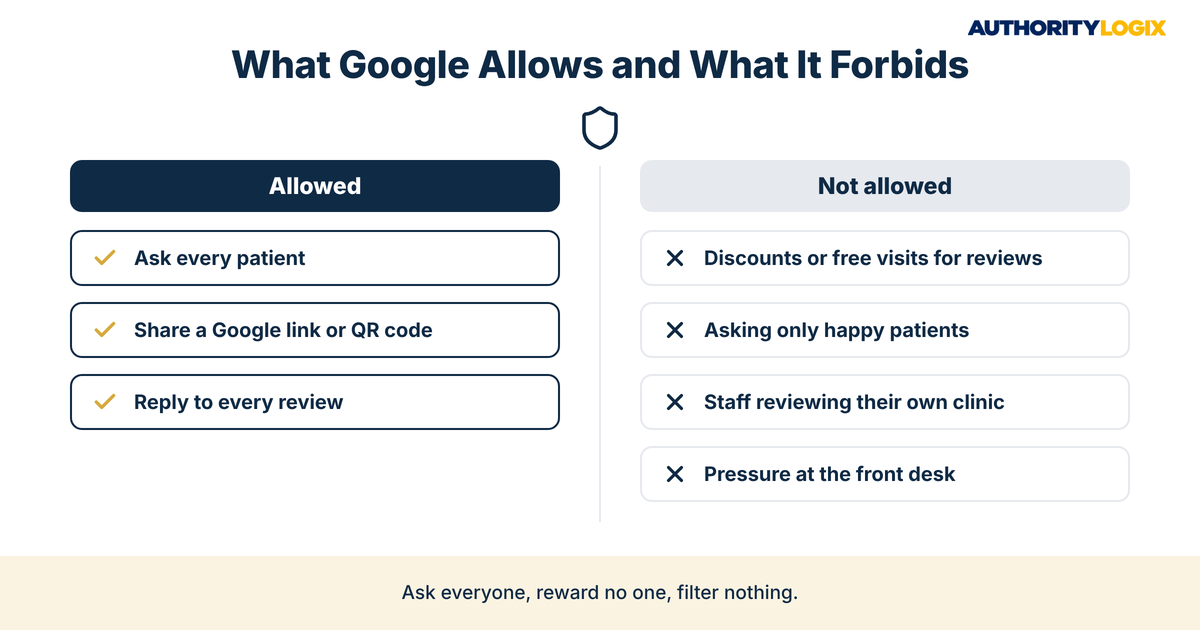
PT Google review policy compliance starts with reading Google’s rules, which are shorter and clearer than most practice owners expect. Google’s prohibited and restricted content policy treats reviews or ratings that have been paid for, directly or in kind, as fake engagement. The same policy forbids businesses to discourage or prohibit negative reviews, or to selectively solicit positive reviews from customers.
Google’s Business Profile help page on getting reviews is just as direct about incentives: offering free or discounted goods or services in exchange for reviews is “strictly prohibited.” The same page describes what is allowed — asking customers to visit a Google link or scan a QR code — and notes that customers must be signed into a Google Account to leave a review.
| Review Practice | Google’s Position | What It Means at the Front Desk |
|---|---|---|
| Asking every patient for a review | Allowed — Google tells businesses to share a Google link or QR code | Ask every discharged patient the same way |
| Offering a discount, gift card or free visit | Strictly prohibited as an incentive | No raffles, copay credits or giveaways tied to reviews |
| Asking only patients you expect to be happy | Prohibited as selectively soliciting positive reviews | No survey that decides who receives the review link |
| Staff or owners reviewing the clinic | Prohibited as content based on a conflict of interest | Employees stay off your own profile |
| Requiring a review before the patient leaves | Merchants should not require or pressure users to review while on the premises | Offer the link and let the patient post later |
| Replying to reviews | Google advises replies that are professional, polite and timely | Reply without sharing any private information |
What Breaks Physical Therapy Google Reviews Generation Fastest
Google is not the only rulebook. In August 2024 the Federal Trade Commission announced a final rule that bans incentives conditioned on writing reviews that express a particular sentiment, undisclosed insider reviews, and review suppression through threats or intimidation, and it lets the agency seek civil penalties against knowing violators. A copay credit offered for a five-star review fails both rulebooks at once.
Violations rarely come from bad intent. They come from a staff member who runs a raffle, or a vendor survey that only sends happy patients to Google. Why reviews matter for rankings is covered in our article on review visibility; physical therapy Google reviews generation is about earning them without risking the profile.
Compliance is easier when the wording is written once. The same content systems that produce your service pages and educational articles can also produce the review request script, the text message template and the reply guidelines. Then physical therapy Google reviews generation stops depending on who is working the desk.
Building a PT Review Request Strategy Into the Discharge Visit
A PT review request strategy works best when it is attached to a moment that already happens for every patient, and for most practices that moment is discharge. Patients return for a series of visits, so by the final appointment they know the team by name.
The Three Parts of a Discharge Review Request
- A spoken ask from the treating clinician or the front desk, using the same short script every time
- A same-day text or email with the practice’s Google review link or QR code
- One polite reminder a few days later, and then no further follow-up
The script should be plain. Something like: “We ask every patient who finishes with us to share their experience on Google — anything you are comfortable saying helps people nearby find us.” It asks for honesty rather than stars, and it goes to everyone, which is the core of physical therapy Google reviews generation done inside the rules.
Patients often hesitate because they are unsure what to write or uneasy about privacy. A note that they never need to mention a diagnosis, and that the practice will never confirm their details publicly, removes both concerns. Material from a patient education hub helps too, because patients who read your articles during their visits have something specific to say about how the practice explained things.
Clinicians are often the most trusted voice in the building and the least comfortable asking. Our clinical authority guide explains how clinician expertise becomes visible online, and the review ask is the smallest version of that idea — physical therapy Google reviews generation framed as visibility, not selling.
Not sure how your review profile compares with the practices ranking above you? The PT Authority Gap Assessment shows where your reviews, profile and pages fall short, and what your physical therapy Google reviews generation should fix first.
Physical Therapy Ethical Review Generation Without Incentives or Gating
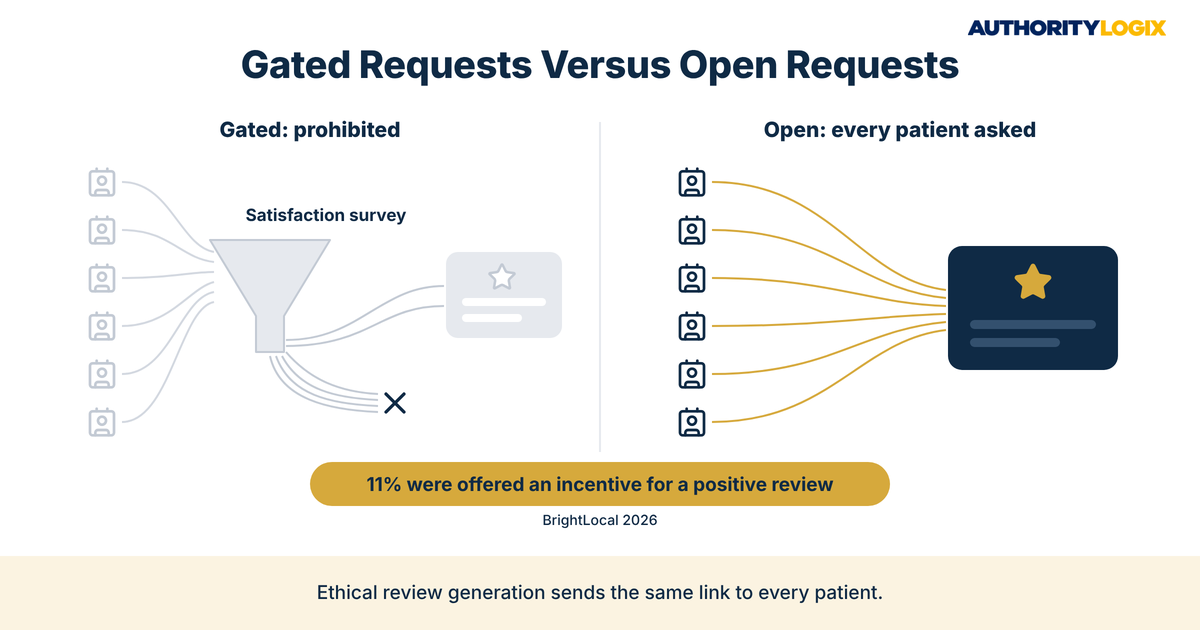
Physical therapy ethical review generation rests on two rules: reward no one, and filter nothing. Review gating — sending a satisfaction survey first and passing only the happy responders to Google — is the selective solicitation Google’s policy prohibits. It also produces a profile that looks too polished to the patients reading it.
Incentives are still common. BrightLocal’s 2026 survey found that 11% of consumers were offered an incentive to write a positive review. In a PT practice that might look like a raffle entry, a discount on a wellness package or a branded water bottle, and every one of those turns an earned review into a policy violation.
The honest alternative is to make leaving a review easy rather than rewarded. Find where the request falls in the patient journey and remove friction: one tap from the text to the review form, a QR code at checkout, and a reminder that a few sentences are enough. Physical therapy Google reviews generation succeeds on convenience, not compensation.
Some patients will leave critical reviews, and that comes with asking everyone. BrightLocal found that 47% of consumers won’t use a business with fewer than 20 reviews, so a full record earned from every patient does more than a short, spotless one built by filtering.
Reviews also give your content a second job. The words patients use — the neighborhood, the type of care — often echo the searches other patients run, which is why the content SEO playbook treats reviews and service pages as one keyword picture. Physical therapy Google reviews generation feeds it real patient language.
Reviews persuade, but they do not capture. A patient who reads ten recent reviews still needs a way to book, which is the job of the lead generation system on your site: an evaluation request form, a callback option and a visible phone number. Physical therapy Google reviews generation and a working capture path belong together.
A Physical Therapy Google Reviews Generation System Your Front Desk Can Run
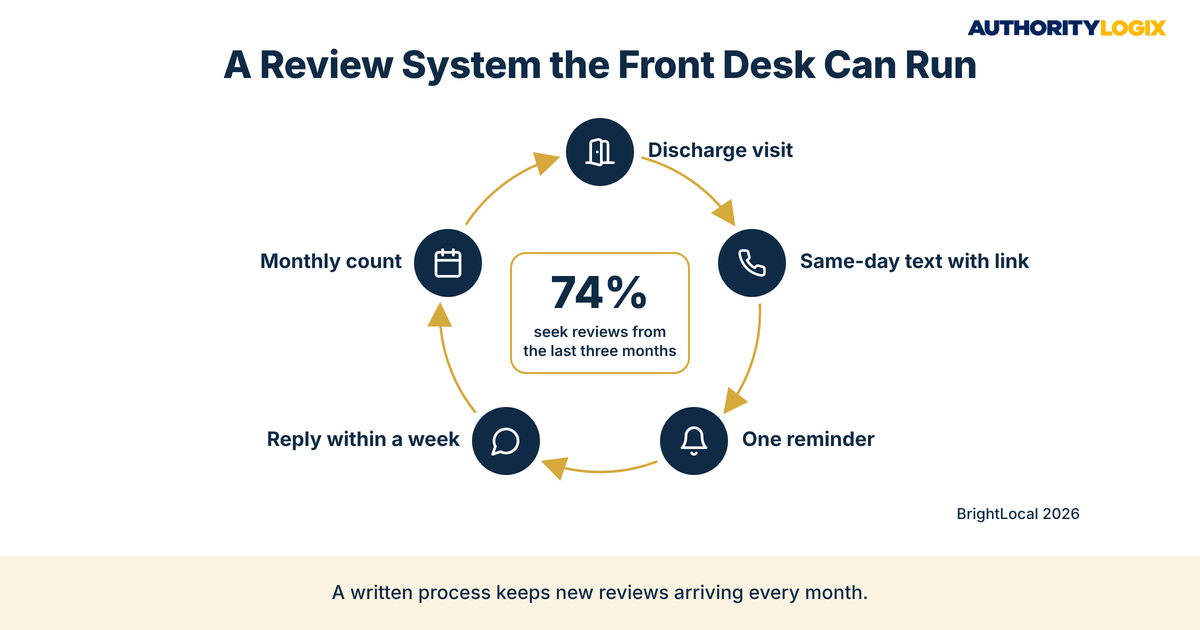
A physical therapy Google reviews generation system has to survive a busy Monday, a new front-desk hire and a clinician on vacation. That means it lives in a written process, not in one person’s memory. Five pieces keep it running:
- Owner: one named person responsible for the review numbers each month
- Trigger: the discharge visit, flagged in the scheduling system
- Message: one approved script and one text template with the review link
- Follow-up: a single reminder, then the request is closed
- Replies: every new review answered within a week, with no private details
Measuring Physical Therapy Google Reviews Generation Month to Month
Track three numbers: requests sent, reviews received and the date of the newest review. BrightLocal’s 2026 survey found 74% of consumers seek reviews written in the last three months, so the newest-review date matters as much as the total. A month with no new reviews usually means a missed trigger, not unwilling patients.
Replies belong in the same routine. BrightLocal found that 80% of consumers say they are likely to use a business that responds to all of its reviews, and 81% expect to hear back within a week. Reply with thanks and a general note, never with details that confirm someone was treated at your clinic.
Strong reviews make every other channel more credible. When your clinicians appear in local media and partner sites through authority distribution, the people who look you up next land on a profile worth reading, and physical therapy Google reviews generation keeps it current.
Physical therapy Google reviews generation is one piece of a local structure that also includes Business Profile setup, location pages and citations. Those pieces are covered across the PT resource library, and physical therapy Google reviews generation works best when they are in place.
What Most PT Practices Get Wrong When Asking Patients for Reviews
Practices that struggle with physical therapy Google reviews generation are rarely short on satisfied patients. They are working from habits borrowed from other industries, and these are the questions owners and patients ask most.
Can we ask patients for a review while they are still in the clinic?
You can mention it and hand over a card with a QR code. Google’s policy says merchants should not require or pressure users to leave ratings or write reviews while on the premises, so a tablet passed across the desk crosses the line.
Is it all right to ask only the patients who loved their care?
No. Selectively soliciting positive reviews is prohibited by Google, and it distorts the profile future patients rely on. A PT review request strategy asks everyone in the same way.
Will a review expose my health information?
Only what you choose to write. You never need to mention a condition or treatment, and a careful practice will reply without confirming any details about your care. That reassurance belongs in the request itself.
Should we hire a company to get reviews for us?
You can hire help to build the system, but not to write or buy reviews, and the FTC’s 2024 rule covers fake reviews and the businesses that buy them. The split between your practice and an outside build is what we do for PT owners: the practice keeps the patient relationships and the ask, and we build the scripts, triggers and reporting around them. Any vendor promising a set number of reviews is describing something Google forbids.
How many reviews does a PT practice need?
There is no fixed target. What matters is a steady flow and a recent date on the newest review, measured against the practices ranking near you, and the growth blueprint explains how that record becomes part of long-term practice authority alongside content and clinician visibility.
Ready to put a policy-safe review request system behind every discharge visit at your practice? Let’s build the script, the triggers and the monthly reporting with your team.
The Honest Math on Reviews and Your Patient Pipeline
The math is simple. A practice that asks every discharged patient builds a review record over time; a practice that asks when someone remembers does not. Physical therapy Google reviews generation needs no tricks, because asking consistently is the whole method.
BKDSCR.com, the AuthorityLogix proof-of-concept in the NYC outer-borough DSCR real estate niche, was built on that principle — 18 pillar pages, 7 interactive investor tools and 48 SEO-optimized blog posts, with zero paid ads, in under 18 months. The sequence in how we build follows the same model, and physical therapy Google reviews generation is a smaller system under the same rule: install it once, then run it every week.
Reviews will not fix a poor patient experience, and no system can promise a rating. They can make an excellent practice visible to a direct-access patient comparing clinics on a phone. That is why AuthorityLogix treats physical therapy Google reviews generation as infrastructure rather than a campaign.
The honest answer is that most PT practices already earn good reviews in person every day. The missing piece is a system that asks for them consistently and inside Google’s rules, so the market can see what your patients already know.