Key Takeaways
- A physical therapy internal linking strategy decides which pages on your existing website Google treats as important and which ones it barely finds.
- Google Search Central states that every page you care about should have a link from at least one other page on your site.
- A physical therapy internal linking strategy for an existing site repairs the links between pages you already have before you publish anything new.
- A PT internal link structure works best when condition, service, clinician, and location pages link in the order patients read them.
- Descriptive anchor text that names the destination helps patients and crawlers understand a page before anyone clicks it.
- A physical therapy internal linking strategy organizes authority your pages already earned. It cannot create that authority.
Why a Physical Therapy Internal Linking Strategy Shapes What Google Ranks
A physical therapy internal linking strategy is the part of SEO most practices never look at, even though it decides which pages Google treats as important. You may have a dozen condition pages, a bio for every clinician, and years of blog posts, and still find that the pages patients most need are the ones Google barely visits. The problem is how your pages connect, which is why the overall
site structure matters before anyone writes another article.
This guide is not about planning a new site from scratch. It is a repair manual for the site you already have: find the pages nobody links to, fix links that point to the wrong place, and rebuild a physical therapy internal linking strategy around how patients actually move through your content. Most practices can do it without publishing a single new page, and the pages they already paid for start pulling their weight.
Google Search Central says Google uses links as a signal when determining the relevancy of pages and to find new pages to crawl. Its
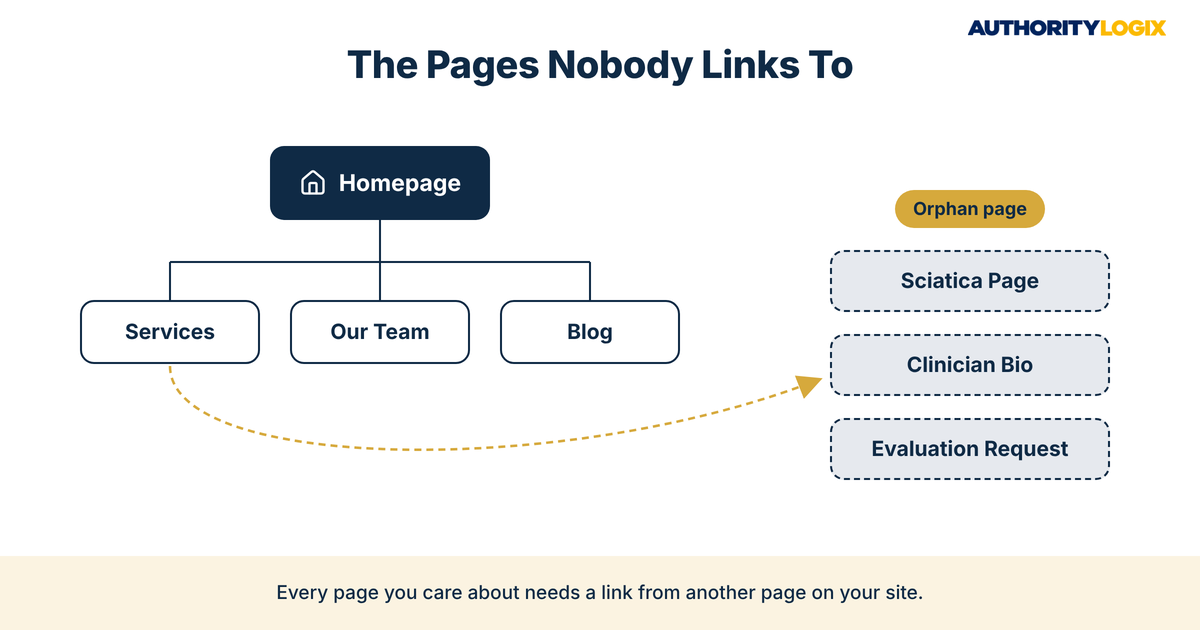
link documentation, last updated in December 2025, also states that every page you care about should have a link from at least one other page on your site. A sciatica page that exists only in your sitemap fails that basic test, and any physical therapy internal linking strategy has to start there.
That is the credible but invisible problem at the page level. The page may be excellent, and patients still never see it because nothing on your own site points to it. The AuthorityLogix PT
resource library is built the opposite way, with every article pointing up to a parent guide and across to its neighbors. A physical therapy internal linking strategy applies that discipline to your whole website.
The Physical Therapy Content & SEO Playbook lays out the full site architecture a physical therapy internal linking strategy sits inside, from keywords to condition pages.
Content SEO Playbook →
Mapping Your PT Internal Link Structure Before You Add a Single Link
Before changing anything, map what you have. A PT internal link structure is the record of which pages link to which, and on most practice websites nobody has looked at it as a whole. Export every URL from your sitemap or a crawler, then note how many pages link to each one and where those links sit: menu, footer, body copy, or nowhere.
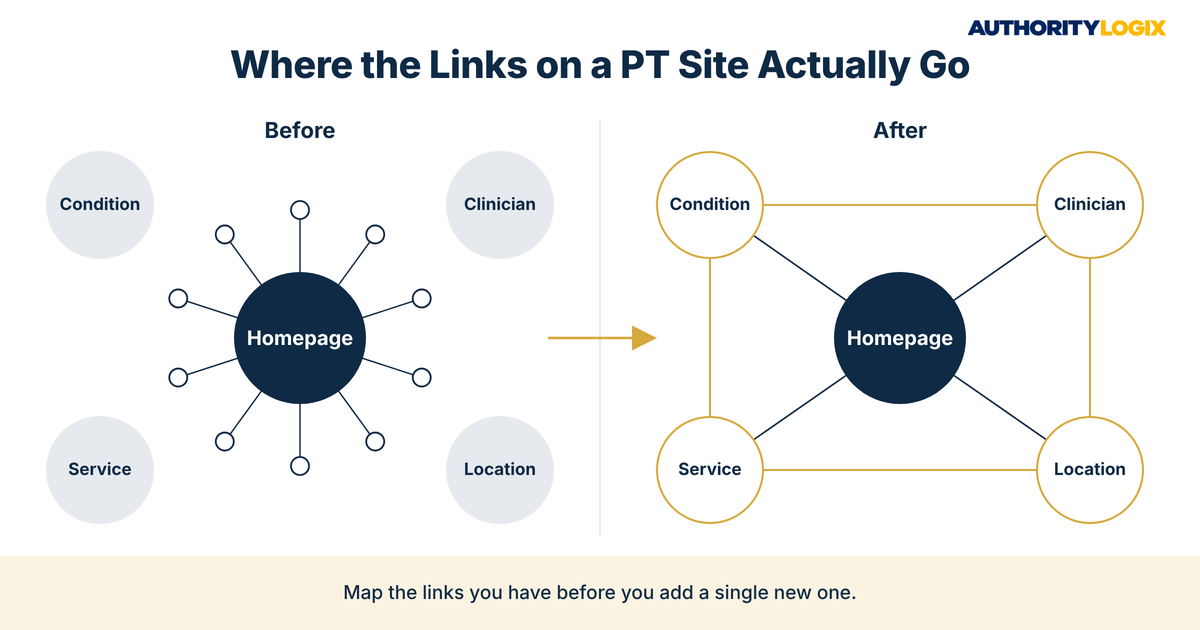
The map usually reveals three patterns. The homepage and contact page carry most links, clinician and condition pages carry very few, and the blog links mostly to itself. The AuthorityLogix approach outlined on the
PT industry hub starts with this kind of inventory, because a physical therapy internal linking strategy built on guesswork just moves the same gaps around.
What the Map Should Tell You About Your Physical Therapy Internal Linking Strategy
Sort your pages into four groups: booking pages such as evaluation requests and locations, question pages such as conditions and FAQs, trust pages such as clinician bios and reviews, and supporting blog posts. A healthy physical therapy internal linking strategy moves readers from question and trust pages into booking pages. If your map shows the opposite, you have found your repair list.
| Page Type |
Common Problem on Existing PT Sites |
What the Fix Looks Like |
| Condition pages |
Reachable only from a dropdown or the sitemap |
Body links from related conditions, the service page, and blog posts |
| Clinician bios |
Listed under Our Team with no links from condition pages |
A link from each condition page to a relevant clinician |
| Service pages |
Link out to nothing except the contact page |
Links down to every condition page the service covers |
| Location pages |
Near-duplicate pages with no links to services |
Links to the services and clinicians at that clinic |
| Blog posts |
Link only to other blog posts, or to nothing |
A link up to the matching condition or service page |
None of this means someone was careless. Most practice websites grew one page at a time, a new clinician bio one year and a condition page the next, with no rule for how each new page connects to the rest. Practices that publish through
content systems with linking rules built in avoid that drift, because every new page ships with its links already decided.
PT Internal Linking Pillar Cluster: Connecting Condition, Service, and Clinician Pages
If your site already has pillar pages, the job here is not to redesign them. Choosing pillar topics and planning
topic clusters is its own project. For an existing website, the PT internal linking pillar cluster question is narrower: do your pages actually link up to their pillar and across to their siblings, or does the cluster exist only on paper?
In a physical therapy internal linking strategy, each condition page needs three links: up to its service page, across to a related condition page, and over to a clinician with relevant experience. A low back pain page that links to your orthopedic service page, your sciatica page, and the right clinician bio gives patients and Google a clear path. A page with none of those links is a dead end.
Where Clinician Pages Fit in a PT Internal Linking Pillar Cluster
Clinician bios are among the least-linked pages on most PT websites. They sit in an Our Team menu with no links from the condition pages where patients decide whether to trust the practice. An
educational hub treats each bio as part of the patient education path, so credentials appear right where a patient is reading. It is one of the simplest repairs on an existing site, and one of the most visible to patients.
This is where a physical therapy internal linking strategy meets patient trust. A patient reading about shoulder pain who can click straight to a qualified clinician’s bio is looking at evidence, not marketing. The E-E-A-T signals in the
clinical authority guide only help when patients and crawlers can reach them.
Not sure whether your site has orphaned pages or a broken PT internal link structure? The PT Authority Gap Assessment shows what to repair first.
Authority Gap Assessment →
Physical Therapy Site Internal Links SEO: Anchor Text That Helps Patients and Crawlers
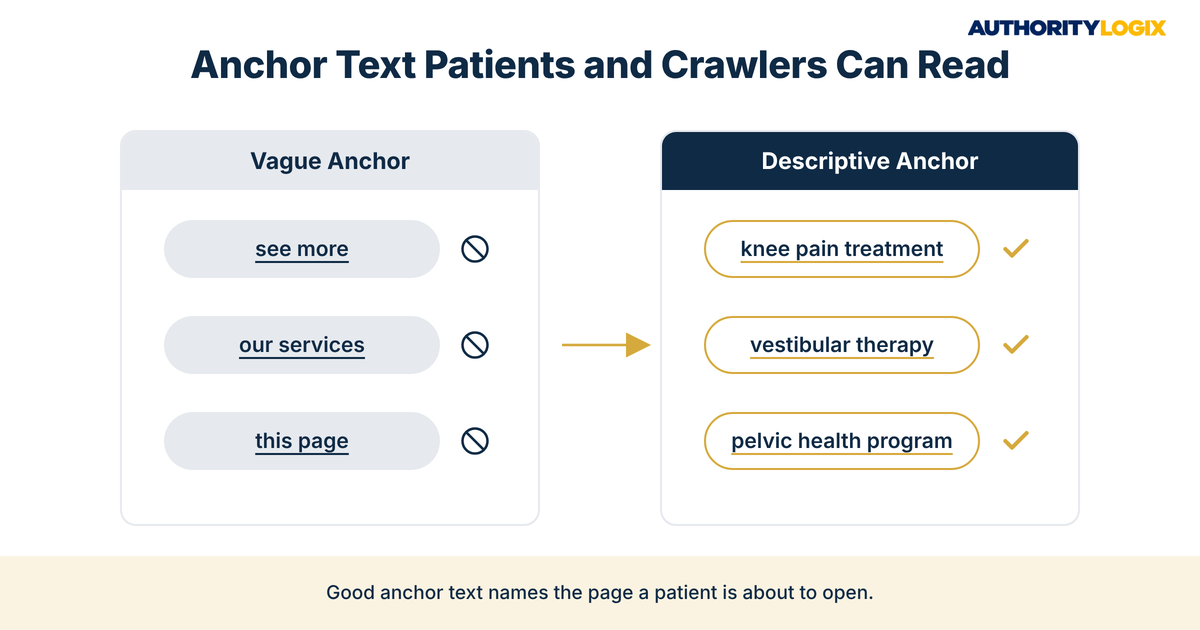
Anchor text is the clickable wording of a link, and it is where physical therapy site internal links SEO is most often wasted. Google’s documentation describes good anchor text as descriptive, reasonably concise, and relevant to the page it sits on. It also notes that paying more attention to the anchor text used for internal links can help both people and Google make sense of your site.
On PT websites the failures are predictable. Links read “see more” or “our services,” and every link to the knee page uses the same vague words. A physical therapy internal linking strategy describes the destination in a patient’s words, such as “knee pain treatment,” “vestibular therapy,” or “pelvic health program,” so the reader knows what opens next.
Anchor Text Rules for Physical Therapy Site Internal Links SEO
- Name the destination page, never the act of clicking
- Use the condition or service name a patient would actually search for
- Keep anchors short enough to read at a glance
- Vary the wording naturally instead of repeating one exact phrase sitewide
- Check that each anchor still makes sense when read on its own
- Link each destination once per page, in the paragraph where it is most relevant
Location pages deserve the same care. A multi-clinic practice should link each condition page to the location pages where that service is offered, using the town name in the anchor. Those links support
local search visibility because they tie service content to the places patients search from.
Internal links will not move your map pack position on their own, because that depends on your Google Business Profile and other local signals. They make sure that when your profile sends someone to your website, the landing page connects to everything a patient needs next. Our
local visibility guide covers how those signals fit together.
A Step-by-Step Physical Therapy Internal Linking Strategy for Existing Sites
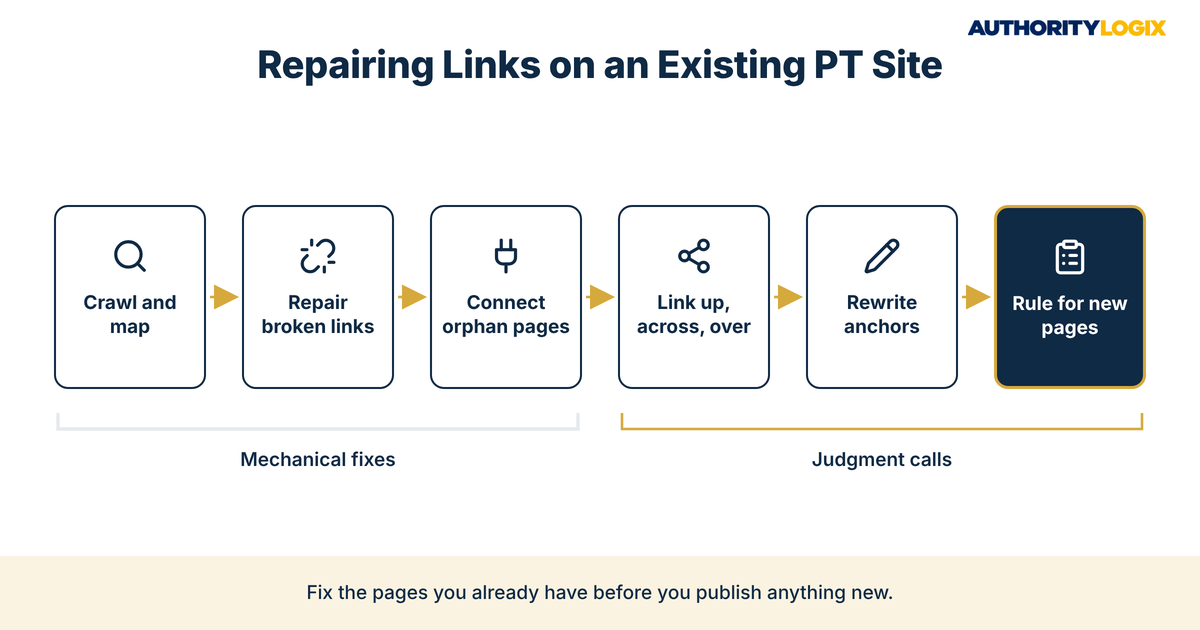
With the map and anchor rules in place, a physical therapy internal linking strategy for an existing site follows a fixed order. Rewriting anchors on links that point to the wrong page wastes effort. The sequence below reflects
how we build linking into every PT website project instead of bolting it on at the end.
| Step |
What to Do |
What It Fixes |
| 1. Crawl and map |
Count the internal links pointing to each page |
Shows orphaned and under-linked pages |
| 2. Repair broken links |
Update links that hit error pages or redirect chains |
Removes dead ends |
| 3. Connect orphan pages |
Give every page you care about a contextual body link |
Meets the minimum Google describes |
| 4. Link up, across, and over |
Connect conditions to services, related conditions, and clinicians |
Turns separate pages into a cluster |
| 5. Rewrite vague anchors |
Use the names patients search for |
Tells readers what each page covers |
| 6. Set a rule for new pages |
Every new page ships with planned links |
Stops the drift from returning |
Steps two and three take the least judgment. Broken links and orphaned pages are mechanical problems with mechanical fixes, and a physical therapy internal linking strategy that starts there gives you a cleaner site before harder decisions begin. Steps four and five need someone who understands how patients read condition content.
BKDSCR.com, the AuthorityLogix proof-of-concept build in the NYC DSCR real estate niche, is organized as one connected library: 18 pillar pages, 7 interactive investor tools, and 48 SEO-optimized blog posts. It ranks for competitive DSCR keywords with zero paid ads. It is not a PT website, but the physical therapy internal linking strategy in this guide uses the same architecture.
The sixth step is the one most practices skip. Without a written rule, a repaired website drifts back as new bios and posts go up unconnected. Keeping that rule in place is part of
what we do for practices that want the repair to last.
What Most PT Practices Get Wrong About Internal Links, From the Patient’s Click Path
Most internal linking mistakes on PT websites come from thinking about Google first and patients second. The questions below are ones patients and practice owners actually raise, and each points to a common mistake. A link is a promise about what the next page will give the reader.
Why can’t I find the clinician from the condition page I’m reading?
Because on many PT websites, that link does not exist. Bios live in the team menu, and condition pages end without pointing to anyone. A physical therapy internal linking strategy that connects every condition page to a relevant clinician closes the gap, so a patient can see who they would work with before calling.
I read a blog post and wanted to book. Why did it send me to another blog post?
Blog posts on PT websites tend to link only to other blog posts, which keeps readers circling instead of booking. Every article should offer a path to the evaluation request or matching service page. The patient journey in the
acquisition playbook treats those paths as part of the pipeline.
Should every page link to every other page?
No. Google’s documentation says there is no magical ideal number of links a given page should contain, and adds that if you think it is too much, it probably is. Links that point everywhere tell patients and crawlers nothing about which pages matter, so the goal is relevance, not volume.
Do internal links bring in new patients by themselves?
Not directly. A visitor only becomes a patient when the page they reach offers a clear next step, such as an evaluation request. That is why a physical therapy internal linking strategy and
lead generation infrastructure are planned together: the links bring the patient to the right page, and the capture path turns the visit into a booking.
Is a link in the main menu enough?
Menu links help people navigate, but they carry little context. A link inside a paragraph about knee pain says more about the destination than a dropdown entry, which is why Google’s documentation recommends linking to related pages in context. A physical therapy internal linking strategy uses both.
Ready to repair the internal links on your existing PT website so condition, service, and clinician pages work as one connected system?
Work With Us →
The Honest Reality: Internal Links Organize Authority, They Don’t Create It
Internal links are a multiplier, not a source. A physical therapy internal linking strategy can only distribute the authority your pages already have, and if condition content is thin, better links send patients to weak pages faster. The
growth blueprint puts linking where it belongs, as one part of a site that keeps earning visibility.
Outside signals matter too. Mentions and links from other websites bring authority in, and a physical therapy internal linking strategy decides where it flows. That is why
authority distribution and on-site linking are planned together.
The approach comes from a working build, not a theory, and that is
why AuthorityLogix treats linking as infrastructure rather than a cleanup chore. BKDSCR.com was built in a live market with AuthorityLogix’s own time and money, and the same connected architecture applies to a PT practice with real clinical expertise and a website that does not yet show it.
The honest answer is that most PT practices already have the expertise, and much of the content, patients are looking for. What is missing is the structure that lets patients and Google find it. A physical therapy internal linking strategy is the least glamorous fix: start with the pages you have, connect them in the order patients read them, and keep the rule in place.