


Key Takeaways
- Physical therapy LinkedIn physician referrals work best alongside direct access, widening the base of referring offices.
- APTA says some form of direct access has existed in all 50 states since early 2015, yet nearly 2 out of 3 PTs in its 2015 survey said their employment setting still required referrals.
- Specialists check credentials, communication and visibility before they refer, so clinician profiles and bio pages must show all three.
- Physical therapy LinkedIn physician outreach earns replies when it shares useful education first and leaves the referral request for later.
- Every LinkedIn post should land on a condition page, clinician bio or referring-provider page.
- Physical therapy LinkedIn physician referrals take months to build and never replace the in-person relationship; LinkedIn keeps that relationship visible between visits.
Table of Contents

Physical therapy LinkedIn physician referrals start from a simple reality: the orthopedic surgeon, the sports medicine physician and the primary care group down the street are already on LinkedIn, and most of them have never seen what your clinicians know. You may have board-certified specialists on staff and a strong local reputation, and still be a name the spine practice down the road cannot place. Referral habits form around whoever stays visible between handshakes, which is the job of authority distribution: putting your clinicians’ expertise in front of the people who decide where patients go next.
This article treats LinkedIn as one channel inside a referral system, not a shortcut. It covers clinician profiles, what specialists check, outreach that avoids the sales pitch and the pages that turn interest into evaluation bookings, then the honest limits, because physical therapy LinkedIn physician referrals are slow to build and easy to overrate.
Why Physical Therapy LinkedIn Physician Referrals Matter Alongside Direct Access
Direct access changed the rules, but it did not change every habit. According to APTA, some form of direct access to physical therapist services has been a reality in all 50 states since early 2015. Yet in APTA’s analysis of a 2015 survey of nearly 6,000 physical therapists, nearly 2 out of 3 respondents said their employment setting required referrals regardless of state law, and 50% reported some use of direct access. Physician referrals remain the backbone of many schedules, and physical therapy LinkedIn physician referrals help protect it.
That is why physical therapy LinkedIn physician referrals belong next to a direct-access strategy rather than in competition with it. Our acquisition playbook lays out the full mix of direct-access search, community presence, reactivation and referral partners, and the physician channel is the one most practices leave to chance. Referrals arrive or they don’t, and nobody on staff can say why a particular office started or stopped sending patients.
The real risk is concentration. One referring doctor retires and the pipeline dries up overnight. A practice with three loyal physician sources has a portfolio of three, and LinkedIn is one of the few places to widen it without hiring a liaison. Physical therapy LinkedIn physician referrals grow by keeping clinicians in front of specialists between the lunches and phone calls that produce referrals.
LinkedIn reports more than 1.3 billion members, with more than 290 million in North America, so the question is rarely whether local physicians have profiles. The question for physical therapy LinkedIn physician referrals is whether they ever see yours. LinkedIn is the distribution layer inside a wider set of visibility systems for outpatient practices, which the PT industry hub maps across content, local search, patient education and lead capture.
The Physical Therapy Practice Authority & Growth Blueprint shows where physical therapy LinkedIn physician referrals fit inside a complete growth system, with referral partners, direct access and local visibility working together.
Building a PT LinkedIn Referral Partner Strategy Around Your Clinician Credentials
A PT LinkedIn referral partner strategy starts with the clinicians, not the company page. Physicians refer to people. A referring office wants to know which therapist handles post-surgical shoulders, who holds the orthopedic or sports specialist certification and who will send a clear progress note back. A company page answers none of those questions.
What a Physical Therapy LinkedIn Physician Referrals Profile Should Show
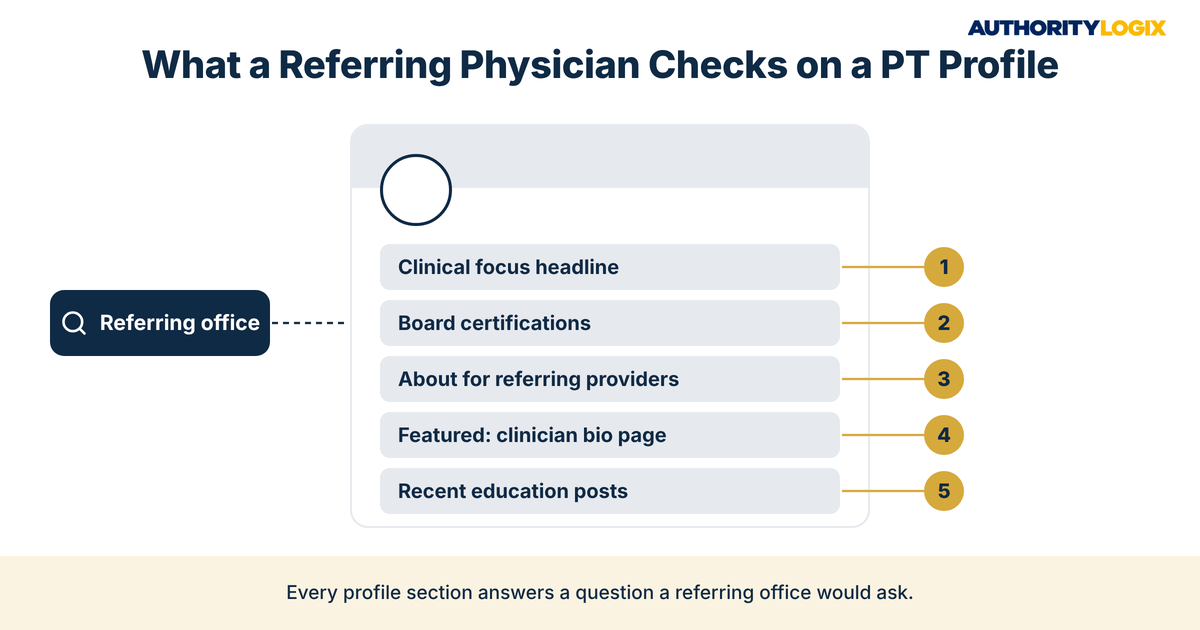
Each clinician profile is a referral asset. For physical therapy LinkedIn physician referrals, the headline should name the conditions and patient groups the clinician sees most, not a generic job title. The About section should read like an introduction for a colleague: training, certifications and how the clinician communicates with referring providers.
- A headline that names the clinical focus, such as post-operative orthopedics or vestibular rehabilitation
- Board certifications and residency or fellowship training in the credentials section
- An About section written for referring providers, not for recruiters
- A featured link to the clinician’s bio page on the practice website
- Recent posts that show how the clinician explains common referral conditions
That featured link matters. LinkedIn is where a specialist notices your therapist and the website is where they confirm the impression, so a complete bio page with credentials, focus areas, a photo and a booking path should sit one click from every clinician profile. When the two tell the same story, physical therapy LinkedIn physician referrals gain a credibility check no message can provide.
Credentials persuade only when they are visible in context. Showing the reasoning behind a certification is what convinces a surgeon your team speaks their language, and those signals of training, published education and a consistent voice are the same ones covered in the clinical authority guide, applied to a professional audience instead of patients.
Your PT LinkedIn referral partner strategy also needs an owner. One clinician or the director should keep profiles current and log engaged physicians where the front desk logs referral sources. Without that, physical therapy LinkedIn physician referrals float free of the data that shows whether they work.
What Physicians and Specialists Look for Before They Send a Patient to Your Practice
Referring providers carry part of the risk of every referral, because a patient with a poor experience remembers who sent them. Before a specialist adds you to the short list their staff hands out, they want evidence of credentials, communication and visibility. The table lists those marketing signals for physical therapy LinkedIn physician referrals; clinical judgment stays with the providers.
| Signal | What the Referring Office Checks | Where They Look |
|---|---|---|
| Credentials | Certifications, training and each clinician’s focus | LinkedIn profiles and clinician bio pages |
| Communication | How the practice reports progress and how quickly it responds | Messages and the referring-provider page |
| Visibility | Whether the practice looks active, established and known locally | Google Business Profile, reviews, LinkedIn activity |
| Patient education | Whether the practice explains conditions clearly to patients | Condition pages and educational articles |
| Access | How fast a referred patient can book an evaluation, and where | Scheduling, location and insurance pages |
Education is the signal practices most often underestimate. A physician choosing between two clinics favors the one whose condition pages they would happily send a patient to read, which is what an educational hub provides: a library of clear, accurate patient education that reflects well on the provider who referred. Physical therapy LinkedIn physician referrals grow faster when your posts can point to that library instead of a homepage.
Widening the circle beyond the doctors who already refer is the strategic point. Concentration is the core problem behind referral dependence, and LinkedIn introduces your clinicians to specialists who have never heard of the practice. Each connection is a potential referral source, built in public rather than one lunch at a time.
None of this is a promise about clinical results. Referring providers want signals that a practice is credible and responsive, and those signals come from infrastructure: profiles, pages, reviews and content that agree. Building that infrastructure for practices whose expertise is real but hard to see is what we do, and it is the foundation that makes physical therapy LinkedIn physician referrals possible.
Not sure a referring physician would find your clinicians credible online? The PT Authority Gap Assessment shows where your profiles, pages and reviews fall short for physical therapy LinkedIn physician referrals.
Physical Therapy LinkedIn Physician Outreach That Does Not Read Like a Sales Pitch
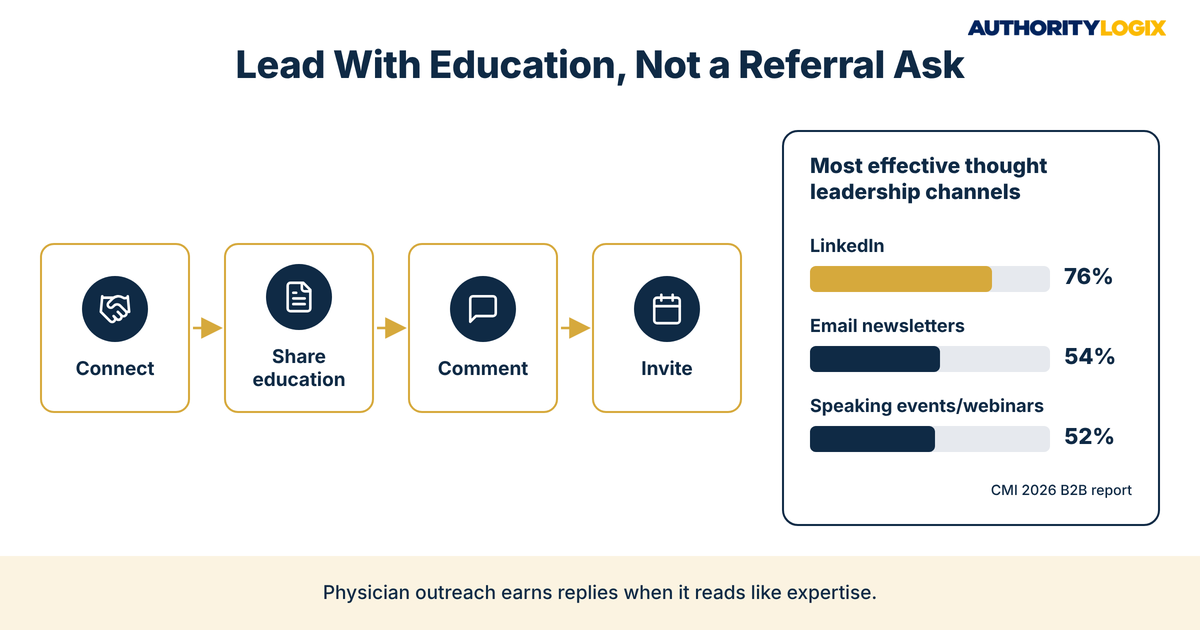
Professionals expect expert commentary on LinkedIn. In the Content Marketing Institute and MarketingProfs report B2B Content and Marketing Trends: Insights for 2026, based on a survey fielded June to August 2025, 76% of B2B marketers named LinkedIn among the three most effective channels for thought leadership, ahead of email newsletters at 54% and speaking events or webinars at 52%. Physicians are not marketers, but the finding shows where professional audiences go for expertise.
The common mistake is treating outreach like cold sales. A connection request that asks for referrals in the first line gets ignored by a busy orthopedic office. Physical therapy LinkedIn physician outreach should lead with something useful, such as a short educational post or a lunch-and-learn invitation, and let the referral conversation come later.
A Four-Step Outreach Sequence for Specialist Offices
- Connect with a short note naming a shared specialty or hospital, with no request attached
- Share one educational post a week, written by a clinician, on a condition that specialist treats
- Comment on the physician’s own posts when you have something useful and professional to add
- After several weeks, invite the office to a lunch-and-learn or a short call
That sequence only works if the posts keep coming. Many practices start strong and then stall, because clinical writing is hard to fit around a full caseload. Posts stay sustainable when they come from content systems that turn condition pages, patient FAQs and workshop notes into short pieces a therapist reviews in minutes.
Keep every message free of patient information. Never reference a specific patient or a recognizable case in a post or a LinkedIn message; that belongs in your compliant referral communication. That separation is part of how we build physician outreach: LinkedIn carries education and visibility, and clinical updates stay in the channels your practice already uses for them.
Connecting PT Professional Network Referral LinkedIn Activity to Condition Pages and Evaluation Bookings
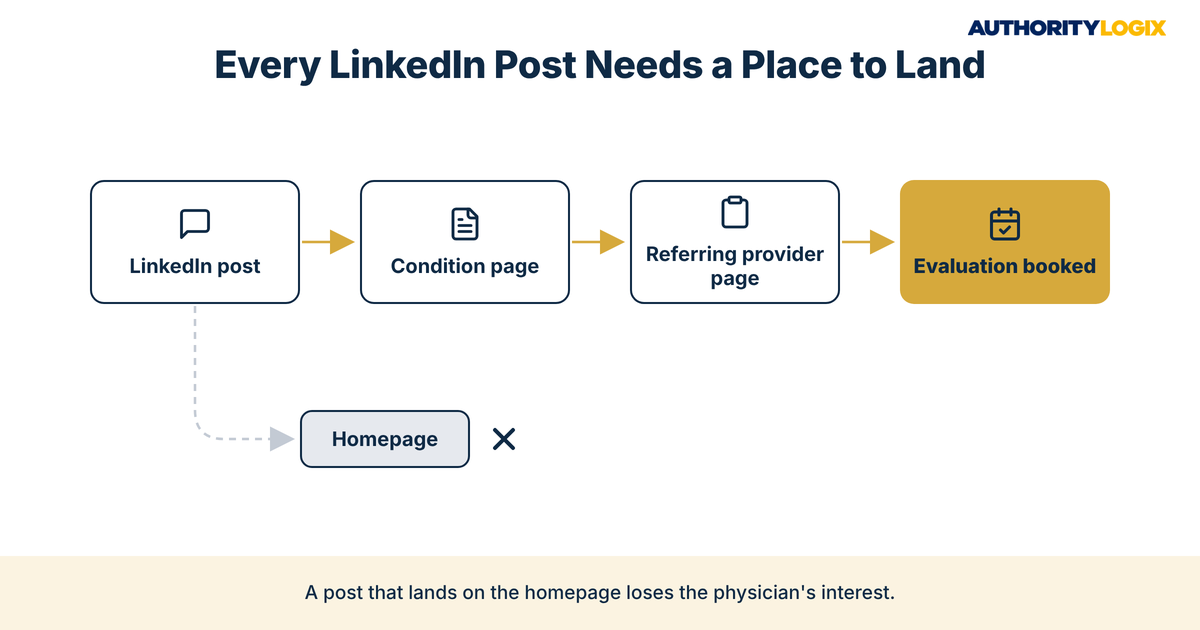
A PT professional network referral LinkedIn effort fails quietly when the posts lead nowhere. A specialist reads a clinician’s post, clicks through and lands on a generic homepage, and the interest dies there. For physical therapy LinkedIn physician referrals, every post should link to the page that continues the conversation: the matching condition page, the clinician’s bio or a page for referring providers.
Where a Physician Lands After Clicking
A referring-provider page is the most overlooked asset in physical therapy LinkedIn physician referrals. It should explain how to refer, each clinician’s focus, scheduling speed and how the practice reports back. The same page structure supports lead generation on the patient side, because a referred patient who searches your name before calling sees the same clear booking path the physician saw.
Track LinkedIn the way you track any referral source. Add it to the intake question about how patients heard of you, note which physicians engaged before they first referred and review the list quarterly. Physical therapy LinkedIn physician referrals rarely announce themselves, and the pattern shows up only when the data is collected on purpose.
Those pages also earn search visibility with patients. A condition page clear enough for a surgeon to share is usually strong enough to rank, and the architecture that connects those pages is laid out in our content SEO playbook. That is the quiet advantage of a PT professional network referral LinkedIn program built on real pages: the same content serves physicians on LinkedIn and direct-access patients on Google.
What Most PT Practices Get Wrong About Physical Therapy LinkedIn Physician Referrals
Practices that give up on physical therapy LinkedIn physician referrals were rarely wrong about the channel. They applied patient-marketing assumptions to professional relationships. These are the questions owners ask most.
Should we post from the company page or from individual clinicians?
Mostly from clinicians. Physicians refer to people they recognize, and a therapist’s own network often includes specialists a company page never reaches. For physical therapy LinkedIn physician referrals, use the company page to reshare clinician posts and announce events.
Is LinkedIn enough if our Google presence is weak?
No. A specialist who notices your therapist on LinkedIn will often search the practice name next, and a thin Google Business Profile or a handful of old reviews undercuts the impression. Strong local search presence is the second half of physical therapy LinkedIn physician referrals, because it confirms in public what the LinkedIn profile claimed.
Can we message physicians about patients we share?
Not on LinkedIn. Patient information never belongs in a LinkedIn message or post, even when the physician already knows the patient. Keep shared-patient communication in the secure, compliant channels your practice already uses.
We have several locations. Does each one need its own approach?
Usually, yes. Each location has its own referral neighborhood, so match clinicians to nearby specialists and keep every location’s listing and page complete; the local visibility guide covers how multi-location practices keep each one visible. A referring office that cannot find the nearest location will send the patient elsewhere.
How long before physical therapy LinkedIn physician referrals show up?
Expect months, not weeks. Professional trust builds through repeated, useful contact, and the first new referral often follows a lunch-and-learn or phone call that LinkedIn made easier to get. Anyone promising a set number of physical therapy LinkedIn physician referrals is guessing.
Ready for a physician referral system where clinician LinkedIn profiles, condition pages and a referring-provider page work as one? Let’s map out what your referring offices need to see.
The Honest Limits of LinkedIn as a Referral Channel
LinkedIn will not replace a good working relationship with a referring office. It will not fix slow scheduling or a front desk that loses faxed referrals. What physical therapy LinkedIn physician referrals do well is narrower: they keep clinicians visible between in-person contacts, give physicians a fast credential check and widen the pool of offices that know you exist.
That narrower role is why we treat physical therapy LinkedIn physician referrals as one connected piece of a larger system rather than a standalone campaign. AuthorityLogix proved the connected model on its own build first: BKDSCR.com, a DSCR real estate education platform with 18 pillar pages, 7 interactive tools and 48 SEO-optimized blog posts, built in under 18 months with zero paid ads. For PT practices, our approach applies the same structure to clinicians, condition pages and referral partners.
The honest answer is that most physical therapy practices already have the clinical expertise physicians want to refer to. What is missing is the visible proof: profiles, pages and content that let a specialist see that expertise before the first phone call. If you are building that proof piece by piece, the PT resource library covers each part of the system, from condition pages to local search.