


Key Takeaways
- Physical therapy long tail keywords are the specific, multi-word searches patients type once they know what is bothering them and where they want care.
- Ahrefs reports that keywords with fewer than 10 searches per month make up almost 93% of its U.S. keyword database, so most real searches are small ones.
- PT long tail keyword research does not need expensive tools: front desk calls, Search Console queries, autocomplete, and patient forums already hold the words.
- One condition, one page: physical therapy specific condition keyword targeting gives each search a page written for exactly that problem.
- A PT low competition keyword strategy lets an independent practice compete where national chains and directories have not built specific pages.
- Physical therapy long tail keywords add up only when the practice keeps publishing; one page is a test, a library is an asset.
Table of Contents
Why Physical Therapy Long Tail Keywords Match How Patients Actually Search
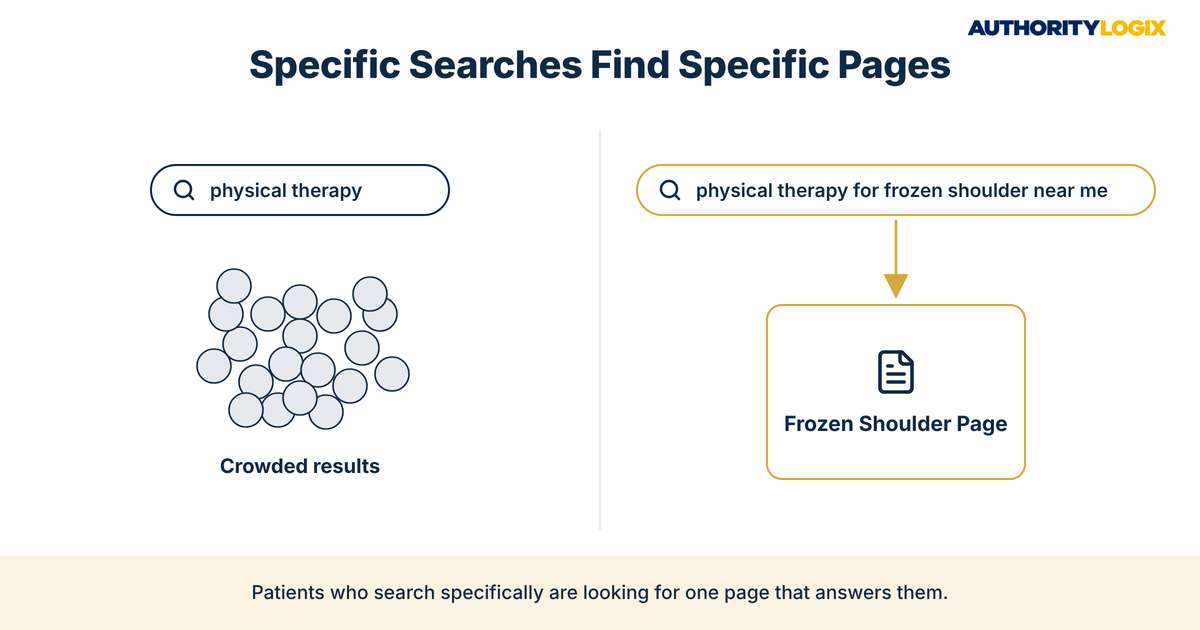
Physical therapy long tail keywords are the longer, more specific searches patients type when they already know what hurts and where they want help — “physical therapy for frozen shoulder near me,” not just “physical therapy.” Most practices build their site around the short version because it feels bigger, then wonder why the pages never move. A sound keyword strategy starts from the other end, with the exact words patients use.
This is where credible but invisible practices lose the most ground. You may treat more frozen shoulders, post-surgical knees, and running injuries than anyone in town, but if your site only says “Services,” a patient searching for their specific problem lands on a clinic that wrote a page about it. Physical therapy long tail keywords are how the depth of your caseload becomes visible.
The math favors physical therapy long tail keywords. Ahrefs’ long-tail keywords guide, updated in May 2026, states that keywords with fewer than 10 searches per month account for almost 93% of its U.S. keyword database — about 2.3 billion of them. The same guide notes there are just under 18,000 keywords with more than 100,000 searches per month, which shows how thin the top of the curve is.
Direct access makes those small searches matter more. APTA’s June 2025 report found that patients in all 50 states, the District of Columbia, and the U.S. Virgin Islands have either provisional or unrestricted direct access to physical therapist services for evaluation and treatment. A patient who can book without a referral may start with a search that names the problem, not the provider.
Each of those searches is an early step in the patient pipeline laid out in the acquisition playbook, where visibility turns into evaluation requests. Physical therapy long tail keywords are usually the first point of contact in that pipeline, which is why they deserve a plan instead of an accident.
The Physical Therapy Content & SEO Playbook shows how physical therapy long tail keywords fit into the full page architecture of a PT site, from service pages to condition pages to educational articles.
PT Long Tail Keyword Research Without Expensive Tools
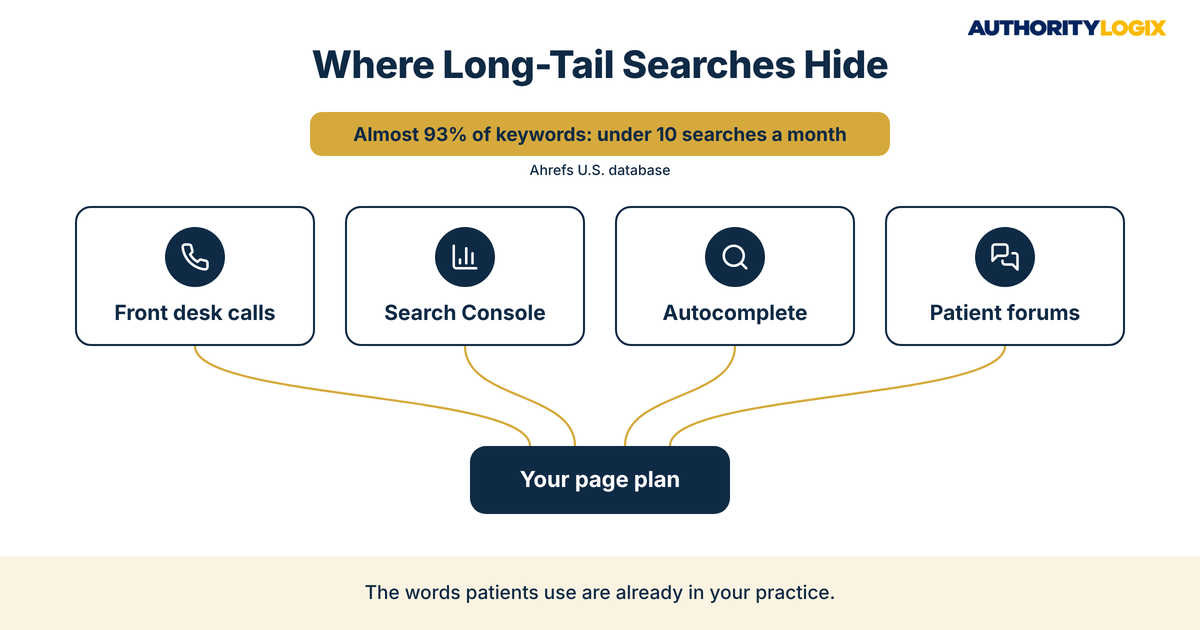
PT long tail keyword research starts with words your practice already hears every day. Patients describe their problems on the phone, on intake forms, and in the first minutes of an evaluation, and those descriptions are the raw material for physical therapy long tail keywords. Paid research tools help with volume estimates, but they cannot tell you how your own patients phrase things. That is why physical therapy long tail keywords are best collected from the practice first and checked in a tool second.
Four Places Physical Therapy Long Tail Keywords Already Live
Before anyone opens a keyword tool, collect phrases from the places patients already use their own words. Each source below surfaces a different kind of search:
- Front desk calls and intake forms — the exact phrases new patients use to describe the problem
- Google autocomplete and related searches — the variations other patients type in your area
- Search Console queries — the searches your site already shows up for, even on page two
- Patient forums and community groups — the questions people ask before they ever call a clinic
Search Console deserves extra attention. Google’s help documentation says the Performance report shows clicks, impressions, click-through rate, and average position, and it can group that data by query, so a practice can see the long searches it already appears for. Ahrefs’ guide calls Search Console an underused source of long-tail discovery, and for a practice working on local search, those queries often include town and neighborhood names worth building around.
Do not throw a phrase away because a tool shows no volume. Ahrefs’ guide states that over 95% of conversational long-tail keywords have no measurable search volume, which means many real patient questions look like zero on a report. Our PT resource library is built the same way — around the questions practice owners actually ask, whatever a tool says about volume.
Group what you collect by condition, by service, and by location. A list of physical therapy long tail keywords sorted that way turns into a page plan almost on its own, and it shows which problems your site never mentions.
Physical Therapy Specific Condition Keyword Targeting for Condition Pages
Physical therapy specific condition keyword targeting means giving each condition you treat a page built around the way patients search for it. A single “Conditions We Treat” list cannot rank for twenty different problems, but twenty focused pages can each compete for their own search. That is the core idea behind dedicated condition content for a PT site.
| Broad Search | Long-Tail Variation | Page That Answers It |
|---|---|---|
| physical therapy | physical therapy for frozen shoulder near me | Frozen shoulder condition page |
| knee pain | physical therapy after ACL surgery in [Town] | Post-surgical knee service page |
| back pain | sciatica physical therapy [Town] | Sciatica condition page |
| sports injury | running injury physical therapy near me | Running and sports injury page |
| dizziness | vestibular physical therapy near me | Vestibular service page |
Each row in that table is a different patient with a different worry, and each one deserves a page that speaks to them in plain language. The page explains the problem in general educational terms, describes how an evaluation works at your practice, and introduces the clinicians who see that condition. Physical therapy long tail keywords work best when the page reads like it came from someone who treats that problem every week.
Trust is the other half of the page. Patients reading about a specific condition look for proof that real experts are behind it — clinician credentials, years of experience with that condition, and clear answers to common questions. The signals covered in the clinical authority guide are what turn a ranking condition page into one a patient believes.
Question searches belong here too. Ahrefs’ guide notes that question-style queries tend to be among the easiest long-tail searches to rank for, and patients ask a lot of them before they ever book. Answering those questions in an educational hub connects each answer back to the matching condition page, so physical therapy long tail keywords feed each other instead of standing alone.
Not sure which physical therapy long tail keywords your site is missing? The PT Authority Gap Assessment shows the condition and location searches you are not covering yet.
A PT Low Competition Keyword Strategy for Independent Practices
A PT low competition keyword strategy is how an independent practice competes with hospital systems, national chains, and directories that dominate the short searches. Ahrefs’ guide says long-tail keywords are generally a lot less competitive, while also warning that some long-tail searches are no easier to rank for than their short-tail versions. The job is telling the two apart before you build a page, and for most independent practices physical therapy long tail keywords tied to a condition are the clearest place to start.
How to Judge Competition for Physical Therapy Long Tail Keywords Without a Paid Tool
The simplest test is to search the phrase yourself and look at what ranks. A results page full of thin, generic pages is an opening; a results page full of detailed pages from large health systems is a longer fight. Look for these signals:
- Directory listings and aggregator pages ranking instead of clinic pages
- Ranking pages that mention the condition only in passing
- No local practice with a page written for that exact problem
- Questions in the results that no ranking page answers well
Location adds a second layer of opportunity. A phrase like “sciatica physical therapy” plus your town can be far less contested than the phrase alone, and the location signals covered in the local visibility guide help those pages earn local trust. Physical therapy long tail keywords with a town or neighborhood attached are where independent practices tend to have the clearest opening.
Pick a starting set you can actually build: the conditions you see most, the services that set you apart, and the towns you serve. The PT industry hub shows how those pieces connect into one system, so a PT low competition keyword strategy becomes a page library instead of a list in a spreadsheet.

Turning Physical Therapy Long Tail Keywords Into Pages That Book Evaluations
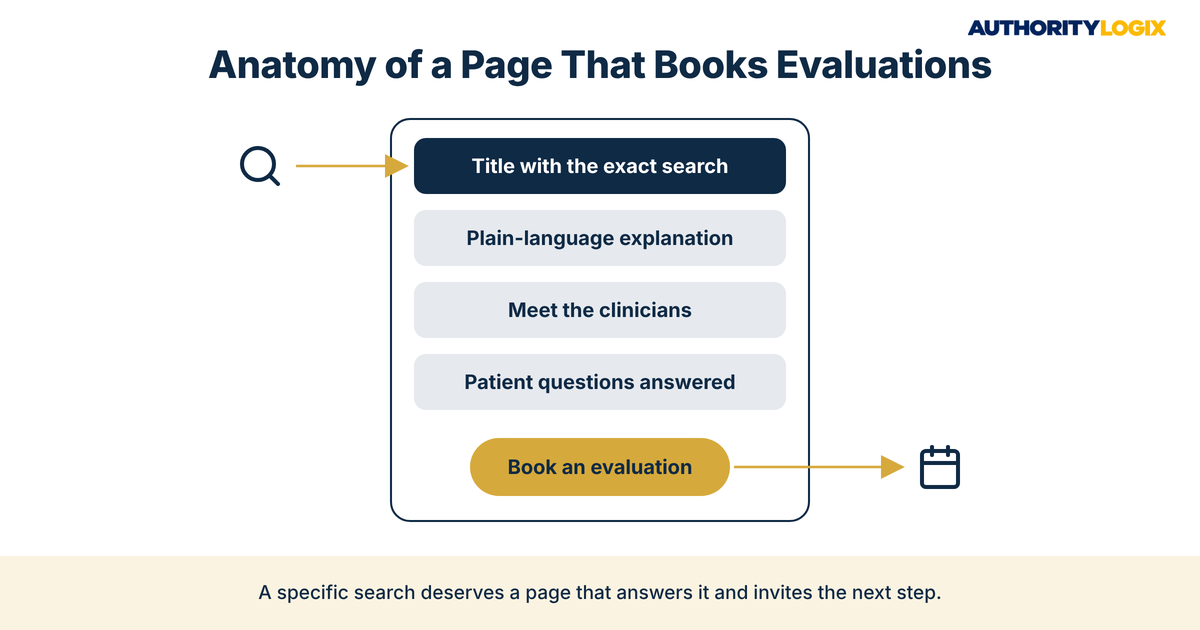
A list of phrases does nothing until it becomes pages. Each page needs a title that uses the search the way patients type it, a plain-language explanation of the problem, a section on how your practice evaluates it, and a clear next step. That structure stays consistent only when content systems produce the pages on a schedule, with every new page held to the same standard.
The payoff is intent. Ahrefs’ guide says long-tail keywords often have a higher conversion rate, which makes sense for a PT practice: a patient searching a specific condition in a specific town is much closer to booking than someone browsing general information. Physical therapy long tail keywords bring fewer visitors per page, but the visitors they bring are closer to the evaluation.
That closeness is wasted if the page ends in a dead end. The lead generation layer — a booking form, a phone number, an evaluation request near the top and bottom of the page — is what turns a long-tail visitor into a scheduled patient. A page that informs without inviting leaves the patient to keep searching.
This is the model AuthorityLogix built for itself first. BKDSCR.com, AuthorityLogix’s proof-of-concept platform in the NYC outer-borough DSCR real estate niche, runs on 18 pillar pages, 7 interactive investor tools, and 48 SEO-optimized blog posts, built with zero paid ads. It is not a physical therapy site, but it follows the same pattern — many specific pages, each answering a specific search, which is how physical therapy long tail keywords work for a clinic.
What Most PT Practices Get Wrong About Long-Tail Searches (and What Patients Type Instead)
Most practices that skip long-tail work are not lazy. They were told to chase the biggest keyword in town, and they built one strong homepage instead of many specific pages. These are the questions owners ask once they look at what patients really type.
Is a keyword with almost no searches worth a page?
Often it is, because one page can rank for many close variations of the same question. Ten small searches a month across dozens of pages adds up, and the growth blueprint explains how that kind of steady visibility becomes a long-term practice asset. A single big keyword you never rank for adds up to nothing.
Should every keyword variation get its own page?
No. “Frozen shoulder physical therapy” and “physical therapy for a frozen shoulder” belong on the same page, because they describe the same patient with the same question. Separate pages make sense when the problem, the service, or the location changes, and grouping physical therapy long tail keywords this way keeps your own pages from competing with each other.
Do patients really search that specifically?
They do, and the data shows how common it is. Ahrefs’ figures put most of its U.S. keyword database in the under-10-searches range, and the phrases your front desk hears every week are proof of the same pattern in your own market.
Why not just rank for “physical therapy” plus my town?
You should try, but that one search is where every competitor in your area is fighting. Long-tail pages give the practice many smaller wins while that bigger ranking builds, which is why the sequence behind how we build starts with condition and service pages before chasing the broadest term. The specific pages also give the site more depth behind that broad term.
How long until long-tail pages bring in patients?
Nobody can promise a timeline or a number of new patients, and anyone who does is guessing. What you can do is publish steadily, watch Search Console for the queries each page starts to show up for, and improve the pages that are close to the first page of results.
Ready to turn the conditions you treat every week into physical therapy long tail keywords and pages that bring in direct-access patients? Let’s map the pages your practice needs.
The Honest View: Small Searches Add Up Only If You Keep Publishing
Physical therapy long tail keywords are not a shortcut. One condition page will not change a practice, and ten pages written once and forgotten will not either. The value comes from a library that keeps growing, where each new page answers another search and links to the pages around it.
Publishing is only part of the job; the pages also need to be seen beyond your own site. Sharing condition articles and patient answers through authority distribution gives each page more places to be found and more reasons for Google to trust it. Physical therapy long tail keywords compound when the library and the distribution run together.
That ongoing build is what we do for PT practices that are credible in their community but missing from its search results. Your clinicians supply the expertise, and the research behind your physical therapy long tail keywords, the pages, and the publishing schedule come from the infrastructure side.
If you want to see why we work this way, our approach explains the system behind it and the proof it was built on. The method is the same whether the market is DSCR lending or physical therapy: specific pages, steady publishing, and patience.
The honest answer is that most PT practices already treat the exact conditions patients are searching for. What is missing is a library of pages that says so, one specific search at a time, and the discipline to keep adding to it.