


Key Takeaways
- Physical therapy patient intake onboarding — everything between the booking and the first visit — decides whether a booked evaluation becomes an attended one.
- Experian Health’s State of Patient Access 2025 found that 43% of patients say that without an estimate, they are likely to postpone or cancel care.
- Most intake friction is fixable: duplicate forms, unclear cost information, silent gaps before the first visit and confusing arrival details.
- BrightLocal’s 2026 survey found that 97% of consumers read reviews for local businesses, so the onboarding experience shows up in your local search results.
- Pre-visit content — what to expect, what to bring, how coverage works — answers new patient questions before they turn into cancellations.
- Physical therapy patient intake onboarding is part of your marketing system: it protects every lead you already paid to generate.
Table of Contents

Physical therapy patient intake onboarding is the stretch of the patient experience most practices never market, even though it decides whether the marketing worked. A new patient finds you, reads your reviews and books an evaluation — and then hears nothing for days except an automated text with a form link that does not open on a phone. Mapping the full patient journey shows the problem plainly: acquisition does not end at the booking.
This is the credible but invisible problem in a new place. Your clinicians may be excellent, but a new patient has not met them yet. Everything they know about your practice between the booking and the first visit comes from your physical therapy patient intake onboarding — the confirmation, the forms, the reminders, the parking instructions — and that experience is either building confidence or quietly draining it.
Why Physical Therapy Patient Intake Onboarding Decides Whether a Booking Becomes a Patient
A booking is a promise, not a patient. Between the click and the first visit, a new patient is still deciding, and every unanswered question is a reason to reschedule, shop around or simply not show up. Physical therapy patient intake onboarding is the system that answers those questions before they become cancellations.
Practices that depend on physician referrals feel this least, because the referring doctor has already done some of the convincing. Direct-access patients and people who found you through search arrive with less context and more doubt. That is why the PT industry hub treats onboarding as part of patient acquisition rather than a front-desk task, and why physical therapy patient intake onboarding matters more as your patient mix shifts toward people who chose you on their own.
The experience after booking also feeds the next wave of patients. A new patient who felt informed and welcomed is more likely to finish their visits, leave a review and mention the practice to a friend. Physical therapy patient intake onboarding is where those referrals start, long before anyone is asked for one.
The Physical Therapy Patient Acquisition Playbook covers the full new-patient pipeline, including how intake and onboarding protect every booking your marketing produces.
Mapping the PT New Patient Intake Experience From Booking to First Visit
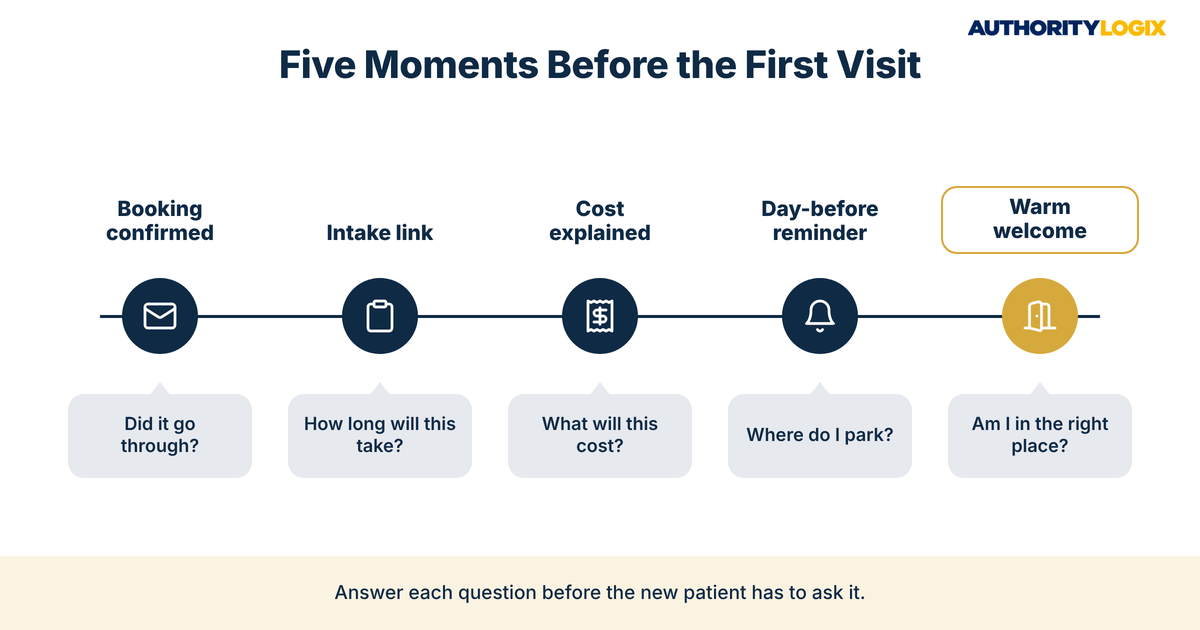
The PT new patient intake experience is a sequence of small moments, and each one either answers a question or creates one. Most practices have never written that sequence down, which is why gaps go unnoticed. Walking through it from the patient’s side usually reveals the same conversion gaps that leak leads earlier in the funnel: silence, confusion and too many steps.
A Physical Therapy Patient Intake Onboarding Timeline
| Moment | What the New Patient Is Wondering | What the Practice Should Send |
|---|---|---|
| Right after booking | Did this actually go through? | A confirmation with the date, time, clinician name and address |
| Before the visit | What paperwork do I need, and how long will it take? | One secure, mobile-friendly intake link with an honest time estimate |
| Coverage questions | What will this cost me? | A clear explanation of coverage and an estimate, or a named person to call |
| The day before | Where do I park, and what should I wear? | A reminder with arrival, parking and clothing details |
| Arrival | Am I in the right place? | A welcome that uses their name and a short wait |
Each row in that physical therapy patient intake onboarding timeline is simple on its own. The difficulty is consistency: the sequence has to run the same way for every new patient, whether they booked online at midnight or called during a busy Monday. That is a system job, not a memory job.
The timeline also connects back to how patients arrived. A new patient who came through your website lead generation path expects the same clarity they saw on the booking page, and a jarring handoff to a clunky form undoes that impression. The PT new patient intake experience should feel like a continuation of the marketing, not a different company. Good physical therapy patient intake onboarding makes that handoff invisible.
Where PT Intake Form Scheduling Friction Costs You Evaluations
PT intake form scheduling friction is rarely dramatic. It is a form that asks for the same insurance details twice, a portal that requires a password before the patient can see what to fill in, or a reschedule request that only works by phone during business hours. Each step is small, and together they turn a confident booking into a hesitant one. Every one is a physical therapy patient intake onboarding problem hiding inside a scheduling tool.
Cost uncertainty is the friction point with the clearest evidence. Experian Health’s patient access survey for 2025 found that 43% of patients say that without an estimate, they are likely to postpone or cancel care. The same survey found that 81% of patients say an accurate estimate helps them prepare to pay, so physical therapy patient intake onboarding that explains cost early removes one of the biggest reasons a new patient backs out.
Fixing friction starts with an honest audit from the patient’s side: book an appointment yourself, open every message on a phone and time the forms. Turning that audit into a working sequence — confirmations, form links, reminders and reschedule options that run on their own — is part of what we do for practices whose clinical reputation is stronger than their front-end experience. Most physical therapy patient intake onboarding fixes come down to wording, order and timing.
Keeping Health Information Off Public Pages
Intake content has a firm boundary. Public pages, emails and social posts should explain what to expect, but health details belong only in a secure, HIPAA-compliant intake system — never a public contact form, a plain email reply or a review response. Write public onboarding material so it never requests or displays patient information, and route every health question to the secure channel. Physical therapy patient intake onboarding that respects that line protects patients and the practice alike.
That boundary is easier to keep when the onboarding messages come from a managed library instead of being typed fresh each time. Practice-run content systems hold approved versions of every confirmation, reminder and FAQ answer, so physical therapy patient intake onboarding stays consistent and compliant even when the front desk turns over.
The same approved answers can then be published as searchable pages, following the structure in the content SEO playbook. Patients who search for what to expect at a first visit then find your physical therapy patient intake onboarding answers instead of a competitor’s.
Not sure where your intake and onboarding are losing new patients? The PT Authority Gap Assessment shows where friction, missing content and weak local signals are costing you evaluations.
How Physical Therapy Onboarding Retention Shapes Plan-of-Care Attendance and Reviews
Physical therapy onboarding retention is a business measure, not a clinical one. It asks whether new patients keep the visits they scheduled and whether they say good things about the practice afterward. Those two numbers — attendance against scheduled visits and review volume — show whether physical therapy patient intake onboarding is doing its job.
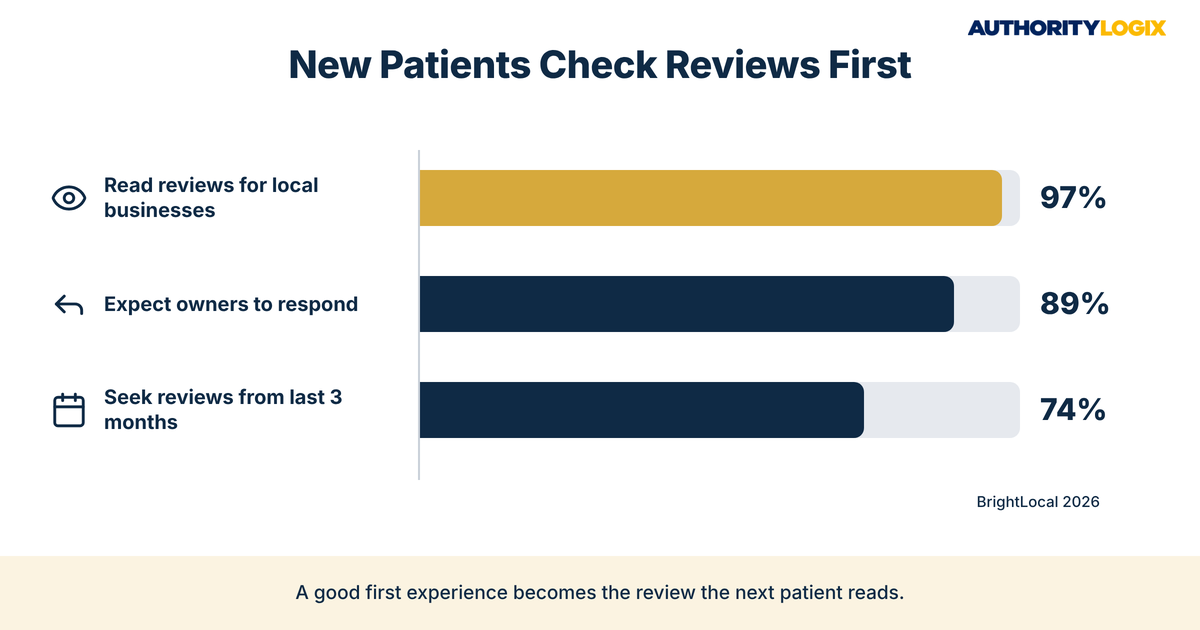
Reviews are where onboarding becomes visible to strangers. BrightLocal’s 2026 Local Consumer Review Survey found that 97% of consumers read reviews for local businesses and 74% seek reviews written in the last three months. A steady flow of recent reviews from patients who felt well looked after from day one is one of the clearest signals in the local visibility guide, and it starts with how those patients were treated before they ever met a clinician.
The same survey found that 89% of consumers expect business owners to respond to reviews. Replies should thank the reviewer and stay general, never confirming that the person is a patient or mentioning any detail of their care. Handled that way, review replies strengthen local search visibility without creating a privacy problem, and they show prospective patients a practice that pays attention.
| Signal | BrightLocal 2026 Finding | What It Means for Onboarding |
|---|---|---|
| Reading habits | 97% of consumers read reviews for local businesses | New patients will check your reviews before the first visit |
| Recency | 74% seek reviews written in the last three months | Physical therapy patient intake onboarding should produce a steady flow of reviews, not a one-time push |
| Owner responses | 89% expect business owners to respond to reviews | Reply to every review in general terms that never reveal patient details |
Using Content to Strengthen Physical Therapy Patient Intake Onboarding
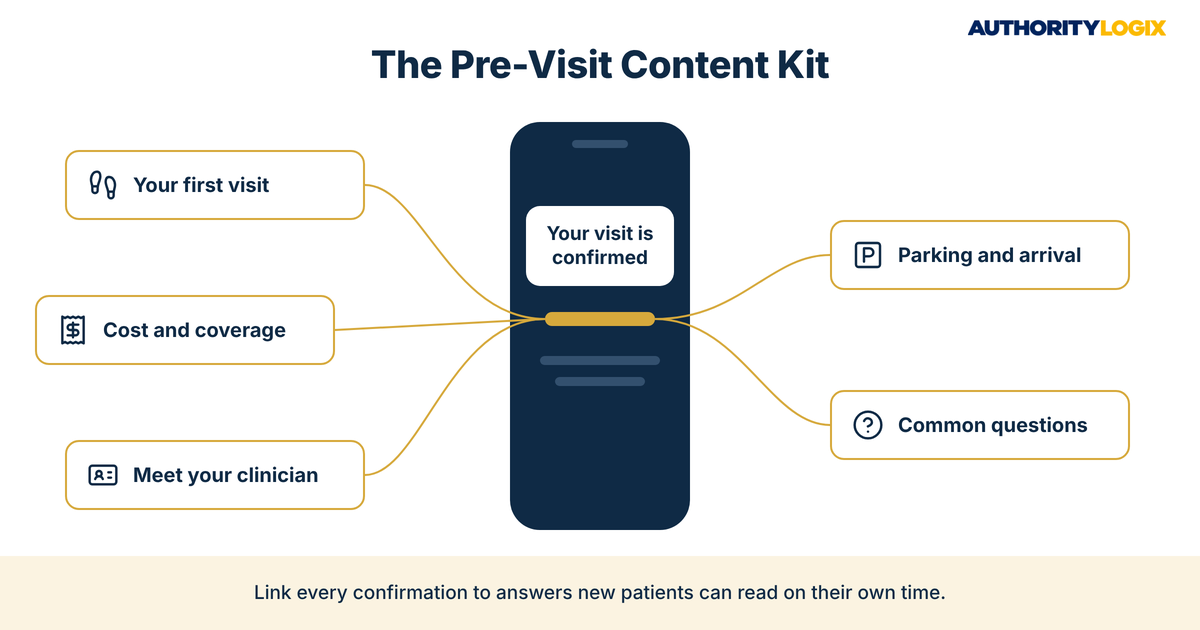
The questions new patients ask before a first visit are predictable, which makes them ideal content. What happens at an evaluation, what to wear, how long it takes, how coverage and estimates work, where to park — every one of those answers can live on your website and be linked from the confirmation message. Content turns physical therapy patient intake onboarding from a string of phone calls into something patients can read on their own time.
What to Publish Before the First Visit
- A “your first visit” page that walks through arrival, paperwork and what the evaluation involves in plain language
- A coverage and cost page that explains how estimates work and who to call with questions
- Clinician profile pages, so new patients know who they will meet
- Short FAQ answers on clothing, parking, timing and rescheduling
- Condition explainers that help new patients understand why the evaluation asks what it asks
Those pages work best grouped together. An educational hub that holds first-visit material alongside condition explainers gives new patients one place to go, and it gives search engines a clear picture of what the practice does. The confirmation email links there, the reminder text links there, and the front desk can point callers there too. That single destination keeps physical therapy patient intake onboarding consistent across every channel.
Clinician profiles deserve special attention in physical therapy patient intake onboarding. A new patient who has read about their clinician’s background arrives with a face and a name in mind, and the trust-building approach in the clinical authority guide applies directly. Keep profiles focused on credentials, training and areas of focus rather than promises about results.
None of this has to be invented from scratch. Practice owners who want to see how first-visit and education content can be structured can browse the PT resource library for examples, then adapt them to their own clinics. The goal is a physical therapy patient intake onboarding library that answers questions once and keeps answering them.
What Most PT Practices Get Wrong After the Booking (and What New Patients Wonder)
Most onboarding problems come from treating the booking as the finish line. The questions below are the ones new patients actually ask, along with the ones practice owners ask when evaluations keep slipping. Each answer points to a fix in physical therapy patient intake onboarding rather than in advertising.
Why do I have to fill out so many forms before my first visit?
Your clinician needs your history and your insurance details before the evaluation, and collecting them ahead of time keeps your visit focused on you. A well-run practice asks for each detail once, through a secure link, and tells you roughly how long it will take.
How will I know what my visit will cost?
You should be told before you arrive. Experian Health’s 2025 survey found that 77% of patients say it is important that their provider can explain insurance coverage before treatment, and a practice with careful physical therapy patient intake onboarding will give you an estimate or a named person to call.
Is it safe to send my health information online?
It should only go through the practice’s secure intake portal. If a clinic asks you to email health details or post them in a public form, ask for the secure option instead. Good physical therapy patient intake onboarding makes the secure route the easiest one.
Why do new patients cancel before the first visit?
Usually because the gap between booking and visit is silent or confusing. A confirmation, a clear intake link, a cost explanation and a reminder close most of that gap. The growth blueprint treats this as a retention metric worth tracking monthly, because every lost evaluation is a lead you already paid to generate.
Should we ask new patients for reviews?
Yes, at a natural point and in a consistent way, without offering anything in return. Reviews build on themselves when the request is part of the routine, and pairing them with clinician mentions in directories and local publications is the job of authority distribution. Keep every request and reply free of patient health details.
Ready to build an intake and onboarding sequence that turns more bookings into attended evaluations, steady reviews and referrals?
The Honest Close: The Experience After Booking Is Part of Your Marketing
Most practices spend their marketing energy getting the phone to ring and almost none on what happens next. That split is costly, because physical therapy patient intake onboarding is where a lead either becomes a patient or slips away. The confirmation, the forms, the cost conversation and the welcome are marketing too.
Building that sequence follows the same order as how we build every patient acquisition system: map the experience, remove friction, publish the answers and connect each message to the next. The work is mostly unglamorous, and it keeps paying back every time a new patient books.
AuthorityLogix tested this kind of connected system on its own build first. BKDSCR.com, a DSCR real estate education platform, was built with 18 pillar pages, 7 interactive tools and 48 SEO-optimized blog posts, and it generates inbound leads with zero paid ads. It is a different industry, but it is the same infrastructure-first thinking behind our approach to physical therapy practices.
The honest answer is that most practices already deliver excellent care once a patient is in the room. What is missing is physical therapy patient intake onboarding that makes the days before that first visit feel as professional as the visit itself.