


Key Takeaways
- A physical therapy patient referral program turns the recommendations satisfied patients already make into a tracked, repeatable source of new evaluations.
- Nielsen’s 2021 Trust in Advertising study names recommendations from people they know as the most trusted channel, at 89%.
- A PT word of mouth referral system works when recommending is easy: a natural ask, something to share and a way to see where new patients came from.
- Referral incentives are a legal question first: the HHS Office of Inspector General describes the federal Anti-Kickback Statute as a criminal law, so review any reward with healthcare counsel.
- Google’s review policy prohibits offering incentives for reviews and selectively soliciting positive ones, so a physical therapy patient referral program keeps rewards and review requests separate.
- A physical therapy patient referral program converts only when the referred patient can find and trust you online.
Table of Contents

A physical therapy patient referral program is the difference between hoping satisfied patients mention you and making sure they can. Most practices already have the raw material: patients who finished care happy and tell friends, coworkers and family about the clinic. What they lack is any structure around those conversations, which is why physician referral dependence stays the default even in practices patients love.
That is the credible but invisible pattern again. Patients trust you and say so, but the friend they tell still has to find you, check you out and book. A physical therapy patient referral program builds the path between the recommendation and the evaluation, and it is one of the connected systems mapped across the AuthorityLogix PT industry hub.
Why a Physical Therapy Patient Referral Program Beats Waiting for Word of Mouth
Word of mouth carries weight that no ad can buy. Nielsen’s 2021 Trust in Advertising study names recommendations from people they know as the most trusted channel, at 89%. That trust is already flowing through your patient base, and a physical therapy patient referral program simply stops it from leaking away.
Left alone, word of mouth is unpredictable. A happy patient mentions you once, the friend forgets the clinic name, and later searches for a physical therapist near me and books whoever ranks first. A physical therapy patient referral program fixes the weak points in that chain: it gives patients something to share, the friend a name to search and your practice a record of what happened.
Patient referrals matter more because patients can often book you directly. According to the American Physical Therapy Association, all 50 states, the District of Columbia and the U.S. Virgin Islands allow some form of direct access to physical therapist services, and its September 2022 summary lists 20 states with no restrictions on treatment absent a referral. A friend sent by a patient may not need a physician’s referral at all, depending on state rules and insurance.
A physical therapy patient referral program also reduces risk. One referring doctor retires and the pipeline dries up overnight, but a base of patient advocates spread across your community does not disappear with one relationship. Building that base on purpose, alongside physician relationships and search visibility, is central to what we do for PT practices.
The Physical Therapy Patient Acquisition Playbook shows how a physical therapy patient referral program fits beside physician referrals, direct access and local search in one connected patient pipeline.
Turning Casual Recommendations Into a PT Word of Mouth Referral System
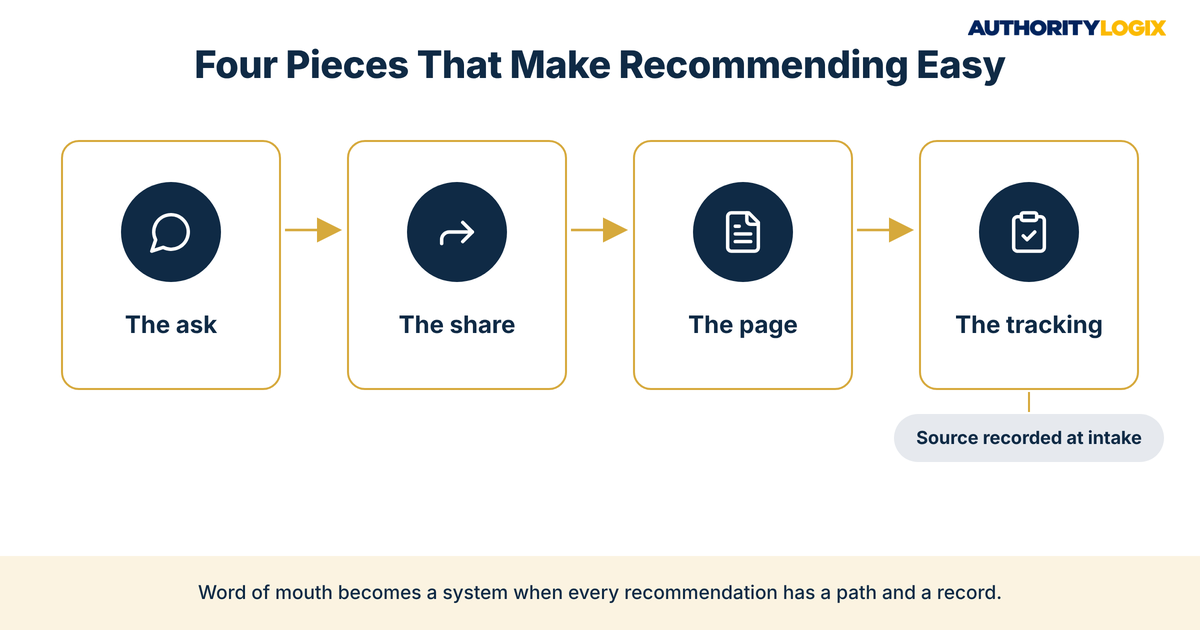
A PT word of mouth referral system is not a rewards card. It is a set of small, deliberate pieces that make recommending your practice easy and visible: a moment to ask, something to share, a page to land on and a way to track where new evaluations came from.
The Four Pieces of a Physical Therapy Patient Referral Program
- The ask: a natural moment near discharge or after a good check-in when the team mentions the practice welcomes new patients
- The share: a referral card, short link or forwardable email that points to a page about the practice
- The page: a clear landing page or condition page the friend can read before booking
- The tracking: a how-did-you-hear-about-us question at intake that records the referral source and nothing clinical about the referrer
The share is where most programs are weakest. A patient can say good things about you, but the friend needs something credible to look at, such as clinician bios, credentials and plain-language explanations of what the practice treats. Building those trust signals is covered in the clinical authority guide, and they matter as much to a referred friend as to a stranger from search.
Condition pages make sharing natural. When a patient’s coworker mentions a nagging shoulder, a link to your practice’s shoulder page is easier to pass along than a phone number, and an educational hub gives every patient advocate something specific to send. That turns each recommendation inside your PT word of mouth referral system into a visit to your site rather than a name someone might forget.
Physical Therapy Referral Incentive Strategy: What Is Allowed and What Is Not
This is the part most referral advice skips, and for a PT practice it matters most. A physical therapy referral incentive strategy that would be routine for a gym or a retailer can create legal exposure for a healthcare provider, because federal and state rules restrict what you can give patients for referrals or for choosing your services. Nothing here is legal advice; it is a map of questions to bring to healthcare counsel.
The federal starting point is the Anti-Kickback Statute. The HHS Office of Inspector General describes it as a criminal law that prohibits the knowing and willful payment of remuneration to induce or reward patient referrals or the generation of business involving items or services payable by federal health care programs such as Medicare and Medicaid. OIG also describes a separate beneficiary inducement statute that imposes civil monetary penalties for offering remuneration to Medicare and Medicaid beneficiaries to influence them to use a practitioner’s services.
OIG’s guidance adds a point that catches many practices: routinely waiving copays could implicate the Anti-Kickback Statute, and providers may not advertise that they will forgive copayments. That puts free-visit or we-cover-your-copay referral offers squarely in counsel territory. State laws and payer contracts add their own rules, which is why any physical therapy referral incentive strategy should be reviewed by counsel familiar with your state before launch.
| Referral Idea | Question to Bring to Counsel |
|---|---|
| A handwritten thank-you note to the referring patient | Is a non-monetary thank-you acceptable under our state rules and payer contracts? |
| A gift card or cash for each referral | Is this remuneration for referrals, especially where Medicare or Medicaid patients are involved? |
| A free or discounted visit for the referrer or the friend | Could this act as a beneficiary inducement or an advertised copay waiver? |
| A free community education workshop | What, if anything, may we offer attendees? |
The safer foundation for a physical therapy patient referral program is content and patient experience rather than rewards. When referrals run on shareable pages, clear communication and a good visit, there is nothing to pay out and far less to review. Producing that shareable material steadily is the job of content systems, not a rewards budget.
Compliance shapes the review side too. Google’s content policy prohibits offering incentives such as payment, discounts or free goods in exchange for posting reviews, and it bars selectively soliciting positive reviews, so referral rewards and review requests are never bundled. Articles across the AuthorityLogix resource library cover how PT practices ask for reviews and referrals within those lines.
Not sure whether your referral efforts are built to convert and to stay compliant? The PT Authority Gap Assessment shows where your physical therapy patient referral program, reviews and pages need work first.
How a PT Patient Advocacy Program Feeds Evaluation Bookings and Direct-Access Patients
A PT patient advocacy program shifts the focus from rewards to relationships. Advocates are patients who are glad to recommend you and would do it more often if it were easy: the people who leave detailed reviews, send family members or ask whether you see patients like their friend. A PT patient advocacy program identifies them, keeps them informed and gives them useful things to share.
Every recommendation in a physical therapy patient referral program should end at a booking path. A referred friend who lands on your site needs online scheduling, a clear phone number and an answer on whether a doctor’s referral is required, which is where lead generation infrastructure turns interest into an evaluation. Without it, a warm introduction becomes one more browser tab that gets closed.
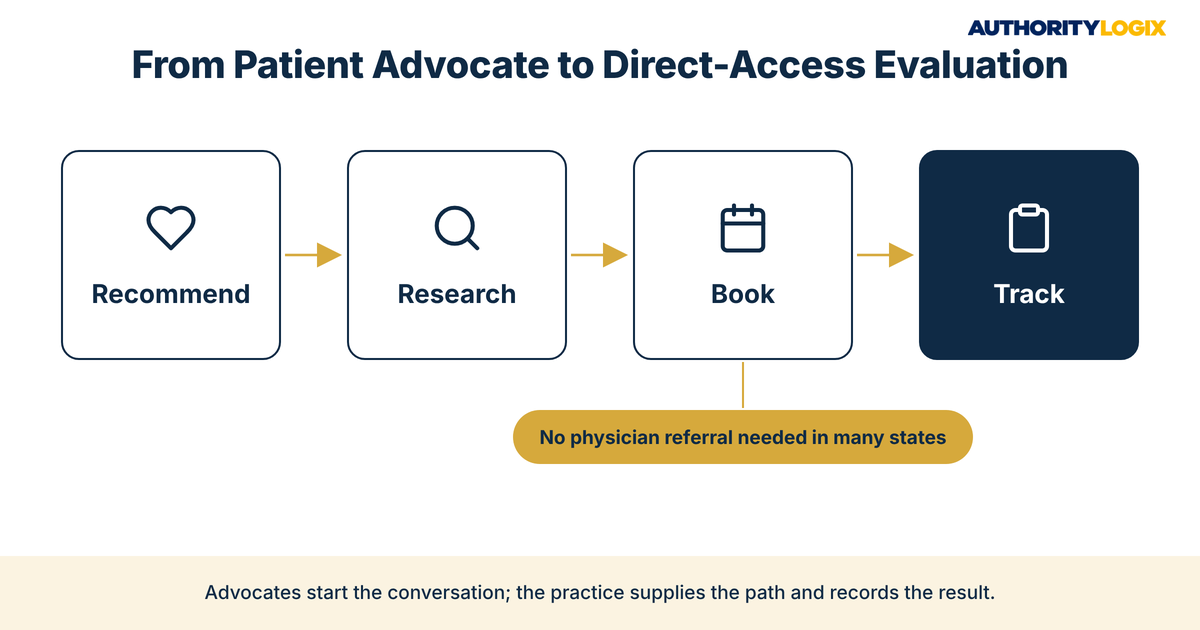
| Stage | What the Advocate or Friend Does | What the Practice Provides |
|---|---|---|
| Recommend | The patient mentions the clinic to a friend or family member | A referral card or short link to a page about the practice |
| Research | The friend searches the practice name | A complete Google profile, recent reviews and clinician bios |
| Book | The friend schedules an evaluation | Online booking and a clear answer on direct access |
| Track | The front desk records the source | An intake question on how the patient heard about the practice |
Tracking is what turns a referral habit into a business asset. When intake captures the source of each new evaluation, you can see how much of the schedule comes from patient advocates versus physicians and search, which is the channel measurement laid out in the growth blueprint. A physical therapy patient referral program that is never measured cannot be improved, because nobody knows whether it works.
Direct access raises the stakes. Because many referred friends can book without a physician’s referral where state rules allow, a physical therapy patient referral program can produce direct-access evaluations that never pass through a doctor’s office. For practices trying to diversify beyond a handful of referring physicians, that is the practical payoff.
Connecting Your Physical Therapy Patient Referral Program to Reviews, the Map Pack and Condition Pages
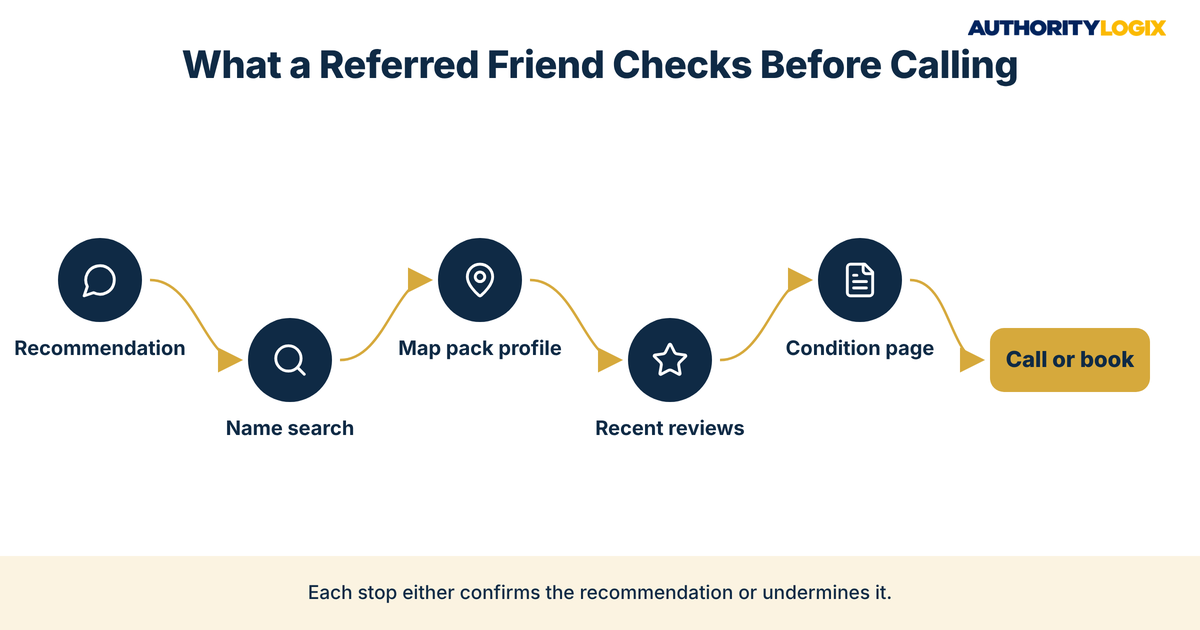
A recommendation rarely ends the decision. The friend who hears about your practice will usually search the name, glance at the map pack, read a few reviews and click through to a page before calling. Your physical therapy patient referral program is only as strong as what they find at each of those stops.
The Google Business Profile is the first stop. Complete categories, current hours, real photos and a clear booking link tell the referred friend the recommendation was sound, and the local visibility guide covers each of those elements in detail. A thin or outdated profile undermines the patient who vouched for you.
Reviews Are the Public Version of a Referral
Reviews are word of mouth written down for strangers. A steady flow of recent, specific patient reviews confirms what the advocate said privately, and asking every patient for feedback in the same neutral way keeps the practice inside Google’s policy. Never offer anything in exchange for a review, and never ask only the happiest patients.
Reviews, categories and location pages together decide where you appear when the friend searches nearby. Strong local search positioning means the referred patient finds you instantly, and the friend who forgot your name can still find you by searching for physical therapy near home or work. A physical therapy patient referral program and local visibility are two halves of the same system.
What Most PT Practices Get Wrong About Referrals (and What Referred Patients Ask First)
Most attempts at a physical therapy patient referral program stall for the same handful of reasons. These are the questions practice owners and referred patients commonly ask.
Do we need to offer a reward for a physical therapy patient referral program to work?
No, and for many practices rewards create more compliance questions than they solve. A physical therapy patient referral program that holds up is built on a good experience, a simple ask and easy-to-share pages. If you want to thank referrers with anything of value, talk with healthcare counsel first.
My friend recommended this practice. Do I need a doctor’s referral to book?
It depends on your state and your insurance plan. APTA’s direct access summary shows every state allows some form of direct access, though many attach provisions such as time or visit limits. The front desk can confirm what applies before your first visit.
Why do referred patients still check Google before calling?
Because a recommendation is a starting point, not a decision. Referred patients want to confirm the clinic is real, convenient and credible, and pages built on the keyword structure in the content SEO playbook are what they find when they search the practice name plus their concern. If those pages are missing, the recommendation loses force.
Should we promote the program on social media?
Promotion helps only when it points somewhere useful. Sharing patient-education articles, clinician introductions and community events through authority distribution gives advocates material to pass along, while a generic refer-a-friend post gives them little. The content does the recommending, and the post just carries it.
How do we know whether a PT patient advocacy program is working?
Track the source of every new evaluation at intake and review it monthly. If the share of evaluations from patient referrals rises over time, the physical therapy patient referral program is doing its job; if it stays flat, look first at the share and booking steps.
Ready to build a physical therapy patient referral program that turns patient trust into tracked evaluations, backed by the pages, reviews and local visibility that make recommendations stick? We will build it with you.
The Honest Close: Referrals Follow a Practice People Can Find and Trust
A physical therapy patient referral program cannot create trust that is not there, and it cannot make up for a practice that is hard to find. What it can do is take the trust you already earned and give it a path to the schedule. The sequence described in how we work builds that path first, with profile, pages and reviews in place before any program launches.
We have tested that order on our own business. BKDSCR.com, the AuthorityLogix proof-of-concept in the NYC outer-borough DSCR real estate niche, was built with 18 pillar pages, 7 interactive investor tools and 48 SEO-optimized blog posts, and it generates inbound leads with zero paid ads. It is not a PT practice, but it shows our approach plainly: build the infrastructure first, then let recommendations and search build on it.
The honest answer is that most PT practices already have patients willing to vouch for them. The missing piece is the infrastructure that lets a recommendation become a booked evaluation, and that infrastructure is what a physical therapy patient referral program should be built on.