Key Takeaways
- A physical therapy practice authority stack timeline puts the build in order, so every layer has something underneath it to stand on.
- In CMI and MarketingProfs research for 2026, 97% of B2B marketers said they have a content strategy, and among those reporting improvement, 74% credited strategy refinement versus 51% who credited new technology.
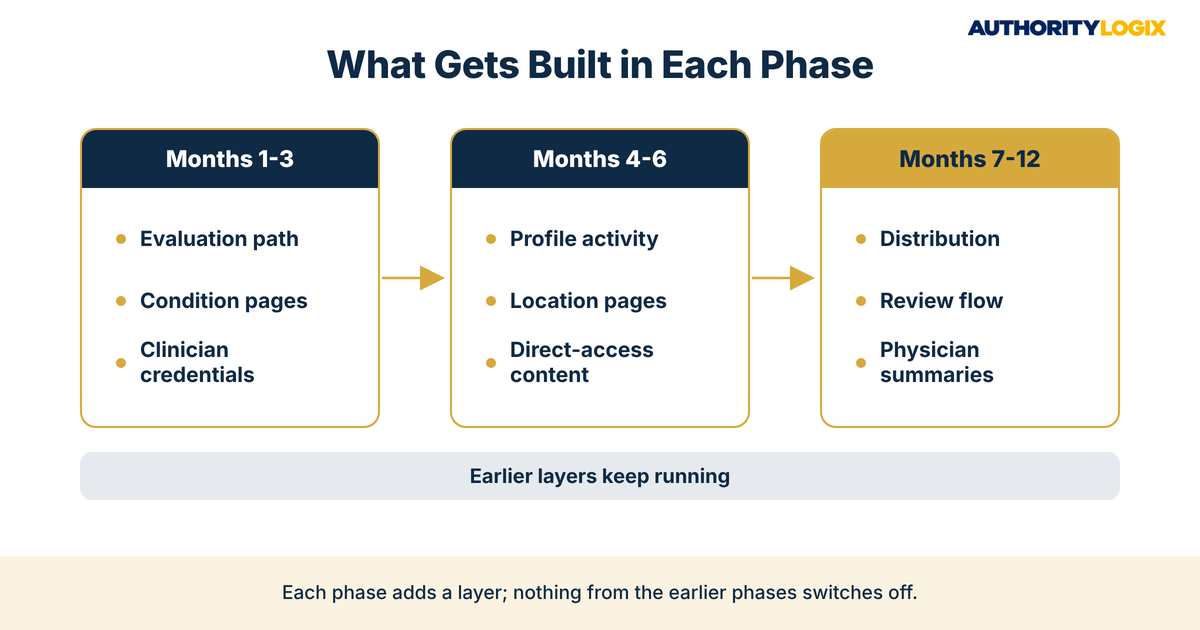
- Months 1-3 cover foundations: evaluation booking paths, core condition pages, and visible clinician credentials.
- Months 4-6 expand map pack visibility and direct-access patient content; months 7-12 add distribution and a steady review flow.
- BrightLocal’s 2026 survey found 74% of consumers seek reviews written in the last three months, so reviews run continuously in a physical therapy practice authority stack timeline.
- No timeline guarantees rankings or patient volume; the physical therapy practice authority stack timeline is a build order, tracked through calls, website clicks, direction requests, and evaluation requests.

A physical therapy practice authority stack timeline answers a question most clinic owners never get a straight answer to: what should be built first, and what can wait. You know your patients, your community, and your referring physicians — but the website, the Business Profile, and the content library rarely reflect any of it. When everything starts at once, nothing gets finished, and the practice stays credible but invisible.
The alternative is a sequence. Rather than buying a website, a social package, and an ad campaign in the same month, you build in layers, and each one gives the next something to stand on. That layered approach is
what we do for physical therapy practices, and this article lays out the physical therapy practice authority stack timeline phase by phase.
Why a Physical Therapy Practice Authority Stack Timeline Beats Building Everything at Once
Sequencing is more than a preference. The
CMI research for 2026, a Content Marketing Institute and MarketingProfs survey of 1,015 B2B marketers fielded in mid-2025, found that 97% have a content strategy and 61% of those with a strategy report improvement, with 74% of improvers crediting strategy refinement versus 51% crediting new technology. Those are business marketers, not clinics, but the lesson carries: more of the improvers credited refining the plan than adding tools.
For a PT practice, building everything at once creates predictable gaps. A new website launches before anyone has written the condition pages it needs. A Business Profile gets polished, but the site it links to cannot convert a direct-access patient. A physical therapy practice authority stack timeline prevents that by putting each layer in order.
Reading the Physical Therapy Practice Authority Stack Timeline as Layers
Think of the stack as five connected systems: content, local search and clinician authority, an educational hub, lead generation, and authority distribution. The
PT industry hub describes each system on its own, and the timeline decides when each becomes the focus. Every layer keeps running once it starts, so month seven adds work on top of month one rather than replacing it.
The first quarter gets the least space here on purpose. A detailed version of those opening months already exists in the
90-day plan, so this article summarizes months 1-3 and spends more time on what comes after. The physical therapy practice authority stack timeline is most useful as a full-year view.
The Physical Therapy Practice Authority & Growth Blueprint shows how each layer of the physical therapy practice authority stack timeline connects to long-term growth and measurement.
Growth Blueprint →
Months 1-3: Foundations for Evaluation Bookings, Condition Pages, and Clinician Credentials
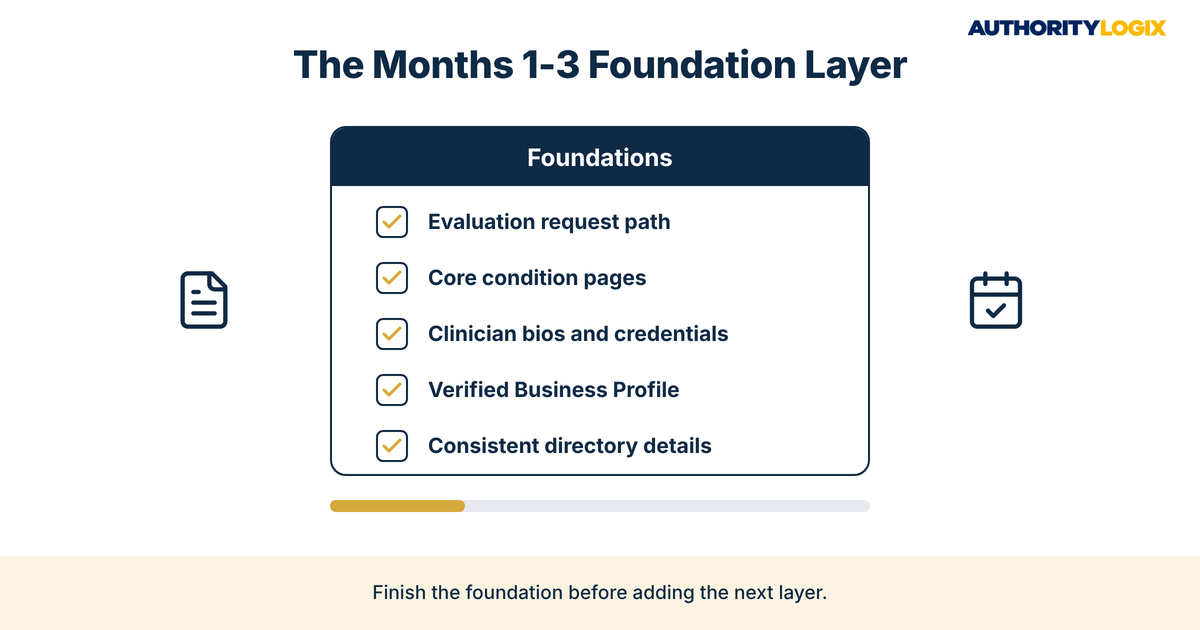
The first three months build the parts every later layer depends on. In a physical therapy practice authority stack timeline, that means a site that can book an evaluation, condition pages for the problems you see most, and clinician credentials that are visible and accurate.
What PT Authority Stack Months 1-3 Should Produce
Keep this phase narrow and finish it. These are the pieces that should exist by the end of month three:
- A clear evaluation request path on every page — phone, form, and direct-access language
- Core condition pages for the problems that make up most of your caseload
- Clinician bios with credentials, specialties, and a real photo
- A claimed, verified Google Business Profile with correct categories and hours
- Consistent name, address, and phone details across the major directories
Those pieces need a production method from day one, or the condition pages stall after the first few. The
content systems that keep a library growing — recorded clinician interviews, a set editing process, a steady publishing rhythm — should start in this phase even though their output builds later. PT authority stack months one through three are about foundations, not volume.
Clinician credentials deserve more attention than most practices give them. Google’s guidance on creating helpful content asks whether pages carry a byline where readers would expect one and whether content shows first-hand expertise, and the
clinical authority guide covers how to turn credentials into visible trust signals. A bio page lets a patient see who they will be working with before calling.
Months 4-6: Expanding Map Pack Visibility and Direct-Access Patient Content
With foundations in place, the second quarter of a physical therapy practice authority stack timeline turns outward. This is when
local search work expands beyond the basics: Business Profile posts, answered questions, photos of the real clinic, and location pages for each neighborhood or town you serve. The goal is to give the map pack more reasons to show your practice, and more substance behind the listing when it does.
This phase also adds content for patients who can come in without a referral. APTA’s 2025 report on the state of direct access says patients in all 50 states, the District of Columbia, and the U.S. Virgin Islands have either provisional or unrestricted direct access to physical therapist services for evaluation and treatment, though some provisions tied to treatment without a referral persist in a number of states. A plain-language page on how direct access works in your state answers a question many self-referred patients have.
Direct-access content in this phase stays educational. It explains what a first visit looks like, how scheduling works, and what to bring, without promising results or offering clinical advice. Placed on the right pages, it gives the physical therapy practice authority stack timeline a layer written for patients who are deciding on their own.
Months 4-6 are also when scattered pages become a structure. An
educational hub groups condition pages, FAQ answers, and articles so patients and search engines see one connected body of knowledge rather than a pile of posts. In the physical therapy practice authority stack timeline, the hub is what turns early condition pages into topical depth.
Multi-location practices should give each clinic its own location page and profile in this phase rather than one shared page. The
local visibility guide covers that location-level work, including categories, citations, and service areas, in more detail. Each location then carries its own clinic director, its own neighborhood names, and its own reviews.
Not sure which layer of your physical therapy practice authority stack timeline is missing? The PT Authority Gap Assessment shows where your practice stands today and what to build next.
Authority Gap Assessment →
Months 7-12: Distribution, Reviews, and the Physical Therapy Year One Authority Plan Payoff
The back half of the year is where the physical therapy year one authority plan starts to show what it has been building. By now the site has condition pages, a hub, and a working profile, so
authority distribution can push that material outward — adapted articles on LinkedIn, local publications, community partner sites, and physician-facing summaries. Distribution works at this point because there is finally something worth sending people to.
Reviews run through the whole physical therapy practice authority stack timeline, but they become a focus here. BrightLocal’s 2026 Local Consumer Review Survey of 1,002 US adult consumers found that 74% seek reviews written in the last three months, and 80% say they are likely to use a business that responds to all of its reviews. A steady monthly request process and a reply to every review matter more than a one-time push.
| Phase |
Build Focus |
Already Running |
What to Watch |
| Months 1-3 |
Evaluation path, core condition pages, clinician credentials, verified profile |
Nothing yet — this is the base |
Pages published, profile verified, booking path tested |
| Months 4-6 |
Profile activity, location pages, direct-access content, educational hub |
Content production and the foundation pages |
Profile views, direction requests, calls |
| Months 7-12 |
Distribution, review requests and replies, physician-facing summaries |
Every earlier layer of the physical therapy practice authority stack timeline |
Website clicks, evaluation requests, review recency |
By month twelve, the pieces are designed to feed one another. Reviews mention the condition pages patients read, profile posts point to new articles, and distributed pieces bring people back to the hub — the cycle described in the
authority flywheel. No timeline can guarantee rankings or a patient count, but the physical therapy year one authority plan should leave you with a system that keeps working after the build phase ends.
How to Track a PT Authority Building Sequence Timeline Without Guesswork
Tracking is where many owners lose confidence in the plan. The same CMI research found that a third of marketers admit they struggle with measuring effectiveness. A PT authority building sequence timeline needs a short list of numbers you check every month, not a dashboard nobody opens.
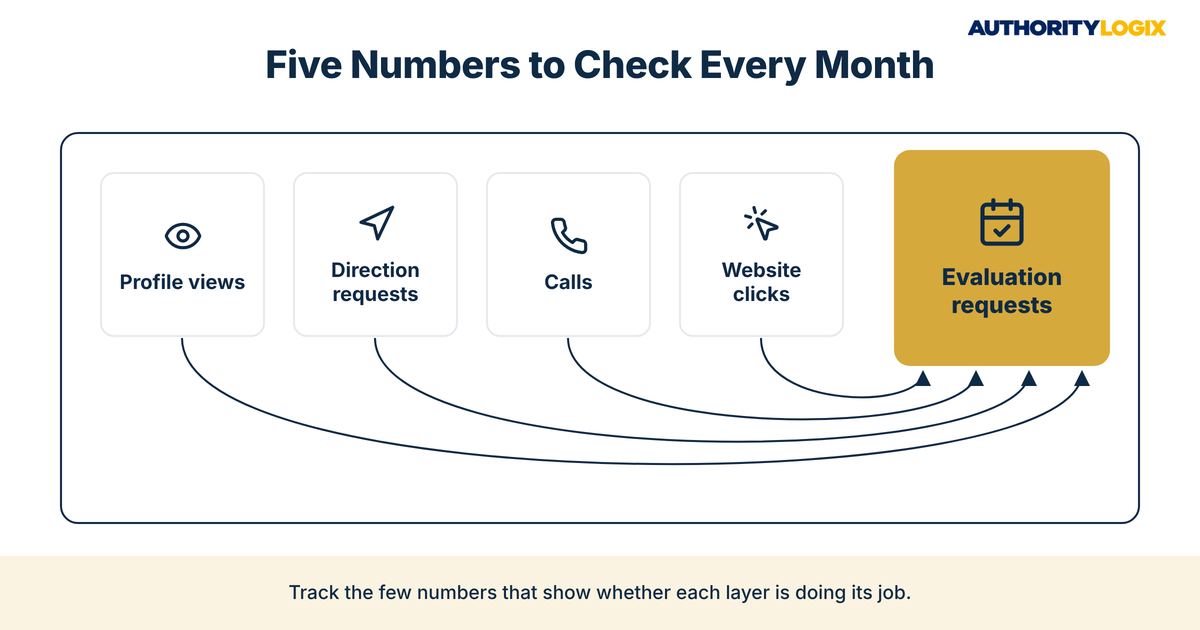
Monthly Numbers for a Physical Therapy Practice Authority Stack Timeline
Google’s Business Profile performance report shows how many people viewed your profile on Search and Maps, asked for directions, clicked the call button, and clicked through to your website. Pair those with evaluation requests from the site and the question your front desk already asks — how did you hear about us — and you have an honest read on each layer.
Evaluation requests are the number that matters most, which is why
lead generation tracking belongs in the stack from the start. Every form, call button, and booking link should be traceable to the page it sits on, so you can see which condition pages and location pages produce requests. A page that ranks but never produces a request is a signal to revise that page, not to abandon the physical therapy practice authority stack timeline.
Referral sources need tracking too. If physician referrals still make up most of your new patients, the goal is a growing share from direct access and search across the year, and the
acquisition playbook explains how to read those streams side by side. That ratio says more about the health of a PT authority building sequence timeline than any single ranking.
Review the numbers once a quarter, not once a week. Monthly figures move around, and a single slow month says little on its own, while a quarter of data shows whether a layer is gaining ground. Each quarterly check should end with one decision about the physical therapy practice authority stack timeline: keep the current focus, adjust it, or move to the next layer.
What Most PT Practices Get Wrong About Their Physical Therapy Practice Authority Stack Timeline
Most stalled builds share a few mistakes. They usually come from good intentions, such as wanting results faster or trying to save money by skipping a layer. These are the questions owners raise most often.
Can we skip the foundations and start with ads or social posts?
You can, but the traffic lands on a site that cannot answer questions or book an evaluation. Ads stop producing the day the budget stops, while the foundation layers keep working. Skipping months 1-3 usually means rebuilding them later.
Should we publish as much content as possible in the first month?
Volume without structure rarely helps. A handful of well-built condition pages, each tied to a clear search target, is a stronger start than dozens of thin posts, and the
content SEO playbook explains how keyword research and page architecture decide which pages come first. The physical therapy practice authority stack timeline spreads publishing across the year on purpose.
What if we already have a website and a profile?
Then the timeline starts with an audit, not a rebuild. Pages that work stay, weak ones get revised, and missing layers get added in order — the same sequence behind
how we build for practices that already have some pieces in place. Starting mid-stack only changes where month one begins.
Can we finish the whole stack in six months instead of twelve?
Some layers can be compressed, but search visibility and review history build over time and cannot be rushed with more spending. A compressed physical therapy practice authority stack timeline usually shortchanges the distribution and review layers.
Does the timeline guarantee more patients by month twelve?
No. No honest plan guarantees rankings, patient counts, or revenue. What the timeline does is make sure every layer is built, connected, and measured, so you can see what is working and adjust.
Who inside the practice should own the timeline?
The owner or clinic director should own the decisions, and someone else should own the production. Clinicians supply expertise and review drafts for accuracy, while the build itself — pages, profile work, tracking — sits with whoever runs the physical therapy practice authority stack timeline day to day. When the owner tries to do both, the build usually stalls.
Ready to have the full twelve-month authority stack built in the right order for your practice, from condition pages to map pack visibility to a steady review flow?
Work With Us →
An Honest Expectation for Year One and Beyond
The build order in this article is the same one AuthorityLogix used on its own proof-of-concept. BKDSCR.com, built in the NYC outer-borough DSCR real estate niche, reached 18 pillar pages, 7 interactive investor tools, and 48 SEO-optimized blog posts in under 18 months with zero paid ads. It is a real estate platform, not a physical therapy client, but it was built layer by layer in the same way.
That proof is a large part of
why AuthorityLogix approaches PT practices with a sequence instead of a package. Year one is a build year: the foundation, local expansion, and distribution layers get finished, and the physical therapy practice authority stack timeline moves from construction to maintenance.
Year two is about depth — more condition pages, more clinician content, and more locations if you grow. The PT
resource library covers each of those areas in the same systems-first way when you are ready for the next layer. By then the physical therapy practice authority stack timeline has done its main job, and the practice is adding to a working system rather than starting over.
The honest answer is that most PT practices already have the clinical expertise and patient relationships to support real authority. What they lack is a physical therapy practice authority stack timeline that builds it in order, so each layer holds up the next and the market can finally see what the practice has earned.