


Key Takeaways
- Physical therapy press coverage in local news gives a practice outside links, mentions and trust signals that its own website cannot create alone.
- According to Pew Research Center, 70% of U.S. adults have at least some trust in information from local news organizations, compared with 56% for national news organizations.
- PT local media coverage is earned with timely community health stories and clinicians who explain things in plain language, not with an expensive agency retainer.
- Physical therapy press mentions only build search authority when they are captured: linked, listed with consistent practice details and published on the practice’s own site.
- PT community PR visibility compounds when the practice pitches on a seasonal calendar every quarter instead of waiting for a reporter to call.
- Physical therapy press coverage works best as one part of a connected authority system, alongside local search, patient education content and lead capture.
Table of Contents
What Physical Therapy Press Coverage Actually Does for Local Search Authority
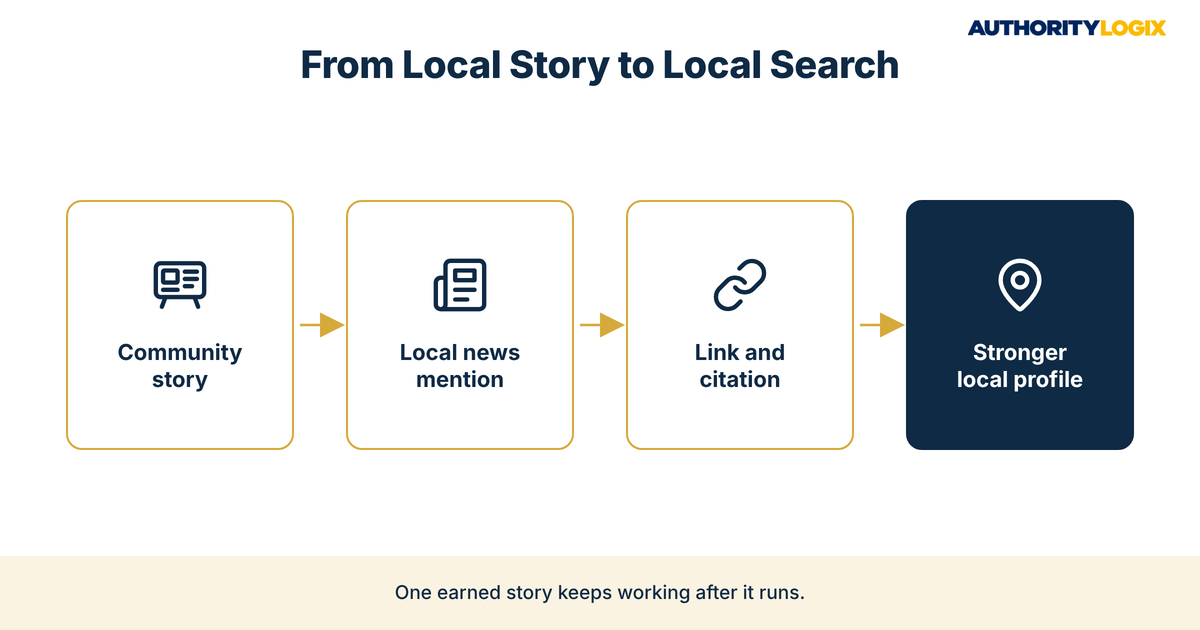
Physical therapy press coverage is one of the few visibility assets a practice can earn rather than buy, and most clinics leave it on the table. You may have years of clinical experience, a loyal referral base and therapists the community respects, yet a new resident searching for help sees a list of names with nothing to tell them apart. That is the credible but invisible problem, and it shows up first in local search, where Google has to decide which practice earns the top spots.
Google explains part of that decision on its own Business Profile help page. It says local results are mainly based on relevance, distance and popularity, and that prominence, meaning how well-known a business is, is based partly on how many websites link to your business and how many reviews you have. A story in the local paper, a segment on community radio or a quote on a neighborhood news site is exactly the kind of outside signal physical therapy press coverage creates.
Physical therapy press coverage also does something a paid ad cannot. It puts your clinicians in front of readers through a source those readers already trust, and the article stays online long after the print edition is recycled. When the story is shared through your newsletter, your social channels and your partner network, a job that belongs to authority distribution, one feature keeps reaching new people for months.
Many practices confuse coverage with announcements. A release about a new location or a new hire has a real role, and well-built press releases support brand authority, but physical therapy press coverage is different: a reporter or editor decides your practice is worth writing about. That independent choice is what gives the mention its weight with patients and with search engines.
The Physical Therapy Local Visibility Guide shows how press mentions, reviews, listings and location pages work together, and where physical therapy press coverage fits inside a complete local search system.
Why Local News Still Carries Trust Patients Act On
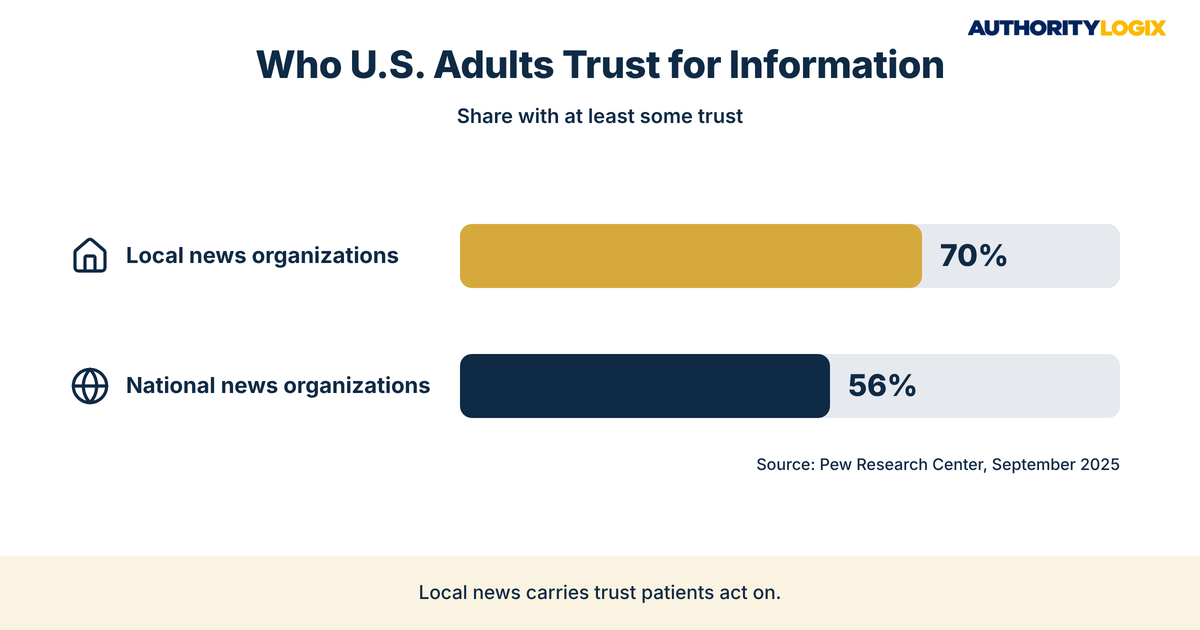
Patients choosing a physical therapist are making a decision about their body, their time and their money, so trust matters more than convenience. National headlines feel distant; local news still feels like a neighbor. According to Pew Research Center’s trust survey, 70% of U.S. adults have at least some trust in information from local news organizations, compared with 56% for national news organizations. Pew surveyed 5,195 U.S. adults from September 8 to 14, 2025.
That trust holds across party lines. In the same Pew survey, 78% of Democrats and 64% of Republicans said they have at least some trust in information from local news organizations. Few channels carry that kind of broad local credibility, which is why physical therapy press coverage deserves a place in your visibility plan.
That trust transfers. When a local outlet quotes one of your therapists on staying active through winter or preparing for a spring race, the reader does not see an advertisement. They see a clinician their community news source chose to feature, which makes your practice feel like a safe choice before anyone visits your website. Physical therapy press coverage works best when the site backs it up with clear patient education that answers the questions the story raised.
PT local media coverage also reaches people who never search for a physical therapist. Many people do not know they may be able to book without a prescription, and a local story frames your practice as the place to ask. Each feature adds to the record of practice authority that patients, referral partners and search engines read when they check you out, and that record gets stronger with every story instead of starting over each month.
How to Earn PT Local Media Coverage Without a PR Agency
PT local media coverage does not require a retainer or a publicist. Local editors and producers need a steady supply of useful, community-focused stories, and they are often short on sources who can explain a health topic clearly and quickly. A practice that becomes a reliable source solves a real problem for them, and that is the whole approach to physical therapy press coverage in one sentence.
Start where your practice already shows up. Race expos, school sports nights, senior center talks and employer workshops are all events local media might cover, and practices with a steady community presence already have the relationships and photos a reporter needs. List the outlets that cover your area, from the weekly paper and neighborhood news sites to local radio and chamber newsletters.
Pitching Physical Therapy Press Coverage Around Community Health Stories
A pitch for physical therapy press coverage works when it is short, local and useful. Lead with why the story matters to readers this week, name the clinician who can speak to it, and offer a specific time and place, such as a free workshop or a community event. Keep it to a few sentences and a phone number, and follow up once.
Community health stories also keep physical therapy press coverage inside the right boundaries. Your clinicians explain general topics, such as why balance matters for older adults or how young athletes can ease into a new season, and they never diagnose anyone or promise results on air or in print. Having that material already written through your content systems means a clinician can answer a reporter’s call with confidence and a ready link to a deeper guide.
Story Angles Local Editors Actually Accept
Editors accept stories that are timely, local and about people in their community. These angles tend to pass that test:
- Seasonal safety: winter slip-and-fall awareness, spring race preparation or summer youth sports camps.
- Community events: a free workshop, a race-day support tent or a school sports night.
- Local milestones: a clinic anniversary, a new location or a clinician’s community award.
- Expert commentary: a clinician quoted when a local story touches on injuries or active living.
Each angle should point back to a page on your site that goes deeper, written with the same search discipline described in the content SEO playbook. Physical therapy press coverage then becomes a front door: the reader meets your clinician in the story and finds the full answer, and the booking button, on your website.
Not sure whether your practice is ready to turn physical therapy press coverage into local search authority? The assessment shows where your visibility gaps are and what to fix first.
Turning Physical Therapy Press Mentions Into Links, Citations, and Profile Signals
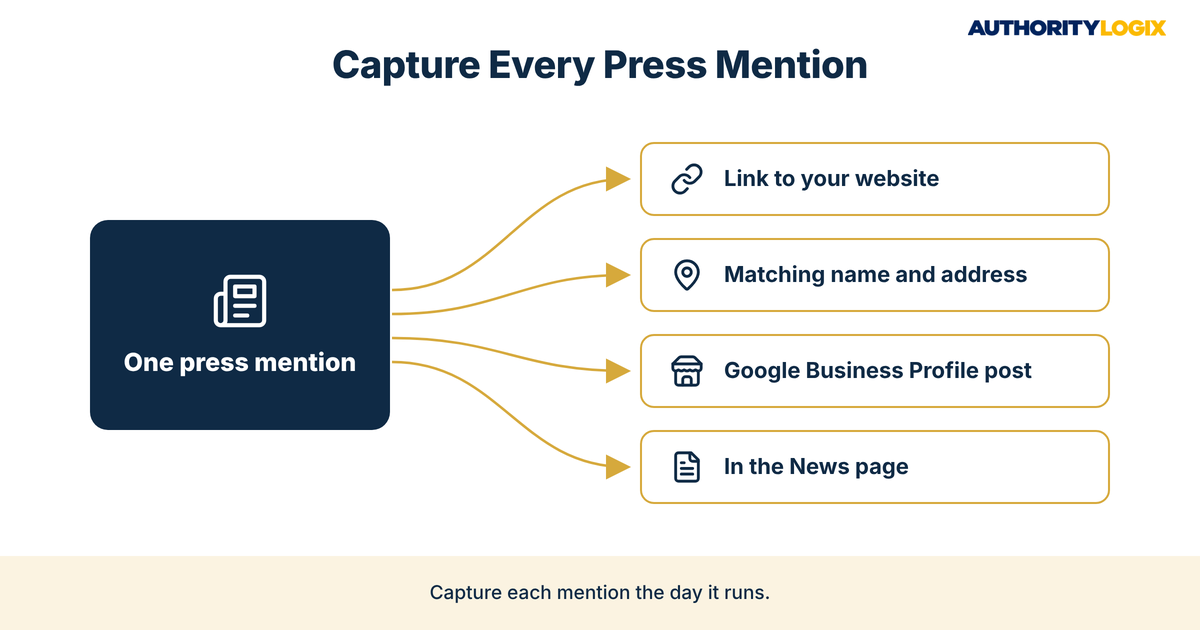
Physical therapy press mentions lose most of their value when nobody captures them. A story runs, the team shares it once, and a few months later no one can find it. The fix is a simple capture routine that turns every piece of physical therapy press coverage into lasting signals for patients and for search engines.
The first signal is the link itself. Many local outlets will include a link to your website if you ask politely and give them the exact page, which is the same principle behind earning links from community organizations and partners. If a story runs without one, a short note to the editor with the correct page is a fair request.
| Signal | What to do | Why it matters |
|---|---|---|
| Link to your website | Ask the outlet to link to the relevant page, not only the homepage | Shows search engines that other websites know your practice |
| Name, address and phone | Check that the story lists your details exactly as your Google Business Profile does | Keeps your practice details consistent across the web |
| Google Business Profile post | Share the story as a profile update with a photo from the event | Shows searchers recent, local activity on your listing |
| In the News page | Add the headline, outlet, date and a short summary to your site | Keeps physical therapy press coverage findable after the outlet archives it |
| Partner and patient sharing | Send the story to referral partners and your patient newsletter | Extends the reach of every mention |
Consistency matters as much as the link. If physical therapy press coverage lists an old address or a misspelled practice name, ask for a correction, because mismatched details work against your local profile. Post the same story to your Google Business Profile so searchers see recent, local proof that the community knows you.
Where Physical Therapy Press Mentions Should Live on Your Website
Every practice that earns coverage needs a permanent In the News page. List each feature with the outlet, the date, the headline and a two-sentence summary, and connect each entry to the patient guide on the same topic inside your educational hub. That turns physical therapy press coverage into a navigation path, from proof of trust straight into helpful content.
Mentions also strengthen clinician pages. A therapist quoted on running or active aging should have those features listed on their bio page, next to credentials. Examples of how practices organize this kind of proof run throughout our PT resources, and the principle is the same everywhere: evidence of authority should be visible, not buried.
Building PT Community PR Visibility That Compounds Year Over Year
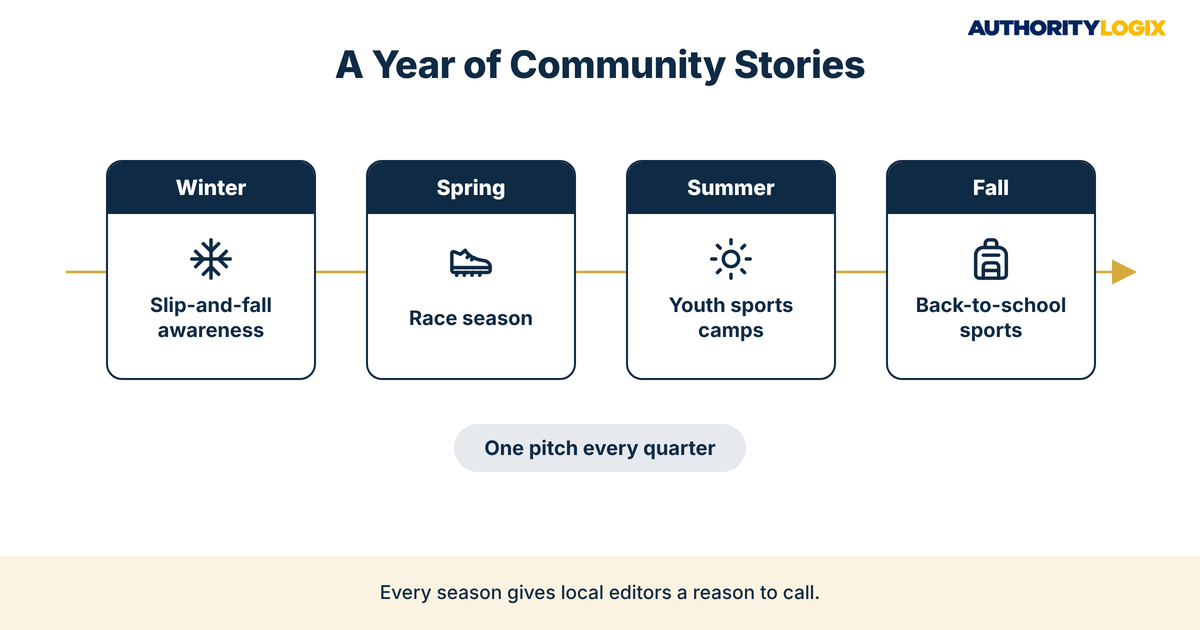
PT community PR visibility compounds when it runs on a calendar instead of on luck. Most practices get one story, enjoy it and then wait for the next reporter to call. A practice that pitches one community story every quarter builds a body of physical therapy press coverage that grows each year, and each new feature makes the next pitch easier because editors already know the name.
The calendar can be simple. Plan winter stories around slip-and-fall awareness, spring around race season, summer around youth sports camps, and fall around back-to-school sports and workplace programs. Over time, those seasonal stories become a dependable part of your patient acquisition mix, introducing your therapists to direct-access patients long before those people ever search for care.
Coverage also needs a way to turn interest into evaluations. Every story should lead to a page with a clear next step, such as a workshop sign-up, an event registration or a short contact form, because that is where lead generation picks up what physical therapy press coverage started. Track inquiries in the weeks after each feature so you know which outlets and angles deserve more effort.
This is the same compounding logic AuthorityLogix tested on its own build. BKDSCR.com, the founder’s proof-of-concept platform in the NYC real estate investment niche, was built in under 18 months with 18 pillar pages, 48 SEO-optimized blog posts and zero paid ads, with every piece connected to the next. Authority compounds. Physical therapy press coverage works the same way when each story feeds a page, each page feeds a profile, and each profile feeds the next pitch.
Physical Therapy Press Coverage FAQ: What Practice Owners Ask Most
How do I get local press coverage for my physical therapy practice?
Start by listing the outlets that cover your area and the community events your team already supports. Then send a short pitch tied to a timely, local health topic, name the clinician who can speak to it, and follow up once. The way we turn that into a repeatable routine is laid out in our process.
Does physical therapy press coverage help Google rankings?
It can help, but it is not a switch. Google says prominence is based partly on how many websites link to your business, so a linked mention from a respected local outlet adds to that signal. It works best alongside a complete Google Business Profile, steady reviews and helpful pages on your site.
Can physical therapy press coverage feature a patient’s story?
Patient information is protected, so any story that names or shows a real patient needs that patient’s written permission and a review by whoever handles privacy compliance at your practice. The safer path is to keep stories focused on community education, events and your clinicians.
Do we need a PR agency for PT local media coverage?
Local editors care about a timely story and a reliable source, not about who sends the pitch. A practice with a clear calendar, ready-to-share patient guides and a clinician willing to take a call can run physical therapy press coverage in-house. If you want the pages, guides and capture routine built for you, that work is part of our services.
How long does physical therapy press coverage keep helping?
A print story fades within days, but the online version, the link and your In the News entry keep working for as long as they stay live. That is why capturing each mention matters more than the moment it is published.
Ready to build the pitch calendar, In the News page and capture routine that turn local stories into lasting search authority for your practice?
Making Local Media a Standing Part of Your Practice’s Authority System
Physical therapy press coverage is not a publicity stunt or a one-time win. It is a source of trust, links and community recognition that most practices already qualify for and rarely pursue. The clinicians are credible, the community stories are there, and local editors need sources. What is usually missing is the routine that connects them, the same routine that sits at the center of effective physical therapy marketing.
Make physical therapy press coverage standing work. Assign one person to own the calendar, pitch every quarter, capture every mention the day it runs, and connect each story to a page that helps patients take the next step. That is the difference between a story you remember and a system that keeps building, and it is why AuthorityLogix treats local media as infrastructure rather than a favor from a reporter.
The honest answer is that most practices already have the expertise local reporters want to quote. The missing piece is the infrastructure that makes the community, and the search engines, see it.