


Key Takeaways
- Physical therapy reputation management negative reviews work starts with one rule: a reply must never confirm that the reviewer is, or was, a patient.
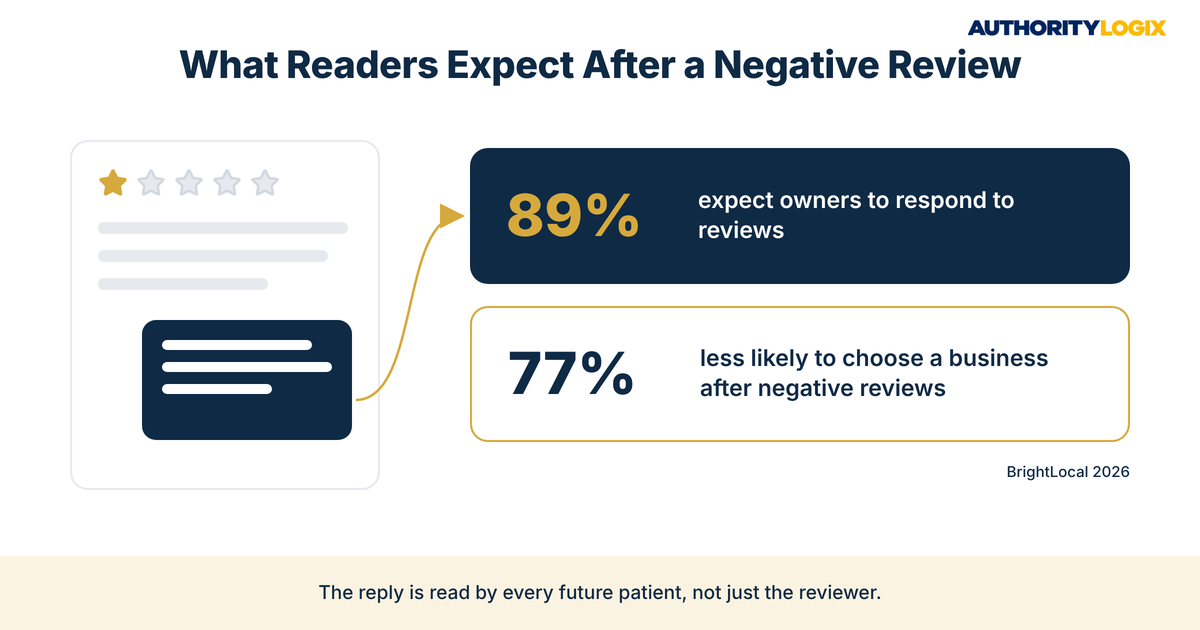
- BrightLocal’s Local Consumer Review Survey 2026 found that 89% of consumers expect business owners to respond to reviews and 77% say negative reviews make them less likely to choose a business.
- In 2023, the HHS Office for Civil Rights announced a $30,000 settlement with a New Jersey provider that disclosed patient information while responding to negative online reviews.
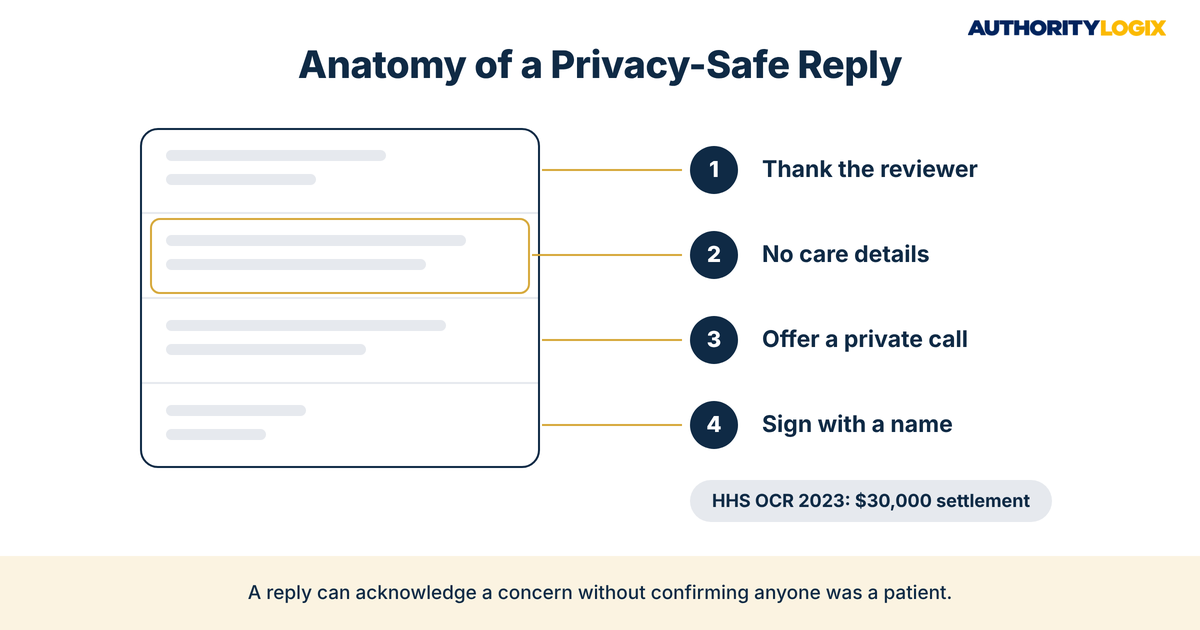
- A PT negative review response strategy uses a short, privacy-safe reply that thanks the reviewer, shares no care details and offers a private conversation.
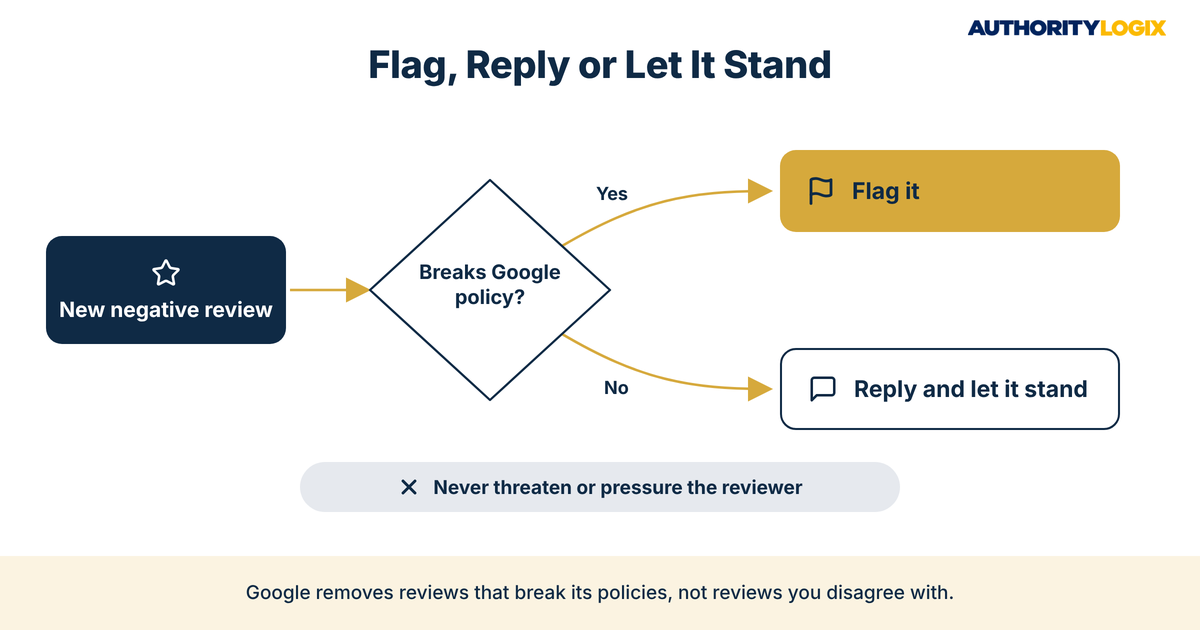
- Google removes only reviews that violate its content policies, so flagging is for policy violations, not for reviews you disagree with.
- Physical therapy Google review management works as a weekly routine, and a steady record of recent reviews matters more than any single reply.
Table of Contents
What Physical Therapy Reputation Management Negative Reviews Require From Owners
Physical therapy reputation management negative reviews work begins the moment a one-star review lands on a profile that took years to earn. You may have built a practice on careful evaluations and long relationships with referring physicians, and still feel that one angry paragraph now speaks louder than everything else. The AuthorityLogix PT industry hub starts from that reality: practices that are credible but invisible online are judged by whatever the profile shows.
What the profile shows matters because readers expect a response. BrightLocal’s Local Consumer Review Survey 2026 found that 89% of consumers expect business owners to respond to reviews, and its review survey found 77% say negative reviews make them less likely to choose a business. Physical therapy reputation management negative reviews handling is therefore a patient-acquisition issue as much as a public-relations one.
That connection runs straight through the patient pipeline. Our acquisition playbook maps how a searcher becomes an evaluation booking, and the review profile sits at the trust step in the middle. A negative review handled badly breaks that step; one handled well can show a prospective patient how the practice behaves when something goes wrong.
Reviews also affect where you appear. Google’s Business Profile help says more reviews and positive ratings can help a business’s local ranking, which is why the local search work AuthorityLogix builds for PT practices treats physical therapy reputation management negative reviews as part of the same system as the Business Profile and location pages. Rankings and reputation are one asset.
The Physical Therapy Local Visibility Guide shows how reviews, replies and ratings connect to your Business Profile and local rankings, so physical therapy reputation management negative reviews work protects the whole local system.
A PT Negative Review Response Strategy That Protects Patient Privacy
A PT negative review response strategy has a constraint most local businesses never face: patient privacy law. A restaurant can explain what happened at table six. A physical therapy practice cannot confirm that the reviewer was ever a patient, let alone discuss attendance, a condition or a plan of care.
The Privacy Line in Physical Therapy Reputation Management Negative Reviews
The risk is not theoretical. In 2023, the HHS Office for Civil Rights announced a $30,000 settlement and a two-year corrective action plan with Manasa Health Center, a New Jersey provider that disclosed patient information in replies to negative online reviews. OCR’s director put it plainly: “Simply put, this is not allowed.” Physical therapy reputation management negative reviews must be written as if OCR will read every reply.
Google’s own guidance points the same direction. Its Business Profile help page advises owners to protect privacy and avoid personal attacks, to never share a reviewer’s private information, and to keep replies professional, polite, short and simple. Our article on reviews and visibility explains why those replies count; the privacy line explains how to write them.
A privacy-safe reply for physical therapy reputation management negative reviews follows a simple pattern. Thank the reviewer for the feedback, say the practice takes every concern seriously, state that privacy rules keep you from discussing anyone’s care online, and invite a private call with a named manager. It confirms nothing, argues nothing and still shows every future reader that someone at the practice is paying attention.
That pattern should exist in writing before the first bad review arrives. The content systems that produce your service pages can also produce an approved reply library — a privacy-safe template for complaints, one for billing frustrations and one for reviews that appear to be about another business. Physical therapy reputation management negative reviews responses then come from a reviewed script rather than an upset owner at midnight.
Physical Therapy Google Review Management as a Weekly Routine
Physical therapy Google review management works when it runs on a calendar rather than on alarm. Most practices only open their profile when a bad review triggers a notification, which means good reviews go unanswered and bad ones get answered in a hurry. A weekly routine changes both sides of physical therapy reputation management negative reviews.
Speed matters in physical therapy reputation management negative reviews, but panic does not. BrightLocal found that 32% of consumers want a response by the following day and 81% expect to hear back within a week. Google notes that replies usually take up to 10 minutes to be reviewed before they appear, though some can take up to 30 days, and that a business must be verified before it can reply at all.
A Weekly Review Checklist
- Read every new review on Google and any other site patients use
- Reply to positive reviews with short, varied thanks and no care details
- Reply to negative reviews with the approved privacy-safe template
- Flag any review that appears to break Google policy
- Log the newest review date and the current rating
- Send any service problem a review reveals to the practice owner
The last item is the one that improves the practice rather than just the profile. A pattern of complaints about wait times or billing is operational information, and physical therapy Google review management should feed it to whoever can fix it. Patient-facing material in an educational hub can also answer the questions that keep showing up in reviews, such as what a first visit involves.
Clinician visibility helps too. When prospective patients can read about your clinicians’ training and approach, one negative review sits inside a fuller picture of the practice. Our clinical authority guide covers how that expertise becomes visible, which gives physical therapy reputation management negative reviews a stronger foundation to stand on.
Not sure how your review profile and replies look to a patient comparing clinics? The PT Authority Gap Assessment shows where your reputation, profile and pages are weakest and what to fix first.
How PT Reputation Local Search Signals Affect Direct-Access Patients
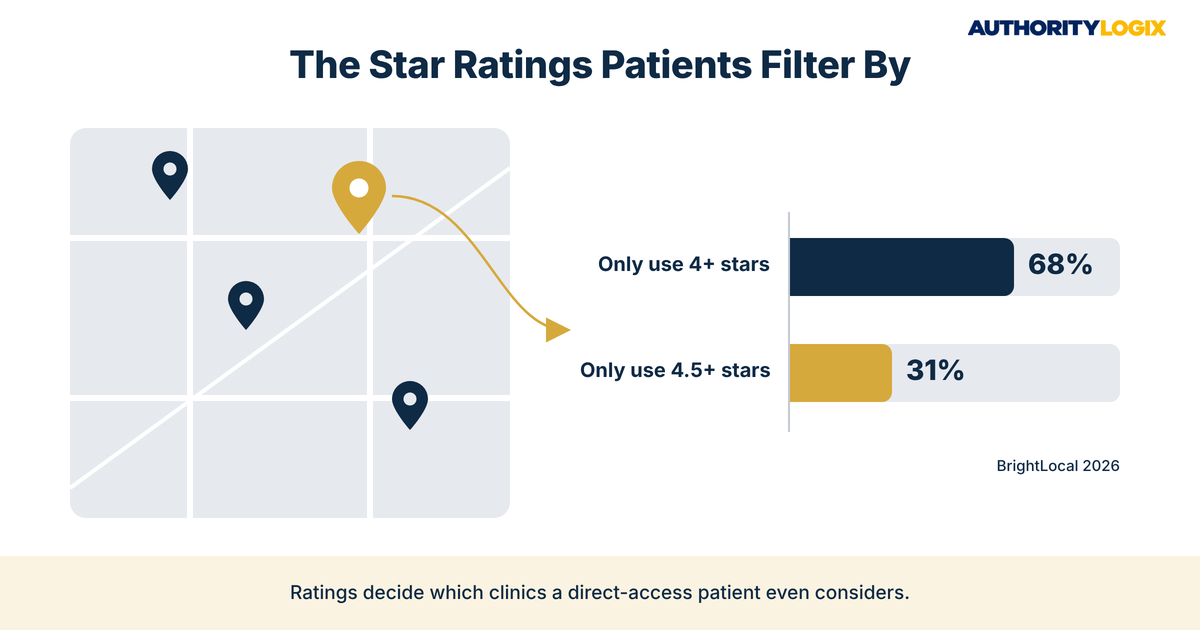
PT reputation local search signals matter most for patients who arrive without a referral. According to APTA, all 50 states, the District of Columbia, and the U.S. Virgin Islands have either provisional or unrestricted direct access to physical therapy. A direct-access patient is choosing from the results on a screen, and ratings decide which clinics make the shortlist.
The rating thresholds are rising. BrightLocal’s 2026 survey found that 68% of consumers will only use a business with four or more stars, up from 55% in 2025, and 31% will only use a business with 4.5 stars or more, up from 17%. For physical therapy reputation management negative reviews, that means a handful of unanswered one-star reviews on a thin profile can move a practice below the line many patients now draw.
| Reputation Signal | BrightLocal 2026 Finding | What It Means for a PT Practice |
|---|---|---|
| Owner responses | 89% expect business owners to respond to reviews | Every review, positive or negative, gets a privacy-safe reply |
| Negative reviews | 77% say negative reviews make them less likely to choose a business | Physical therapy reputation management negative reviews work is patient-acquisition work |
| Silence | 42% say they’re unlikely to use a business that never replies | An unanswered profile reads as an unattended practice |
| Template replies | 50% are put off by generic or templated replies | Use approved templates as a base, then adjust the wording |
| Rating threshold | 68% only use a business with four or more stars | A few unanswered one-star reviews on a thin profile cost visibility |
Ratings are only part of PT reputation local search. Practices that also publish genuine local authority content — community involvement, local partnerships, clinician profiles — give searchers more to judge than a star average. A strong local identity makes one bad review look like an exception rather than a pattern.
Reviews and content work together. Patients describe the neighborhood and the type of care they received in their own words, and the content SEO playbook treats that language as part of the same keyword picture as your service pages. A healthy review record supports the pages, and the pages support the record.
None of it books an evaluation on its own. A patient who has read your replies and liked what they saw still needs a clear way to act, which is the job of lead generation infrastructure on your site: an evaluation request form, a callback option and a visible phone number. Physical therapy reputation management negative reviews work earns the trust; the capture path collects it.
Physical Therapy Reputation Management Negative Reviews: When to Flag, Reply or Let It Stand
Physical therapy reputation management negative reviews come down to three choices: flag the review, reply to it, or reply and let it stand. Most negative reviews fall in the last group, and the urge to make them disappear causes more damage than the review itself.
What Google Will and Will Not Remove
Google is clear about removal. Its help page says you can report any review, but only those that violate Google policies are eligible for removal, and it tells owners: “Do not report a review just because you disagree with it or dislike it.” It also states that Google doesn’t get involved in conflict between businesses and customers.
When a review does break policy — spam, a review clearly meant for another business, offensive content — flag it and track the report in Google’s Reviews Management Tool. Google says review evaluation typically takes several days, and if a flagged review doesn’t qualify for removal, the business can submit a one-time appeal covering up to 10 reviews. Reply in the meantime, because the review stays visible while it is evaluated, and an unanswered review is the weakest position in physical therapy reputation management negative reviews.
What a practice must never do is pressure the reviewer. The Federal Trade Commission’s 2024 rule on fake reviews bans review suppression through unfounded legal threats, intimidation or physical threats. Physical therapy reputation management negative reviews handling should rely on a calm reply and a private conversation, never a demand that the review come down.
Replies also travel beyond Google. When your clinicians appear in local media and partner sites through authority distribution, the people who look you up next will see how the practice handles criticism. Physical therapy reputation management negative reviews replies become part of that public record.
The surrounding pieces of local visibility, from citations to location pages, are covered across the PT resource library. Reputation work holds up best inside that wider structure.
What Most PT Practices Get Wrong When a One-Star Review Lands
Most PT practices that struggle with physical therapy reputation management negative reviews are not short on good patients. They are reacting under pressure, often without a plan. These are the questions owners and patients ask most.
Can we explain our side of the story in a reply?
Not with any details about care. A reply that mentions attendance, a condition or treatment confirms the reviewer was a patient, which is the kind of disclosure HHS has penalized. State that privacy rules prevent discussion online and invite a private call, which is the safe default for physical therapy reputation management negative reviews.
Should we ask happy patients to post reviews to bury a bad one?
Asking every patient for a review is healthy; recruiting only happy ones in response to a complaint is the selective solicitation Google’s policy forbids. Build a routine that asks everyone at discharge, all the time.
As a patient, will my review be used against me?
It should not be. A practice that follows privacy rules will reply in general terms, confirm nothing about your care and offer a private conversation if you want one. That is the standard every PT negative review response strategy should meet.
Can a vendor make negative reviews disappear?
No legitimate vendor can remove a review that follows Google’s policies, and Google itself says it only removes reviews that violate them. What an outside partner can do is build the reply library, the weekly routine and the reporting, which is what we do for PT owners while the practice keeps control of every reply.
Does one bad review really matter?
One review on a profile with hundreds rarely does; one review on a profile with eight can define the practice. The growth blueprint explains how a deep, recent review record becomes part of long-term practice authority. Physical therapy reputation management negative reviews work is easiest when the record is already deep.
Ready to put a privacy-safe reply system and weekly review routine behind your practice’s local reputation? Let’s build the templates, the schedule and the reporting with your team.
Why a Steady Review Record Matters More Than Any Single Reply
No single reply rescues a reputation, and no single review ruins one. What protects a practice is a steady record: recent reviews arriving every month, every one answered within a week, and every reply written inside privacy rules. Physical therapy reputation management negative reviews become small events inside that record rather than emergencies.
BKDSCR.com, the AuthorityLogix proof-of-concept in the NYC outer-borough DSCR real estate niche, was built on the same principle — 18 pillar pages, 7 interactive investor tools and 48 SEO-optimized blog posts, with zero paid ads, in under 18 months. The sequence in how we build installs the system first and lets consistency do the rest, and a review routine follows the same rule.
Reputation work will not fix a poor patient experience, and no system can promise a rating. It can make sure an excellent practice is judged fairly by the patient comparing three clinics on a phone. That is the core of our approach to physical therapy reputation management negative reviews: build the routine before you need it.
The honest answer is that most PT practices already earn far more goodwill than their profiles show. The missing piece is a routine that answers every review calmly, protects every patient’s privacy and keeps the record current, so the market sees the practice your patients already know.