

Key Takeaways
- What physical therapy practice write about is not a question of inspiration — it is a question of patient search intent. Every piece of content should map to a patient search query, a stage in the patient’s decision process, or a topical authority signal that Google requires to rank healthcare content.
- 77% of patients use search before booking a healthcare appointment, per Google’s Digital Journey to Wellness research. The PT practice whose content answers the questions patients are already searching earns the first visit — before a competitor even has a chance to compete.
- Practices that blog receive 4.8x more inquiries than those without, per Searchlab’s 2026 healthcare marketing statistics. The multiplier effect comes from topical relevance — content that matches patient search intent earns visits from patients who are already primed to book.
- Content marketing costs 62% less than traditional marketing and generates 3x the number of leads, per Demand Metric data. For PT practices competing against health system marketing budgets, a well-targeted content program is the highest-ROI patient acquisition channel available.
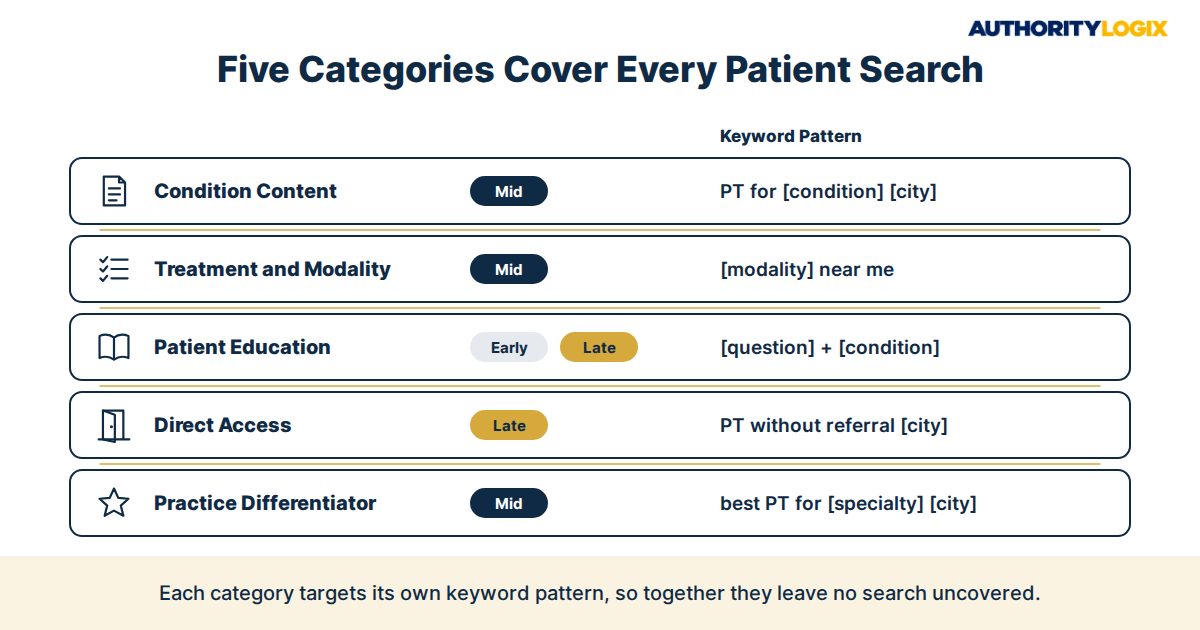
- The five content topic categories every PT practice needs — condition content, treatment content, patient education, direct access content, and practice differentiator content — each target their own keyword pattern and patient intent. Publishing across all five builds the topical authority signal Google evaluates for YMYL healthcare rankings.
- A documented content strategy is consistently linked to content marketing success — organizations with documented strategies tend to outperform those without, per CMI’s B2B research.
- PT content that earns AI Overview citations is structured around specific questions patients ask, written in clear patient language, attributed to a credentialed clinician, and organized with headers that mirror the question-answer format AI systems select for summarization.
Table of Contents
What physical therapy practice write about is not a question of inspiration — it is a question of patient search intent. Every piece of content a PT practice publishes is either matching the specific questions patients type into Google at specific stages of their decision process, or it is invisible to the patients it is meant to reach.
The practices that produce content without a patient-intent framework publish topics they find clinically interesting, organizational news, and general wellness advice that attracts no targeted traffic and builds no rankable topical authority. The practices that build patient-driven content strategies publish content patients are actively searching for — and those practices generate consistent patient inquiry from organic search, month after month, without ongoing advertising spend.
This article covers the five content topic categories every PT practice needs, the patient search intent each category serves, the keyword patterns that connect each category to actual patient searches, and the production framework that makes a patient-driven content strategy sustainable. The content strategy article covers the broader pillar-cluster architecture — this article focuses specifically on the topic selection logic that fills that architecture with content patients are actually searching for.
Why What Physical Therapy Practice Write About Must Start With Patient Intent
Per Google research, 77% of patients use search before booking an appointment — and organic search drives a large share of healthcare website traffic. The implication for PT content strategy is direct: the practice that appears in search results when a patient is searching for answers to their condition questions earns the first visit. The practice that publishes content patients are not searching for earns nothing from that content, regardless of its clinical quality.
Patient search intent for physical therapy falls into predictable stages. Early-stage patients are searching for information about their condition: what it is, what causes it, whether PT can help, and what treatment involves. Mid-stage patients are searching for providers: which PT practice treats their specific condition, what the practice’s credentials are, and what other patients’ experiences have been. Late-stage patients are searching for logistics: how to schedule, what to bring to a first appointment, whether their insurance covers PT, and what to expect from the intake process. A complete PT content strategy has content mapped to all three stages — and uses different keyword patterns and content formats for each.
Healthcare practices that blog see 4.8x more inquiries than practices without content programs, per Searchlab’s 2026 healthcare marketing statistics. That multiplier compounds over time because educational content that answers the questions patients ask during their research phase builds topical authority that amplifies the practice’s rankings for provider-selection queries at the mid-stage.
The acquisition playbook covers how content strategy connects to the full patient acquisition pipeline — from first search through booked evaluation. Content is the entry point that makes the rest of that pipeline worth building.

Explore the AuthorityLogix PT Content & SEO Playbook built for physical therapy practices.
The 5 Content Topic Categories Every PT Practice Needs
The five categories below cover the full range of patient search intent across all three stages. A practice publishing regularly across all five builds a content library that earns patients at every stage of their decision process — and builds the topical authority signal Google’s Helpful Content system requires to rank YMYL healthcare content from an independent PT practice against health system competitors.
What Physical Therapy Practice Write About Category 1 — Condition Content
Condition content is the highest-converting content type a PT practice publishes. It targets the specific condition-plus-location searches that high-intent patients use when they have a diagnosis and are selecting a provider: ‘physical therapy for frozen shoulder [city],’ ‘ACL recovery PT near me,’ ‘sciatica treatment physical therapy [neighborhood].’ Each piece of condition content covers one specific condition — what it is in patient language, what causes it, how physical therapy addresses it, what treatment typically involves, and realistic recovery timelines.
Condition content earns rankings for patients in the mid-stage provider-selection phase — the patients who are closest to booking. The authority guide covers how condition content builds the E-E-A-T signals Google requires for healthcare content — including how clinician attribution and cited evidence affect rankings.
Category 2 — Treatment and Modality Content
Treatment and modality content answers the second question high-intent patients ask: what will PT actually do to address my condition? Pages covering dry needling, manual therapy, therapeutic exercise, vestibular rehabilitation, aquatic therapy, and post-surgical recovery protocols serve patients who have found the practice and are evaluating whether the specific treatment approaches match what they need. Treatment content also earns specialty-specific rankings that differentiate the practice from general PT competitors — a practice with a detailed dry needling page ranks for ‘dry needling near me’ while competitors with no modality content do not. The educational hub is the operational system that organizes condition and treatment content into a navigable knowledge library patients can explore before and between appointments.
Category 3 — Patient Education Content
Patient education content targets the early-stage informational searches patients perform before they know they need PT — and the logistics questions they ask when they are ready to book but need reassurance. ‘Signs you need physical therapy for knee pain,’ ‘how long does PT for a rotator cuff take,’ ‘what to expect at a first PT evaluation,’ ‘do I need a doctor’s referral for physical therapy’ — these are the question-form queries that earn AI Overview citations and build the E-E-A-T credibility that patient-facing content requires in the YMYL healthcare category.
Patient education content that directly answers these questions in clear patient language, structured with H3 question headers and direct answer-first paragraphs, is the content format Google selects for AI Overview summarization. The local search system ensures that patient education content also carries the local geographic signals that connect informational content to the local patient population it is designed to serve.
Category 4 — Direct Access Content
Direct access content is one of the most under-targeted content categories in PT marketing — and one of the highest-opportunity segments because few independent practices have published it deliberately. As of 2026, all 50 states allow some form of direct access to physical therapy without a physician referral — but most patients do not know this.
Content targeting direct access searches — ‘do I need a referral for physical therapy in [state],’ ‘physical therapy without a doctor referral [city],’ ‘can I go to PT without seeing my doctor first’ — captures patients who want PT but have delayed seeking care because they assumed a referral was required. The content systems built for PT practices include direct access content as a core acquisition layer in the editorial framework — because the patients it captures are the ones who would otherwise never enter the practice’s pipeline.
Not sure which content topics your practice is missing?
Category 5 — Practice Differentiator Content
Practice differentiator content targets the comparison-stage searches patients perform when they are evaluating the practice against local competitors: ‘best physical therapist for pelvic floor [city],’ ‘PT clinic specializing in sports injuries [neighborhood],’ ‘physical therapist with dry needling certification near me.’ This content category requires the practice to clearly articulate what makes it distinctively qualified for specific patient populations — its specialty certifications, clinician credentials, the conditions it treats most effectively, the patient populations it serves best, and the clinical outcomes it has produced.
Differentiator content is not marketing copy; it is evidence-based specialty positioning that gives patients a reason to choose this practice over equally accessible alternatives. The visibility guide covers how specialty positioning connects to the local search signals — GBP category selection, service listings, review strategy — that reinforce the practice’s clinical differentiation in map pack and organic results.

What Physical Therapy Practice Write About Means for a Patient-Driven Content Calendar
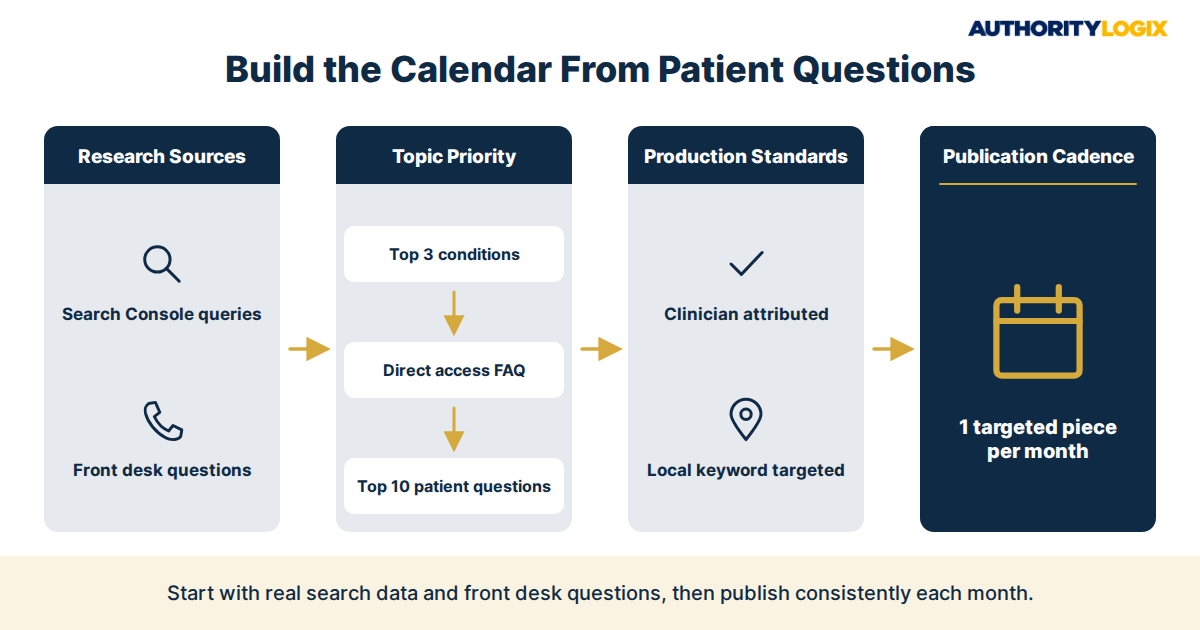
A patient-driven content calendar is built backward from patient search data — not forward from editorial convenience. The starting point is Google Search Console: which queries are already driving impressions to the practice’s website, which condition-plus-location combinations are generating clicks, and which questions patients are asking that the practice’s current content does not answer. The website structure article covers how new content topics slot into the practice’s page hierarchy — ensuring every new piece connects to the right service page pillar and earns link equity rather than sitting as an orphaned page.
Topic Prioritization Framework
Prioritize condition content for the three to five conditions that represent the majority of the practice’s current patient caseload — these are the topics where clinical depth is genuine and where the practice can produce content that authentically demonstrates first-hand Experience, the signal Google’s YMYL evaluation weighs most heavily. Add direct access content for the practice’s state and top condition categories as a parallel track — these pages require minimal updates and produce patient inquiries that would otherwise never enter the pipeline.
Build patient education content around the top five to ten questions the front desk answers repeatedly — these are the exact informational queries patients are searching before they call. The lead generation system connects the content calendar to the conversion infrastructure that turns content visitors into booked evaluations — ensuring every new piece of content has a clear path to patient inquiry.
Publication Cadence and Depth
Content marketing is cost-effective and generates 3x the number of leads, per Demand Metric data. The implication for PT practices is that consistent, targeted content production compounds in patient acquisition value over time — but only when individual pieces are written with enough depth to earn rankings. One well-researched condition page targeting a specific local search term produces more sustainable patient inquiry than ten thin general wellness posts.
The production sequence that produces the strongest early returns: condition pages for the practice’s top three conditions (with city and neighborhood keyword targeting), a direct access FAQ page for the practice’s state, and patient education content covering the ten most common patient questions. These twelve to fifteen pieces, properly structured and internally linked, form the core of a content library that ranks for patient searches before any additional content is published.
Clinician Attribution and E-E-A-T
Every condition page, treatment page, and patient education article should carry the name and credentials of the clinician who provided the clinical perspective — not as a byline afterthought, but as a structured author element that Google’s quality systems can evaluate as an Experience signal. Content marketing research from CMI has long linked a documented content strategy — one with clear authorship standards, review processes, and structured publishing workflows — to stronger content marketing results.
For PT practices, this means: every piece of condition or treatment content is attributed to a named PT with credentials, clinical claims are supported by cited evidence, and the content reflects the practice’s actual clinical approach rather than generic physical therapy information that could apply to any clinic. The PT industry hub demonstrates how the five-system framework — content, local search, patient education, lead generation, and authority distribution — works as a coordinated system that amplifies clinician-attributed content across all patient acquisition channels.
Frequently Asked Questions
How long should PT condition content pages be?
Condition pages targeting provider-selection queries — ‘physical therapy for rotator cuff injury [city]’ — should run 800 to 1,500 words. That length is enough to cover the condition comprehensively in patient language, include a clinician perspective on the practice’s treatment approach, address the most common patient questions about the condition, and include a clear conversion path. Longer is not automatically better — a 3,000-word condition page that repeats the same information at length earns no additional ranking benefit and risks losing patients who want a direct answer. The authority guide covers the E-E-A-T signals that quality condition content must demonstrate, regardless of length.
How often should a PT practice publish new content?
Consistency matters more than frequency. A practice publishing one thoroughly researched, locally targeted condition page per month produces stronger long-term organic results than a practice publishing four generic wellness posts per week. The minimum sustainable cadence that produces compounding organic results is one targeted piece per month — either a new condition page, a direct access FAQ, or a patient education article targeting a specific high-volume patient question. The distribution system covers how each new piece of published content is amplified through authority distribution channels — building the inbound signals that accelerate rankings for subsequent content pieces.
Should PT practices cover conditions they rarely treat?
No. Content covering conditions the practice rarely treats produces topical authority the practice cannot sustain with clinical depth — and Google’s quality evaluation systems weight the first-hand Experience signal heavily for YMYL healthcare content. A condition page written without genuine clinical experience of that condition is detectable through its generic descriptions, absence of practice-specific treatment nuance, and inability to answer condition-specific patient questions that only a treating clinician would know to address. Publish condition content for the conditions the practice treats regularly and can describe with authentic clinical specificity.
What makes PT content earn AI Overview citations?
AI Overview citations in healthcare go to content that is: structured with question-format H3 headers (‘How long does PT for a rotator cuff take?’), written with direct-answer-first paragraphs (the answer in the first sentence, context and nuance in the body), attributed to a credentialed clinician, and supported by cited evidence. The question-format structure mirrors how patients phrase queries to AI search tools — and gives AI systems the extractable, quotable answer format they select for summarization. Content that buries the answer in the third paragraph after several sentences of general context will not earn AI citations even when the clinical information is accurate.
How does content strategy connect to local search?
Every piece of condition content and patient education content should include the practice’s city, neighborhood, and service area in the H1, meta title, meta description, and first paragraph — connecting the topical authority content to the geographic signals that drive local search rankings. This is not keyword stuffing; it is the same geographic signal the practice’s GBP profile carries, reinforced by the website content. The growth blueprint covers how content strategy, local search optimization, and practice authority signals work together as a coordinated growth system — each amplifying the others rather than operating independently.
Ready to stop guessing what to write and build a content plan around the five topic categories patients actually search?