Key Takeaways
- Physical therapy content SEO strategy is not a blogging schedule — it is a content architecture that makes every page the practice publishes a permanent patient acquisition asset. The practices that rank consistently for high-intent PT searches have built interconnected content systems, not collections of isolated articles.
- Content marketing generates 3x more leads than traditional marketing at 62% less cost, per Demand Metric. For PT practices competing against well-funded health systems, this cost-efficiency advantage is the highest-ROI channel available.
- Top-performing organizations are far more likely than the least successful to have a documented content strategy — the documentation gap is one of the strongest predictors of content underperformance.
- Sites implementing a pillar-cluster content architecture tend to see stronger organic traffic growth than non-clustered strategies — because Google’s Helpful Content system evaluates topical depth and breadth, not individual page authority.
- AI Overviews now appear in 88% of healthcare queries, per BrightEdge — making structured, question-format condition content the primary vehicle for AI search citation visibility for PT practices.
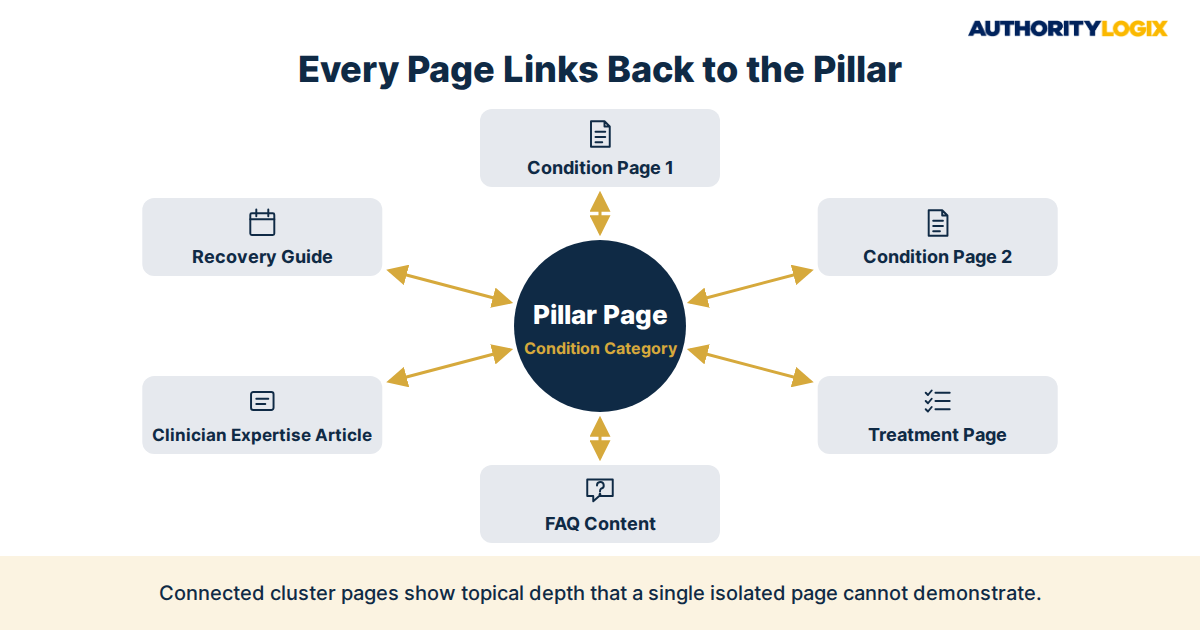
- The pillar-cluster architecture for a PT practice maps directly to how the practice operates: one cornerstone pillar page per major condition category, supported by specific condition pages, treatment pages, FAQ content, and clinician expertise articles that link back to the pillar.
- A PT practice’s content system serves two audiences simultaneously: Google’s quality evaluation systems, which need topical depth and E-E-A-T signals, and prospective patients, who need clear answers to condition and treatment questions in patient language.
Physical therapy content SEO strategy is the architecture that determines whether a practice’s clinical expertise is findable — or invisible. Most PT practices produce content reactively: a blog post here, a condition page there, a FAQ when a patient asks a question the front desk gets tired of answering. That approach produces a disorganized collection of individual pages that Google cannot evaluate as an authoritative body of knowledge. A deliberate content SEO strategy — built around a pillar-cluster architecture, condition-specific keyword targeting, and structured internal linking — produces a compounding library that ranks for more queries over time and builds the topical authority Google requires to surface YMYL healthcare content.
This article covers the full physical therapy content SEO strategy framework: how pillar-cluster architecture applies to PT practices, how to structure condition and service pages for maximum search visibility, how keyword targeting connects content to patient intent, and how to build a content system that earns both traditional search rankings and AI Overview citations. The content playbook is the cornerstone resource for this category — this article expands on the specific content strategy implementation that PT practices use to build a searchable clinical knowledge library from the ground up.
Why Physical Therapy Content SEO Strategy Requires Architecture, Not Activity
Top-performing content organizations are far more likely than the least successful to have a documented content strategy. The gap is not in content volume — it is in strategic architecture. A PT practice publishing two blog posts per month without a content architecture is producing activity, not a system. A practice building out a deliberate pillar-cluster structure — even at a slower publication cadence — is building a compounding asset.
Google’s Helpful Content system evaluates the depth and breadth of a site’s coverage across a topic — not the quality of any single page in isolation. A practice with one excellent condition page for shoulder pain sits on a thin topical foundation. A practice with a shoulder pain pillar page, three specific condition cluster pages (rotator cuff, frozen shoulder, shoulder impingement), a treatment modality page, a post-surgical recovery guide, and a condition-specific FAQ section is demonstrating comprehensive topical expertise to Google’s quality evaluation systems. That depth earns rankings that the single-page approach cannot.
The same architecture that earns search rankings also earns AI Overview citations.
BrightEdge data shows AI Overviews now appear in 88% of healthcare queries — and Google’s citation selection in YMYL healthcare content favors sites with structured, question-format informational content and strong E-E-A-T signals. A practice that builds condition-specific content in a structured pillar-cluster format, with patient question H3s and direct answer-first responses, is building the content architecture that earns AI search visibility alongside traditional rankings.
Content marketing also has a proven cost efficiency advantage over paid patient acquisition. Demand Metric research shows content marketing generates 3x more leads than traditional marketing at 62% lower cost. For an independent PT practice competing against health system marketing budgets, a well-executed content SEO strategy is the highest-ROI acquisition channel available. The
acquisition playbook covers how content strategy connects to the full patient acquisition pipeline — from first search through booked evaluation.
The Physical Therapy Content SEO Playbook covers the full system for building a searchable library of clinical expertise, from keyword research to publishing cadence.
Content SEO Playbook →
The Physical Therapy Content SEO Strategy Framework: 4 Content Types
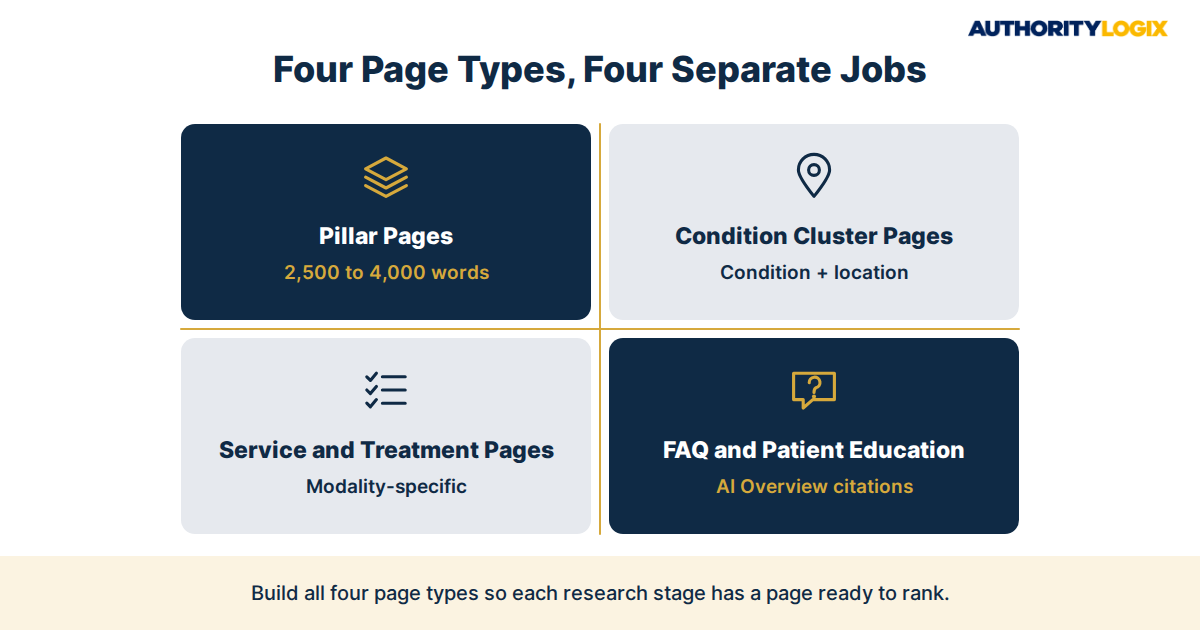
A complete physical therapy content SEO strategy is built from four content types, each serving a different function in the topical authority system and a different stage of the patient’s research process. Building all four types — and connecting them through deliberate internal linking — is what transforms isolated pages into a compounding content library.
Physical Therapy Content SEO Strategy Pillar Pages — The Cornerstone of Each Condition Category
A pillar page provides comprehensive coverage of a broad condition category — shoulder conditions, knee rehabilitation, spine disorders, sports injuries, post-surgical recovery — at a high level, with links out to every cluster page in that category. The pillar page targets the broad category keyword and earns rankings for the head term while passing authority to each cluster page through internal links. Pillar pages for PT practices run 2,500 to 4,000 words and must be genuinely comprehensive — thin pillar pages undermine the entire cluster’s authority signal. The
educational hub is the operational infrastructure that organizes condition pillar pages into a permanent knowledge library patients can navigate on their own terms.
2. Condition Cluster Pages — Specific, High-Intent Landing Pages
Condition cluster pages target the specific condition-plus-location queries that bring direct-access patients to the practice: ‘physical therapy for rotator cuff tear in [city],’ ‘frozen shoulder PT [neighborhood],’ ‘shoulder impingement rehab near me.’ Each cluster page covers one specific condition — what it is, what causes it, how physical therapy addresses it, what treatment looks like, and expected recovery timeline — and links back to the pillar page and forward to the relevant treatment or FAQ page. The
keyword guide covers the keyword targeting approach for condition cluster pages — including how to identify the specific terms patients in a local market use when searching for their condition.
3. Service and Treatment Pages — What PT Actually Does
Service and treatment pages answer the second patient question: ‘What will physical therapy actually do for this condition?’ Treatment modality pages — manual therapy, therapeutic exercise, dry needling, vestibular therapy, aquatic therapy — serve patients who have found the practice and are evaluating whether the specific treatment approaches align with what they need. These pages also earn specialty-specific rankings that differentiate the practice from general PT competitors in the local market. The PT Authority Gap Assessment identifies where service and treatment page gaps exist relative to local competitors — so the practice knows which pages to build first for maximum early visibility.
4. Patient Education and FAQ Content — Authority and AI Visibility
Patient education articles and FAQ content serve two simultaneous functions: they build the E-E-A-T signals that Google’s YMYL evaluation requires, and they earn AI Overview citations for the question-format queries that dominate healthcare search in 2026. A practice whose website directly answers ‘how long does rotator cuff physical therapy take,’ ‘do I need a referral for PT,’ and ‘what should I expect at my first PT evaluation’ is building the content layer that earns AI citation visibility alongside traditional rankings. The
education guide covers the patient education content strategy — including the specific question categories and writing structure that earn AI Overview citations.
Building the Pillar-Cluster Architecture for a PT Practice
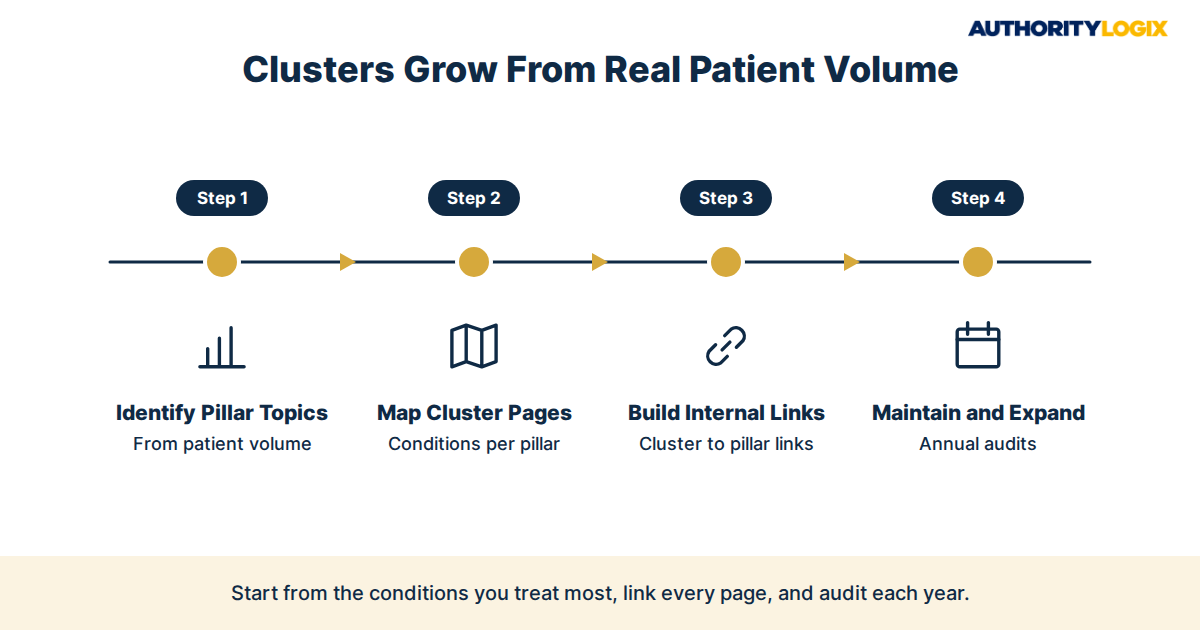
Sites implementing pillar-cluster architecture tend to see stronger organic traffic growth than non-clustered strategies — because Google’s Helpful Content system evaluates the depth and breadth of a site’s topical coverage, not individual page authority. For a PT practice, the pillar-cluster architecture maps directly to how the practice operates clinically. The most common condition categories the practice treats become the pillar page topics. The specific conditions within each category become the cluster pages. The treatment modalities become the service pages. The patient questions become the FAQ content.
Step 1 — Identify Pillar Topics From Patient Volume
The pillar page topics for a PT practice are determined by its actual patient caseload — the condition categories that represent the majority of evaluations booked. A practice that treats primarily musculoskeletal conditions should build pillar pages for: shoulder conditions, knee rehabilitation, spine disorders, and hip and lower extremity conditions. A practice with sports injury specialization adds a sports rehabilitation pillar. A practice offering pelvic floor therapy adds a women’s health pillar. The pillar topic list should reflect the practice’s actual clinical expertise — not a list of every condition physical therapy can treat. Pillar pages built around conditions the practice rarely treats produce topical authority the practice cannot sustain or convert.
Step 2 — Map Cluster Pages to Each Pillar
For each pillar topic, map out the specific condition and treatment cluster pages that cover the full range of subtopics patients search for within that category. A shoulder conditions pillar supports cluster pages for: rotator cuff injuries, frozen shoulder, shoulder impingement, AC joint injuries, post-surgical shoulder rehabilitation, and shoulder strengthening exercises. Each cluster page targets a distinct, non-overlapping condition keyword — no two cluster pages in the same pillar target the same primary search term. The
local search system ensures that each condition cluster page also carries the local geographic signals — city, neighborhood, GBP profile link — that connect the content to the local patients it is meant to serve.
Step 3 — Build the Internal Link Structure
The internal link structure is what transforms a collection of individual pages into a functioning content cluster. Every cluster page links back to its pillar page — using anchor text that includes the pillar’s primary keyword. The pillar page links out to every cluster page. Cluster pages within the same pillar link laterally to directly related cluster pages where the connection is genuinely useful for the patient. Service and treatment pages link to the relevant condition cluster pages they treat. FAQ and patient education content links back to the most relevant condition cluster page or pillar page for the condition it addresses.
Step 4 — Maintain and Expand the Cluster Over Time
A content cluster is not built once and left static. Google’s Helpful Content system evaluates freshness alongside depth — outdated condition information, outdated treatment descriptions, and stale statistics quietly erode the pillar’s authority signal over time. Each condition cluster page should be audited annually at minimum, with updates to treatment approach information, clinical guidelines, and patient statistics. New cluster pages are added as the practice identifies condition subtopics not yet covered. The
lead generation system connects updated and expanded content — new condition pages, refreshed FAQ sections, treatment modality updates — to the conversion infrastructure that turns content visitors into booked evaluations.
Keyword Strategy for Physical Therapy Content SEO
Every page in the physical therapy content SEO strategy must target a specific, distinct keyword — not a broad topic. Keyword targeting is the mechanism that connects the practice’s clinical expertise to the specific searches patients perform when they are ready to find a provider. A content system built without deliberate keyword targeting produces pages that cover important topics but rank for nothing because they compete with each other or with pages from high-authority health system websites.
Condition Page Keyword Formula
Every condition cluster page targets one primary keyword following the formula: [condition name in patient language] + [physical therapy or PT] + [location modifier]. Examples: ‘physical therapy for knee pain in [city],’ ‘rotator cuff PT [neighborhood],’ ‘frozen shoulder treatment near me.’ The condition name is always in patient language — the term the patient uses to describe their condition, not the clinical term. ‘Knee pain’ outperforms ‘gonalgia.’ ‘Shoulder stiffness’ outperforms ‘adhesive capsulitis.’ The location modifier ensures the page competes only for local patients, not against national health system content that dominates broad condition terms.
Service Page Keyword Formula
Service and treatment pages target: [treatment modality in patient language] + [physical therapy or PT] + [location modifier]. ‘Dry needling physical therapy [city],’ ‘manual therapy near me,’ ‘sports injury rehab [neighborhood].’ Specialty certification pages follow the same formula but target the certification-specific patient population: ‘pelvic floor therapy [city],’ ‘vestibular PT near me.’ The
visibility guide covers how these service page keywords connect to the practice’s full local search presence — including GBP service listings and map pack optimization that reinforce the same keyword signals.
FAQ and patient education content targets question-form keywords — the exact questions patients type into Google and into AI search tools: ‘how long does PT for a rotator cuff take,’ ‘do I need a referral for physical therapy,’ ‘what happens at a first PT evaluation.’ These question-form keywords earn AI Overview citations because BrightEdge data confirms AI Overviews appear most frequently for informational query types — exactly the format patient education content targets. The
authority guide covers how patient education content builds the E-E-A-T signals that Google’s YMYL evaluation requires for healthcare content to rank and be cited.

Frequently Asked Questions
How many cluster pages does a PT practice need to build topical authority?
The answer depends on how many condition categories the practice treats — but a functional starting point is 3 to 5 cluster pages per pillar, covering the specific conditions that make up the majority of the practice’s patient caseload. A practice with a shoulder conditions pillar, a knee rehabilitation pillar, and a spine disorders pillar, each supported by 4 to 5 cluster pages, has built a content system of 12 to 15 pages that Google can evaluate as genuine topical expertise. The
growth blueprint covers how to sequence content production for maximum early authority gain — starting with the highest-volume conditions and expanding cluster depth over time.
Should condition pages be written by the clinician or a content writer?
The optimal approach is collaborative. The clinician provides the first-hand clinical perspective — how the practice approaches the condition, what patients typically experience, what treatment looks like, what realistic recovery timelines are. A content writer structures and formats that input for readability and SEO optimization. The page carries the clinician’s name as the named author with their credentials. A condition page written entirely by a content writer without clinician input lacks the first-hand Experience signal that Google’s YMYL standards require for healthcare content.
How long does it take for content clusters to produce rankings?
Content clusters do not produce overnight results. The authority signal accumulates as Google indexes more cluster pages, as internal links pass equity through the structure, and as the practice builds external citations pointing to the cluster content. Realistic timelines: condition cluster pages for lower-competition local terms can produce first-page rankings within 30 to 60 days of publication. Pillar pages targeting broader category terms typically require 3 to 6 months of cluster development before the full topical authority signal affects rankings. The
distribution system covers how syndicating condition content through external channels accelerates the authority signals that connect the content cluster to rankings.
What is the difference between a pillar page and a condition page?
A pillar page provides comprehensive coverage of a broad condition category at a high level — it introduces the category, covers the major conditions within it, explains how physical therapy addresses conditions in this category generally, and links to every cluster page. A condition page covers one specific condition in depth — the specific diagnosis, its causes, symptoms, how PT addresses it specifically, what treatment looks like for that condition, and the expected recovery timeline. A pillar page is 2,500 to 4,000 words covering the category. A condition cluster page is 800 to 1,500 words covering one specific condition within that category.
How does physical therapy content SEO strategy connect to local search?
Every condition cluster page should include the practice’s city and neighborhood in the H1, the meta title, the meta description, and the first paragraph — connecting the topical authority content to the geographic signals that drive local search rankings. The
PT industry hub demonstrates how the five-system framework — content, local search, patient education, lead generation, and authority distribution — works as a coordinated system. Content SEO does not replace local search optimization; it amplifies it. A practice with strong local search signals and a well-built content cluster compounds its visibility across both organic rankings and map pack results.
Ready to turn your clinical expertise into a searchable content library that keeps bringing in new patients?
Work With Us →