Key Takeaways
- Physical therapy pillar pages and topic clusters are the content architecture that transforms a PT website from a collection of isolated pages into a topical authority system — one that Google’s Helpful Content system evaluates as deep, interconnected clinical expertise rather than scattered, disconnected articles.
- Sites implementing content cluster architecture see an average 40% increase in organic traffic compared to non-clustered strategies, per Digital Applied’s 2026 SEO research — because Google evaluates topical depth and breadth, not individual page authority in isolation.
- Well-structured topic clusters tend to earn more AI Overview citations than single-page competitors — because the bidirectional internal linking structure creates a semantic map that AI search engines use to identify which sites hold genuine subject-matter authority on a topic.
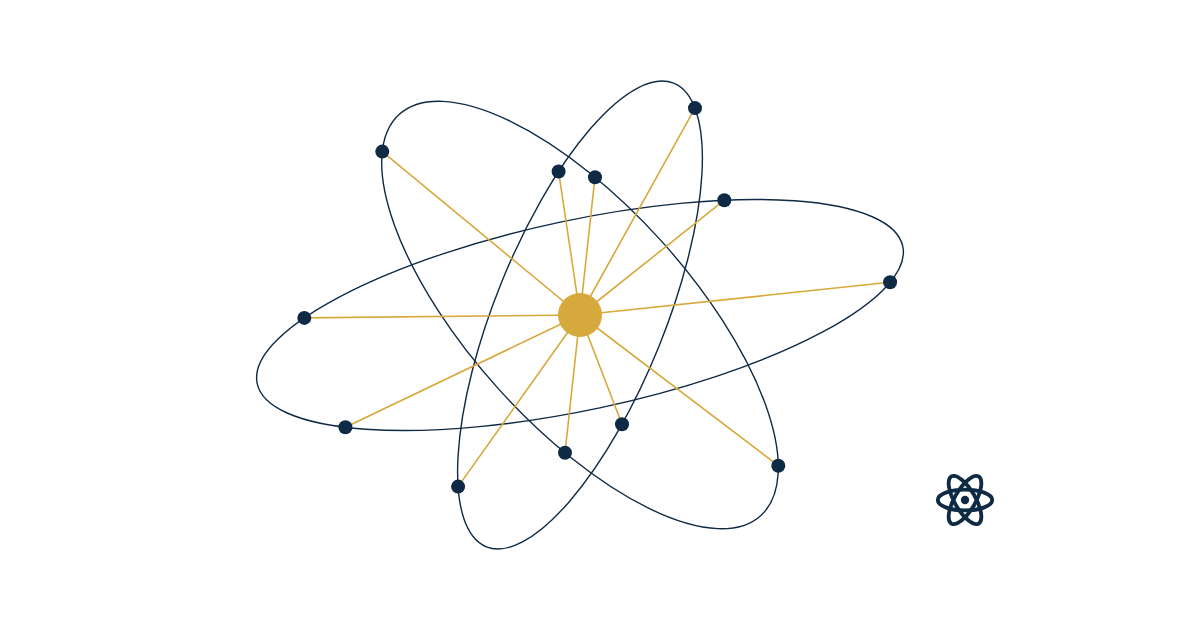
- The pillar page covers a broad condition or service category comprehensively — 3,000 to 5,000 words — and links to every cluster page in the topic. Each cluster page covers one specific subtopic and links back to the pillar. This bidirectional structure is the core mechanism through which cluster authority accumulates at the pillar.
- Internal linking can meaningfully improve search rankings and crawl efficiency — because link equity flows from the pillar to the clusters, from clusters back to the pillar, and from high-authority pages to the pages that most need ranking support.
- Ahrefs recommends 3 to 5 contextual internal links per cluster article — enough to distribute authority and aid discovery without diluting individual link value. These links should appear in body content, not footers or related-posts widgets, because contextual placement carries the strongest topical signal.
- For a PT practice, the pillar-cluster architecture maps directly to clinical reality: one pillar page per condition category (shoulder, knee, spine, sports injury), supported by specific condition pages, treatment pages, and patient education articles that form the cluster around each pillar.
Physical therapy pillar pages topic clusters are the structural backbone of a PT website that earns and holds search rankings over time. Without this architecture, a practice can publish condition pages, treatment pages, and patient education content indefinitely — and still produce no compounding topical authority, because each page operates as an isolated ranking attempt rather than a coordinated signal system. The pillar-cluster model solves this by organizing every piece of content into a coherent hierarchy: one comprehensive pillar page per condition category, linked bidirectionally to a cluster of specific condition and treatment pages beneath it. Google’s Helpful Content system is designed to reward exactly this kind of depth-and-breadth topical organization.
This article covers how physical therapy pillar pages work, how to build topic clusters around them, how to wire the internal linking architecture that makes clusters function, and how to audit and fix an existing PT website that has grown without this structure. The content playbook covers the overall content SEO strategy — this article focuses specifically on the pillar-cluster architecture and internal linking mechanics that make that strategy work.
What Physical Therapy Pillar Pages Are and Why They Work
Per
cluster research, sites implementing content cluster architecture see an average 40% increase in organic traffic compared to non-clustered strategies. The mechanism is straightforward: Google’s Helpful Content system evaluates the depth and breadth of a site’s coverage across a topic. A practice with one condition page for shoulder pain sits on a thin topical foundation. A practice with a shoulder conditions pillar page linking bidirectionally to six specific condition cluster pages — rotator cuff, frozen shoulder, shoulder impingement, AC joint, post-surgical shoulder recovery, shoulder strengthening — is demonstrating comprehensive topical expertise. That depth earns rankings the single-page approach cannot.
A pillar page is the hub of a topic cluster — a comprehensive resource covering a broad condition or service category at a high level, typically 3,000 to 5,000 words. It introduces every major subtopic within its category, links to each cluster page that covers a specific subtopic in depth, and targets the broad head keyword for the category: ‘shoulder physical therapy,’ ‘knee rehabilitation,’ ‘spine physical therapy.’ The pillar page earns rankings for broad search terms while the cluster pages earn rankings for specific condition and treatment terms. Together, they cover more search territory than any single page could. The
content strategy article covers how pillar-cluster architecture fits within the broader PT content SEO framework.
Well-structured topic clusters also tend to earn more AI Overview citations than single-page competitors. AI search systems use internal link topology as a topical authority signal — a well-linked cluster presents a coherent semantic map that confirms the site holds genuine expertise across a topic, not just a single page on a single subtopic. For PT practices, this means the pillar-cluster architecture that earns traditional search rankings also earns AI search visibility — both benefits compound from the same structural investment.

The Physical Therapy Content SEO Playbook covers the full content architecture pillar pages and topic clusters are built on.
Content SEO Playbook →
How to Build Physical Therapy Pillar Pages Topic Clusters: Step by Step
Physical Therapy Pillar Pages Topic Clusters Step 1 — Choose Pillar Topics From Clinical Volume
PT pillar topics are determined by the practice’s actual patient caseload — the condition categories that represent the majority of evaluations booked. A musculoskeletal practice builds pillars for: shoulder conditions, knee rehabilitation, spine disorders, hip and lower extremity conditions, and sports injuries. A practice with pelvic floor specialty adds a women’s health pillar. Each pillar topic must reflect genuine clinical depth — a pillar page built around a condition category the practice rarely treats will lack the first-hand Experience signal that Google’s YMYL evaluation requires. The
acquisition playbook covers how pillar topics connect to the patient acquisition pipeline — ensuring each pillar drives patient inquiry, not just search traffic.
Step 2 — Write the Pillar Page
A PT pillar page covers its condition category at a high level: what the category includes, the major conditions within it, how physical therapy addresses conditions in this category generally, what treatment typically involves, and what patients should expect. It links contextually to every cluster page — not in a list at the bottom, but as natural in-body links where the text introduces each specific condition.
The pillar page targets the broad head keyword (‘shoulder physical therapy,’ ‘knee rehabilitation PT [city]’) and should run 3,000 to 5,000 words to cover the topic comprehensively. Thin pillar pages undermine the entire cluster’s authority signal. The
educational hub organizes pillar pages into a navigable patient knowledge system, ensuring that patients who land on any pillar page can find their way to the specific condition content that addresses their situation.
Step 3 — Build the Cluster Pages
Each cluster page covers one specific condition or treatment subtopic within the pillar’s category — in depth, not at a surface level. A rotator cuff cluster page covers: the anatomy of the rotator cuff, the common injury types (tear, tendinitis, impingement), how PT addresses rotator cuff injuries specifically, what treatment involves at the practice, and expected recovery timelines.
It targets a specific condition-plus-location keyword: ‘physical therapy for rotator cuff [city],’ ‘rotator cuff PT near me.’ Cluster pages link back to the pillar page using an anchor that includes the pillar’s primary keyword — ‘shoulder PT,’ ‘shoulder rehabilitation’ — and link laterally to directly related cluster pages where the connection is genuinely useful for the patient. The
website structure article covers the URL patterns and navigation architecture that make the pillar-cluster hierarchy legible to both patients and search engines.
Step 4 — Wire the Internal Links
Internal linking is the mechanism that makes a pillar-cluster architecture function. Each cluster article should carry a small, focused set of internal links — enough to distribute authority and aid discovery without diluting individual link value. For a PT practice, the internal linking rules are: every cluster page links to its pillar page, every cluster page links to two to three directly related cluster pages, and the pillar page links to all cluster pages. These links appear in body copy — not footers, not related-post widgets — because contextual links carry the strongest topical signal. The anchor text for cluster-to-pillar links should include the pillar’s primary keyword; anchor text for pillar-to-cluster links should be the condition name.

Physical Therapy Pillar Pages Topic Clusters: Condition Category Examples
Shoulder Conditions Cluster
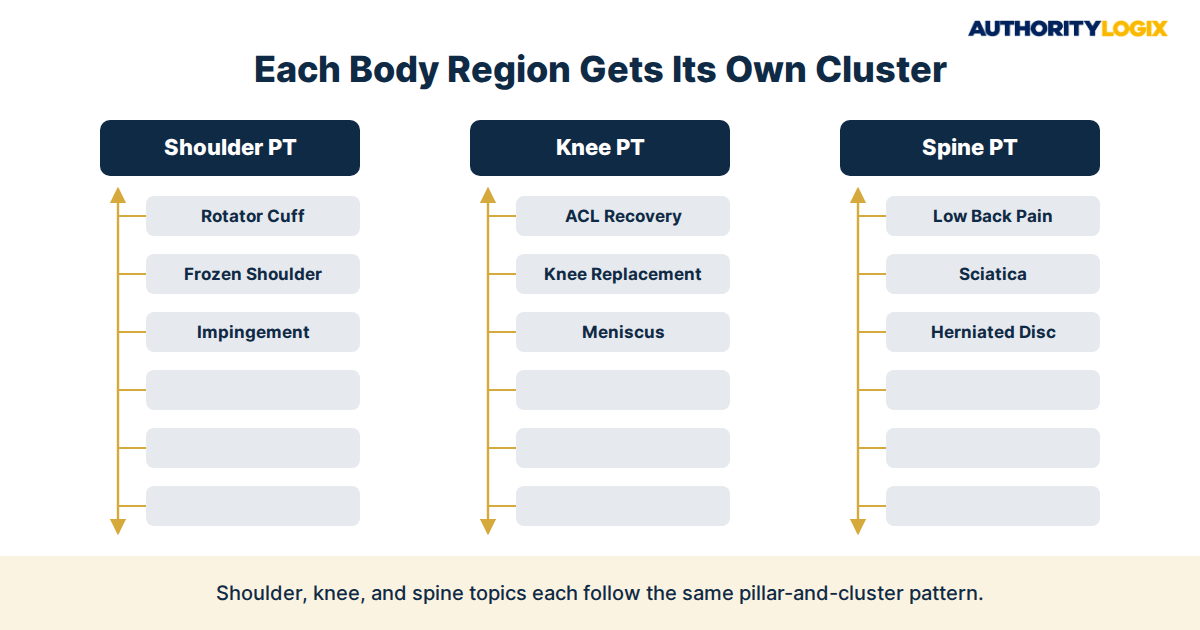
Pillar page: shoulder physical therapy — covers the full range of shoulder conditions PT addresses, how the practice approaches shoulder rehabilitation generally, and what patients should expect. Cluster pages: rotator cuff injury PT, frozen shoulder PT, shoulder impingement PT, AC joint injury PT, post-surgical shoulder recovery PT, shoulder instability PT, shoulder strengthening.
Each cluster page links back to the shoulder pillar with an anchor like ‘shoulder PT’ or ‘shoulder rehabilitation.’ The shoulder conditions pillar links out to each cluster page contextually within the body content where the specific condition is introduced. The
local search system connects each condition page in the cluster to the geographic signals — GBP profile, location page, neighborhood keyword — that make the content findable by local patients at the moment of provider selection.
Knee Rehabilitation Cluster
Pillar page: knee physical therapy — covers the major knee conditions PT addresses and how rehabilitation works generally for knee injuries. Cluster pages: ACL recovery PT, knee replacement PT, meniscus injury PT, knee osteoarthritis PT, patellar tendinitis PT, IT band syndrome PT, knee pain PT.
The knee cluster is often a PT practice’s highest-converting content cluster because knee conditions are among the most common reasons patients seek PT and among the most specific in their search behavior — a patient searching ‘ACL recovery PT [city]’ is in provider-selection mode, not research mode. The
lead generation system connects the knee cluster’s condition pages to the scheduling infrastructure that converts patient inquiries into booked evaluations — ensuring each piece of content in the cluster has a clear path to patient acquisition.
Spine Disorders Cluster
Pillar page: spine physical therapy — covers the broad range of spine conditions PT addresses, from cervical to lumbar, and how the practice approaches spinal rehabilitation. Cluster pages: low back pain PT, sciatica PT, herniated disc PT, neck pain PT, spinal stenosis PT, post-surgical spine recovery PT.
Spine is typically the largest cluster for most PT practices because spine conditions span a wide range of specific diagnoses and because patients search by specific condition name — ‘PT for sciatica near me,’ ‘physical therapy for herniated disc [city]’ — rather than by broad category. The
authority guide covers how patient education content within spine clusters — explaining what disc herniation is, how sciatica develops, what conservative treatment involves — builds the E-E-A-T signals that Google requires for YMYL healthcare content to rank.
Auditing and Fixing an Existing PT Website for Pillar-Cluster Architecture
Most PT websites that have grown without deliberate content architecture have the same structural problems: condition pages published as blog posts with no connection to a service page pillar, patient education articles with no internal links pointing to them from relevant condition pages, and location pages sitting in isolation without links to the condition pages most relevant to each location’s patient population. Internal linking helps search rankings and crawl efficiency — making an internal linking audit one of the highest-ROI SEO interventions available to a practice that already has content published.
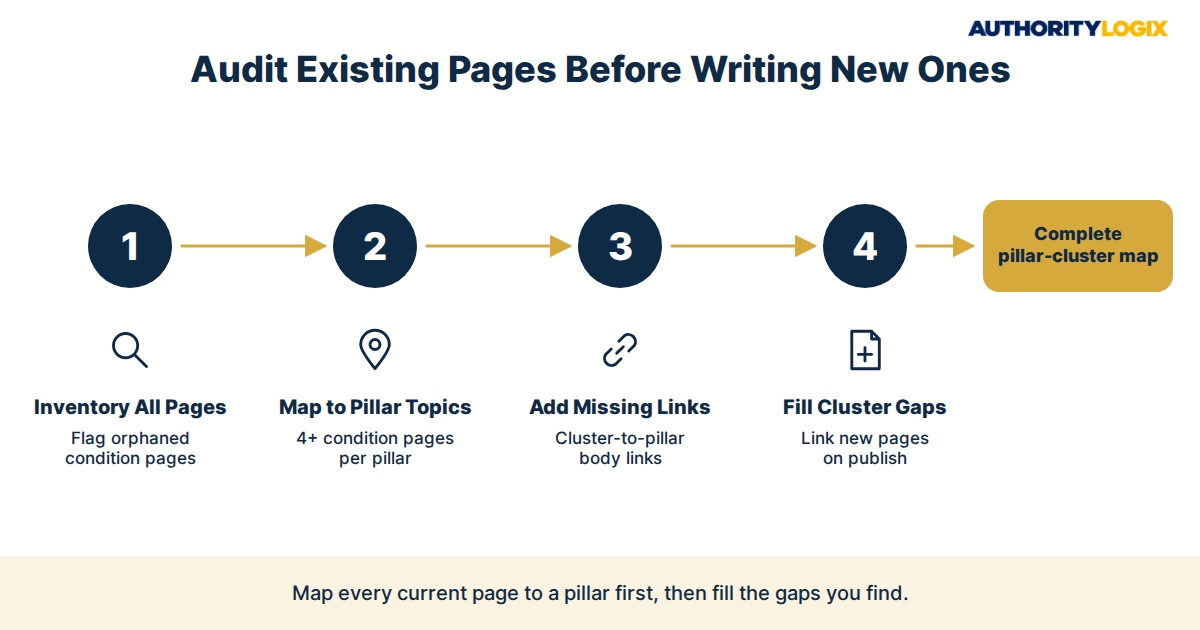
Step 1 — Inventory All Published Pages
Export all pages from the PT website using Google Search Console or a crawl tool like Screaming Frog. Categorize each page into one of the four content types: service pages, condition pages, location pages, or patient education. Identify which condition pages have no internal links pointing to them from a service page — these are orphaned condition pages, and they are the most common structural failure on PT websites.
Step 2 — Map Existing Conditions to Pillar Topics
Group all existing condition pages by category: shoulder conditions, knee conditions, spine conditions, sports injuries, and so on. Identify which category has enough existing condition pages to support a pillar — typically 4 or more condition pages in the same category. Build or upgrade the service page for that category to function as the pillar: expand it to comprehensive coverage of the full category, and add contextual body links to all existing condition cluster pages. The
PT industry hub demonstrates how the five-system framework — content, local search, patient education, lead generation, and authority distribution — works as a coordinated system when pillar-cluster architecture is the underlying structure.
Step 3 — Add Missing Cluster-to-Pillar Links
For each existing condition page, open the page and add a contextual body link back to the relevant pillar page. The anchor text should include the pillar’s primary keyword: a rotator cuff page links back to the shoulder pillar with an anchor like ‘shoulder PT’ or ‘shoulder rehabilitation.’ This is the fastest structural fix available — it connects orphaned condition pages to the pillar’s authority system without requiring new content to be published. The ranking impact is typically visible within one to two crawl cycles as Google re-evaluates the topical relationships the new links establish.
Step 4 — Identify and Fill Cluster Gaps
Cluster gaps are condition subtopics within a pillar category that the practice treats but has no dedicated cluster page for. A shoulder conditions cluster with pages for rotator cuff and frozen shoulder but no page for shoulder impingement — despite treating impingement regularly — has a cluster gap. Filling gaps prioritizes the conditions patients are most likely to search for that the practice most wants to rank for.
New cluster pages are linked immediately from the pillar page on publication — never published without connecting them to the pillar. The
distribution system amplifies each new cluster page published through authority distribution channels that build external links and citations pointing back to the cluster — accelerating the authority accumulation that makes new cluster pages rank faster.
Frequently Asked Questions
How many cluster pages does a PT pillar page need?
Most successful topic clusters pair each pillar page with a focused set of supporting cluster pages. For PT practices, the practical range is 4 to 8 cluster pages per condition category pillar — enough to cover the major specific conditions within each category without publishing thin pages for minor conditions the practice rarely treats. Quality and depth matter more than cluster size: 5 genuine condition pages with authentic clinical depth outperform 12 thin pages that add no topical authority signal. The
visibility guide covers how the geographic keyword targeting on each cluster page connects the topical authority system to the local search signals that drive map pack rankings.
Can a PT practice use existing blog posts as cluster pages?
Yes — if the existing blog posts are substantive enough to cover their specific subtopic comprehensively and targeted to a specific condition-plus-location keyword. A 500-word general wellness post cannot function as a cluster page. A 1,000-word condition-specific article covering a specific diagnosis in patient language, targeting a specific local search term, and attributed to a clinician can be upgraded to cluster page status by: adding the pillar page link in the body content, adding a specific condition-plus-location keyword target, and expanding the article to cover the condition more thoroughly if needed.
What is the difference between a pillar page and a service page?
For PT practices, a condition category pillar page and a service page often serve the same structural function — both are broad category pages that link down to specific condition or treatment pages. The distinction is functional: a service page answers ‘what does the practice offer,’ while a pillar page answers ‘what does the practice know about this condition category.’ The most effective PT websites use condition category pillar pages that combine both functions — describing the practice’s service offering within the condition category alongside comprehensive condition category information. The
growth blueprint covers how content architecture connects to the long-term practice growth system that compounds visibility over time.
How long does it take for a topic cluster to produce rankings?
Cluster performance compounds over 6 to 12 months as Google indexes more cluster pages, as internal links establish the topical relationships within the cluster, and as external links to the pillar accumulate authority that cascades to the cluster pages. Condition cluster pages for lower-competition local terms can produce first-page rankings within 30 to 60 days. Full cluster authority — where the pillar ranks for broad head terms and the cluster pages rank across the full range of specific condition-plus-location queries — typically requires 6 to 12 months of consistent cluster development and maintenance.
How does pillar-cluster architecture affect AI search visibility?
AI search engines use internal link topology as a topical authority signal — a well-linked cluster presents a coherent semantic map that helps AI systems identify which sites hold genuine expertise across a topic, not just on individual pages. Content organized in a pillar-cluster structure, with question-format H3 headers on cluster pages and direct-answer-first paragraphs, is structured for AI extraction as well as traditional ranking. The bidirectional link structure between pillars and clusters confirms topical authority at both the category level (the pillar) and the specific subtopic level (the cluster) — the two layers AI systems use to evaluate whether a site should be cited for a given healthcare query.
Ready to build the pillar page and topic cluster architecture that lets your whole site rank together?
Work With Us →