


Key Takeaways
- A physical therapy keyword strategy that targets only one type of keyword is leaving the majority of organic patient acquisition opportunity on the table. The complete physical therapy keyword strategy covers four distinct keyword types, each targeting a different stage of the patient search journey.
- The four physical therapy keyword types are: condition keywords (researching whether PT can help), treatment keywords (evaluating specific modalities), service keywords (choosing a practice), and patient question keywords (seeking specific answers for AI Overview citations).
- Physician-authored healthcare content earns 3.2x higher organic traffic than generic marketing copy, per 2026 healthcare SEO data — keyword strategy and clinician attribution are inseparable investments.
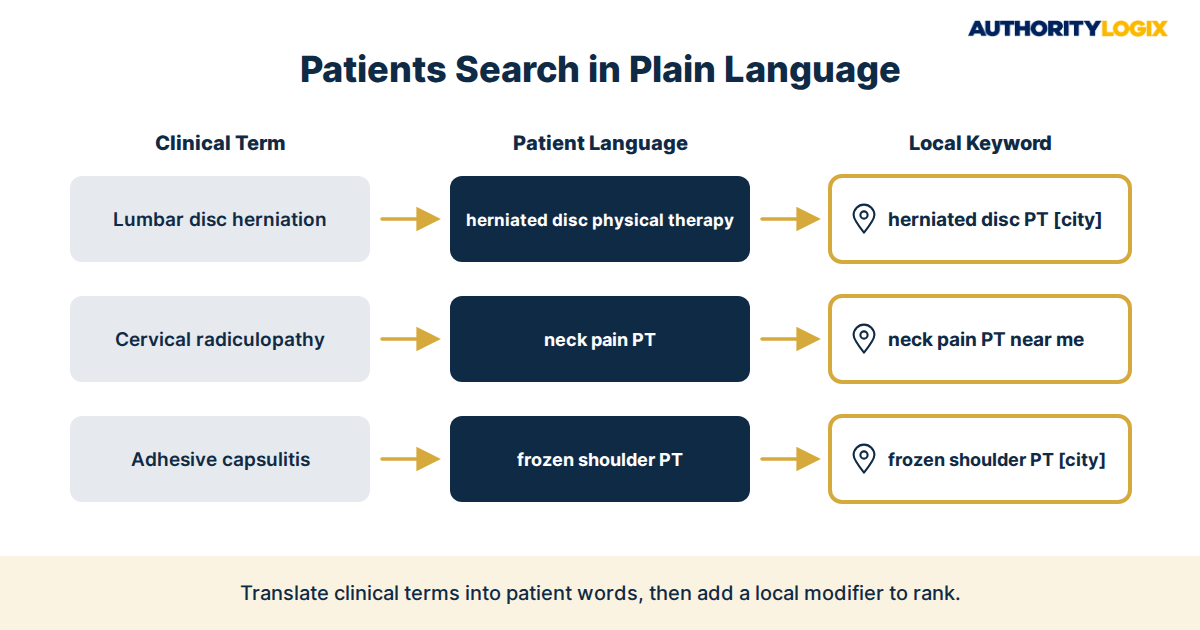
- The most common physical therapy keyword strategy mistake is using clinical terminology instead of patient language. Patients search for “neck pain PT near me,” not “cervical radiculopathy rehabilitation.”
- Local keyword modifier strategy — city, neighborhood, “near me” — is the highest-leverage keyword investment for most PT practices because local search delivers the most actionable patient intent.
- Content marketing generates 3x more leads at 62% less cost than traditional outbound marketing — keyword strategy is the research phase that makes content marketing produce the right leads.
- Keyword mapping — assigning specific keyword targets to specific page types — turns keyword research from a list into a content architecture.
Table of Contents
A physical therapy keyword strategy is the research and planning process that identifies what patients actually search for at every stage of their provider-selection journey — from the first diagnostic search through treatment evaluation through provider selection through specific patient questions. A practice that targets only one of those stages is visible to a fraction of the patients who are actively looking for what the practice offers.
This article covers the four physical therapy keyword types, how to identify the right keywords in each category, how to prioritize targets given limited content production capacity, and how to map each keyword to the right page type. The physical therapy content playbook — linked above as CTA — covers the full content and SEO system; this article focuses specifically on the keyword research and mapping strategy.
The 4 Physical Therapy Keyword Types Every Practice Needs
The four physical therapy keyword types map to four distinct stages in the patient search journey. Per 2026 healthcare SEO data, physician-authored content earns 3.2x higher organic traffic than generic marketing copy — meaning keyword strategy and clinician attribution are inseparable: identifying the right keyword is only half the investment.
Physical Therapy Keyword Strategy Type 1 — Condition Keywords
Condition keywords target patients who have a diagnosis and are researching whether PT is the right treatment path — “physical therapy for sciatica,” “does PT help frozen shoulder.” These are the highest-value informational keyword category for PT practices because they intercept patients at the moment of maximum educational receptivity. The service vs condition article covers how condition keywords map to condition pages — the specific page type built to capture this search intent.
Type 2 — Treatment Keywords
Treatment keywords target patients evaluating specific treatment approaches — “dry needling near me,” “manual therapy PT,” “cupping therapy physical therapy [city].” A practice with substantive treatment explainer pages for its distinctive modalities earns treatment keyword rankings that competitors without those pages cannot touch. The educational hub organizes treatment content into the searchable knowledge library structure that makes each treatment explainer page findable.
Type 3 — Service Keywords
Service keywords target patients who already know they want PT and are choosing between practices — “orthopedic physical therapy [city],” “sports PT near me.” Service keywords are the most competitive PT keyword category. The local search system connects service keyword targeting to the full local authority infrastructure that determines which practice appears for service keywords in the map pack.
Type 4 — Patient Question Keywords
Patient question keywords target patients seeking answers to specific questions — “do I need a referral for PT in [state],” “how long does PT take for a rotator cuff.” Question-format content is well suited to being cited in AI-generated answers. The content systems built for PT practices include the FAQ content architecture that maps patient question keywords to the specific page sections that earn AI Overview extraction.

Explore the AuthorityLogix PT Content and SEO Playbook built for physical therapy practices.
Physical Therapy Keyword Strategy: Building a Keyword List for Each Type
Building a physical therapy keyword list starts with patient language, not clinical language. Practices that use clinical terminology instead of patient language are targeting a keyword set that patients who need those services are not searching for. The pillar pages article covers how patient-language keyword targets anchor the pillar-cluster content architecture.
Condition Keyword Identification
Condition keyword identification starts with the practice’s own caseload: list the top 15 to 20 diagnoses, then translate each one into patient-facing language. “Lumbar disc herniation” becomes “herniated disc physical therapy.” Insurance searches and condition-based searches are among the highest-intent local search categories. The acquisition playbook covers how condition keyword rankings connect to the patient acquisition pipeline.
Treatment Keyword Identification
Treatment keyword identification starts with the practice’s distinctive modalities — the treatment approaches that differentiate it from competitors. Build a list of every treatment modality the practice offers, translate each into patient-facing language, add a local modifier, and verify search volume. The content systems — already referenced above — built for PT practices include the treatment page content standards that connect treatment keyword targets to the specific page structure that converts visitors into evaluation bookings.
Service Keyword Identification
The primary service keyword structure is predictable: “[specialty] physical therapy [city],” “[specialty] PT near me.” Specialty categories that generate the highest service keyword volumes include: orthopedic, sports, pelvic floor, neurological, vestibular, pediatric, geriatric, post-surgical, and hand therapy. The visibility guide covers how service keyword targeting connects to GBP category signals and location page architecture.
Patient Question Keyword Identification
Patient question keyword identification draws from three sources: the questions the front desk answers repeatedly, the Google “People Also Ask” boxes for the practice’s top condition searches, and the AI Overview answers that appear for condition-plus-treatment queries. The authority distribution system amplifies patient question content through syndication — making FAQ content visible beyond the practice website.
Keyword Mapping — Assigning Keywords to the Right Page Types
Keyword mapping converts a keyword list into a content architecture. Each keyword target is assigned to the specific page type that serves the search intent behind it. The lead generation system connects keyword mapping to the conversion infrastructure — ensuring that each page type’s conversion pathway matches the readiness level of the patient searching the keyword that page targets.
Avoiding Keyword Cannibalization
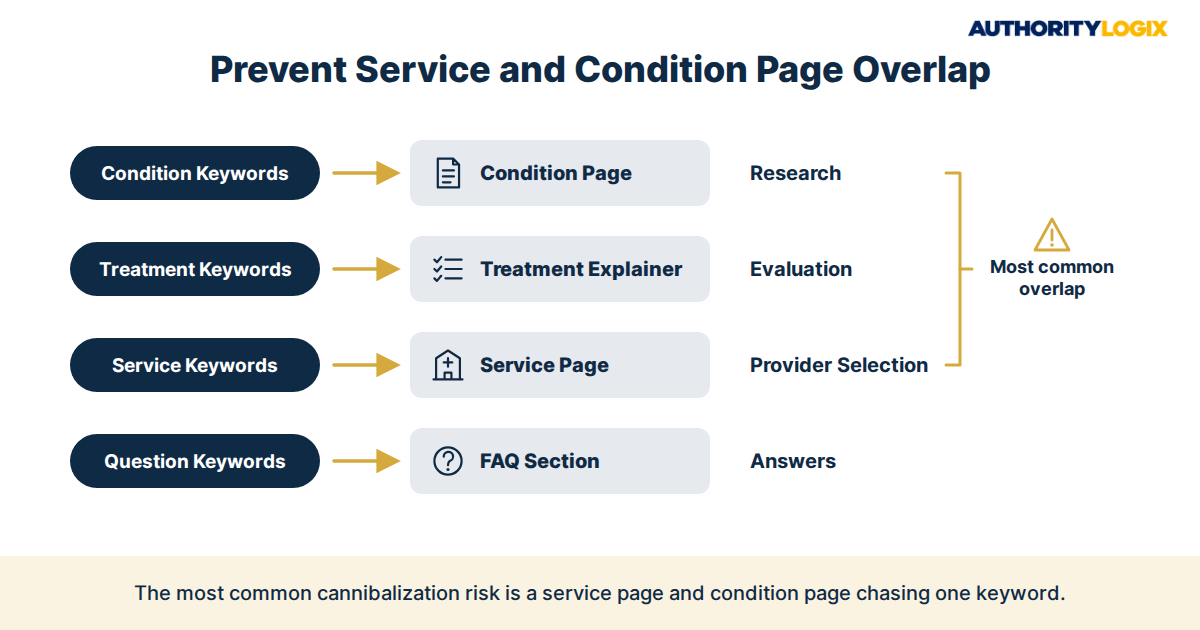
Keyword cannibalization occurs when two or more pages on the same website target the same keyword. The most common PT scenario is a service page and a condition page both targeting the same condition keyword. The fix: differentiate the keyword targets by intent. The service page targets “[specialty] PT [city]” (provider-selection); the condition page targets “PT for [specific condition] [city]” (research intent). The PT industry hub demonstrates how the five-system framework coordinates keyword mapping across all content types to prevent cannibalization.
Not sure which keywords your PT practice is missing?
Physical Therapy Keyword Strategy and Local Search
Local keyword modifiers are the highest-leverage keyword strategy investment because 77% of patients used search before booking an appointment, per a Google/Compete study, and the vast majority of that research is geographically bounded. Every condition keyword, treatment keyword, and service keyword in the practice’s keyword map should have at least one city-targeted and one neighborhood-targeted variant. The growth blueprint covers the long-term keyword strategy framework — including how topical authority built through condition and treatment keyword rankings compounds over 12 to 24 months.
Frequently Asked Questions
How many keywords should a PT practice target?
A single-location PT practice should plan for 55 to 105 total keyword targets across all four types — approximately 20 to 40 condition keywords, 10 to 20 treatment keywords, 15 to 25 service keywords, and 10 to 20 patient question keywords. This is not 105 separate pages — many of these keywords are covered by sections within existing pages. The mapping step determines which keywords need dedicated pages and which can be addressed within existing content.
What tools does a PT practice need for keyword research?
Google Search Console is the most important keyword research tool for established PT practices — it shows exactly which queries are already driving impressions and clicks to existing pages. Google’s “People Also Ask” boxes are a free, high-quality source of patient question keywords. The content systems — already referenced above — built for PT practices include the keyword tracking workflow that connects GSC data to content calendar planning.
How long does it take for keyword-targeted content to rank?
Content targeting condition keywords for low-to-medium competition queries typically begins earning impressions within 4 to 8 weeks, reaches stable ranking positions within 3 to 6 months, and compounds in traffic volume over 6 to 18 months. Patient question keywords typically earn AI Overview citations within 2 to 4 months when properly structured. The acquisition playbook — already referenced above — covers the full organic patient acquisition timeline.

Ready to build a keyword strategy that maps conditions, treatments and patient questions to the pages that win them?