


Key Takeaways
- Physical therapy service pages and condition pages are not the same type of content, they do not target the same search intent, and they cannot replace each other — a PT practice website that has only service pages is missing the highest-converting local search traffic; a website that has only condition pages is missing the breadth-of-practice signals that serve patients who already know they need PT but are choosing between providers.
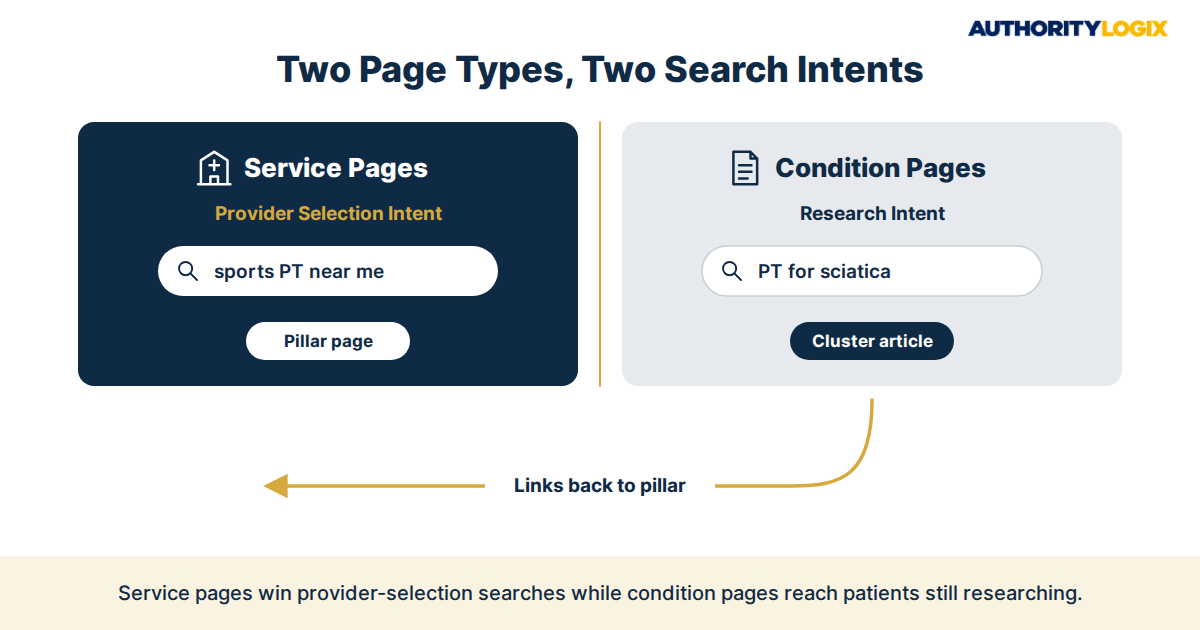
- Service pages target decision-ready patients who already know they want PT and are evaluating which practice to choose — searches like ‘physical therapy near me,’ ‘sports PT [city],’ and ‘physical therapist accepting Medicare.’ These pages are provider-selection pages.
- Condition pages target patients who are researching whether PT can help them — searches like ‘physical therapy for sciatica,’ ‘PT for rotator cuff tear,’ ‘does PT help frozen shoulder.’ These pages are patient-education pages that earn the trust that converts research into provider selection.
- 67% of patients start their healthcare search on Google, per Searchlab’s 2026 healthcare marketing statistics — and much of that research happens on condition-specific pages, not generic service pages.
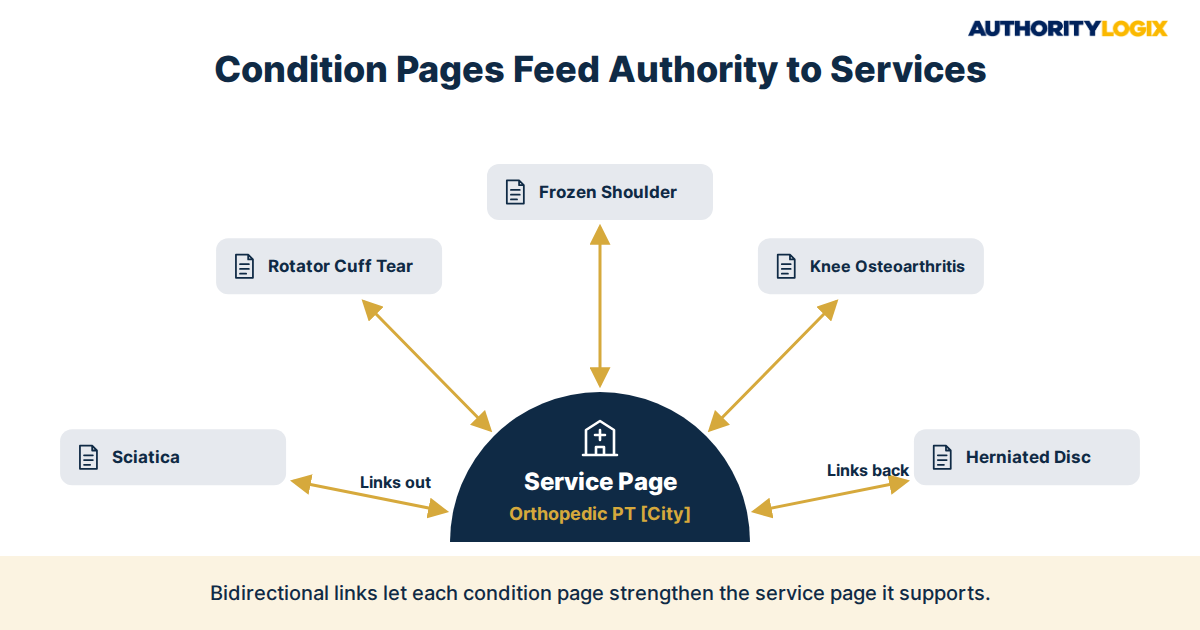
- Service pages and condition pages have a specific structural relationship: service pages are pillar pages that describe what the practice offers across a category; condition pages cluster beneath them, linking back to the service page pillar and targeting the specific condition searches that convert.
- A PT practice that has no condition pages is competing for ‘physical therapist near me’ — high-competition, low-differentiation. A practice with condition pages is also competing for ‘PT for [specific condition] [city]’ — lower competition, higher intent.
- Internal linking between service pages and condition pages is the structural investment that makes both page types perform better: condition pages inherit topical authority from the service page pillar; service pages gain supporting content depth from the condition pages that cluster beneath them.
Table of Contents
Physical therapy service pages condition pages are the two most important page types on any PT practice website — and the difference between them, what each one does, and how they connect to each other is one of the most commonly misunderstood elements of PT website strategy. Getting this architecture right is the foundation of the content strategy that earns local search rankings, AI Overview citations, and patient trust simultaneously.
This article covers what physical therapy service pages and condition pages are, what each type is designed to accomplish, how to build each type correctly, and how to connect them through internal linking. The content playbook covers the full content and SEO system — this article focuses specifically on the two most important page types and the structural relationship between them.
Physical Therapy Service Pages Condition Pages: What Service Pages Are and Do
A physical therapy service page is a pillar page that describes a category of services the practice offers — orthopedic PT, sports rehabilitation, pelvic floor therapy, neurological rehabilitation, vestibular therapy. It targets patients who already know they want PT and are evaluating which practice has the expertise that matches their needs. The search intent for service pages is provider-selection intent: “orthopedic physical therapy [city],” “sports PT near me,” “pelvic floor therapist [neighborhood].” Per Searchlab’s 2026 healthcare marketing statistics, 67% of patients start their healthcare search on Google — and the service page is the page they land on when they search for the type of PT they already know they need.
Service pages are broad by design — they describe the full scope of the practice’s capability in a clinical category, list the conditions treated within that category, and describe the clinicians who treat them. The content strategy article covers how service pages anchor the pillar-cluster architecture — with the service page as the pillar and condition pages as the cluster articles that support and link back to it.
Practices with comprehensive service pages outperform those with generic “our services” pages. Per Searchlab’s 2026 healthcare marketing statistics, practices with blogs get 4.8x more inquiries than those without.
The local search system connects service page content to the GBP category signals, location page architecture, and citation network that amplify service page rankings in the local pack. A strong service page with none of that infrastructure behind it rarely ranks on its own.
The Physical Therapy Content SEO Playbook covers how service pages and condition pages fit into one content system that ranks and converts.
What Physical Therapy Condition Pages Are and What They Do
A physical therapy condition page is a cluster article that targets patients researching whether PT can address their specific diagnosis — “PT for sciatica,” “does PT help knee osteoarthritis.” These patients are earlier in their decision journey: they have a diagnosis and are evaluating whether PT is the right treatment path. Condition pages educate first and convert second. The authority guide covers the E-E-A-T requirements for condition pages — including the named clinician attribution, clinical specificity, and patient-accessible language that make condition pages credible to both patients and Google’s YMYL quality evaluation.
Condition pages convert at a higher rate than generic service pages for the specific conditions they cover, because they intercept patients at the moment of maximum educational receptivity. The pillar pages article covers the pillar-cluster architecture in detail — this article focuses on the distinction between service pages and condition pages within that architecture.
The competitive opportunity in condition pages comes from specificity. Each condition page should address what the condition is, symptoms to watch for, the treatment approach, and the practice’s specific methodology and techniques — the structure that supports both local rankings and AI Overview citations for condition-specific queries.
How to Build Physical Therapy Service Pages That Rank and Convert
A service page that ranks and converts has five required elements: a specialty-plus-location H1, a specialty description naming specific conditions and certifications, a named clinician section linking to each treating clinician’s bio page, a geographic signal section, and internal links to the top condition pages that cluster beneath this service page. The educational hub organizes the relationship between service pages, condition pages, and clinician bio pages into a navigable knowledge library architecture that compounds authority across the full site.
Physical Therapy Service Pages Condition Pages vs. Location Page — the Critical Distinction
A service page covers a clinical category across the practice’s entire operation. A location page covers all services at a specific practice location, targeting the neighborhood or city of that location. A multi-location practice needs both: service pages for each clinical category and location pages for each physical site. The acquisition playbook covers how the service-location page architecture connects to the local search signals that drive map pack rankings.
How to Build Physical Therapy Condition Pages That Rank and Convert
A condition page that ranks and converts follows the condition-first structure: what the condition is in patient terms, how PT specifically addresses this condition, what a treatment session involves, what the recovery timeline looks like, and what the patient’s role in recovery will be. The visibility guide covers how condition page content connects to GBP category signals and location page architecture to build a unified local authority profile.
Condition Page URL Structure
Condition page URLs follow a consistent structure: “/physical-therapy-for-[condition]/” or “/[condition]-physical-therapy/.” For location-targeted condition pages: “/[condition]-physical-therapy-[city]/.” This URL structure keeps the primary keyword in the slug and makes the content hierarchy legible to Google’s crawler. The lead generation system connects condition page URL structure to the conversion architecture.
The Internal Linking System That Connects Physical Therapy Service Pages Condition Pages
The internal linking system between service pages and condition pages is bidirectional and hierarchical. The service page links to each of its top condition pages as contextual anchor links within the body content. The condition pages link back to the parent service page in the introductory paragraph. This bidirectional internal linking creates the pillar-cluster signal that tells Google the service page is the authoritative parent resource. The authority distribution system amplifies this internal topical authority through external syndication.
A fully connected service page and condition page ecosystem creates the topical authority profile that earns the highest local search rankings available for specialty PT practices. Condition page search traffic can also convert well for specific conditions, because the patient already has a diagnosis in mind. The PT industry hub demonstrates how the five-system framework coordinates service pages, condition pages, clinician bio pages, and location pages into a unified patient acquisition infrastructure.

Not sure which service pages and condition pages your PT website is missing?
Frequently Asked Questions
How many service pages does a PT practice need?
One service page per clinical category the practice treats at meaningful volume — typically 3 to 6 for a general outpatient practice. Each service page should have genuine clinical depth — naming specific conditions, listing relevant certifications, identifying treating clinicians. The growth blueprint covers how the number of service pages connects to the practice’s overall authority positioning.
How many condition pages does a PT practice need?
One condition page per condition the practice treats frequently enough to have genuine clinical expertise to share — typically 10 to 30 pages for a general outpatient practice. Priority order: start with the practice’s top 3 to 5 highest-volume conditions, then add specialty conditions where the practice has credentialed expertise. One substantive condition page per quarter outperforms 12 thin condition pages per year.
Can a page serve as both a service page and a condition page?
Rarely — and the attempt usually produces a page that does neither job well. Service pages are designed for provider-selection intent; condition pages are designed for research intent. A single page cannot be in both of those places in the patient journey simultaneously. For any practice that treats multiple conditions, the service page and condition page functions should remain separate, with clear internal linking between them.

Ready to build service and condition pages that work together to rank and convert?