


Key Takeaways
- Physical therapy local authority positioning is the deliberate process of making a PT practice the first name patients, physicians, and community members think of when they need physical therapy in a specific geography — achieved not through advertising spend but through clinical credibility, consistent visibility, and a multi-channel presence that compounds over time.
- Public confidence in making health decisions dropped 10 points globally in a single year, per the 2026 Edelman Trust Barometer — creating a gap that local PT practices with visible, attributed clinical expertise are positioned to fill at the community level that national chains cannot replicate individually.
- 84% of patients check online reviews before booking with a provider, per rater8’s Patient Choice Report research — meaning that local authority is not just clinical reputation but the visible, searchable expression of that reputation across the channels patients use during their provider selection research.
- Most patients research providers online before booking — the practice that appears first, looks most credible, and answers the most patient questions during that online research phase captures the patient before any competitor has a chance to compete.
- Local authority positioning works across four dimensions simultaneously: search visibility (appearing for the right local queries), clinical credibility (named clinicians with visible expertise), community presence (involvement in local health conversations), and reputation consistency (reviews, ratings, and patient-reported outcomes across all platforms).
- The physical therapy market remains highly fragmented — roughly 39,000 outpatient clinics with the 50 largest companies holding just 29% of revenue — which means local authority in a defined geography is genuinely achievable by an independent practice with a documented positioning strategy.
- Practices that build local authority systematically outperform those that compete on convenience or price, because authority is the input that produces patient preference — and patient preference is what fills a schedule without ongoing advertising dependency.
Table of Contents
Physical therapy local authority positioning is what separates the practice patients recommend to their neighbors from the practice patients settle for because it was the closest result in a directory listing. In a competitive local market — where PE-backed chains, franchise operators, and hospital-affiliated clinics all compete for the same patient population — the independent PT practice that has deliberately positioned itself as the local clinical authority earns patient preference that convenience alone cannot deliver. Local authority is not about marketing volume; it is about being the practice whose expertise is visible, credible, and specifically relevant to the patients in a defined community before they ever pick up the phone.
This article covers the four dimensions of physical therapy local authority positioning — search visibility, clinical credibility, community presence, and reputation consistency — and the specific operational actions within each dimension that compound into genuine local market authority. The authority growth article covers the five-pillar authority system that underpins this positioning work; this article focuses specifically on the local market application of that system — the tactics that make authority visible and relevant at the geography where patients actually book appointments.
Why Physical Therapy Local Authority Positioning Matters in 2026
Public confidence in finding health answers and making informed health decisions dropped 10 points globally in a single year, per the Edelman Barometer. Healthcare providers are competing with AI tools, social media creators, and uncredentialed influencers for the attention of patients who are increasingly uncertain about where to find reliable guidance. In this environment, the PT practice that presents as a clear, credible, locally accessible expert — with named clinicians, specific condition expertise, and visible community engagement — captures the trust that diffuse national brands and anonymous corporate chains cannot generate at the individual patient level.
The market structure reinforces this opportunity. With roughly 39,000 outpatient clinics nationwide and the 50 largest competitors capturing just 29% of revenue, outpatient physical therapy remains one of the most geographically fragmented healthcare sectors in the US. A practice that builds deliberate local authority in a 10-mile radius — the local geography from which most PT practices draw the large majority of their patients — can dominate that territory regardless of what national competitors do at scale. Local authority is a winnable position precisely because it is defined at a level of geographic specificity that large operators cannot maintain at each individual clinic.
Most patients research providers online before booking — and the practice that appears first, provides the most substantive answers to their questions, and looks the most credible during that research phase captures the patient before any in-person interaction occurs. Local authority positioning is the work that ensures a PT practice occupies that research-phase visibility consistently — for the condition searches, local service queries, and clinician credibility signals that patients evaluate before they commit to calling. The acquisition playbook covers how local authority connects to the full patient acquisition pipeline from first search through booked evaluation.

Explore the AuthorityLogix PT Practice Authority & Growth Blueprint.
Dimension 1: Search Visibility — Physical Therapy Local Authority Positioning Starts Online
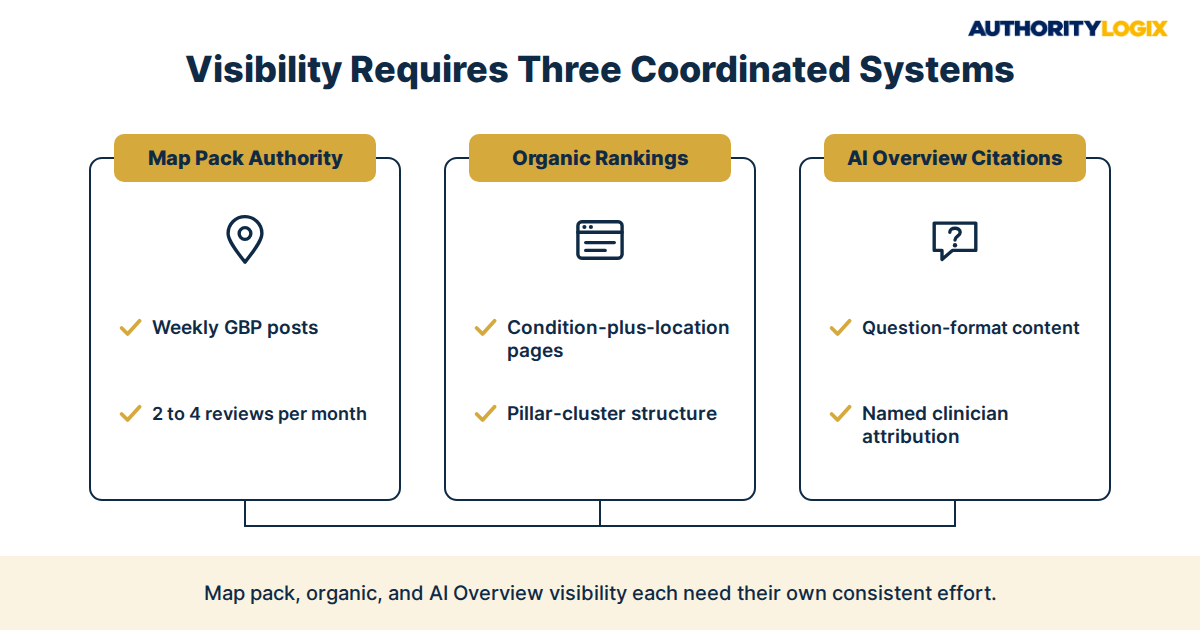
82% of patients research providers online before booking, per Searchlab’s 2026 healthcare marketing analysis — and the practice that appears in the right local search results, with the right content depth, and with the strongest review signals is positioned as the local authority before a patient has read a single word of clinical content. Search visibility for local authority has three components: map pack presence for the practice’s neighborhood and city, organic rankings for condition-plus-location queries, and AI Overview citations for the patient questions that now get answered in search results before any website is clicked.
Map pack presence is the foundation of local search authority — a practice that does not appear in the top three Google Maps results for ‘physical therapy [neighborhood]’ is invisible to the majority of patients who use the map pack as their primary provider discovery tool. Sustained map pack presence requires: a fully optimized GBP profile with the practice’s primary clinical category, comprehensive service listings in patient language, weekly posts demonstrating active clinical engagement, and a consistent review velocity of at least two to four new reviews per month. The visibility guide covers the full GBP optimization and local search authority framework — the operational system that produces map pack presence.
Organic rankings for condition-plus-location queries — ‘physical therapy for sciatica [city],’ ‘rotator cuff PT near [neighborhood],’ ‘vestibular therapy [city]’ — are where the practice’s content investment produces patient acquisition that compounds month over month. These rankings require dedicated condition pages that cover the specific diagnosis in patient language, target the condition-plus-location keyword, and link to the practice’s service pages and local pages as part of a coherent pillar-cluster structure. The local search system governs the full infrastructure — GBP, location pages, and condition content — as a coordinated local authority system rather than three separate tactics.
Dimension 2: Clinical Credibility — Making Expertise Visible and Specific
Clinical credibility is the dimension of physical therapy local authority positioning that distinguishes the practice from every other clinic in the map pack. A practice that appears in local search but presents no visible evidence of specific clinical expertise — no named clinicians, no condition depth, no credentials displayed in patient-accessible content — is competing on convenience rather than authority. The authority guide covers the E-E-A-T content standards that Google’s YMYL evaluation applies to healthcare content — and the specific attribution and evidence-linking practices that distinguish credible clinical content from generic health marketing copy.
Physical Therapy Local Authority Positioning Through Clinician Bio Pages as Authority Assets
Every PT’s bio page is an authority asset — not a staff directory entry. A clinician bio that lists only name, degree, and years of experience builds no local authority. A clinician bio that names the specific conditions the PT has the most experience treating, lists relevant certifications (OCS, SCS, CSCS, PRPC, COMT), references continuing education in specialty areas, and links to condition pages the PT has authored is a local authority signal that search engines evaluate as genuine first-hand Experience.
Each bio page should target the clinician’s specialty plus the practice’s city — ‘vestibular PT specialist [city],’ ‘pelvic floor physical therapist [neighborhood]’ — creating a clinician-level local search presence that reinforces the practice’s overall positioning. The educational hub organizes clinician expertise, condition pages, and patient education content into a navigable knowledge library that compounds the clinical credibility signal across the full site.
Condition Pages as Local Authority Proof
Condition pages are the primary vehicle through which a PT practice demonstrates specific clinical authority to both patients and search engines. A condition page for rotator cuff injuries that is authored by a named PT with shoulder specialization, covers the anatomy and common injury types in patient language, describes how the practice’s specific approach to rotator cuff rehabilitation works, and answers the six or seven questions patients most commonly ask before booking — that page is a local authority asset.
It earns rankings for provider-selection queries in the practice’s city, builds clinician-level E-E-A-T signals, and presents the practice as the specialist rather than a generalist option. The content topics article covers the five content topic categories that every PT practice needs — including condition content, treatment content, and direct access content — and the keyword patterns that connect each category to patient searches.
Not sure which clinical credibility gaps exist in your practice’s current positioning?
Dimension 3: Community Presence — Building Local Authority Beyond Search
Community presence is the dimension of physical therapy local authority positioning that operates outside the search environment — and that builds the referral relationships and word-of-mouth authority that search alone cannot produce. A PT practice that is visibly involved in its local healthcare community — known to local physicians, present at community health events, referenced in local health publications, and active in the conversations where community members discuss health and wellness — builds an authority footprint that reinforces its search visibility and makes its digital presence more credible.
Physician Relationship Development as Authority Building
Physician relationship development for local authority is not about visiting offices with marketing materials — it is about making the practice’s clinical expertise consistently visible to referring physicians through educational touchpoints that demonstrate genuine specialty knowledge. A quarterly email to local orthopedic surgeons covering one specific post-surgical rehabilitation protocol the practice follows, a LinkedIn article addressed to primary care physicians about how the practice approaches chronic low back pain without opioid dependence, or a one-page clinical summary of the practice’s approach to direct access patients — these are authority signals that position the practice as a clinical peer rather than a vendor. Physicians refer to practices they trust clinically, and trust is built through demonstrated expertise, not marketing frequency.
Local Health Content as Community Authority
Local health content — articles, posts, and patient education resources that address the health concerns of the specific community the practice serves — builds community authority by making the practice’s clinical expertise accessible to people before they become patients. A PT practice near a popular running trail publishes a post on preventing common trail running injuries in that geographic area.
A practice near a youth sports complex publishes content on ACL injury prevention protocols for young athletes. A practice in a community with a high proportion of older adults publishes a guide to fall prevention exercises. This content earns local relevance signals that reinforce the practice’s geographic authority, builds the community recognition that drives word-of-mouth referrals, and produces the patient education footprint that the distribution system amplifies through external syndication channels.

Dimension 4: Reputation Consistency — The Social Proof Layer of Local Authority
Reputation consistency is the dimension of physical therapy local authority positioning that converts interest into confidence. A patient who has found the practice through local search, reviewed the clinician’s bio and condition content, and decided the practice looks like the right clinical fit will check reviews before booking — consistently. Negative reviews, sparse ratings, outdated directory information, or contradictory practice details across platforms introduce doubt at the moment a patient is ready to commit. The content systems built for PT practices include the post-visit patient communication workflows that generate consistent review volume as a byproduct of the discharge process rather than a separate marketing campaign.
Review Velocity as an Authority Signal
Review velocity — the rate at which a practice receives new reviews over time — signals active patient engagement to both Google’s local ranking algorithm and to patients who use the date of the most recent review as a proxy for the practice’s current quality level. A practice with 200 reviews and no new reviews in six months looks less actively engaged than a practice with 80 reviews and 12 new reviews in the past 90 days.
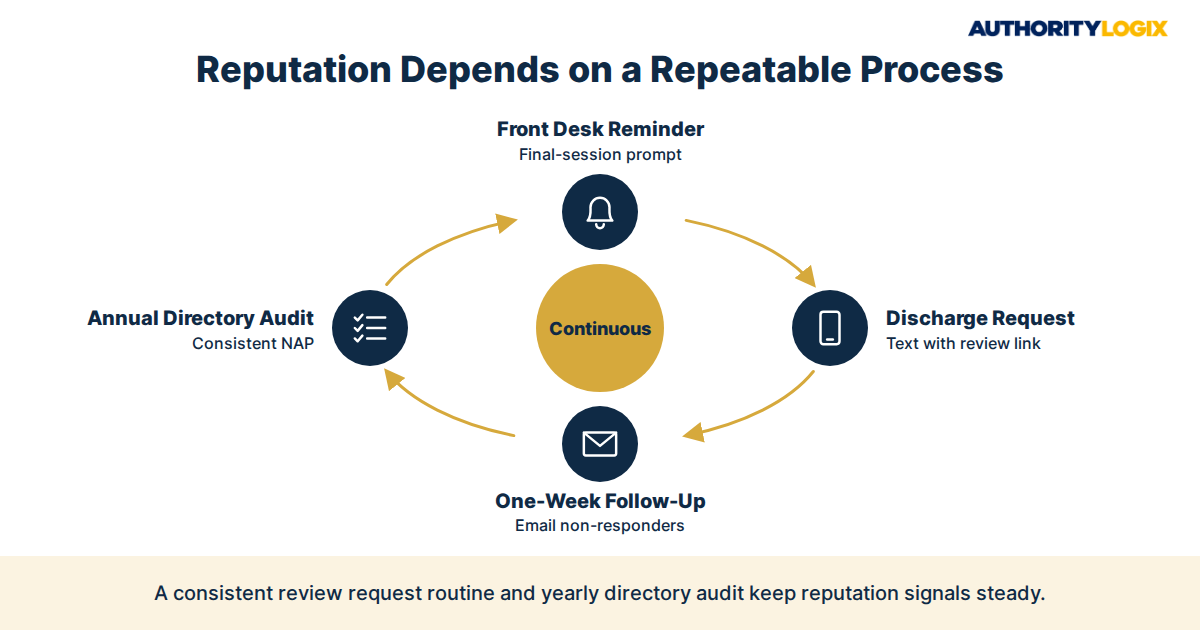
Consistent review velocity requires a systematic post-discharge process: a text message at discharge directing patients to the practice’s Google review link, a follow-up email at the one-week mark for patients who did not respond, and a front desk reminder protocol for patients completing their final session. The lead generation system integrates the post-discharge review workflow with the full patient communication infrastructure — ensuring review generation operates as a standard operational process rather than a periodic initiative.
Directory Consistency as Local Authority Infrastructure
Every PT practice has a presence across multiple healthcare directories — Healthgrades, Zocdoc, Yelp, the APTA member directory, insurance plan directories, and dozens of secondary directories that aggregate from data providers. Inconsistent NAP (name, address, phone) data across these platforms — a different suite number, an old phone number, a misspelled practice name — creates entity fragmentation that suppresses local search authority and introduces doubt for patients who encounter contradictory information.
Directory consistency requires an annual audit of all active directory listings, a single canonical NAP standard applied across every platform, and a process for updating all directories when any practice detail changes. The PT industry hub demonstrates how the five-system framework operates as a coordinated infrastructure where directory consistency reinforces every other local authority signal rather than operating as an isolated administrative task.
Frequently Asked Questions
How long does local authority positioning take to produce results?
Local authority positioning produces results in layers. Map pack improvements from GBP optimization are typically visible within 30 to 60 days of consistent signals. Condition page rankings for local terms with lower competition appear within 60 to 90 days of publication. AI Overview citations for question-format content typically emerge within 3 to 6 months of consistent clinician-attributed publishing. Full local authority — where the practice is the first name patients and physicians associate with specific condition categories in its geography — typically requires 12 to 24 months of consistent execution across all four dimensions. The content playbook covers the content publication cadence that produces compounding local authority within those time frames.
Should a PT practice try to establish authority across the whole city or focus on a neighborhood?
Start with the neighborhood or zip code the practice draws most patients from, then expand. Local authority is easier to establish at higher geographic specificity — ‘vestibular PT in [neighborhood]’ has less competition and more local relevance than ‘vestibular PT in [large city].’ A practice that dominates its immediate neighborhood first, then expands its local authority footprint to adjacent neighborhoods and the broader city, builds authority more efficiently than one that spreads resources across a large geography from the start. The map pack ranking factors also favor proximity — a practice that earns strong authority signals in its immediate service area appears more consistently for patients searching from nearby locations.
How does local authority positioning differ from general SEO?
General SEO focuses on organic search rankings across broad keyword sets. Local authority positioning is a multi-dimensional strategy that combines local search signals (GBP, location pages, NAP consistency), clinical credibility signals (named clinicians, condition expertise, E-E-A-T), community presence (physician relationships, local health content, events), and reputation consistency (review velocity, directory accuracy) into a coherent positioning system that makes the practice the first choice in a defined geography. SEO is one component of local authority positioning, not the whole of it. A practice with strong SEO but no community presence and no physician relationships has partial local authority — visible online but not embedded in the local healthcare referral ecosystem.
How does a PT practice measure local authority progress?
Track four sets of leading indicators monthly: search visibility (Google Search Console impressions and clicks for condition-plus-location queries; GBP profile views and direction requests), clinical credibility (number of published and indexed condition pages with clinician attribution; AI Overview appearances for target condition queries), community presence (physician referral source count; local press mentions; event participation), and reputation consistency (monthly new review count; average rating trend; directory listing accuracy score).
The lagging indicators — patient inquiry volume from organic search, new patient bookings attributed to organic or AI search, and physician referral volume — typically follow the leading indicators by 3 to 6 months. Track leading indicators monthly and do not judge the investment by lagging indicators until at least 6 months of consistent execution.
What is the single highest-impact first step for local authority positioning?
GBP optimization, if the practice’s profile is incomplete or inconsistently maintained. A fully optimized GBP profile with the correct primary category, comprehensive service listings in patient language, and a systematic weekly post cadence is the fastest single action that produces local search visibility improvements — typically within 30 to 60 days. If GBP is already optimized, the highest-impact next action is publishing one condition page for the practice’s highest-volume condition with city and neighborhood keyword targeting and a named clinician author. These two actions — optimized GBP and one well-targeted condition page — establish the foundation of local authority that all subsequent positioning work amplifies.
Ready to become the practice your local market sees as the authority, not just another clinic on the map?