

Key Takeaways
- Physical therapy practice authority growth is the compounding system by which an independent PT practice builds a market position that is genuinely difficult for PE-backed chains to replicate — not through scale, but through clinical depth, community trust, and a multi-channel visibility infrastructure that connects every patient touchpoint.
- The US physical therapists industry is projected to reach $55.7 billion in 2026 with a 2.9% CAGR, per IBISWorld — and remains one of the most fragmented healthcare sectors in the country, with roughly 39,000 outpatient clinics and the 50 largest companies holding just 29% of revenue. Fragmentation is the opportunity: geographic and specialty niches remain where independent practices can dominate.
- “My doctor” remains the most trusted source on health issues, per the 2026 Edelman Trust Barometer — but public confidence in finding health answers and making informed health decisions is declining globally. The practice that builds a visible, credible, patient-facing authority presence captures the trust that centralized chains cannot manufacture at the local level.
- The five pillars of PT practice authority are: clinical specialization, content and SEO visibility, local search dominance, patient education credibility, and authority distribution. Each pillar reinforces the others — a practice that invests across all five builds a compounding competitive moat that grows stronger over time.
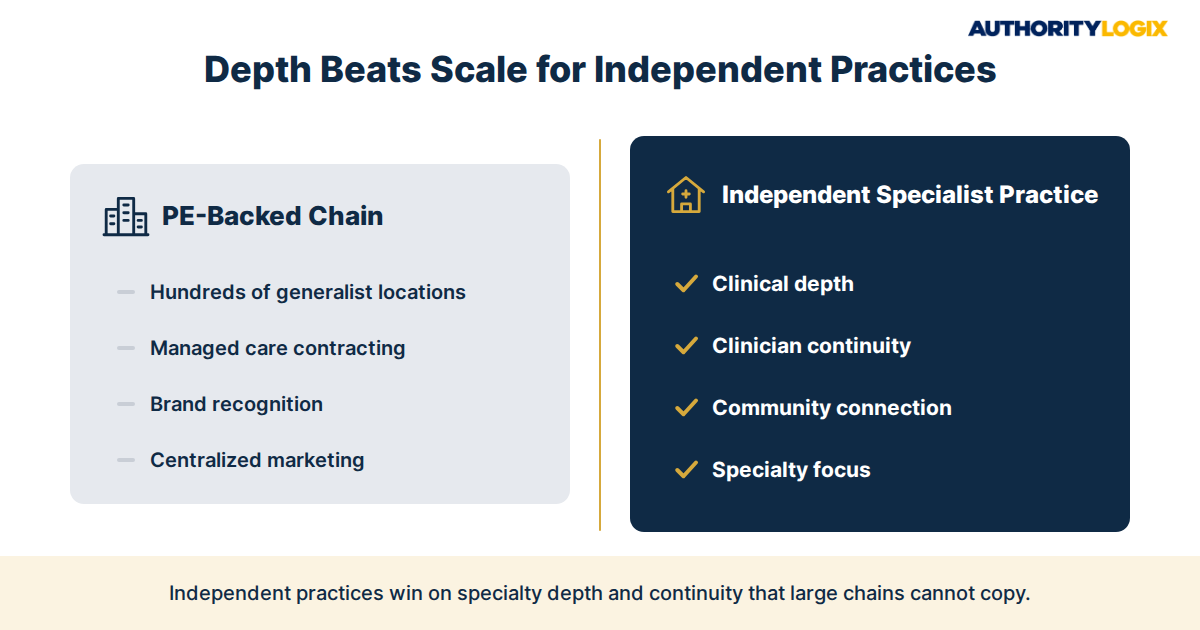
- Independent PT practices win against PE consolidators on clinical depth, clinician continuity, community connection, and specialty focus — advantages that are structurally unavailable to large corporate operators managing hundreds of locations under a shared brand.
- Authority is not built by a single channel — it is built by the consistent presence of the practice’s clinical expertise across every touchpoint where patients and referral sources search for information: Google, GBP, social platforms, condition pages, clinician bios, patient education content, and external syndication.
- The practice authority growth system requires a documented strategy, consistent execution across five systems, and a measurement framework that tracks the leading indicators of authority — search visibility, content inventory, GBP signals, and review velocity — before they show up in patient volume.
Table of Contents
Physical therapy practice authority growth blueprint is the strategic process by which an independent PT practice builds a market position that compounds over time — one where clinical expertise is visible to the patients and referral sources who need it, where the practice’s reputation precedes it in every search and every conversation, and where the visibility infrastructure it has built is genuinely difficult for larger competitors to replicate. In a market where PE-backed consolidators are systematically acquiring independent clinics across the country, the practices that survive and grow as independents do so by building authority that scale cannot buy.
This article covers the five-pillar physical therapy practice authority growth system: clinical specialization, content and SEO visibility, local search dominance, patient education credibility, and authority distribution. Each pillar is a distinct investment area. Together, they build the compounding market presence that makes an independent PT practice the first choice in its local market — for patients searching online, for physicians considering referral sources, and for the community members who trust their neighbors’ recommendations. The acquisition playbook covers how authority connects to the full patient acquisition pipeline — this article focuses specifically on the authority-building system that makes that pipeline self-sustaining.
The Physical Therapy Practice Authority Growth Blueprint Context: Why It Matters Now
The US physical therapists industry is projected to generate $55.7 billion in revenue in 2026, with a 2.9% compound annual growth rate from 2021 through 2026, per IBISWorld. That growth is not distributed evenly. PE-backed consolidators — Upstream Rehabilitation, Confluent Health, H2 Health, Select Medical, and dozens of regional platforms — are systematically acquiring independent clinics to build scale advantages in managed care contracting, technology infrastructure, and brand recognition across large geographic footprints. The independent practice that has not built a visible authority position finds itself competing against well-capitalized operators with centralized marketing resources and brand equity accumulated across hundreds of locations.
The structural counterpoint to consolidator scale is the fragmentation that still defines the PT market. Roughly 39,000 outpatient clinics operate nationwide, per Orbital, and the 50 largest competitors capture just 29% of revenue, per Research and Markets — making outpatient PT one of the most fragmented healthcare sectors in the country. Geographic and specialty niches remain where an independent practice with genuine clinical depth, consistent local visibility, and a documented patient education system can dominate its local market against any competitor at any scale. The practices building authority systematically in 2026 will be the ones that consolidators acquire at premium multiples — or that remain stubbornly independent by making themselves the obvious first choice for patients in their market.
Trust is the most durable competitive advantage an independent PT practice holds over a national chain. Edelman Barometer finds that doctors and healthcare providers remain the most trusted source of health information globally — more than AI tools, social media, and uncredentialed influencers — even as overall confidence in finding accurate health information is declining. The practice that makes its clinicians’ expertise visible, attributed, and accessible builds the trust capital that a PE platform operating under a corporate brand cannot replicate at the individual clinician level.
The authority guide covers how patient-facing clinical authority content builds the E-E-A-T foundation that authority distribution amplifies. Without that foundation, distribution just spreads generic content further.

Explore The Physical Therapy Practice Authority & Growth Blueprint.
Pillar 1 of the Physical Therapy Practice Authority Growth Blueprint: Clinical Specialization
Why Clinical Specialization Anchors a Physical Therapy Practice Authority Growth Blueprint
Clinical specialization is the starting point of physical therapy practice authority growth because it is the only differentiator that a PE-backed chain with hundreds of generalist locations cannot easily replicate at the individual clinic level. A practice that has built genuine clinical depth in pelvic floor rehabilitation, vestibular therapy, sports injury recovery, neurological rehabilitation, or post-surgical care for a specific procedure type owns a competitive position that cannot be purchased through acquisition.
Independent PT practices that win against consolidators do so on clinical depth, clinician continuity, community connection, and specialty focus — structural advantages that large corporate operators cannot provide at local granularity. The content systems built for PT practices are organized around specialty-specific content architecture — ensuring that clinical specialization is expressed in the practice’s website structure, condition pages, and treatment content in a way that Google’s quality evaluation systems can measure.
Specialization produces a second compounding advantage: it makes the practice’s content indexable at a level of clinical specificity that generalist competitor content cannot match. A practice that has published comprehensive condition pages for vestibular disorders — BPPV, vestibular migraine, labyrinthitis, vestibular neuritis — across multiple specific diagnoses builds topical authority in that specialty that earns rankings for high-intent patient searches no generalist competitor can contest. Specialization in clinical practice and specialization in content architecture reinforce each other — a practice that treats a condition at depth can describe it at depth, and Google rewards that clinical specificity with rankings that reflect genuine expertise.
Sequencing Specialization Before the Content System
The specialization decision should be made before the content system is built — because the content system is the primary vehicle through which specialization becomes visible to patients, referral sources, and search engines. A practice that has treated pelvic floor conditions for ten years but has no condition pages, no clinician bio mentioning that specialty, and no patient education content about those conditions has hidden its most valuable competitive asset from the search systems patients use to find it. The educational hub is the operational system that organizes specialty-specific condition pages, treatment content, and clinician expertise into a permanent patient education library that compounds in authority value over time.
Not sure where your practice’s authority gaps are relative to local competitors?
Pillar 2: Content and SEO Visibility — Making Authority Searchable
Physical therapy practice authority growth requires that clinical expertise be visible to the patients who are searching for it — and in 2026, that means a structured content and SEO system that connects the practice’s clinical depth to the specific search queries patients use at every stage of their decision process. A practice with genuine vestibular therapy expertise but no condition pages for BPPV, vestibular migraine, and dizziness PT is invisible to the patients searching ‘vestibular physical therapy near me’ right now.
A practice with a documented content strategy targeting the specific condition-plus-location queries its patient population uses earns consistent organic patient inquiry that compounds month over month without ongoing advertising spend. The content strategy article covers the pillar-cluster architecture that organizes condition pages into a compounding topical authority system.
Content-based authority also earns AI Overview citations — the search format that is increasingly the first result patients encounter before they click to any website. AI Overviews now appear in approximately 88% of healthcare queries, per BrightEdge data, and they tend to favor structured, question-format educational content attributed to credentialed clinicians.
A practice whose clinicians have authored condition-specific articles answering the exact questions patients type into AI search tools — ‘how long does vestibular PT take,’ ‘what is BPPV treatment,’ ‘can PT help with vertigo’ — builds the citation footprint that makes the practice visible in AI-generated answers before patients ever reach a search results page. The content playbook covers the full content SEO strategy framework — keyword targeting, pillar-cluster architecture, and the publication cadence that produces compounding authority.
The content topics a PT practice writes about determine the patient population it attracts — condition pages for the diagnoses the practice treats most effectively attract the patients most likely to complete treatment and refer others. The content topics article covers the five content topic categories that every PT practice needs: condition content, treatment content, patient education, direct access content, and practice differentiator content. Each category serves a different patient intent stage and contributes a different type of authority signal to the practice’s overall search visibility.
Pillar 3: Local Search Dominance — Owning the Geographic Market
Physical therapy practice authority growth requires local search dominance — the map pack visibility, GBP authority, and geographic content signals that make the practice the obvious first choice when patients in the practice’s service area search for PT. Local search is where independent practices have the most durable advantage over PE-backed chains: a national chain with 200 locations has 200 separate GBP profiles to maintain, 200 separate location pages to optimize, and 200 separate review velocity strategies to execute.
An independent practice with one location in a specific neighborhood, maintained with operational discipline, builds the per-location GBP signals that a multi-location operator cannot match at each individual clinic. The visibility guide covers the full local search optimization system — GBP management, NAP consistency, review velocity, and location page architecture — that produces map pack authority.
Local search dominance for a PT practice has three core components: a fully optimized GBP profile with the correct primary category, comprehensive service listings in patient-facing language, and consistent review velocity from post-discharge review requests; a dedicated location page for each physical clinic that carries both geographic keyword signals and condition-specific content relevant to that location’s patient population; and citation consistency across all healthcare directories — Healthgrades, Zocdoc, APTA directory, Yelp, and the data aggregators that feed secondary directories. The local search system governs all three components as a coordinated local authority system rather than three separate tasks.

Pillar 4: Patient Education Credibility — Building Trust Before the First Visit
Patient education credibility is the authority pillar that operates across the longest time horizon but builds the most durable competitive advantage. A practice whose clinicians have authored and published comprehensive patient education content — condition guides, FAQ pages, treatment explainers, direct access resources — is building a permanent reputation infrastructure that earns patient trust before a phone call is made or an appointment is booked.
The 2026 Edelman Trust Barometer health report confirms that “my doctor” remains the most trusted source on health issues — and that trust works hardest for a practice when its clinical expertise is visible and attributed. A clinician whose name and credentials appear on condition content, who is cited in AI search answers, and whose clinical perspective is accessible to patients researching their condition before they call a practice has built a trust presence that an anonymous corporate brand cannot replicate.
Patient education credibility requires four operational elements: every condition page and treatment article carries the name and credentials of the clinician who provided the clinical perspective; content is updated annually to reflect current treatment standards; patient questions — the specific questions the front desk answers repeatedly — are addressed explicitly in FAQ sections structured for AI Overview citation; and the educational content links coherently to the practice’s service pages, condition pages, and booking infrastructure so that educated patients have a clear path to scheduling. Skipping any one of these four weakens the credibility signal the other three are building.
The authority guide covers the content types and attribution formats that build E-E-A-T credibility — the signals Google’s YMYL evaluation uses to distinguish genuine clinical expertise from generic health marketing copy. The lead generation system connects the patient education library to the conversion infrastructure that turns educated, trust-primed patients into booked evaluations.
Pillar 5: Authority Distribution — Amplifying Expertise Across Every Channel
Authority distribution is the fifth pillar of physical therapy practice authority growth and the one that amplifies the investment in the other four. A practice with deep clinical specialization, a well-structured content library, strong local search signals, and credible patient education content has built a concentrated authority asset — but concentrated authority reaches only the patients who find the practice through the channels it has already optimized.
Authority distribution expands the reach of that asset through syndication channels that build external links, citations, and brand mentions that reinforce the practice’s authority signals across the full web. The distribution system covers the specific syndication channels — press releases, editorial submissions, PT industry publications, local healthcare directories, and content distribution networks — that amplify every piece of content a practice publishes.
For an independent PT practice, authority distribution serves a second strategic function: it builds the external authority signals that AI search systems use to decide which practices to cite when generating healthcare answers. AI Overviews and AI assistant recommendations are drawn from the full body of external evidence that confirms the practice’s clinical expertise — not from the practice’s own website alone.
A practice cited in local press coverage, referenced in PT industry publications, listed with complete profiles across healthcare directories, and with external content attributing specific condition expertise to named clinicians is building the entity authority that AI systems recognize. The PT industry hub demonstrates how the five-system framework — content, local search, patient education, lead generation, and authority distribution — works as a coordinated system when all five pillars are operating simultaneously.
Frequently Asked Questions
How long does it take to build practice authority?
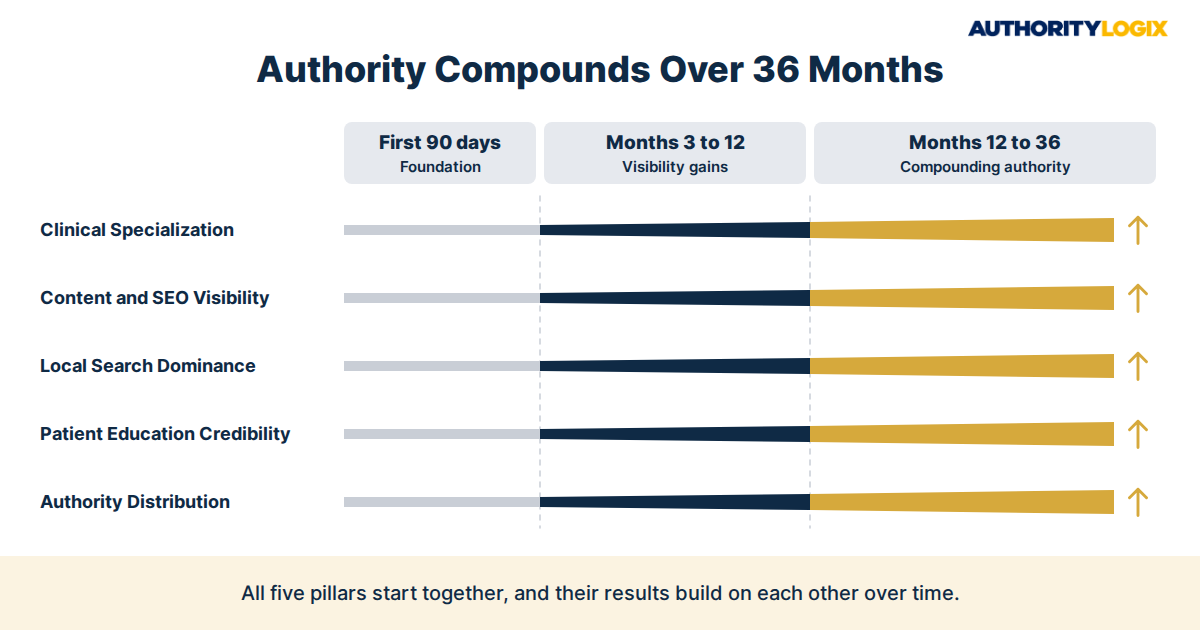
Authority builds in layers over 12 to 36 months depending on where the practice starts. The first 90 days establish the foundation: GBP optimization, core condition pages, clinician bios with credentials, and citation consistency. Months 3 to 12 produce measurable visibility gains as content indexes, GBP signals accumulate, and review velocity compounds.
Months 12 to 36 produce the compounding authority effects — rankings for specific condition queries, AI Overview citations, and referral source recognition — that give the practice a reputation that precedes it. In a consolidated market, the independent practices that win tend to do so through leadership, differentiation, culture, and scalable systems rather than short-term tactics. Authority is a long-term system investment, not a campaign.
How does practice authority connect to valuation?
For practices that may eventually seek acquisition or partnership, authority is a direct valuation multiplier. PE buyers price physical therapy practices based on revenue, payer mix, referral diversity, and clinical independence from the owner. A practice with a documented content system, strong local search signals, a diversified patient acquisition channel mix, and a brand that operates independently of any single clinician’s relationships is worth materially more than an equivalent practice dependent on owner referral relationships and word-of-mouth alone. Authority-building is not separate from practice financial performance — it is the infrastructure through which a practice reduces referral dependence, diversifies its patient acquisition, and demonstrates operational durability to any future partner or acquirer.
Can a single-location practice build meaningful authority against larger competitors?
Yes — and geographic and specialty focus are the mechanisms. A single-location practice that owns deep topical authority for vestibular conditions in its specific city, earns consistent map pack visibility in its neighborhood, and has built a patient education library that answers every question a vertigo patient searches before booking is the first choice in its specialty and geography regardless of what a 200-location chain does nationally. The content playbook covers the content architecture through which single-location specialty practices build this kind of concentrated local authority faster than generalist competitors at any scale.
What metrics indicate that practice authority is building?
The leading indicators of practice authority are: organic search impressions and clicks for condition-specific queries (Google Search Console), GBP profile views and direction requests per location, review volume and velocity per month, number of indexed condition and treatment pages, and external mentions and citations (Google Alerts for practice name, clinician names). The lagging indicators — patient inquiry volume from organic search, referral source acknowledgments of the practice’s specialty reputation, and new patient bookings attributed to organic search or AI search — typically follow the leading indicators by 3 to 6 months. Track leading indicators monthly; do not judge the investment by lagging indicators until at least 6 months of consistent execution.
How do the five authority pillars connect to each other?
Each pillar reinforces the others in specific ways. Clinical specialization determines what condition content to build and what local search signals to optimize. Content and SEO visibility makes the specialization findable and earns the external citations that authority distribution amplifies. Local search dominance ensures that the content is visible to the geographic patient population it is designed to serve. Patient education credibility earns the trust of patients who find the content, builds AI Overview citations, and primes patients to book before they call.
Authority distribution amplifies all four by building the external authority signals that reinforce every other pillar’s effectiveness. The five systems are designed to be built simultaneously, at a cadence that matches the practice’s available resources, and to compound in value as each pillar strengthens the others. The growth blueprint covers the full practice authority and growth framework — this article covers the specific pillars that the blueprint is built from.
Ready to put the practice authority growth blueprint to work in your market?