

Key Takeaways
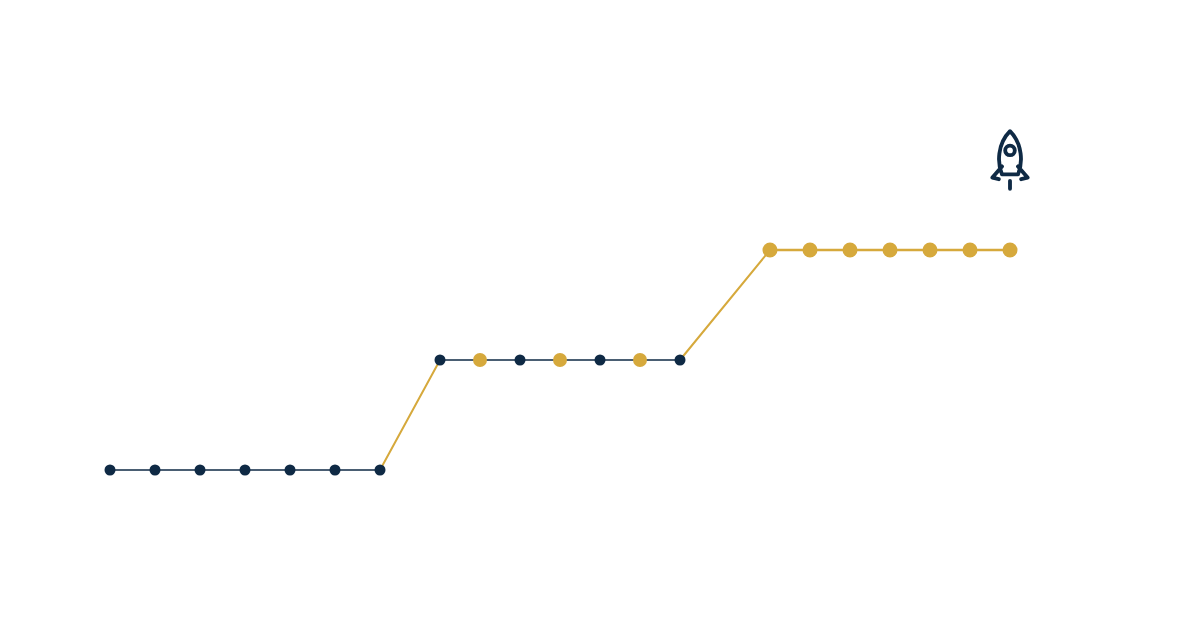
- A 90-day physical therapy authority growth plan answers the question every PT practice owner faces when starting to build marketing systems: where do I start? The answer is sequenced, not simultaneous — certain investments produce results within weeks, others require months to compound, and building in the wrong order wastes resources on activities that cannot gain traction without the foundations beneath them.
- GBP signals carry 32% of local pack ranking weight in Whitespark’s expert survey, making the Google Business Profile the single highest-leverage first investment — and fully optimized GBP profiles receive more appointment requests than incomplete ones. Map pack improvements from complete GBP optimization are typically visible within 30 to 60 days.
- Days 1 through 30 are infrastructure: GBP optimization to full completion, NAP consistency across all healthcare directories, clinician bio pages published with credentials and specialty anchors, and a post-discharge review request workflow activated. These are the foundations that all subsequent work amplifies.
- Days 31 through 60 are content foundation: the first three condition pages targeting the practice’s highest-volume conditions with city and neighborhood keyword targeting, a direct access FAQ page for the practice’s state, and the first clinician-authored patient education articles structured for AI Overview citation.
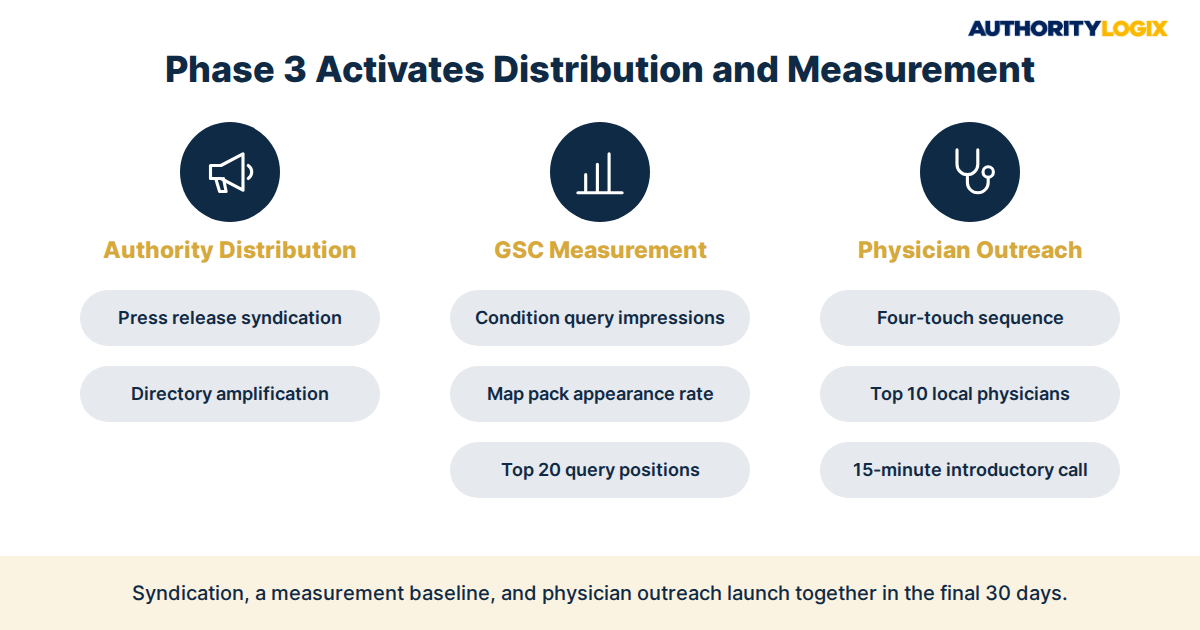
- Days 61 through 90 are distribution and measurement: activating authority distribution through press release syndication and directory amplification, establishing the Google Search Console baseline for all condition queries, and launching the physician outreach sequence that connects clinical expertise to referral relationships.
- CMI’s 2026 research shows 74% of marketers whose content results improved credit strategy refinement — not new tools or budget increases. The 90-day plan is the documented strategy that makes every subsequent investment more effective because each phase builds on what the previous phase established.
- The three phases of the 90-day plan are not waterfall — each phase overlaps with the next — but the sequencing of priorities within each phase is deliberate: local visibility before content rankings, content foundation before distribution, and measurement before scaling.
Table of Contents
A 90 day physical therapy authority growth plan is the answer to the most common question PT practice owners ask when they decide to stop relying on physician referrals and start building patient acquisition systems: what do I build first? The instinct is to do everything at once — optimize the GBP, start a blog, get more reviews, build condition pages, reach out to physicians, post on social media, and set up email campaigns. The result of doing everything at once is doing nothing well. The 90-day plan sequences the investments that produce the most patient acquisition value in the first 90 days, in the order that makes each subsequent investment more effective.
This article covers the three phases of the 90-day physical therapy authority growth plan — the specific actions, the sequencing logic, and the measurement framework that tells a practice whether each phase is producing the leading indicators of sustainable patient acquisition. The authority growth article covers the five-pillar authority system this plan executes against; this article covers the specific 90-day build sequence that gets those pillars operational as quickly as the investment will support.
Why Sequencing Matters in the 90 Day Physical Therapy Authority Growth Plan
GBP signals account for 32% of local pack ranking weight in Whitespark’s Local Search Ranking Factors expert survey — the single largest factor in local pack placement. A practice that spends the first 30 days building condition pages and physician outreach before completing GBP optimization is investing in activities that cannot achieve full impact because the local search foundation is not yet in place. The sequence that produces the fastest patient acquisition results starts with the highest-leverage, fastest-returning investments and progresses to the investments that compound over longer time horizons.
Practices with fully optimized GBP profiles receive more requests than those with incomplete profiles. That multiplier is available within 30 to 60 days of completing GBP optimization — which means the fastest patient acquisition win available to most PT practices is not a new marketing channel but the completion of what is already the practice’s most powerful local visibility asset. The local authority article covers all four dimensions of local authority positioning — this plan focuses specifically on the sequence that builds those dimensions in the 90-day window.
The content side of the 90-day plan follows a different timeline. SEO-driven content typically takes 3 to 6 months to begin ranking — but CMI’s 2026 research shows that 74% of marketers whose content results improved credit strategy refinement — not new tools or budget. This means starting content early in the 90 days, even though rankings will not appear within the 90-day window, is the right sequencing decision. The content published in days 31 through 60 produces organic patient inquiries in months 4 through 6. Waiting until month 4 to start publishing delays those results by 90 days. The acquisition playbook covers how the full patient acquisition pipeline connects to these authority-building investments.

Explore the AuthorityLogix PT Practice Authority & Growth Blueprint.
Phase 1: Days 1–30 — Infrastructure
The first 30 days of the 90-day physical therapy authority growth plan are infrastructure days. Nothing in this phase produces patient inquiries immediately — but everything in this phase is the prerequisite for every patient acquisition channel that follows. A practice that skips infrastructure and moves straight to content or physician outreach will find that both investments underperform because the foundation they depend on is absent.
90 Day Physical Therapy Authority Growth Plan Step: GBP Optimization to Full Completion
GBP optimization is the first priority because it is the highest-leverage, fastest-returning local visibility investment available. The specific actions: set the primary category to ‘Physical Therapist’ (not a generic health category); build out every service entry with patient-language service names and descriptions that include the condition category and the practice’s city; and upload 10 to 15 photos including exterior, interior, treatment areas, and clinician headshots.
Beyond that, complete all attributes relevant to the practice (accepts new patients, offers direct access, parking, accessibility), set hours accurately including any extended hours, and activate the weekly GBP post cadence — two posts per week answering patient questions about conditions the practice treats. The local search system governs GBP management, citation consistency, and location page architecture as a coordinated local authority system.
NAP Consistency Audit
Name, address, and phone number inconsistencies across healthcare directories suppress local search authority by creating entity fragmentation — Google stops trusting the practice’s location data when it sees contradictory information across platforms. The Phase 1 NAP audit covers: Healthgrades, Zocdoc, Yelp, WebMD, Vitals, the APTA member directory, and any insurance plan directories where the practice is listed. Every listing must match the practice’s canonical NAP exactly — same suite number format, same phone number, same practice name spelling. The visibility guide covers the full citation consistency framework, including the data aggregators that feed secondary directories automatically when the primary listings are corrected.
Clinician Bio Pages
Clinician bio pages are authority assets, not staff directory entries. Each bio page published in Phase 1 targets the clinician’s specialty plus the practice’s city — ‘sports physical therapist [city],’ ‘pelvic floor PT [neighborhood]’ — and lists specific certifications (OCS, SCS, CSCS, PRPC, COMT), names the conditions the PT treats most effectively, and links to any condition pages that already exist. Bio pages published in Phase 1 begin indexing immediately and contribute E-E-A-T signals that reinforce the condition page rankings built in Phase 2. The educational hub organizes clinician expertise, condition pages, and patient education content into a navigable knowledge library that compounds authority across the full site.
Review Request Workflow
The post-discharge review request workflow is a Phase 1 infrastructure action because it activates a process that compounds over time — every week of delay is a week of reviews not generated. The workflow: a text message sent at the final session directing patients to the practice’s Google review link, a follow-up email at day 7 for patients who did not respond, and a front desk verbal reminder for patients completing their final in-person session. This workflow produces two to four new reviews per month at minimum from a practice seeing 20 or more discharges per month — and review velocity is one of the three most weighted signals in Google’s local ranking algorithm post-March 2026 core update.

Phase 2: Days 31–60 — Content Foundation
Phase 2 of the 90-day physical therapy authority growth plan builds the content foundation that earns organic patient acquisition over months 3 through 6 and beyond. The GBP work from Phase 1 is now producing early map pack improvements — meaning patients who find the practice through local search are now landing on a site that needs condition-specific content to convert their interest into a booked evaluation. Phase 2 addresses that conversion gap while simultaneously building the topical authority signals that produce organic condition rankings. The content playbook covers the full content SEO strategy — Phase 2 executes the highest-priority elements of that strategy in the first 30 days of content production.
Condition Pages — Top Three Conditions
The first three condition pages target the conditions that represent the majority of the practice’s current patient caseload — the conditions where clinical depth is deepest and where the practice’s geographic market has the highest patient search volume. Each condition page covers the specific condition in patient language (what it is, what causes it, how PT addresses it, what treatment involves, what recovery looks like), and targets a specific condition-plus-location keyword such as ‘physical therapy for rotator cuff [city]’ or ‘sciatica PT near [neighborhood].’
Each page also carries the named clinician who treats that condition most frequently, and links back to the relevant service page pillar. The content systems built for PT practices include the content architecture standards that organize condition pages into the pillar-cluster structure that compounds topical authority over time.
Direct Access FAQ Page
A direct access FAQ page targeting the practice’s state is a Phase 2 priority because it captures a high-intent patient population that most practices are systematically missing: patients who want PT but have delayed seeking care because they assumed a physician referral was required. The page answers questions like ‘Do I need a referral for physical therapy in [state]?,’ ‘How do I schedule PT without seeing my doctor first?,’ ‘Does insurance cover direct access PT?,’ and ‘What should I bring to a direct access PT evaluation?’
Each question gets an H3 header and a direct-answer-first paragraph — the structure that earns AI Overview citations. The authority guide covers the full patient education content standards, including the attribution and question-format structures that make direct access content eligible for AI search summarization.
Patient Education Articles
The first two patient education articles in Phase 2 target the top patient questions for the practice’s specialty — the questions the front desk answers repeatedly that patients are also typing into search engines. Each article follows the question-format H3 structure, is attributed to a named clinician, and links to the relevant condition pages published earlier in Phase 2. Patient education articles indexed in Phase 2 begin competing for informational queries in months 3 through 5 — the same period when the direct access FAQ page and condition pages are producing their first organic inquiries from provider-selection searches.
Not sure which content gaps are costing your practice the most patient inquiries?
Phase 3: Days 61–90 — Distribution and Measurement
Phase 3 of the 90-day physical therapy authority growth plan activates the channels that amplify the infrastructure and content built in phases 1 and 2. At day 61, the practice has: a fully optimized GBP producing early map pack improvements, three condition pages indexed and beginning to compete for local search queries, a direct access FAQ page targeting high-intent patients who bypassed PT due to referral confusion, two patient education articles indexed and building topical authority, and a review workflow generating new reviews weekly.
Phase 3 takes everything built and starts distributing it beyond the practice’s own website. The distribution system covers the full authority distribution framework — Phase 3 activates the highest-priority distribution channels for a practice in its first 90 days.
Authority Distribution Activation
Authority distribution in Phase 3 focuses on two channels: press release syndication and directory amplification. A practice that has published three new condition pages, a direct access FAQ, and two patient education articles has content worth syndicating — these are specific, patient-relevant topics that local healthcare journalists and medical directory editors find genuinely useful.
A press release covering the practice’s direct access PT capability, distributed through a syndication service that reaches local health publications and news aggregators, builds the external citation footprint that AI search systems use to confirm the practice’s entity authority. Directory amplification in Phase 3 involves claiming and completing profiles on healthcare-specific directories — Healthgrades, APTA’s Find a PT, and specialty directories relevant to the practice’s conditions. The PT industry hub demonstrates how the five-system framework operates as a coordinated system when authority distribution amplifies content and local search investments simultaneously.
Google Search Console Baseline
The GSC baseline established in Phase 3 is the measurement foundation for all subsequent authority-building investments. At day 61, the practice sets the baseline for: total impressions and clicks for all condition queries, map pack appearance rate for the practice’s primary city and neighborhood searches, average position for the top 20 queries driving impressions, and click-through rate for condition-plus-location queries. This baseline is the measuring stick against which months 4 through 12 are evaluated.
Practices that skip the Phase 3 baseline have no way to attribute subsequent ranking improvements to specific Phase 1, 2, or 3 investments — which makes optimization decisions in months 4 through 6 guesswork rather than data-driven. The lead generation system connects GSC measurement to the conversion infrastructure — tracking which content types and keyword categories are producing the patient inquiries that book evaluations.
Physician Outreach Sequence
Physician outreach in Phase 3 is a four-touch sequence, not a single visit. The sequence: an introduction email to the top 10 local physicians most likely to refer the practice’s specialty conditions, with a one-page clinical summary of the practice’s approach to the top condition in that physician’s specialty; a LinkedIn connection request with a brief message referencing the email; a second email at week 3 of Phase 3 with one specific clinical insight relevant to that physician’s patient population; and a direct request at week 4 for a 15-minute introductory call.
This sequence is content-first rather than sales-first — every touchpoint delivers clinical value before asking for anything. Physicians refer to practices they perceive as clinical peers, and clinical-peer perception is built through demonstrated expertise, not through showing up at the front desk with brochures.
The 90 Day Physical Therapy Authority Growth Plan: What to Expect After Day 90
At day 90, a practice that has executed all three phases has a fully optimized GBP producing map pack appearances for neighborhood searches, three condition pages indexed and beginning to compete for local provider-selection queries, a direct access FAQ page earning impressions for referral-free PT searches, a review workflow generating two to four new reviews per month, active directory profiles across all major healthcare directories, an established GSC baseline for tracking condition query progress, and a physician outreach sequence in mid-execution. That foundation is what the next 90 days build on, not a finish line in itself.
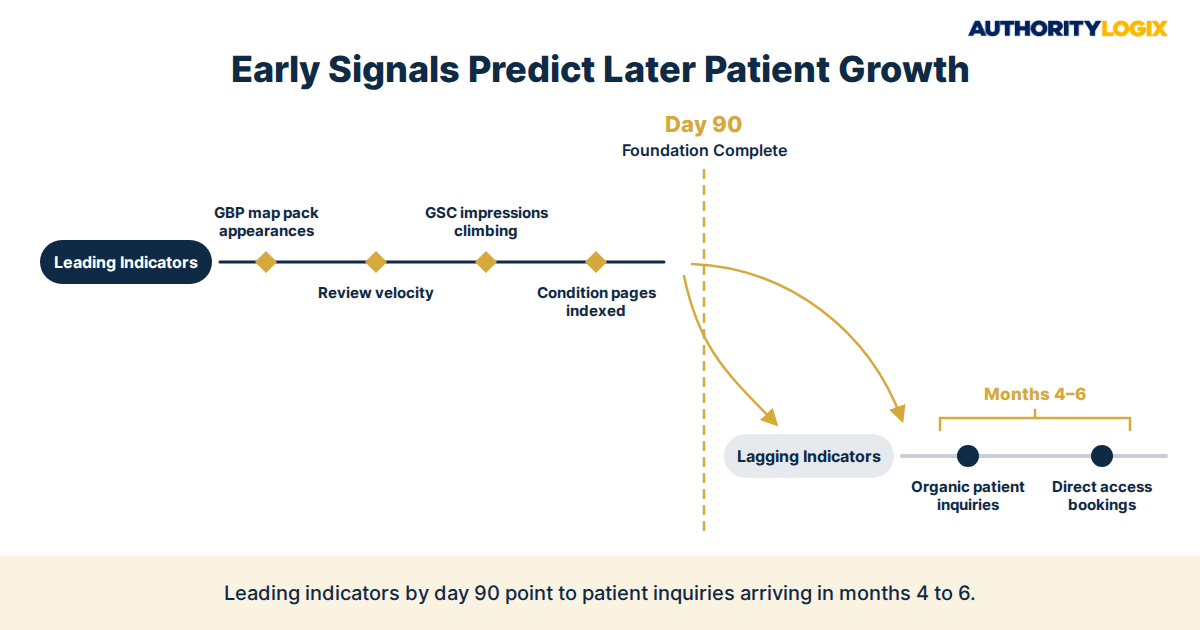
The leading indicators — GSC impressions for condition queries, GBP profile views, monthly new review count — are measurable and improving. The lagging indicators — patient inquiries attributed to organic search, direct access patient bookings — typically begin appearing in months 4 through 6 as the Phase 2 content indexes and begins ranking.
Companies with active blogs generate 67% more leads monthly than those without, per 2026 content marketing research — but that multiplier reflects the compounding effect of a content program that has been running for 6 to 12 months, not the first 90 days. The 90-day plan is the foundation that makes month 6 and month 12 results possible. Practices that try to shortcut the foundation — skipping GBP completion, skipping clinician bios, skipping the review workflow — find that their content investments underperform because the local authority signals that amplify content rankings are absent. The content playbook — already referenced above — covers the content publication cadence that sustains the Phase 2 foundation through months 4 through 12.
Frequently Asked Questions
Can a solo practice execute this plan without a marketing team?
Yes — the 90-day plan is designed for resource-constrained independent practices, not enterprise marketing organizations. Phase 1 GBP optimization and NAP audit are one-time tasks completable in 8 to 12 hours. Clinician bio pages take 2 to 3 hours each. The review workflow is a template created once and activated permanently. Phase 2 condition pages take 4 to 6 hours each at the depth required for genuine E-E-A-T signals.
Phase 3 distribution and physician outreach are templates and sequences that scale without proportional time increases. A solo practice owner who allocates 4 to 6 hours per week to the plan completes all three phases within 90 days. The authority growth article covers the broader authority system that sustains Phase 3 momentum through months 4 and beyond.
What if the practice already has some of these elements?
Audit what exists before starting. A practice with an active GBP profile should audit it against the Phase 1 checklist — many active profiles have incomplete service listings, outdated photos, or missing attributes that are suppressing local rankings. A practice with existing condition pages should audit them for clinician attribution, local keyword targeting, and pillar-cluster links before publishing new ones. The 90-day plan is a sequence, not a checklist of entirely new content — existing investments that need optimization count as Phase 1 or Phase 2 completions when they meet the standards outlined above.
How does the plan change for a multi-location practice?
Multi-location practices run the plan once per location, prioritizing the lowest-performing location first. Each location needs its own GBP profile, its own location page, its own clinician bio pages, and its own condition pages targeting the neighborhood and city the location serves. The physician outreach sequence is location-specific — the physicians most likely to refer to each clinic are the ones in proximity to that location, not the practice’s best referral relationships from a different geography. The visibility guide — already referenced above — covers multi-location local search strategy, including how to structure location pages and GBP profiles when the practice operates across multiple service areas.
What should be measured at the end of day 90?
Four leading indicators that confirm the 90-day plan is working: GSC impressions for condition-plus-location queries (should be climbing from a low baseline), GBP profile views and direction requests (should be increasing week-over-week), monthly new review count (should be 2 to 4 minimum from the review workflow), and number of indexed condition pages with position data in GSC (should be 3 to 5 pages appearing for relevant queries). If any of these indicators are absent or flat at day 90, audit the corresponding phase investment — flat GSC impressions after condition page publication typically indicates an indexing issue, a canonical tag error, or insufficient internal linking from the service page pillar to the new condition pages.
Ready to put the 90-day authority plan in motion, with the first systems built in the right order?