


Key Takeaways
- Physical therapy community presence self referral is the pipeline that forms when neighbors know your clinic by name before they need a physical therapist.
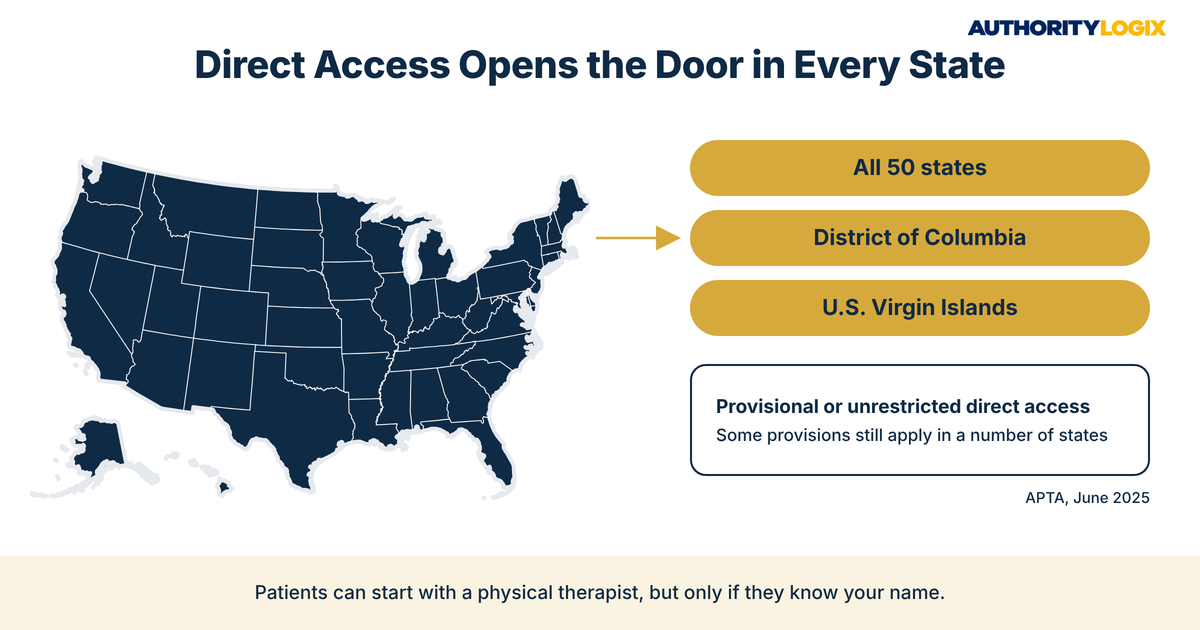
- APTA’s June 2025 report confirms that patients in all 50 states, the District of Columbia, and the U.S. Virgin Islands have provisional or unrestricted direct access to physical therapist services.
- A PT community marketing strategy works best when it starts with the groups you already serve, not a long sponsorship list.
- BrightLocal’s 2026 survey found that 97% of consumers read reviews for local businesses, so community goodwill has to be visible on Google.
- Physical therapy local community outreach only compounds when every event leaves a trace online.
- Physical therapy community presence self referral is an infrastructure build, not a calendar of events.
Table of Contents
What Physical Therapy Community Presence Self Referral Looks Like in a Real Practice
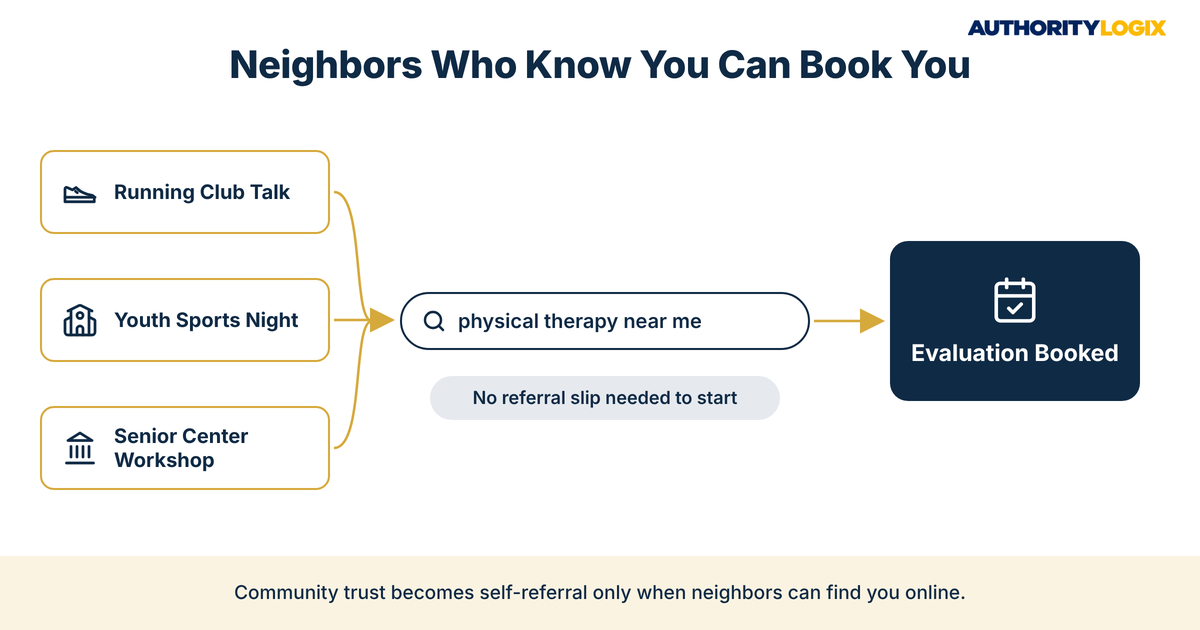
Physical therapy community presence self referral is what happens when people in your town already know your clinic by name before they ever need a physical therapist. You have treated half the high school soccer team and spoken at the senior center — and still, most new patients arrive on a physician’s script. Neighbors who could book directly do not know they can, or cannot find you. Practices that build a steady flow of direct-access patients treat community work as the front end of a system.
That gap is the credible but invisible problem in its local form. Your clinicians are trusted inside a few circles, but that reputation stops at the edge of each circle. Physical therapy community presence self referral closes the gap by making local reputation searchable, so a neighbor who heard your name once can find you, check you, and book without a referral slip.
In a working practice, physical therapy community presence self referral shows up in three measurable ways. New patients mention an event or a clinician by name at intake. Branded searches for the clinic rise after a community appearance. Reviews start to reference a talk or a group the clinic supports. If none of those signals appear, the community work is happening but is not connected to anything that books an evaluation.
Every AuthorityLogix engagement starts from the premise on the PT industry hub: for an established clinic, clinical skill is rarely the problem. The problem is that the market cannot see the expertise it would gladly pay for. Physical therapy community presence self referral is one of the clearest places to fix that, because the trust already exists and has simply never been routed anywhere useful.
The Physical Therapy Patient Acquisition Playbook maps the full direct-patient pipeline that physical therapy community presence self referral feeds, from the first community touchpoint to the booked evaluation.
Why Direct Access Makes PT Self Referral Community Work Pay Off
Community work only produces self-referred patients if those patients are allowed to start care without a prescription, and every state now allows that in some form. According to APTA’s direct access report, published June 25, 2025, patients in all 50 states, the District of Columbia, and the U.S. Virgin Islands have provisional or unrestricted direct access to physical therapist services. That single fact changes the economics of a PT self referral community effort.
The same APTA report is clear that access is not uniform, noting that some provisions tied to treatment without a referral still persist in a number of states. Those rules differ by state and change as legislatures act. Check your own state’s practice act before you write community materials, and say “you can start with a physical therapist” only in the form your state actually allows.
Most people in your community still do not know this. They assume a doctor has to send them, so they wait. Physical therapy community presence self referral works because it does two jobs at once: it tells neighbors they can come straight to you where the law allows it, and it makes your clinic the name they recognize when they decide.
That second job is where most clinics fall short. Explaining direct access at a health fair is education; making sure those people find a booking path on Google afterward is infrastructure, and building that infrastructure is what we do for practices that are already trusted locally. Without it, physical therapy community presence self referral stays a word-of-mouth effect you cannot measure.
Trust is the other half. A neighbor who heard your clinician speak still wants proof before booking: credentials, plain-language condition pages, and answers to the questions they did not ask at the event. The trust layer described in the clinical authority guide is what turns a familiar name into a booked evaluation, and it keeps a PT self referral community effort from depending on one well-known clinician. It also gives physical therapy community presence self referral a destination worth finding.
Building a PT Community Marketing Strategy Around Who You Already Serve
A PT community marketing strategy should start with your caseload, not with a stack of sponsorship requests. Look at the last year of evaluations and ask which groups you already help most: weekend runners, high school athletes, older adults, desk workers. Each group has its own gathering places and recurring questions. They are where physical therapy community presence self referral has the shortest path to a booked visit.
Choosing a few groups and showing up for them repeatedly builds local authority that a single booth at a street fair never will. A running club that hears from the same clinician every season starts to think of that clinician as its physical therapist. A banner seen once builds very little.
Matching Physical Therapy Community Presence Self Referral to Specific Groups
The table below pairs common community groups with the presence that tends to earn trust and the online trace each appearance should leave. The trace column matters most, because it connects physical therapy community presence self referral to the search results neighbors check later.
| Community Group | Where You Show Up | Online Trace It Should Leave |
|---|---|---|
| Running and walking clubs | Seasonal talks and race-day presence | An event page and a Google Business Profile post |
| School and youth athletics | Preseason education nights for parents | A youth sports page parents can find later |
| Older adults | Talks at senior centers about staying active | A plain-language education page |
| Local employers | Workplace talks on desk setup | An employer page and a booking link |
| Neighborhood associations | Meetings and newsletters | Partner links that strengthen physical therapy community presence self referral |
Narrowing to three or four groups is a choice, not a limitation. The growth blueprint treats differentiation the same way: a clinic known for something specific is easier to remember and easier to recommend than a clinic known for everything. A PT community marketing strategy built on focus gives each group a concrete reason to say your name.
Presence also travels further when someone else carries it. A local newspaper column or a youth league newsletter puts your clinicians in front of people who were never at the event. That is the job of authority distribution: taking expertise your team already has and placing it where the community already pays attention.
Not sure whether your community work shows up where neighbors search? The PT Authority Gap Assessment shows where your physical therapy community presence self referral pipeline leaks and what to build first.
Physical Therapy Local Community Outreach That Shows Up in Search and the Map Pack
Physical therapy local community outreach produces a familiar name, and search is where that name is confirmed or lost. A neighbor who met your clinician at a school sports night will usually look you up before calling. What they see in that moment decides whether physical therapy community presence self referral turns into an evaluation.
Reviews carry much of that moment. BrightLocal’s 2026 Local Consumer Review Survey of 1,002 U.S. adults found that 97% of consumers read reviews for local businesses, 74% look for reviews written in the last three months, and 47% will not use a business with fewer than 20 reviews. A clinic with a strong community reputation but a thin review profile looks less established online than in person.
The fix is to give every community appearance an online counterpart. Full profile and map pack setup is covered in the local visibility guide, but for physical therapy local community outreach the priorities are narrower: event posts on your Google Business Profile, photos from each event, and a steady review request to the people who already know you.
Event Pages and Google Business Profile Posts
Each recurring community program deserves its own page on your site. Those pages give search engines something specific to rank and give neighbors something specific to find when they search the program by name. Physical therapy community presence self referral gets stronger every time one of those pages earns a link from a partner organization.
Consistency is the quiet requirement underneath all of it. Your clinic’s name, address, and phone number should match everywhere the community finds you — partner websites, event listings, local directories — because inconsistent details weaken local search rankings without any visible warning. A community calendar listing with an old phone number is a quiet leak in physical therapy community presence self referral.

Turning Physical Therapy Community Presence Self Referral Into Evaluation Bookings
Recognition is not a booking. The distance between “I have heard of that clinic” and a scheduled evaluation is a set of small, fixable steps that most practices leave to chance. Turning physical therapy community presence self referral into evaluations means designing what happens after the event, not only the event itself.
The Follow-Up Path After Every Community Event
Every appearance should end with one clear next step for the people who were there. That might be a short guide sent after a talk or a booking link with its own landing page. Capturing those contacts and routing them to your front desk is the lead generation layer, and it separates measurable community work from hopeful community work.
A working follow-up path is not complicated. It usually includes five connected pieces:
- A landing page named for the event or the group
- A short guide or answer sheet sent within a few days of the event
- A direct booking link that explains, in plain terms, whether your state requires a referral
- An intake question asking how the patient heard about the clinic
- A review request to attendees who later become patients
The intake question is the piece most clinics skip, and it is the one that tells you which groups deserve more of your time. Feeding those answers back into your content systems keeps physical therapy community presence self referral improving instead of repeating the same calendar every year.
The same connected model runs BKDSCR.com, the AuthorityLogix proof-of-concept build in the NYC outer-borough real estate investment niche. It was built in under 18 months with 18 pillar pages, 7 interactive tools, and 48 SEO-optimized blog posts, with zero paid ads, and every piece points the visitor to a next step. The market is different; the principle is the same.

What Most PT Practices Get Wrong About Community Marketing (and What Neighbors Ask)
Most clinics that struggle with community work are not short on effort. The questions below are the ones neighbors and practice owners ask most often about physical therapy community presence self referral.
Do I need a doctor’s referral to see a physical therapist?
Patients in every state have at least some form of direct access, according to the same APTA report, although some provisions still apply in a number of states. A clinic website should answer this question plainly for your state, ideally on a page inside an educational hub that neighbors can find on their own. That page keeps answering the question long after the event ends.
Is sponsoring every local event the fastest way to get known?
Spreading a budget across every banner and booth buys a little recognition everywhere and real trust nowhere. Repeated presence with a few groups is easier to measure. A PT community marketing strategy should be judged by bookings traced back to it, not by the number of logos on a race shirt.
Why don’t people who meet us at events end up booking?
Usually because nothing connects the event to the booking. The attendee searches later and finds old reviews or a website with no mention of the program they attended. Physical therapy community presence self referral breaks at that handoff more often than anywhere else.
What should our website say about our community programs?
Each program needs a page that explains who it is for, when it runs, and what a person should do next. Structuring those pages so they rank for the searches neighbors actually run is covered in the content SEO playbook, including how program pages connect to condition and service pages. Pages that sit alone rarely rank.
Where can I see more examples of this kind of patient education content?
Practice owners who want more examples can browse the AuthorityLogix PT resource library, which collects guides on patient acquisition, local search, clinical authority, and content structure. It is a practical way to see how each piece of physical therapy local community outreach fits into a larger visibility system.
Ready to turn the trust your clinicians have built in the community into a booking path neighbors can find on Google? Let’s build the event pages, profile, and follow-up system that connect the two.
The Honest Close: Community Presence Compounds When It Is Visible Online
Community work is one of the few acquisition channels where an established physical therapy practice starts with an advantage competitors cannot buy. Years of talks and neighbors treated well are real assets. The sequence in how we build starts by making those assets visible — pages, profile, reviews — before adding any new activity on top.
Physical therapy community presence self referral compounds when it is visible online. Every event page, review, and partner mention keeps working after the event ends, and each one makes the next appearance easier to convert. Without that layer, the same effort has to be repeated every year from zero.
We build this way because we have done it ourselves in a live, competitive market, which is the short version of why AuthorityLogix works the way it does. No one can promise a specific number of new patients from community work.
The honest answer is that most established clinics already have the community trust that physical therapy community presence self referral depends on. What is missing is the infrastructure that lets neighbors find, check, and book that trust on their own. Build that, and the community work you are already doing starts paying back.