Key Takeaways
- Physical therapy case studies patient outcomes privacy rules decide which stories a practice can publish, and most of the risk sits in small details, not names alone.
- HHS de-identification guidance lists identifiers that include names, geographic detail smaller than a state, all elements of dates except year, and full-face photographs.
- With limited exceptions, HHS says the HIPAA Privacy Rule requires a patient’s written authorization before their protected health information is used for marketing.
- The HHS Office for Civil Rights has settled with a dental practice for $23,000 and a psychiatric practice for $30,000 over patient information disclosed in replies to online reviews.
- A physical therapy HIPAA compliant case study usually describes process and clinician reasoning rather than promising results.
- Physical therapy case studies patient outcomes privacy is an infrastructure problem: a written review step, authorization forms and approved formats protect patients on every page.

Why Physical Therapy Case Studies Patient Outcomes Privacy Rules Shape Every Story You Publish
Physical therapy case studies patient outcomes privacy rules are the main reason most clinics never publish the stories that would help prospective patients trust them. Every practice has patients whose progress would make a compelling story. Owners know those stories show the clinic’s expertise, and they also know one careless detail can expose a patient. So the stories stay in the treatment room, and the website stays generic.
That silence has a cost. Prospective patients comparing clinics want evidence that a practice understands problems like theirs, and the
acquisition playbook treats that evidence as a core part of turning searchers into evaluation bookings. The answer is not to publish carelessly. It is to build physical therapy case studies patient outcomes privacy safeguards into the content process itself.
Patients weigh more than credentials. The 2025 Edelman Trust Barometer special report on
Trust and Health, based on more than 16,000 respondents in 16 countries surveyed in March 2025, found that “formal academic training is the most important credential when considering someone as a legitimate health expert,” yet nearly two thirds say that “personal experience with health issues and helpful prior advice qualify your expertise.” A record of helping people before is that kind of evidence, which is why physical therapy case studies patient outcomes privacy decisions matter so much.
Credible but invisible describes most clinics here: the expertise is real, the proof exists, and none of it reaches the website. Within the AuthorityLogix
PT industry hub, case content sits inside the same systems as condition pages and clinician bios, so it is planned, reviewed and published on purpose rather than improvised.
This article treats HIPAA in plain language for marketing purposes only. It is not legal advice, and any physical therapy case studies patient outcomes privacy policy should be confirmed with the practice’s privacy officer or healthcare attorney. That boundary is part of
our approach: we build the publishing infrastructure, and your compliance advisors set the rules it follows.
The Physical Therapy Patient Education & Clinical Authority Guide shows where physical therapy case studies patient outcomes privacy safeguards fit alongside condition pages, clinician content and patient FAQs.
Clinical Authority Guide →
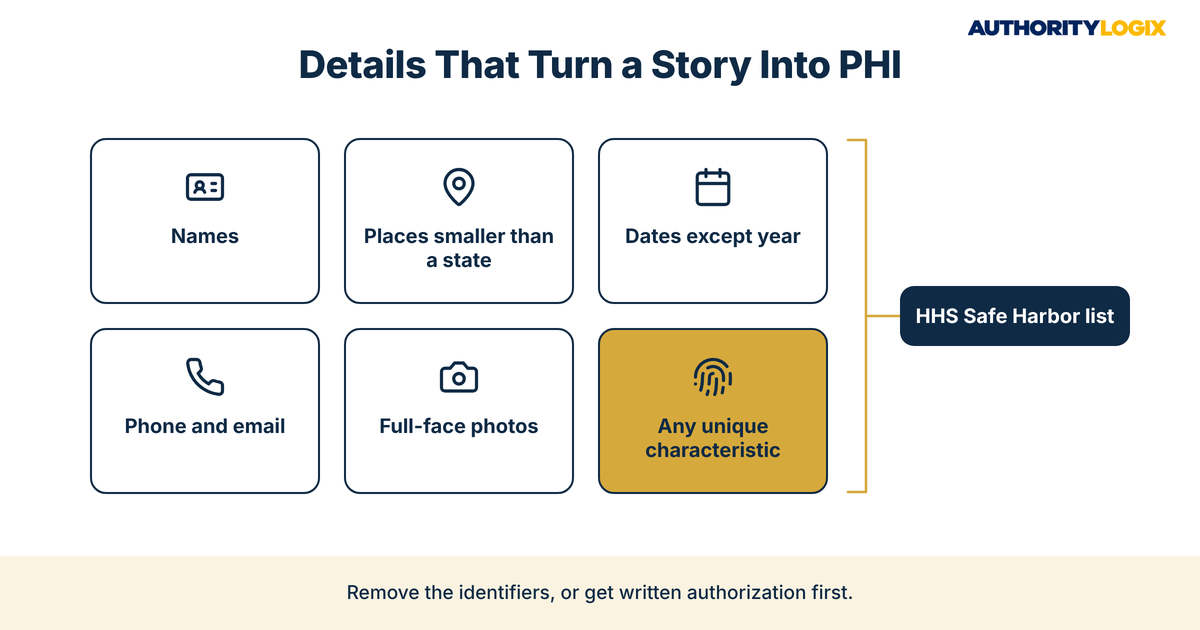
For physical therapy case studies patient outcomes privacy, protected health information is broader than most marketers assume. HHS de-identification guidance describes two ways to de-identify health information, Expert Determination and Safe Harbor. The Safe Harbor list of identifiers includes names, all geographic subdivisions smaller than a state, all elements of dates except year, telephone numbers, email addresses, and “full-face photographs and any comparable images.”
The list ends with a catch-all that matters most for storytelling: “any other unique identifying number, characteristic, or code.” The guidance also requires that the practice have no actual knowledge that the remaining information could identify the person. In a small community, a job title, a team, a surgery date and a neighborhood together can point to one person as clearly as a name, and physical therapy case studies patient outcomes privacy reviews have to catch that.
The Physical Therapy Case Studies Patient Outcomes Privacy Test for Hidden Identifiers
Before any story goes live, a reviewer should read it the way a neighbor, coworker or teammate would. These are the details that most often slip through:
- Exact dates of an injury, surgery or discharge, even without a name
- An employer, school, team or job title
- A neighborhood, town or landmark smaller than a state
- Photos or video that show a face, a tattoo or a distinctive setting
- A rare condition or unusual circumstance only one local patient shares
- Quotes copied from a review that already carries the patient’s name
The same story can sit on either side of the line depending on how it is told. The difference between
education versus marketing content matters here, because a teaching example about a condition rarely needs a real person, while a promotional story almost always does. Deciding which job a page is doing comes before deciding what details it can hold.
That planning step is easier when every page belongs to a structured archive. The AuthorityLogix PT
resource library is organized by the job each article does, which is the same discipline a practice needs to keep patient education and patient stories apart.
Building PT Patient Outcome Case Study Content Around the Process, Not Promises
PT patient outcome case study content works best when the story is about what the clinic did, not about a result the reader is meant to expect. A process story explains how the evaluation was structured, which clinician led it, how the plan was explained and how progress was tracked. It shows expertise without suggesting the next patient will get the same result.
This is also the safer story to tell. Process detail rarely needs identifiers, and it is the part of the story a clinic controls. Producing it repeatedly takes
content systems with a set template, a short clinician interview and a privacy review step, so every story meets physical therapy case studies patient outcomes privacy safeguards by default.
Language That Describes Progress Without Promising It
Outcome language is where most case stories cross from education into a promise. A headline like “pain-free in six weeks” reads as a guarantee to the next reader, even when it was true for one person. Plainer framing works better: what the patient wanted to return to, what the plan focused on, and a clear note that individual results vary.
Process stories also earn search visibility that testimonials rarely do. A page explaining how a clinic approaches a type of case can rank for the questions patients search before they book, which is the model the
content SEO playbook builds around. The case story becomes a lasting educational asset instead of a one-off post.
Not sure whether your current patient stories meet physical therapy case studies patient outcomes privacy standards? The PT Authority Gap Assessment shows where your content is exposed and what to build first.
Authority Gap Assessment →
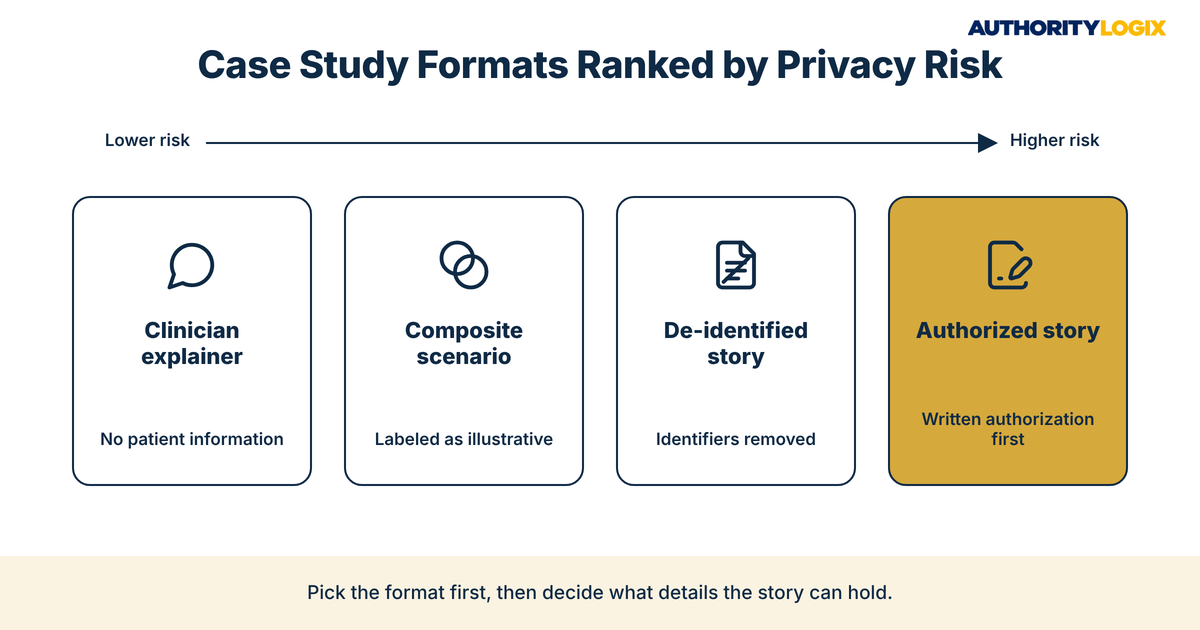
There is no single physical therapy HIPAA compliant case study template, but a few formats keep patient information out of the story by design. Each trades some specificity for safety, and each should still pass the practice’s privacy review before it is published.
| Case Study Format |
What It Shows |
Privacy Approach |
| Composite scenario |
A typical patient journey built from common patterns |
No real patient; clearly labeled as illustrative |
| De-identified process story |
How the clinic structured care for a type of case |
Identifiers removed and checked against the Safe Harbor list |
| Authorized patient story |
A real patient’s own words, photo or video |
Written authorization signed before publication |
| Clinician explainer |
A therapist describing how they approach a condition |
No patient information at all |
| Program overview |
What a program includes and how sessions are structured |
No patient information; meets physical therapy case studies patient outcomes privacy rules by design |
HHS guidance on marketing says that, with limited exceptions, the HIPAA Privacy Rule requires an individual’s written authorization before their protected health information is used or disclosed for marketing. HHS describes marketing as a communication about a product or service that encourages recipients to purchase or use it, and a patient story on a clinic website is built to do exactly that. The authorized story is the only format above that uses a real patient’s identity.
Applying Physical Therapy Case Studies Patient Outcomes Privacy Rules to Photos and Video
Photos and video carry the highest physical therapy case studies patient outcomes privacy risk because a face is an identifier by itself. A sensible authorization process names where the story will appear, such as the website, social posts or ads, and keeps the signed form with the published asset. If a patient later asks for a story to come down, the practice needs a way to find every copy.
Formats only protect patients when they are used consistently across the whole site. An
educational hub built with approved story formats, a review log and clear labels for composite scenarios keeps physical therapy case studies patient outcomes privacy decisions consistent from one page to the next.
The review step belongs before publishing, not after a complaint. In
how we build content for practices, each story passes clinician review for accuracy and the practice’s own privacy review for identifiers before it is scheduled. That sequence keeps the clinician’s expertise in the story and the patient’s identity out of it.
PT Case Story Marketing Compliance Across Condition Pages, Reviews and Social Posts
PT case story marketing compliance does not stop at the case study page. The same patient information can leak through a condition page example, a social caption or a reply to a review, and each channel needs the same physical therapy case studies patient outcomes privacy standard.
Review replies are where practices have landed in real trouble. The HHS Office for Civil Rights announced a $23,000 settlement in 2022 with a dental practice that disclosed patient names, treatment and insurance information in response to online reviews. None of that makes reviews less important, and the article on
patient reviews covers why they shape search visibility. It means every reply has to be written without revealing anything about a patient’s care.
In 2023, OCR announced a $30,000 settlement with a New Jersey psychiatric practice over patient information disclosed in replies to online reviews. OCR Director Melanie Fontes Rainer put it plainly: “Simply put, this is not allowed.” A safe reply thanks the reviewer, invites a private conversation and stops there, without confirming treatment or correcting the patient’s account in public.
The Google Business Profile adds its own exposure points: owner replies, uploaded photos and posts. The
local visibility guide covers how those features build map rankings, and each needs a physical therapy case studies patient outcomes privacy check before anything patient-related appears. A treatment-room photo with a recognizable patient in the background can disclose patient information even when no one is named.
Social posts follow the same rule. A celebratory post with a patient photo needs the same written authorization as a website story, which is why AuthorityLogix
local search work treats profile posts and social updates as part of one connected visibility system. One standard, applied everywhere, is easier to follow than five.

What Most PT Practices Get Wrong About Case Studies (Read It as the Patient Would)
Most physical therapy case studies patient outcomes privacy mistakes are not careless. They come from reading the story as the clinic wrote it, instead of as the patient, or the patient’s coworker, would read it.
If we leave out the patient’s name, is the story safe to publish?
Not necessarily. Dates, places, jobs and photos can identify a person without a name, and HHS de-identification guidance lists many of those details alongside names. Removing the name is the first step of a physical therapy case studies patient outcomes privacy review, not the last.
A patient posted a glowing review. Can we feature it on our website?
A public review is the patient’s own words in a place the patient chose, and copying it into clinic marketing is a different use. The safer course is to ask for written permission before featuring it anywhere else, and to confirm that approach with your privacy advisor.
Will a strong case study guarantee more evaluation bookings?
No content can promise that, and outcome-style claims are exactly what to avoid. A privacy-safe case story answers the question a hesitant patient is already asking, and the
lead generation path beside it, a short booking form or a clear phone number, gives that patient an easy next step. Results depend on the whole system, not one page.
As a patient, how would I know a clinic protects my story?
Look for clear labels on composite or illustrative stories, a note that featured patients gave written permission, and review replies that never discuss anyone’s care. Those small signals tell a prospective patient how the practice will treat their information too. Clinics that get physical therapy case studies patient outcomes privacy right tend to show it in exactly those details.
Ready to publish patient stories that show your clinic’s expertise without exposing a single patient? Let’s build the case study formats, review steps and authorization workflow your practice needs.
Work With Us →
Physical Therapy Case Studies Patient Outcomes Privacy: The Honest Line Between Proof and Exposure
The honest line is simpler than it looks. Proof is the clinic’s process, reasoning and expertise; exposure is anything that points to a specific patient without their written permission. Practices that hold that line can publish steadily for years, which is the long-term position the
growth blueprint describes.
Stories that pass a physical therapy case studies patient outcomes privacy review also travel further. A process story with no patient identifiers can be adapted for a local publication, a physician newsletter or a community talk through
authority distribution, without a new privacy question each time. That reach is what turns a single case story into a lasting authority asset.
For most practices, the stories already exist and the clinicians already know how to tell them. Building the formats, review steps and publishing system around physical therapy case studies patient outcomes privacy safeguards is
what we do for physical therapy practices, while your privacy advisors set the rules the system follows.
The honest answer is that physical therapy case studies patient outcomes privacy is rarely the real reason clinics stay invisible; missing infrastructure is. Clinics that build a review step, a set of approved formats and an authorization process once can show their expertise on every page. The patients stay protected, and the market finally sees what the practice has been doing all along.


