Key Takeaways
- Patient education vs marketing content physical therapy websites publish are two different jobs, and blurring them into one undifferentiated page weakens both.
- Education earns trust before a patient is ready to act; marketing content gives an already-convinced reader a clear next step — neither substitutes for the other.
- Research on top-performing content programs consistently finds that audience-first, educational content outperforms promotional messaging at building the trust that eventually converts.
- A workable content mix skews heavily toward education, with promotional content concentrated in a small number of clearly labeled pages.
- Editorial planning that accounts for both content types up front prevents a practice’s calendar from drifting entirely toward one or the other.
- The two types work best combined on the same page — an educational page with one clear, honest call to action, not two separate campaigns.

Patient education vs marketing content physical therapy practices publish often blur together on the same website, and that blur costs them patients who came looking for one and got the other. A visitor researching a condition wants information, not a sales pitch. A visitor ready to book wants a clear path to schedule, not another paragraph of general education. A website that cannot tell the two apart ends up serving both visitors poorly.
This is not an argument for choosing one type of content over the other. Both jobs matter, and a practice that only publishes one — all education with no path to action, or all promotion with nothing to earn trust first — leaves real patient volume on the table. The fix is knowing which job a given page is doing, and building it well for that specific job instead of trying to make every page do everything at once. Getting patient education vs marketing content physical therapy content right, page by page, is what separates a website that converts from one that simply exists.
Why Patient Education vs Marketing Content Physical Therapy Confusion Costs Practices
A condition page that opens with a call to book an evaluation before explaining anything about the condition itself reads as a sales page pretending to be educational. A treatment page written entirely as a persuasive pitch, with no honest description of what actually happens during a session, reads the same way. This is the core failure mode behind most patient education vs marketing content physical therapy confusion — patients notice the mismatch quickly, and the reaction is rarely generous. It reads as a practice more interested in booking a visit than in actually helping.
The
educational hub system exists precisely because this confusion is common and costly. A practice that separates its content by job — pages that teach, pages that convert, and pages that do a deliberate combination of both — consistently performs better on patient education vs marketing content physical therapy metrics than one where every page tries to do all three at once and does none of them particularly well.
The
patient education authority framework treats this distinction as foundational to trust. A visitor who feels like they are being sold to before they have even finished understanding their own condition tends to discount everything else on the page, including information that happens to be accurate and genuinely useful. Getting patient education vs marketing content physical therapy sequencing right — education before promotion, every time — is what prevents that discount from happening in the first place.
The Physical Therapy Patient Education & Clinical Authority Guide covers the full framework this balance is built on.
Clinical Authority Guide →
What Patient Education and Marketing Content Actually Mean on a PT Website
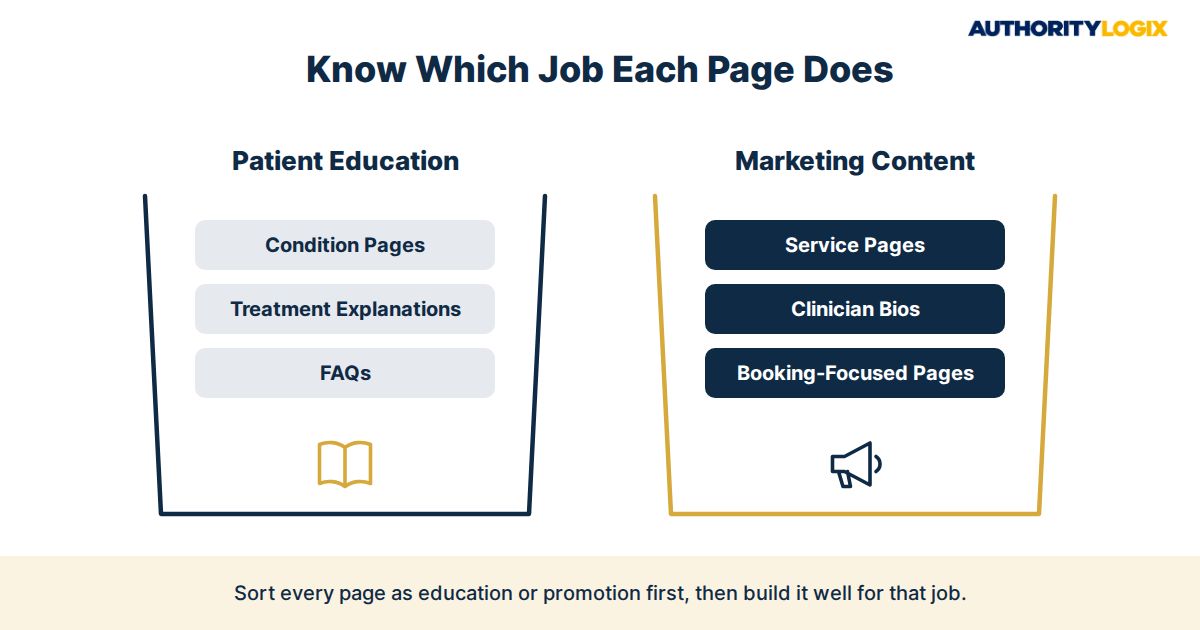
Patient education vs marketing content physical therapy practices need is not a distinction of quality — both can be well written and accurate. It is a distinction of job. Education content exists to help a reader understand something. Marketing content exists to move a reader toward a decision. A page can lean heavily toward one job while still doing a small amount of the other, but it should always be clear which job comes first — that clarity is the entire point of thinking about patient education vs marketing content physical therapy pages as separate categories in the first place.
What Counts as Patient Education vs Marketing Content Physical Therapy Pages Publish
Condition pages, general treatment explanations, and FAQ content all fall on the education side of the line. The
education library a practice builds should be made up almost entirely of this content type — pages whose primary job is helping a reader understand their situation, with no expectation that reading the page alone should end in a booking.
The
treatment content a practice publishes belongs in this same education category, provided it genuinely explains rather than sells. A treatment page that describes what happens during a session and why is doing education work, even when the topic happens to be a service the practice offers.
What Counts as Promotional Marketing Content
Service pages built around a specific offer, a clinician’s
bio page written to build confidence in a specific person, and any page whose primary structure leads directly to a booking form all fall on the marketing side. None of this is dishonest or lesser content — a bio page and a service page are supposed to move a reader toward a decision.
Doing that job clearly, without pretending to be neutral education, is exactly what makes a practice’s
acquisition playbook work. A service page that is honest about being a service page converts better than one dressed up as an educational article, because readers can tell the difference and respond better to the version that does not pretend otherwise.
PT Content Strategy Education vs Promotion: Setting the Right Balance
PT content strategy education vs promotion decisions should start from a simple premise: most visitors are not ready to book the moment they land on a page, and content that assumes otherwise loses them. CMI’s
B2B research on what separates top-performing content programs from average ones found that roughly nine in ten of the most effective content marketers put audience needs ahead of their own company’s message, and patient education vs marketing content physical therapy websites publish are not exempt from that same dynamic.
The
content topics a practice chooses should reflect this weighting directly — most of what gets published should exist to answer a real patient question, with only a smaller, deliberate portion built specifically to convert. That weighting is a planning decision, not something that happens naturally once a practice starts publishing regularly.
The
SEO playbook reinforces this same ratio from a search perspective, since search engines consistently reward genuinely useful content over pages that exist mainly to sell. A site with a healthy education-to-promotion ratio tends to rank better across a wider range of searches than one weighted almost entirely toward its own services.
Physical Therapy Content Mix: How Much of Each Type a Practice Actually Needs
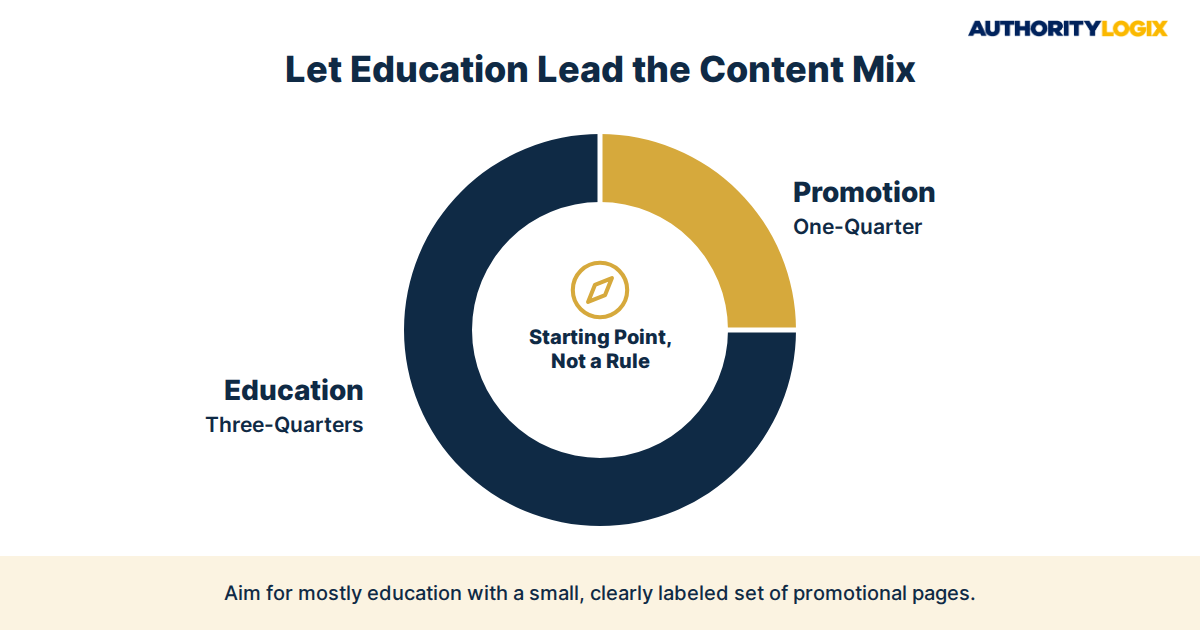
Physical therapy content mix guidance from broader content marketing research generally lands in a similar range: somewhere around three-quarters education to one-quarter promotion, adjusted for the specific audience and specialty a practice serves. That is a starting ratio for patient education vs marketing content physical therapy websites, not a rule carved in stone, but it is a useful check against the common failure mode of a website that has quietly become almost entirely promotional over time.
The
website structure a practice builds should make this ratio visible at a glance — a large, well-organized education library sitting alongside a smaller, clearly labeled set of service and booking pages, rather than the two types scattered together with no discernible pattern. A visitor should be able to tell within a few clicks which section of the site they are in and what that section is trying to do for them.
The
visibility guide covers why this mix also affects local search performance directly — a site with a thin layer of promotional pages and no real educational depth behind it struggles to rank for the specific, high-intent searches that a genuinely useful physical therapy content mix tends to capture instead. Depth in the education library is frequently what wins those searches, not additional promotional pages targeting the same terms.
PT Editorial Planning: Building Both Types Into One Calendar
PT editorial planning that does not account for both content types up front tends to drift entirely toward whichever type is easier to produce on a given week, which is almost always promotional content, since it requires less research and rarely needs a clinician’s input. A calendar built without a deliberate split just watches that drift happen and calls it a strategy after the fact — the practice ends up with a patient education vs marketing content physical therapy imbalance it never actually chose.
The
content calendar a practice maintains should assign a type to every planned piece before writing begins, not after, so the ratio is a planning decision rather than an accident of what felt easiest to produce that month. This is one of the simplest structural fixes available for a lopsided patient education vs marketing content physical therapy calendar. Building in specific education topics ahead of time also makes it far easier to hit a genuine three-to-one ratio consistently.
The
patient FAQs a practice maintains are one of the easiest education categories to plan for consistently, since the questions themselves come directly from what the front desk and clinicians already hear from patients every week. That built-in supply of topics is one of the simplest ways to keep the education side of the calendar full without inventing new subjects from scratch.
Where Education and Marketing Content Work Together on the Same Page
The cleanest version of patient education vs marketing content physical therapy pages achieve is not separation into two entirely different sections of the site — it is a single page that leads with genuine education and closes with one clear, honest next step. A condition page that thoroughly explains the condition and then offers a single, clearly labeled path to book an evaluation is doing both jobs correctly, in the right order. This combined structure is usually the fastest path to a healthier patient education vs marketing content physical therapy ratio, since it does not require maintaining two entirely separate sets of pages.
The
authority distribution layer extends this same principle beyond the website — content shared on LinkedIn or through other channels should lead with the educational value first, with any promotional element clearly secondary rather than the entire point of the post. A distributed post that is purely promotional tends to get scrolled past, while one that teaches something first earns the attention needed to reach the promotional line at the end.
The
growth blueprint treats this combined approach as the standard, not an exception — nearly every piece of content a practice builds should be able to do both jobs at once, education first, with promotion appearing only where it belongs. Treating the combination as the default, rather than a special case reserved for a handful of pages, is what keeps the ratio healthy without requiring constant manual correction.
What Most PT Practices Get Wrong About the Balance
They let every page slowly become promotional
Content that starts as genuine education often accumulates promotional edits over time — an extra call-to-action here, a service mention there — until the original educational value is buried under accumulated sales language. Reviewing older content periodically to strip out these additions is as important as writing new patient education vs marketing content physical therapy pages correctly the first time.
They treat education content as a nice-to-have instead of core infrastructure
Some practices publish promotional service pages first and treat education content as an afterthought to build “when there’s time,” which rarely arrives. The
why us page makes the opposite case directly: education content is the infrastructure that makes the promotional pages worth visiting in the first place, which means getting the patient education vs marketing content physical therapy balance right deserves to happen first, not last.
Patient Questions About Why a Practice Publishes Both Types
The
our approach page covers how a practice measures whether this balance is actually working, but most patients never think about patient education vs marketing content physical therapy distinctions consciously — they simply respond better to sites that get it right without being able to say exactly why.
Why does this page feel like a sales pitch instead of useful information?
That reaction usually means the page led with a promotional message before establishing any genuine educational value, which is the most common patient education vs marketing content physical therapy mistake and tends to feel like being sold to before being helped.
Is it a bad sign if a practice’s website has a “book now” button on an educational page?
Not at all — a clearly labeled, secondary booking option on an otherwise educational page is exactly the combination that works best for most readers.
Should a practice avoid promotional content entirely to seem more trustworthy?
No — patients ready to book need a clear path to do so, and hiding that path in the name of appearing purely educational just creates a different kind of frustration, which defeats the purpose of thinking carefully about patient education vs marketing content physical therapy balance in the first place.

Want patient education content that builds trust first and still brings in new evaluations?
Work With Us →
Building a Patient Education vs Marketing Content Physical Therapy Plan: Where to Start
Audit the existing website first: sort every page into education, promotion, or a genuine mix of both, and note which category is overrepresented. Most practices discover the imbalance runs the opposite direction from what they assumed — usually toward too much promotion and too little real education, rather than the reverse. Fixing that imbalance is usually the single most impactful change a practice can make to its patient education vs marketing content physical therapy strategy. The
what we do page outlines how to build the education side back up once that gap is visible.
The honest answer is that most practices are not missing the expertise required to write strong educational content — they are missing a system that makes education the default and treats promotion as the deliberate exception, placed only where it earns its spot. Patient education vs marketing content physical therapy websites get right when that system exists, and get wrong when every page is left to find its own balance by accident. The
PT industry hub demonstrates how the five-system framework — content, local search, patient education, lead generation, and authority distribution — keeps patient education and marketing content working together.


