


Key Takeaways
- Physical therapy specialty certifications patient choice happens online, at the moment a patient compares clinicians on bio pages, Business Profiles and condition pages.
- According to the American Board of Physical Therapy Specialties, 45,398 individuals held board certification as clinical specialists in physical therapy as of July 2026, across 10 specialty areas.
- A PT credentials content strategy places each credential on the bio, service and condition pages where it is relevant, in the same wording every time.
- Physical therapy advanced certification marketing leads with plain words and keeps the letters as support, following APTA’s order for designations.
- PT specialty training patient trust shows up in the map pack, reviews and direct-access searches, where patients choose without a referral.
- Credentials are a verified choice and trust signal, never a promise about outcomes, and physical therapy specialty certifications patient choice depends on presenting them that way.
Table of Contents
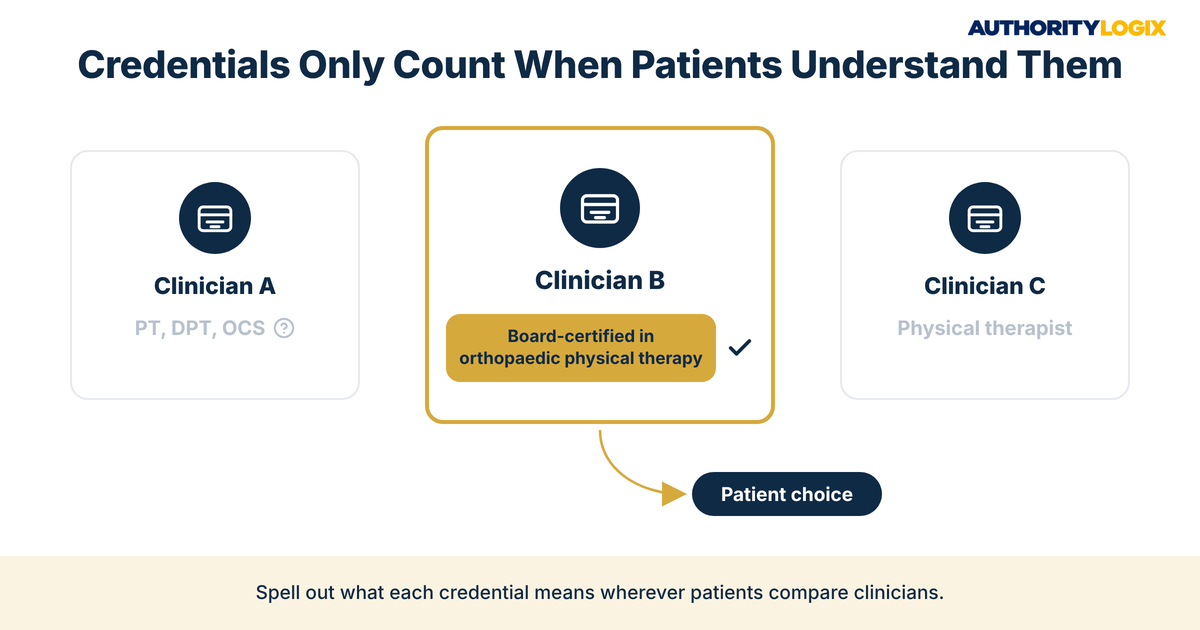
Physical therapy specialty certifications patient choice decisions now happen on a phone screen, long before a patient sits across from a clinician. A prospective patient comparing three clinics sees names, photos, star ratings and sometimes a string of letters after a therapist’s name that tells them very little. Credentials only shape a choice the patient can see and understand, which is why the acquisition playbook treats clinician credentials as part of the patient pipeline rather than a line on a résumé.
Credible but invisible describes many credentialed clinicians. A residency, a fellowship or a board certification can sit behind a three-letter abbreviation that the website never explains. This article covers how to feature those credentials as a trust signal without overstating what they mean.
How Physical Therapy Specialty Certifications Patient Choice Decisions Happen Online
A patient usually starts with a problem and a place — a knee, a back, a running injury, a clinic nearby — and then compares the clinicians who appear. Physical therapy specialty certifications patient choice comes into play at that comparison stage, when the patient is deciding which of several similar-looking practices to call. The credential has to be visible at that exact moment to matter.
That comparison happens on bio pages, Google Business Profiles, condition pages and review snippets, which is why the PT industry hub treats credentials as visibility infrastructure. If a clinician’s specialty training appears only on a framed certificate in the lobby, it plays no part in physical therapy specialty certifications patient choice. The patient never sees it when it counts.
The practical goal is simple. Every credential a clinician has earned should be visible, explained in plain words and connected to the conditions it relates to, everywhere a patient might compare options. Physical therapy specialty certifications patient choice is shaped by what the patient can verify, not by what the clinician knows privately.
Physical therapy specialty certifications patient choice also depends on context. A board certification in sports physical therapy may mean little to a family looking for help for an aging parent, and a great deal to the family of a high school runner. Matching each credential to the conditions and patients it relates to is what turns it from a résumé line into a reason to book.
The Physical Therapy Patient Education & Clinical Authority Guide shows how credentials, condition education and clinician expertise work together as trust signals — the foundation behind physical therapy specialty certifications patient choice.
Which Credentials Patients Recognize: Board Certification, Residencies and Fellowships
Board certification is the most formal of the specialty credentials. According to the American Board of Physical Therapy Specialties, as of July 2026, 45,398 individuals have achieved board certification as clinical specialists in physical therapy, across 10 specialty areas. Specialists can show that certification with initials such as OCS, SCS or NCS after their names, under APTA’s policy on designations.
| Specialty Area | Board-Certified Specialists (ABPTS, as of July 2026) |
|---|---|
| Orthopaedics | 25,306 |
| Neurology | 5,768 |
| Geriatrics | 4,665 |
| Sports | 4,153 |
| Pediatrics | 3,219 |
| Pelvic & Women’s Health | 1,055 |
| Cardiovascular & Pulmonary | 632 |
| Clinical Electrophysiology | 281 |
| Oncology | 281 |
| Wound Management | 38 |
| All 10 areas | 45,398 |
Orthopaedics accounts for 25,306 of those specialists, more than half the total, while wound management has 38. For physical therapy specialty certifications patient choice, the counts matter less than what they signal: a board-certified clinician has met the requirements of a national specialty board, and a patient can check that fact. It is one piece of the broader clinical expertise story a practice tells, alongside experience, focus areas and how the clinician explains care.
Residencies and fellowships are the other major path. ABPTRFE, the board that accredits physical therapist residency and fellowship programs, describes a residency as a postprofessional planned learning experience in a defined area of practice, and a fellowship as one in a defined area of subspecialty practice. Few patients know these terms, so an educational hub page that explains each one in two sentences does more for physical therapy specialty certifications patient choice than a longer list of letters.

Building a PT Credentials Content Strategy Across Bio, Service and Condition Pages
A PT credentials content strategy decides where each credential appears and what it says. The common mistake is treating credentials as a single line in a bio. A board-certified sports specialist’s credential belongs on the bio page, on the sports injury service page, on condition pages for common athletic injuries and in the Business Profile description.
Mapping Physical Therapy Specialty Certifications Patient Choice to Each Page
- Bio page: the credential spelled out, what earning it involved in plain words and the conditions the clinician focuses on
- Service pages: which clinicians hold specialty training relevant to that service
- Condition pages: a short note naming the clinician whose specialty covers that condition
- Business Profile: specialty areas named in the description and in posts
- Team page: credentials shown in the same order and wording for every clinician
Physical therapy specialty certifications patient choice improves when that list is followed for every clinician, not just the most credentialed one. A team page where one clinician’s training is explained and the others show only a name creates an uneven picture. Consistency tells a patient the practice takes every clinician’s training seriously.
Each clinician’s therapist bio page is the anchor of the system, because every other mention points back to it. That page should spell out the credential, explain briefly what earning it involved and connect it to the patients the clinician typically sees. It should also avoid any suggestion that the credential guarantees a result.
Keeping those mentions consistent across dozens of pages is a maintenance job, not a writing job. Practices that manage it run credentials through content systems that update every page when a clinician earns a new certification, joins the team or leaves. Without that discipline, a PT credentials content strategy decays as pages drift out of date and show credentials that no longer match the team.
Credentials also strengthen the search structure itself. A condition page that names a board-certified clinician and links to their bio gives readers and search engines a named expert behind the topic, the same pillar-and-cluster logic laid out in the content SEO playbook. Handled this way, physical therapy specialty certifications patient choice and search visibility reinforce each other.
Not sure whether your clinicians’ credentials are visible where patients compare practices? The PT Authority Gap Assessment shows where your bio, service and condition pages are missing the trust signals behind physical therapy specialty certifications patient choice.
Physical Therapy Advanced Certification Marketing Without the Alphabet Soup
Physical therapy advanced certification marketing often fails in the signature line. A clinician listed with several stacked abbreviations looks impressive to colleagues and unreadable to patients. APTA’s policy on the appropriate use of designations, dated May 22, 2026, sets an order — PT first, then the highest earned physical therapy degree such as the DPT, with ABPTS specialist certifications as an optional later designation.
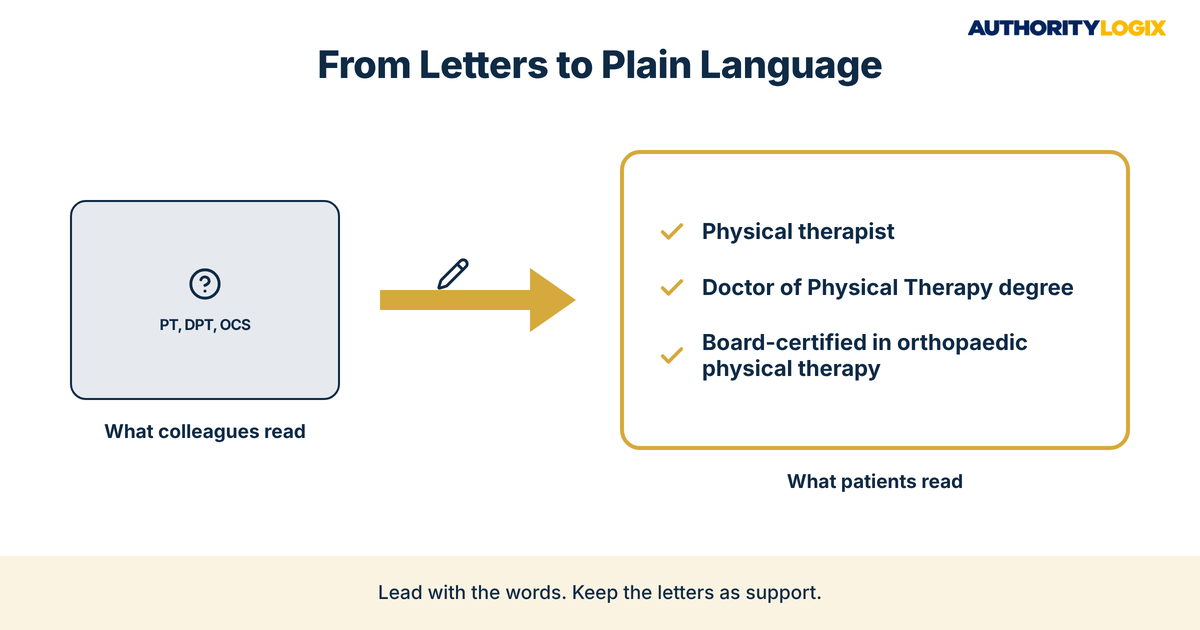
The same policy encourages specialists to spell out the credential when space allows, and that is the heart of physical therapy advanced certification marketing. OCS is professional shorthand; a phrase such as board-certified in orthopaedic physical therapy tells a patient something specific. The patient-facing version should lead with the words and keep the letters as support for physical therapy specialty certifications patient choice.
Translating Credentials Into Plain Language
| Credential Type | Patient-Facing Wording | Where It Appears |
|---|---|---|
| ABPTS specialist certification (such as OCS, SCS or NCS) | Board-certified in orthopaedic, sports or neurologic physical therapy | Bio, service and condition pages |
| Residency completion | Completed an accredited residency in the named area of practice | Bio and related service pages |
| Fellowship completion | Completed an accredited fellowship in the named subspecialty area | Bio and related condition pages |
| Doctor of Physical Therapy (DPT) | Doctor of Physical Therapy degree | Bio and team page |
| Certificates from other organizations | Described in words, not abbreviated after the name | Bio page only |
Plain-language credentials travel better outside the website too. A local news quote, a community talk listing or a podcast introduction that says a board-certified sports physical therapist is understood instantly, and placing those mentions is the work of authority distribution. Physical therapy advanced certification marketing works when the same clear description appears wherever the clinician’s name does. That consistency carries physical therapy specialty certifications patient choice beyond the practice’s own pages.
None of this requires a clinician to become a marketer. The clinician earned the credential, and the practice’s job is to describe it accurately and place it where patients look, which is what we do for independent practices that want physical therapy specialty certifications patient choice working in their favor. The work is careful rather than loud, because an overstated credential costs more trust than a modest one.
How PT Specialty Training Patient Trust Shows Up in Reviews, the Map Pack and Direct-Access Searches
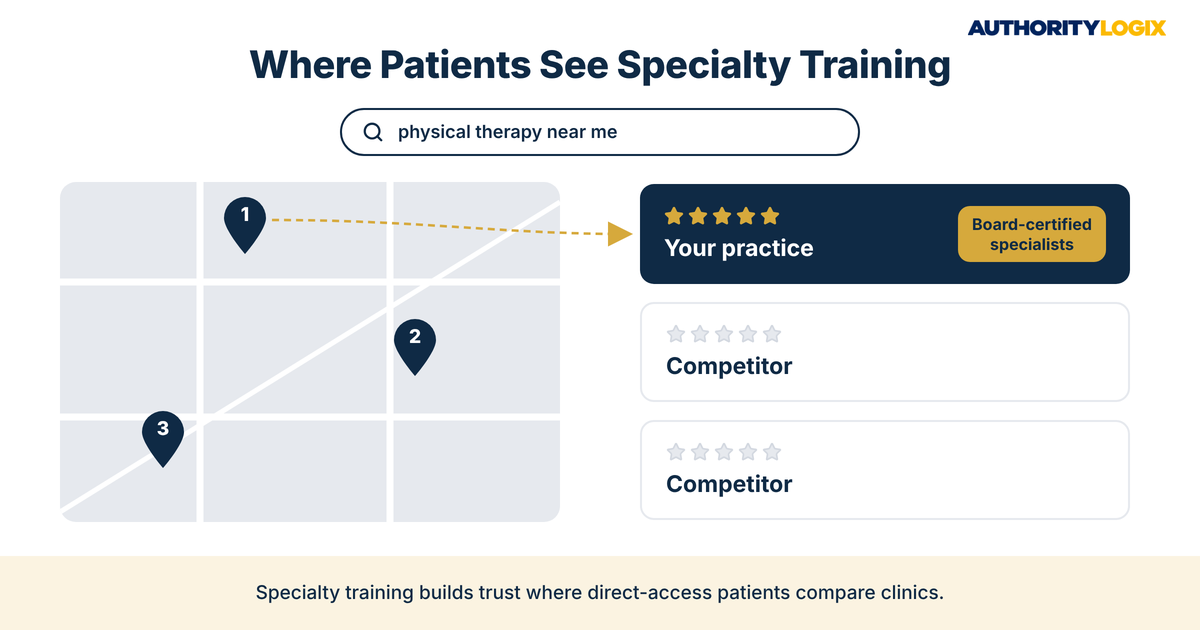
PT specialty training patient trust is built in the same places patients compare clinics: the map pack, the Business Profile and the reviews underneath it. The local visibility guide covers how those local signals rank, and credentials belong inside them. A Business Profile description that names the specialty areas your clinicians are board-certified in gives a searcher a reason to choose before they reach your website. That is physical therapy specialty certifications patient choice at its most direct.
Reviews add the patient’s voice. A patient might mention in their own words that a therapist works with many runners, and that language reinforces the credential without the practice claiming anything. Building review requests and personal responses into local search work keeps PT specialty training patient trust visible, as long as responses never confirm that the reviewer is a patient.
Direct-access searches deserve special attention. A patient who books without a physician referral, where state law allows it, is choosing entirely on what they find, so physical therapy specialty certifications patient choice likely weighs more heavily for them. The lead generation path on each specialty page — a clear booking form or phone number next to the credential explanation — turns that trust into an evaluation request.
What Most PT Practices Get Wrong About Credentials (and What Patients Actually Ask)
Credential mistakes usually come from modesty or habit, not carelessness. Clinicians are trained to list designations for colleagues, and few practices ever rewrite them for patients. These are the questions patients and owners raise about physical therapy specialty certifications patient choice.
What do the letters after a physical therapist’s name mean?
They stand for degrees and certifications, listed in an order set by APTA policy that starts with PT. A practice that explains each one on a short glossary page, and links to it from every bio, answers the question before it is asked. The resource library covers the patient education pages that make that kind of explanation easy to find.
Does a board-certified specialist guarantee a better result?
No, and a practice should never imply it does. Board certification shows that a clinician has met a national specialty board’s requirements in a specific area of practice. It is a verified signal patients can use when choosing, not a promise about any individual outcome. Honest framing is what keeps physical therapy specialty certifications patient choice credible.
Is a residency the same as board certification?
No. A residency is an accredited postprofessional program in a defined area of practice, while board certification is awarded by the American Board of Physical Therapy Specialties. Some clinicians hold both, and each deserves its own plain-language explanation. Explaining the difference clearly supports physical therapy specialty certifications patient choice.
Should we list every continuing-education course?
Usually not on the main bio. A long list of weekend courses buries the credentials patients can verify, and APTA’s designation policy does not provide for abbreviating non-APTA certifications after a name. Part of our approach is choosing the few credentials that matter most to the patients each clinician sees, then explaining those well.
Why do some practices leave credentials off the website?
Usually because no one owns the job. Clinicians assume the website handles it, and the website was built once and never updated. Physical therapy specialty certifications patient choice cannot happen if the patient never sees the credential.
Ready to turn your clinicians’ specialty certifications and advanced training into trust signals patients see when they compare practices? Let’s build the bio, service and condition pages that explain them clearly and support physical therapy specialty certifications patient choice.
Physical Therapy Specialty Certifications Patient Choice: The Honest Bottom Line
Credentials are not a marketing trick, and they should never be presented as one. They are evidence of training a clinician chose to pursue, and patients deserve to understand them. Physical therapy specialty certifications patient choice is simply what happens when that evidence is visible and explained at the moment someone is deciding.
Over time, well-presented credentials become part of how a practice is known in its market. The growth blueprint treats that recognition as a long-term practice asset, and credentials are one of the few trust signals a competitor cannot copy without doing the training. A practice with board-certified clinicians that never mentions them is giving that advantage away.
The work itself is orderly. The sequence in how we build starts with accurate bio pages and a credential glossary, then carries the same wording into service pages, condition pages and the Business Profile. Each step is small, but together they change what a patient sees and how physical therapy specialty certifications patient choice plays out in your market.
The honest answer is that most credentialed clinicians already hold training their patients would value; the gap is that patients cannot see it. You already earned the credibility. We build the infrastructure that makes the market see it.