Key Takeaways
- Physical therapy condition page SEO patient education means one page doing two jobs: ranking for the condition a patient searches and explaining it clearly enough that the patient books an evaluation.
- A 2013 Pew Research Center report found that 77% of online health seekers began at a search engine such as Google, Bing, or Yahoo.
- Google Search Central says its systems give even more weight to strong E-E-A-T on health and safety topics, and that trust is most important.
- A PT condition page writing strategy starts with the patient’s own search language and answers patient questions in the order they are asked.
- Named clinician review, visible credentials, and plain-language accuracy make physical therapy condition page SEO patient education trustworthy to patients and to search systems.
- The PT condition SEO and education balance breaks when keywords crowd out explanation, so physical therapy condition page SEO patient education is written for the patient first and checked for search second.
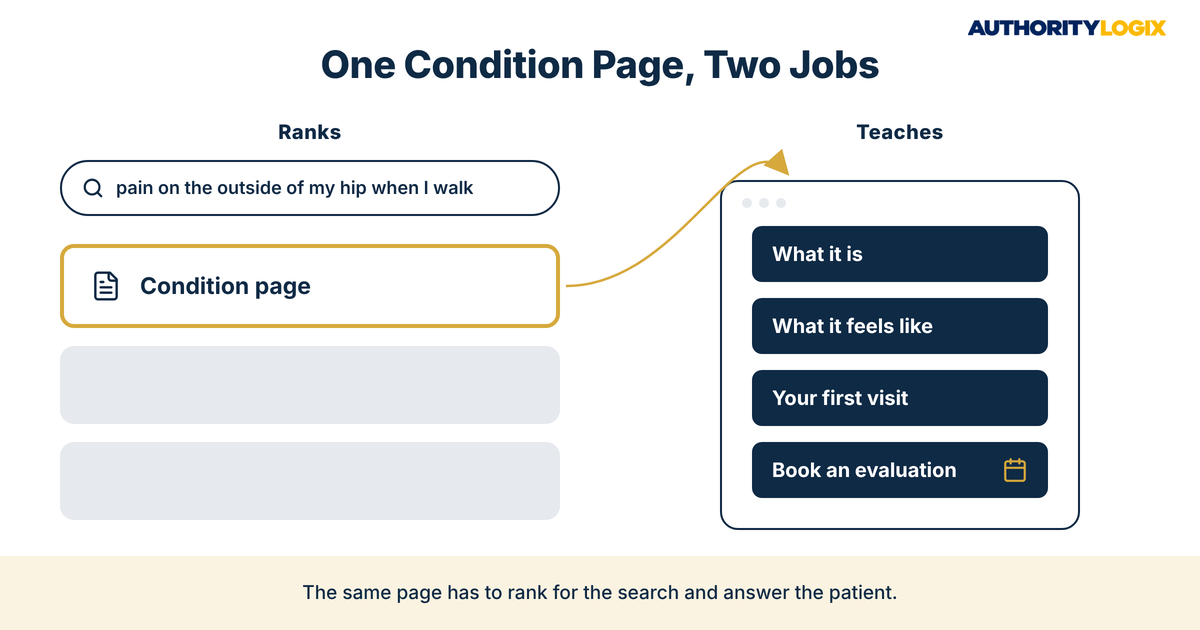
Physical therapy condition page SEO patient education is the work of building one page that ranks when a patient searches a condition and teaches that patient enough to book an evaluation. Many practices treat knee pain every day and give it one line on a services list. The search architecture behind that gap sits in the
content SEO playbook, and the condition page is where it holds or falls apart.
This is the credible but invisible problem at its most concrete. The clinical knowledge exists in every treatment room, but the patient searching at night sees only the practices that wrote it down. Physical therapy condition page SEO patient education closes that gap one condition at a time.
Why Physical Therapy Condition Page SEO Patient Education Has to Do Two Jobs at Once
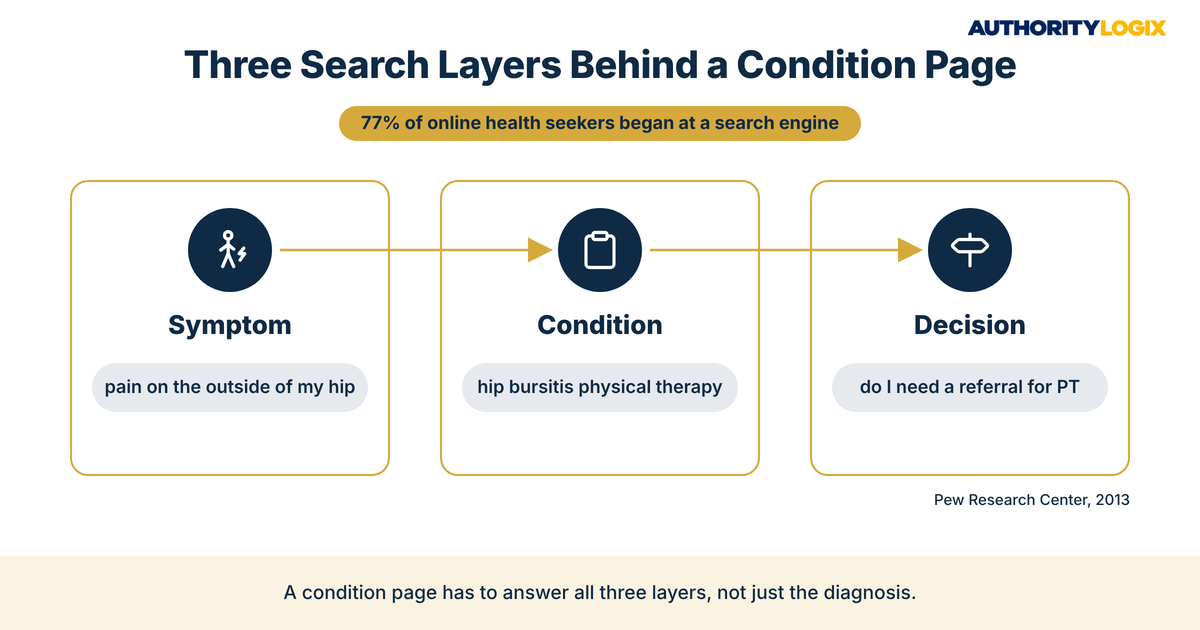
Condition searches are where many patients start. A 2013 Pew Research Center report found that 72% of internet users had looked online for health information within the past year, and 77% of those online health seekers said they began at a search engine such as Google, Bing, or Yahoo. The survey is more than a decade old, so treat it as a baseline, but the habit it describes puts physical therapy condition page SEO patient education at the front of the patient journey.
That is why a condition page belongs inside your patient pipeline. The first job is ranking, which means matching the words patients type. The second job is teaching, which means answering the questions that keep a patient from calling. Both jobs feed the evaluation bookings mapped in the
acquisition playbook, and physical therapy condition page SEO patient education fails the moment either job is skipped.
Direct access raises the stakes. APTA reports that as of July 1, 2025, all 50 states, the District of Columbia, and the U.S. Virgin Islands have either provisional or unrestricted direct access to physical therapist services for evaluation and treatment, though some states still limit treatment without a referral. A patient who can book you directly decides from your page, which is why the AuthorityLogix
PT industry hub treats condition-level visibility as core infrastructure.
The Physical Therapy Patient Education & Clinical Authority Guide shows where physical therapy condition page SEO patient education fits in the wider trust system of clinician credentials and patient FAQs.
Clinical Authority Guide →
A PT Condition Page Writing Strategy That Starts With the Patient’s Search
A PT condition page writing strategy begins before anyone writes a sentence. Start with the phrase a patient types, not the diagnosis on the intake form: “pain on the outside of my hip when I walk” is a search, while “greater trochanteric pain syndrome” is a chart note. Physical therapy condition page SEO patient education needs both, but the patient’s language has to lead.
Mapping the Search Before Physical Therapy Condition Page SEO Patient Education Begins
Map every condition page to three layers of search. The symptom layer covers what the patient feels, the condition layer covers the name they were already given, and the decision layer covers questions such as whether a referral is needed. A page that only targets the condition name misses every patient who has not heard that name yet.
Inside those layers, patients ask a fairly predictable set of questions. A strong condition page answers them in roughly the order they come up:
- What the condition is, in plain language
- What it commonly feels like and when it tends to show up
- How a physical therapist evaluates it at the first visit
- What physical therapy care generally involves, without promising a result
- Whether the patient needs a referral in your state
- How to book an evaluation and what to bring
Answering those questions across dozens of conditions is not a one-afternoon project. Practices that keep pages current use
content systems that pull answers from the clinicians who field those questions every week. Without that pipeline, physical therapy condition page SEO patient education stalls after the first few pages.
Which conditions deserve their own URL is covered in the companion piece on service and
condition pages. This article stays on a single page and asks how one URL can rank and teach at once, which is where most PT condition page writing strategy breaks down.
What Google Expects From Health Content: YMYL, Accuracy and Clinician Review
Condition pages fall into a category of search that Google treats with extra care. Google Search Central’s guidance on
helpful content states that for topics that could significantly impact the health, financial stability, or safety of people — which Google calls Your Money or Your Life topics — “our systems give even more weight to content that aligns with strong E-E-A-T.” For physical therapy condition page SEO patient education, that sentence sets the bar.
The same Google page lists questions site owners can ask about their own content, including whether it is “written or reviewed by an expert or enthusiast who demonstrably knows the topic well.” It also states that of the experience, expertise, authoritativeness, and trust aspects, “trust is most important.” A page with no clinician attached answers neither question well.
What Clinician Review Looks Like in Physical Therapy Condition Page SEO Patient Education
Clinician review should be visible, not implied. Name the physical therapist who wrote or reviewed the page, list the credential, and show a reviewed-on date that changes when the content changes. Those details tell a patient a licensed professional stands behind the explanation, which is the expert review Google’s questions ask about.
Accuracy matters as much as attribution. Every statement about a condition or about care should be something your clinicians would say in the room, with no outcome promises and no recovery timelines framed as guarantees. Physical therapy condition page SEO patient education that overstates results fails the trust standard Google describes and the honesty test every patient applies.
Trust also comes from outside the page. When your clinicians are quoted in local media or cited by other health sites, those mentions reinforce the expertise the page claims, and building them is the job of
authority distribution. A page signed by a clinician with a public footprint reads as more credible to the patient who checks the name.
Pairing clinician knowledge with search structure is the center of
our approach to PT content. The clinicians own the accuracy, and the infrastructure handles structure, publishing, and review dates.
Not sure whether your condition pages meet the trust bar Google sets for health content? The PT Authority Gap Assessment shows where your physical therapy condition page SEO patient education is thin and what to fix first.
Authority Gap Assessment →
Structuring for Physical Therapy Condition Content Ranking: Headings, Internal Links and Local Signals
Physical therapy condition content ranking depends on structure that Google can read and a patient can scan. Google’s helpful content guidance asks whether “the main heading or page title” provides “a descriptive, helpful summary of the content,” and the same test applies to every subheading on the page. A heading such as “What Sciatica Pain Feels Like” tells both readers what follows.
A Section Order That Serves the Patient and the Search Engine
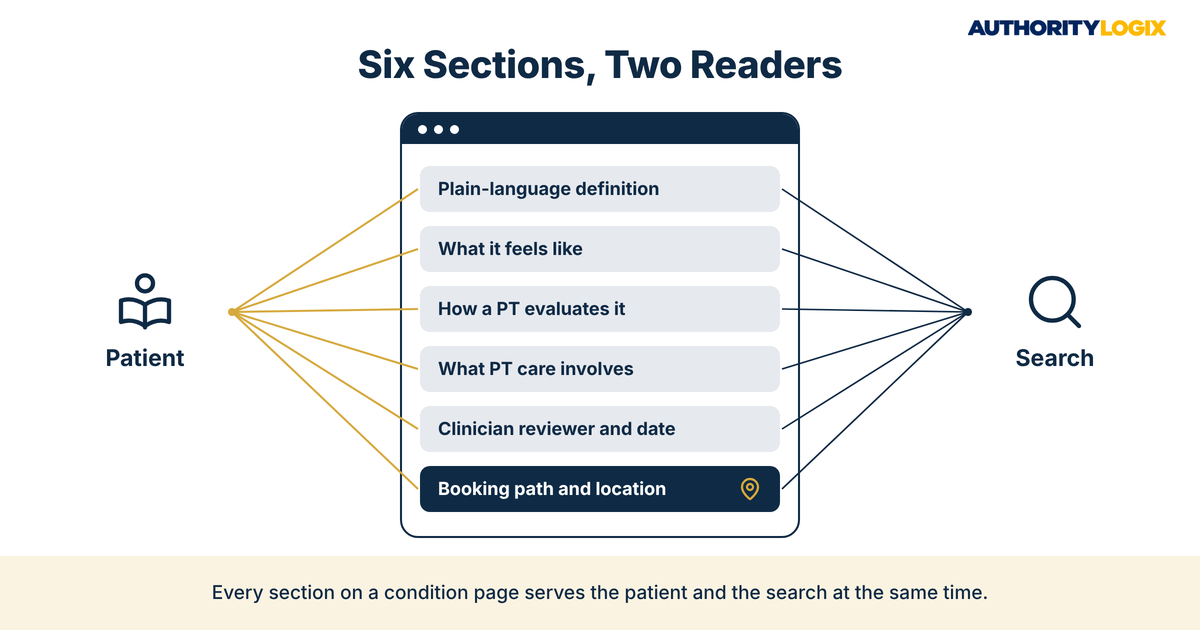
The table below is a starting blueprint of six sections for a single condition page. Each section has a patient job and a search job, and physical therapy condition page SEO patient education works when the same words serve both.
| Condition Page Section |
Patient Job |
Search Job |
| Plain-language definition |
Confirms the patient is on the right page |
Opens physical therapy condition page SEO patient education with the condition name |
| What it feels like |
Lets the patient recognize their own experience |
Captures symptom-language searches |
| How a PT evaluates it |
Lowers uncertainty about the first visit |
Answers what-to-expect searches |
| What PT care generally involves |
Sets realistic expectations with no promised outcome |
Earns decision-stage searches |
| Clinician reviewer and date |
Shows who stands behind the explanation |
Puts the expert review Google asks about on the page |
| Booking path and location |
Gives one clear next step |
Ties physical therapy condition page SEO patient education to local searches |
The last row is where condition pages meet the map. A patient searching “physical therapy for knee pain near me” is asking two questions at once, and the page should name the clinic, the neighborhood, and the booking path. The map pack side is covered in the
local visibility guide, and condition pages are the organic half of that system.
Each condition page should also connect to the location page and the Google Business Profile services list that name the same condition. That alignment is the practical side of
local search, because it shows the page, the location, and the profile describe one real practice. Physical therapy condition content ranking is harder to earn when those signals contradict each other.
Internal links finish the structure. Each condition page should link up to its service page and across to related conditions, so Google reads the set as organized
topic clusters rather than isolated posts. Physical therapy condition page SEO patient education is stronger as a connected library than as a scattered list of pages.
Keeping the PT Condition SEO and Education Balance Without Keyword Stuffing
The PT condition SEO and education balance tips over in one predictable direction. Someone sees a page stuck on page two, adds the condition name a dozen more times, and the explanation gets buried under repetition. Google’s guidance names the same instinct, asking whether content is “primarily made to attract visits from search engines” and whether writers are working to a word count “because you’ve heard or read that Google has a preferred word count.”
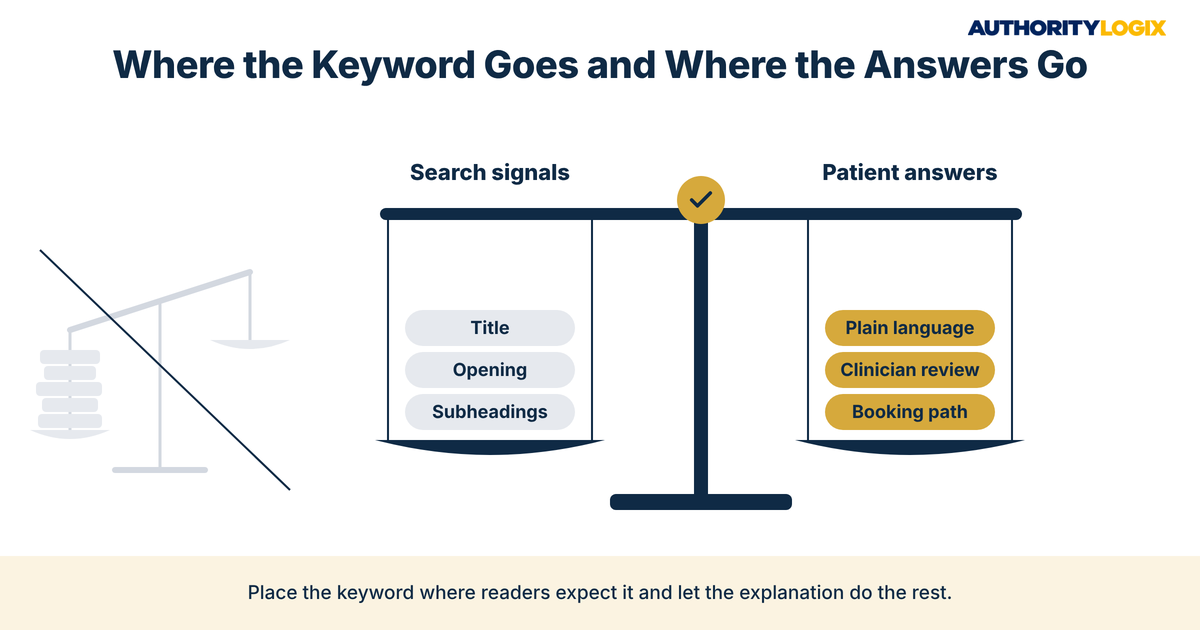
Physical therapy condition page SEO patient education holds up when the main phrase appears where a reader expects it — the title, the opening, a few subheadings — and the rest of the page uses the words a clinician naturally uses when explaining. Synonyms, related symptoms, and patient questions cover the topic more fully than repetition does.
Balance also depends on where the deeper material lives. A condition page does not need every insurance scenario; it needs the core answers and a pointer to longer explanations in an
educational hub. That split keeps each page readable and gives physical therapy condition page SEO patient education room to grow without bloating a single URL.
Read every draft aloud before it publishes. The PT condition SEO and education balance is easier to hold when the reviewer is a clinician first and an editor second.
What Most PT Practices Get Wrong on Condition Pages (Read Them Like a Patient)
Most mistakes in physical therapy condition page SEO patient education are easy to see once you read the page the way a patient does. The questions below are the ones patients and practice owners actually raise.
Why does this page sound like it was written for another clinician?
Often it was adapted from a clinical reference. Patients search in symptom language, and physical therapy condition page SEO patient education built on anatomical terms loses them in the first paragraph.
Is it a problem if the page promises I will be pain-free by a certain date?
Yes, for the patient and for the practice. No clinic can guarantee an outcome, and a condition page that implies one undermines the trust Google’s guidance puts first. Honest pages describe what care generally involves and leave the plan to the evaluation.
I read the whole page and still did not know how to book. Is that common?
It is one of the most common gaps. A page that explains the problem and then ends without a booking path hands the patient back to the search results, and the
lead generation side of the system exists to close that leak. The fix is a clear next step placed where the explanation ends.
Where should a patient go after reading a condition page?
Somewhere that keeps the education going, never a dead end. For practice owners, the AuthorityLogix
resource library collects related guides on patient education and local search. On your own site, every condition page should lead to the next useful page.
Ready to turn your clinicians’ expertise into physical therapy condition page SEO patient education that ranks for what patients search and explains it well enough to book?
Work With Us →
Physical Therapy Condition Page SEO Patient Education: The Honest Timeline
Condition pages are not a fast lever. Rankings for health topics build as a page stays accurate, a clinician stays attached to it, and other pages support it, which is usually measured in months rather than weeks. Physical therapy condition page SEO patient education pays later and keeps paying, and the
growth blueprint lays out how that long-horizon visibility fits a practice’s broader plan.
We built this pattern on our own proof-of-concept before offering it to anyone. BKDSCR.com, our build in the NYC outer-borough DSCR real estate niche rather than a PT client, runs on 18 pillar pages, 7 interactive tools, and 48 SEO-optimized blog posts, and it was built in under 18 months with zero paid ads. The subject is different, but the structure behind physical therapy condition page SEO patient education is the same: one page per real question, connected into a library.
For a PT practice, that structure starts with the conditions that bring in most of your evaluations. Building those pages with clinician review is
what we do for practices that are trusted in the treatment room and missing from the search results.
The sequence matters. The highest-demand conditions go first, clinician review is built into publishing from day one, and each new page links to the ones already live, which is
how we build condition libraries that keep working.
The honest answer is that most physical therapy practices already know more about these conditions than any page currently ranking for them. What is missing is the infrastructure that turns that knowledge into physical therapy condition page SEO patient education a patient can find, trust, and act on. Authority compounds, but only once the pages exist.