


Key Takeaways
- Telehealth physical therapy marketing turns virtual visits from a quiet line on a services page into a real entry point for new patients.
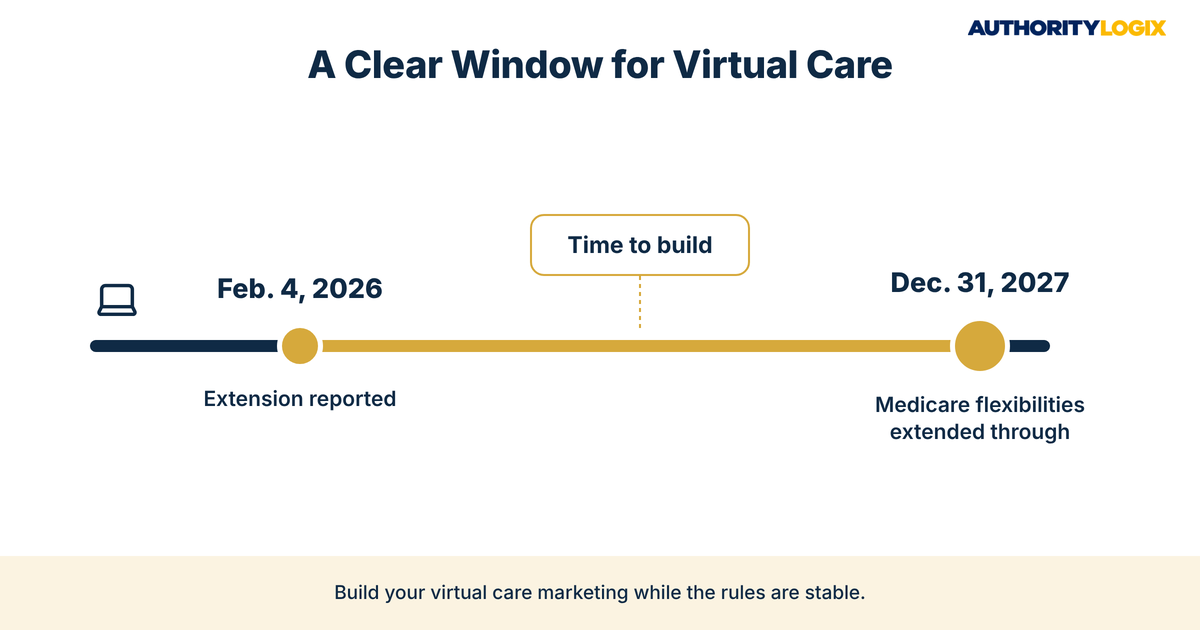
- APTA reports that Medicare telehealth flexibilities were extended through Dec. 31, 2027, which gives practices a defined window to build telehealth physical therapy marketing on stable ground.
- Virtual physical therapy visits widen the map of patients a practice can serve, within the states where its clinicians are licensed to practice.
- Most PT telehealth patient reach is lost on the website and the Google profile, where virtual care is buried or never mentioned at all.
- PT online consultation leads need a fast, documented response and a short follow-up sequence before they become booked evaluations.
- A complete telehealth physical therapy marketing plan covers search, service pages, educational content, booking and monthly measurement.
Table of Contents
Why Telehealth Physical Therapy Marketing Matters Now That Medicare Telehealth Flexibilities Run Through 2027
Telehealth physical therapy marketing starts with a fact most practice owners already sense: many of the patients who could use your care do not live a short drive from your front door. Your clinicians are skilled and your reputation inside the clinic is earned, yet the market outside your neighborhood has no idea you offer virtual visits. Most PT practices list telehealth as a single line on a services page and stop there, which is why the option rarely produces new evaluations.
The timing makes this worth fixing now. According to APTA’s telehealth advocacy page, Congress approved a two-year extension of pandemic-era Medicare telehealth policy through 2027, and APTA reported on Feb. 4, 2026 that Medicare telehealth flexibilities were extended through Dec. 31, 2027. That gives telehealth physical therapy marketing a defined window to work on stable ground instead of guessing whether the rules will change next quarter.
APTA also supports making PTs and PTAs permanent Medicare telehealth providers and endorses H.R. 1614, a bill that would establish them in that role. Until then, the extension through 2027 is the planning horizon, and telehealth physical therapy marketing built now has time to rank and earn trust before the next deadline.
Telehealth physical therapy marketing is not a separate campaign. It is one more entry point into the same new-patient system that already runs on your website, your Google profile and your referral relationships. When virtual visits sit inside that system, a patient two counties away can find you, request a virtual consult and later become an in-clinic patient, which is lead generation working the way it should.
Virtual care also reduces a risk every owner knows. One referring doctor retires and the pipeline dries up overnight. A clear virtual option gives patients another way to reach you through direct access instead of waiting for a prescription, as long as your state’s rules allow it and your clinicians decide a virtual evaluation fits.
The practices that get real value from telehealth physical therapy marketing treat it as infrastructure: pages that explain virtual visits clearly, listings that mention them, and a booking path that works on a phone. That structure is at the center of our approach, because the expertise is already in your clinic and the job is to make it visible to patients who will never drive past your sign.
The Physical Therapy Patient Acquisition Playbook maps the full new-patient pipeline and shows where telehealth physical therapy marketing fits beside referrals, local search and direct access.
How Virtual Physical Therapy Visits Widen the Map of Patients You Can Serve
Virtual physical therapy visits change the geography of a practice. A video visit removes most of that friction for the first conversation, so the practice can serve people across the region where its clinicians are licensed, not only the few neighborhoods around the building.
That wider map only matters if those patients can find you. Search results for a clinic are tied to location, which is why local visibility still decides who sees your practice first, even for a virtual service. The telehealth physical therapy marketing task is to give distant patients a clear reason to choose you anyway.
The people a virtual option reaches are easy to name: commuters who cannot leave work for a clinic visit, parents juggling school pickups, residents of rural towns with no practice nearby, and former patients who moved away but want to keep their therapist. Each group arrives at a different point in the patient journey, and each one needs its own message about why virtual physical therapy visits make sense for them.
Hybrid Care Messaging for Patients Outside Your Drive Radius
Hybrid care messaging tells a distant patient exactly how the relationship will work. Explain which parts of care can happen by video, when the practice may ask for an in-clinic visit, and how scheduling works for both. Patients need to know what to expect before they book.
Telehealth physical therapy marketing for hybrid care should also be honest about limits. Your clinicians decide whether a virtual visit fits each patient, and your pages should say so plainly. Clear expectations protect trust, and trust turns a first virtual visit into a lasting relationship.

Where PT Telehealth Patient Reach Breaks Down on Most Practice Websites
Most practices lose PT telehealth patient reach long before anyone books. The service exists, the clinicians are ready and the scheduling software supports video, yet the website treats virtual care as an afterthought. A single line on a services page or a button that leads to a generic contact form tells a patient the practice is not serious about it.
| Where reach breaks down | What the patient sees | What to build instead |
|---|---|---|
| Telehealth buried on one services page | No clear proof the practice offers virtual visits | A dedicated virtual visits page with its own booking path |
| No licensing or location context | Uncertainty about whether they can be seen from their town | A plain-language note on where your clinicians can see patients |
| Generic contact form | No sense of what happens after they submit | A short virtual consult request with a stated response time |
| Google profile silent on virtual care | A clinic that looks in-person only | Telehealth physical therapy marketing in profile services and posts |
| No problem-specific content | No page that matches what they searched | Educational pages that explain how a virtual first visit works |
The Google profile gap is often the most expensive one. Patients who search for a physical therapist usually see map results before websites, and a profile that never mentions virtual visits signals that you only treat people in person. Strong local search foundations make sure the profile, the website and your listings describe the same telehealth service in the same words.
The content gap follows close behind. A patient who searches a specific problem from home wants a page that answers it and then offers a next step, and a virtual visit makes that next step easier to take. Building those pages with the discipline set out in the content SEO playbook is how telehealth physical therapy marketing earns rankings instead of hoping for them.
None of these gaps is a clinical problem. They are infrastructure problems, which means they are fixed with structure rather than more posting. Telehealth physical therapy marketing that skips the website simply sends people to a dead end faster.
Not sure where your telehealth physical therapy marketing loses patients today? The assessment shows which gaps in your website, Google profile and booking path to fix first.
How to Turn PT Online Consultation Leads Into Booked Evaluations
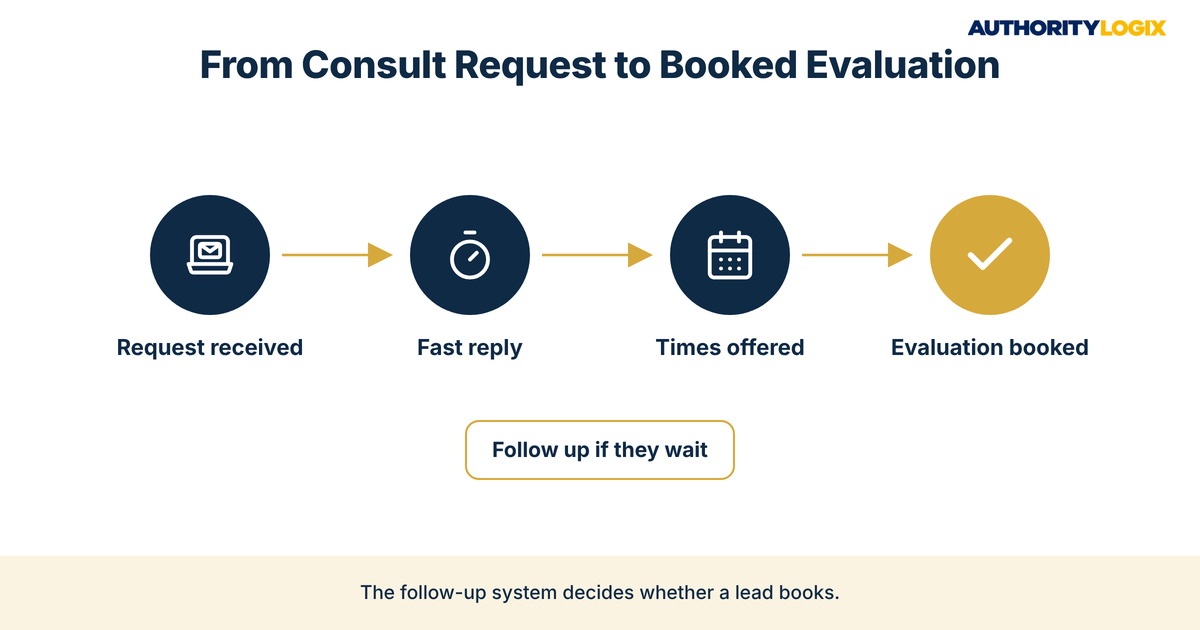
PT online consultation leads behave differently from phone calls. The person filling out a virtual consult request is often researching after hours, comparing practices, and ready to move on if nobody answers. Telehealth physical therapy marketing earns the lead; the follow-up system decides whether that lead becomes a booked evaluation.
Start by mapping what happens after a request comes in. Who sees it, how fast they respond, what they say and how the patient picks a time should all be written down, the same documented discipline behind our process with every practice. Once that path is on paper, the front desk stops improvising and every patient gets the same experience.
Response Time for Online Consultation Requests
Speed matters more online than on the phone because the patient has other tabs open. Set a clear response standard for virtual consult requests, state it on the request form, and staff it during the hours patients actually submit them. A practice that promises a same-day reply and keeps it looks more trustworthy than one that says nothing.
The first reply should confirm the request, explain what a virtual visit involves and offer specific times. Do not ask for detailed health information by email; collect what you need through your secure intake system instead. That keeps PT online consultation leads moving while protecting patient privacy.
Leads that do not book right away still have value. A short follow-up sequence with a helpful guide, a reminder of how virtual visits work and an easy link to schedule keeps the practice in mind. Sharing that same material across email, social channels and your newsletter is the job of distribution, giving undecided patients a reason to return.
Track the numbers that show whether the system works: virtual consult requests, replies sent within your standard, consults completed and evaluations booked. Reviewing them monthly shows where telehealth physical therapy marketing is producing patients and where the follow-up is leaking them.
What a Telehealth Physical Therapy Marketing Plan Should Include Across Search, Content and Follow-Up
A complete telehealth physical therapy marketing plan has three layers: being found, being understood and being easy to book. Each layer has a specific job, and each one hands the patient to the next.
- Search: Google profile services and posts that name virtual visits in plain words.
- Website: a dedicated virtual visits page, plus service pages that mention the option.
- Content: educational articles that answer the questions remote patients search.
- Booking: a mobile-friendly consult request with a stated response time.
- Follow-up: a short sequence for leads that do not book on first contact.
- Measurement: monthly counts of requests, consults and evaluations booked.
Those pieces need to be produced on a schedule, not when someone has a free afternoon. Repeatable content systems turn the plan into a steady flow of pages, posts and guides, so the telehealth message stays current as rules, services and staff change.
Telehealth Physical Therapy Marketing on Your Service Pages
Every service page should answer one question for a distant patient: can I start this with a virtual visit? Add a short section that says whether a virtual first visit is available for that service, what it involves and how to request one. Telehealth physical therapy marketing on service pages works because it meets the patient on the page they already found.
Group those pages and their supporting articles into a single educational hub so search engines and patients can see the depth behind your virtual care. A hub that explains how virtual visits work signals a practice that has thought the service through.
Articles inside that hub should teach rather than sell. Clear patient education about what to expect from a video session, how to set up a space at home and when the practice may suggest coming in builds the trust that makes a distant patient book.
AuthorityLogix built this kind of infrastructure first for its own proof-of-concept, BKDSCR.com, a real estate investment education platform with 18 pillar pages, 7 interactive tools and 48 blog posts that generates inbound leads with zero paid ads. The industry is different, but the structure carries over.
Telehealth Physical Therapy Marketing FAQ: What Practice Owners Ask Most
These are the questions practice owners and prospective patients raise most often about virtual care. The answers focus on how telehealth physical therapy marketing works, not on clinical decisions, which always belong to your licensed clinicians.
Should you offer virtual physical therapy if most of your patients are local?
Often it is worth considering, because virtual visits also serve local patients who cannot leave work or arrange a ride. The decision depends on your staff, your scheduling system and whether your clinicians are comfortable delivering care by video.
Is online physical therapy covered by insurance?
Coverage depends on the plan. For Medicare, APTA reports that telehealth flexibilities have been extended through Dec. 31, 2027. Commercial plans vary, so a practice should publish a clear note on its virtual visits page and verify each patient’s coverage before the first session.
What do I need for a virtual physical therapy session?
Most patients need a phone, tablet or computer with a camera, a stable internet connection and enough room to move. A good practice sends simple setup instructions with every booking confirmation. Practices that publish guides like the ones in our PT resources library make that preparation easy before the first call.
Can telehealth physical therapy grow your practice?
It can widen the area you serve and give patients another way to start care, but it does not grow a practice on its own. Growth comes from the pages, listings and follow-up that make virtual visits visible and easy to book, which is the kind of system our services are built to deliver.
What services are provided by a virtual physical therapist?
That depends on the practice and on each patient, and your clinicians make that call. ClinicSense, a practice management software company, lists evaluating new patients, assessing patient progress and monitoring patient exercise among the services that can be provided virtually. Your website should say which of these you offer.

Ready to build the virtual visits pages, listings and consult follow-up that turn telehealth into a steady source of new evaluations for your practice?
Building a Virtual Front Door That Feeds Your In-Clinic Schedule
Telehealth physical therapy marketing works best when it is treated as a front door, not a separate wing of the practice. A virtual consult is often the first conversation, and the in-clinic plan of care is where the relationship continues. The marketing job is to make that first door visible to people who would never have found you otherwise.
That front door needs the same long-term thinking as every other channel. Measure virtual requests, consults and evaluations each month, and fold what you learn into the wider authority growth plan for the practice. Infrastructure compounds. Ads stop.
The honest answer is that most practices already have the clinicians, the software and the reputation to serve patients by video. What they lack is the telehealth physical therapy marketing infrastructure that tells those patients the option exists, explains it clearly and makes booking easy. Build that, and the extension through 2027 becomes time well used rather than a deadline you watched pass.