


Key Takeaways
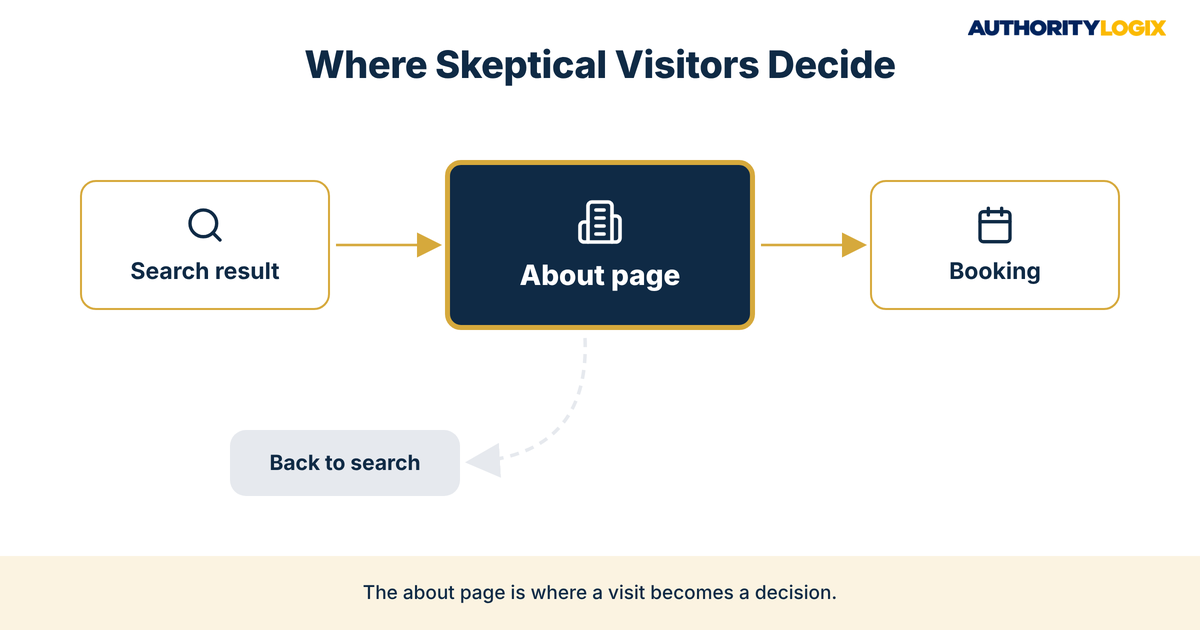
- A physical therapy about page is where a skeptical visitor decides whether your clinicians are worth a phone call.
- Nielsen Norman Group found in 2019 that users expect About Us information to be authentic and transparent, and compare testimonials with third-party review sites.
- A physical therapy practice story works when it explains, in plain language, why the practice exists and who it serves.
- PT about page trust comes from proof a visitor can verify: named credentials, real photos, linked reviews and listings that match the page.
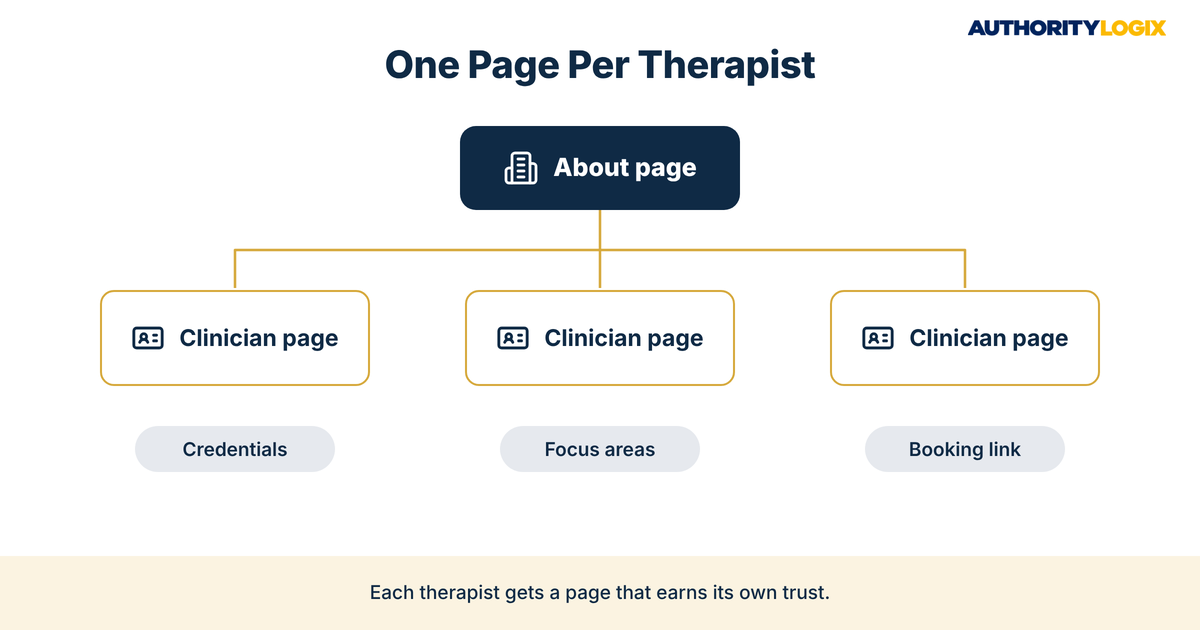
- A PT clinician authority page for each therapist gives patients a reason to choose a specific person, not just a building.
- Every physical therapy about page should end with a clear, low-pressure path to booking.
Table of Contents
Why the Physical Therapy About Page Is Where Skeptical Visitors Decide
Your physical therapy about page is where a skeptical visitor stops browsing and starts deciding. They found you through a search, a friend or a physician’s note, and now they want to know who will treat them and whether the practice can be trusted. Most practices answer with two generic sentences and a stock photo, and the visitor leaves to compare the next clinic. That lost visit is a quiet leak in your patient acquisition pipeline that rarely shows up in a report.
You already have what the visitor is looking for: qualified therapists, years in the neighborhood and patients who speak well of the care. None of it is visible on the page. That is the credible but invisible gap, and it is how a newer clinic with a clearer story wins the booking.
At AuthorityLogix, we treat the about page as infrastructure, not decoration. It answers a trust question rather than a clinical one, and it has to work for the direct-access patient comparing clinics, the physician’s office checking where it sends people, and the job candidate deciding whether to apply.
A physical therapy about page that does this job well also supports everything else you publish. Condition pages, reviews and listings all lead back to the question of who you are, and this is where that answer lives. Treating it as part of long-term authority growth, rather than a page written once at launch, is what keeps it accurate as therapists join, services change and the practice expands.
The rest of this guide covers what skeptical visitors look for, how to tell your story, how to prove it and when to give each therapist a dedicated page. Each step fits inside a broader PT marketing system, so the physical therapy about page becomes a working part of how new patients choose you.
The Physical Therapy Patient Education & Clinical Authority Guide shows how clinician credentials, patient education and trust signals work together, and where a strong physical therapy about page fits inside that system.
What Skeptical Patients Look For Before They Trust a Practice
Skeptical visitors are not reading your physical therapy about page for entertainment. They are checking whether the practice is real and honest. In a 2019 study of About Us sections on corporate websites, Nielsen Norman Group’s About Us research found that users now expect companies to demonstrate a heightened level of authenticity and transparency, and that even when testimonials appear on a company site, users still read them and often compare the information with third-party review sites.
That research looked at corporate sites, not clinics, but the behavior carries over. The same study reported that users are skeptical of companies and see right through complex corporate speak, jargon and stock photography. A prospective patient reads your physical therapy about page through the same filter, and borrowed photos or generic copy make the whole site feel hollow.
Most visitors arrive with an impression already forming from your Google listing and a few reviews, so the page has to confirm what your local visibility promised rather than contradict it. When the hours, address, therapist names and services on your physical therapy about page match what appears in search, the visitor relaxes. When they don’t, doubt sets in before the first call.
The same questions come up for almost every skeptical visitor on a physical therapy about page. Each one deserves a direct answer on the page itself:
- Who are the therapists, and what credentials do they hold?
- Do the photos show the real clinic and the real team?
- Does the practice explain what it treats in plain language?
- Do the reviews on the page match what other sites say?
- Is it clear how to book, and whether a referral is needed?
- Does the practice seem connected to the community it serves?
These questions line up closely with experience, expertise, authoritativeness and trustworthiness, the qualities Google shortens to E-E-A-T. The about page is one of the clearest places to display E-E-A-T signals such as clinician credentials, practice history and accountable authorship. A physical therapy about page that answers cautious patients well also shows search engines who stands behind the care.

How to Tell Your Physical Therapy Practice Story Without Sounding Like an Ad
Most owners either skip the story or fill it with claims about compassionate, state-of-the-art care that could belong to any clinic. A useful physical therapy practice story answers three questions in plain language instead: why the practice exists, who it was built to serve and what the experience is like for a new patient. It should read the way you would explain the practice to a neighbor. Specific details and real names do more work than adjectives.
Founder Story, Mission, and Community Ties
The founder story is usually the strongest material on a physical therapy about page because it is the one thing no competitor can copy. Explain when and why the practice opened, what need the founder saw in the community, and how that idea still shapes the practice. Nielsen Norman Group’s guidance points the same way, advising companies to explain their origins, how they view business and how they relate to the community.
The mission belongs here too, but only if it is specific. “We help people move better” is a slogan; “every new patient works with the same therapist from evaluation to discharge” is a commitment a visitor can hold you to. Community ties close the loop, showing the school teams, clubs and local events your physical therapy about page can name as proof you belong to the neighborhood.
Writing the story once is not enough, because practices change. Therapists join and services expand, so the page needs an owner and a review schedule. Practices that run their pages through repeatable content systems keep the story current without depending on the owner to remember it.
The story also has a search job. Visitors who search your practice name or your founder’s name often land here, so headings, page title and internal links should follow the same content SEO discipline as your service pages. Branded searchers are often the visitors closest to booking.
Finally, connect the story to the education behind it, such as a condition guide or a short article from one of your therapists. For examples of how that patient-facing material can be structured, the guides in our resource library are each built to show expertise rather than claim it.
Not sure whether your physical therapy about page tells a story skeptical visitors believe? The assessment shows where your practice story, credentials and proof fall short today, and what to fix first.
Building PT About Page Trust With Proof Visitors Can Verify
PT about page trust is built from evidence, not adjectives. Every claim on the page should point to something a visitor can check: a credential, a review on another site, a photo of the real treatment floor or a community partner they recognize. The more a skeptical visitor can verify, the less they take on faith.
| Claim on the page | Proof a visitor can verify | Where it lives |
|---|---|---|
| Experienced therapists | Named clinicians with credentials and focus areas | Team section and individual clinician pages |
| A real, local practice | Photos of the actual clinic, team and neighborhood | Physical therapy about page gallery and Google Business Profile |
| Patients trust us | Balanced reviews linked to full profiles | Review section on the physical therapy about page |
| Part of the community | Named schools, clubs and events the practice supports | Community section and partner pages |
| Easy to get started | Plain explanation of booking and direct access | Closing section and booking page |
None of these require a bigger budget, only a decision to show what is already true. A physical therapy about page with five verifiable proof points gives a skeptical visitor more than a longer page of claims nobody can check.
Linking Reviews and Third-Party Proof on a Physical Therapy About Page
Reviews deserve special handling. Because visitors compare testimonials with what they find elsewhere, hand-picked glowing quotes can raise suspicion. Nielsen Norman Group recommends honest and balanced testimonials, and the practical version is simple: show a representative sample on your physical therapy about page, link to the full review profiles, and keep every quote free of patient health details.
Third-party proof only works when it is accurate. The same study advised keeping contact information and other details on third-party sites accurate, because users rely on those sites when forming impressions. For a practice, your Google profile, directory listings and physical therapy about page should share the same name, address, phone, hours and therapist roster, the foundation of strong local search performance.
Proof also travels beyond the page. Therapist interviews and patient education videos published on other channels point back to the about page, which is the job of authority distribution. AuthorityLogix applied the same principle on BKDSCR.com, its own proof-of-concept build in the DSCR real estate niche, where 18 pillar pages and 7 interactive tools let visitors test the expertise instead of reading claims about it.

When to Add a PT Clinician Authority Page for Each Therapist
A single physical therapy about page can introduce the whole team, but at some point it stops being enough. Some patients want to choose a person, not a building, and that takes more than a headshot and three letters after a name. That is the point where a PT clinician authority page for each therapist earns its place.
The about page and the individual clinician pages do different jobs. The about page tells the practice story and introduces each team member briefly, while each therapist’s bio page goes deeper into credentials, focus areas and why that person chose physical therapy. Linking the two both ways lets a visitor move from the practice to the person and back.
Not every practice needs one on day one. Add a dedicated PT clinician authority page when any of these signals appear:
- A therapist holds a specialty certification patients search for
- Callers regularly ask for a specific therapist by name
- A therapist leads a program, such as a running clinic
- The team has grown past what one section can introduce clearly
- A therapist writes or records patient education the site already publishes
Each page should make the therapist’s experience visible without overstating it. List credentials accurately, describe focus areas plainly, and avoid any promise about results, since no honest page can say how a patient will respond to care. Done well, these pages turn clinician expertise into something a cautious visitor can actually see and compare.
These pages also give the physical therapy about page a stronger backbone. Instead of claiming an experienced team, it points to named therapists whose pages carry the detail. That shows that expertise is the asset the practice is built on.
Physical Therapy About Page FAQ
These are questions practice owners and prospective patients commonly raise about a physical therapy about page. The answers apply to single clinics and multi-location groups alike.
What should a physical therapy about page include?
At minimum, include the practice story, the team with real photos and credentials, community ties, verifiable reviews and a clear way to book. Each element should answer a question a skeptical visitor already has.
How do I write an about us page for my physical therapy practice?
Start with why the practice exists and who it serves, then add the people, the proof and the next step. Cut any sentence a competitor could copy word for word. The page works best as the front door to a larger educational hub, so visitors can move from your story into the patient education that supports it.
How can I tell whether a physical therapy practice is trustworthy before I book?
Look for named therapists with listed credentials, photos of the actual clinic, recent reviews on more than one site and clear booking information. A practice that is open about how it works is easier to evaluate before your first visit.
Should every therapist have a meet our team profile?
A short profile for every clinician in a meet our team section is a sensible baseline. Therapists with distinct focus areas or programs benefit from a full page of their own.
Who can build an about page that turns visitors into booked evaluations?
Most practice owners know their story but lack time to structure and maintain the page. Building a physical therapy about page around the trust questions visitors ask is one of the systems covered in our services.
Ready to rebuild your physical therapy about page into a trust system, with a real practice story, verifiable proof and clinician pages that move skeptical visitors toward booking?
Turning Your About Page Into a Path to Booking
A physical therapy about page that earns trust but offers no next step leaves the decision unfinished. By the bottom of the page, a visitor has checked your story, people and proof, and the next move should be obvious.
Calls to Action That Match Visitor Intent
Not every visitor is ready to book an evaluation. Some want to call with a question, check whether a referral is required in their state, or read about their condition first. A booking button, a phone number and a link to patient education let each visitor take the step that fits, which is how lead generation works on a physical therapy about page.
The honest assessment is that most physical therapy practices already have everything a strong about page needs: qualified clinicians, a real history and patients who would vouch for them. What is missing is the structure that puts that evidence in front of skeptical visitors in the order they look for it. That structure is the focus of our process, starting with the page most practices wrote once and never touched again.
Your patients already trust your therapists once they meet them. The physical therapy about page is where that trust has to start, before they ever walk through the door.