Key Takeaways
- Physical therapy physician referrals remain a core source of new patients, even though APTA reports that every state allows some form of direct access to physical therapy.
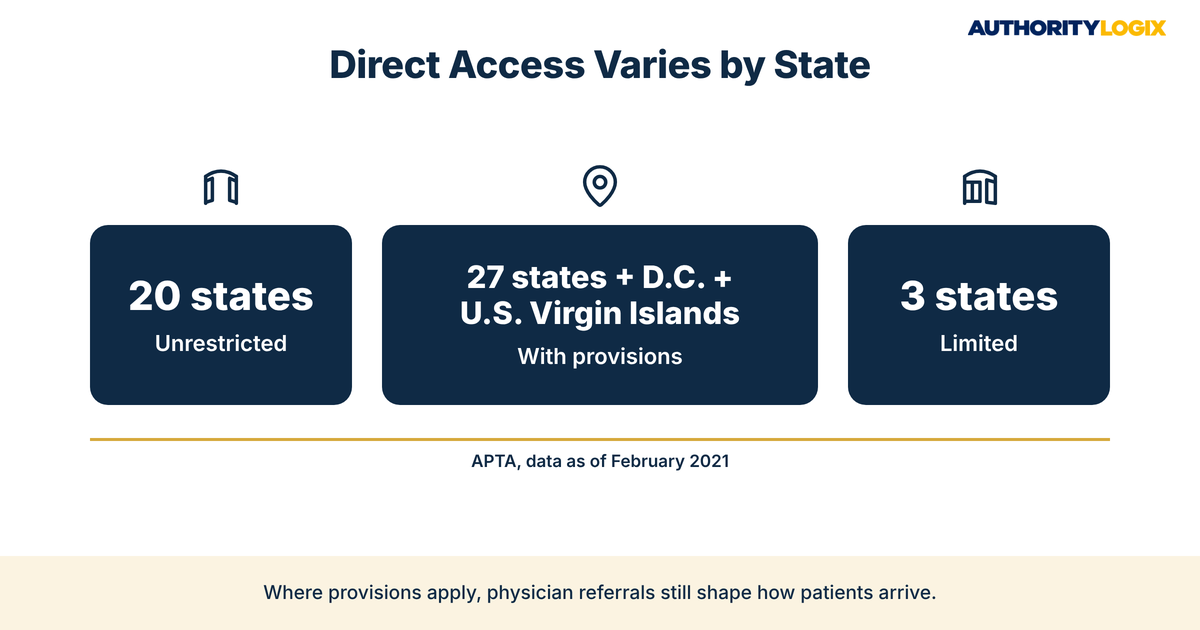
- APTA’s direct access map, with data current as of February 2021, shows 20 states with unrestricted access, 27 states plus D.C. and the U.S. Virgin Islands with provisions, and 3 states with limited access.
- Physical therapy physician referrals from orthopedic surgeons and primary care doctors depend on the same basics: prompt scheduling, clear updates and a practice they can check online.
- PT physician referral relationships last when they run as a system with an owner, a schedule and shared educational material, not as occasional lunch visits.
- A PT primary care network grows through patient education that busy offices can hand out, not through cold calling.
- Tracking physical therapy physician referrals from first call to completed plan of care shows which relationships deserve more of your time.
Why Physical Therapy Physician Referrals Still Matter in a Direct Access World
Physical therapy physician referrals are still the backbone of new-patient volume for many practices, even in a market where patients can book without a prescription. You have the credentials, the clinical record and years of careful work, yet the doctors who could send you patients every week may barely know your name. That gap between earned credibility and what referring physicians actually see is a structural problem inside your
patient acquisition system, not a question of effort.
Direct access has changed the conversation, but it has not removed the doctor. According to the APTA
direct access map, all 50 states, the District of Columbia and the U.S. Virgin Islands have some form of direct access to physical therapy, with data current as of February 2021: 20 states had unrestricted access, 27 states plus D.C. and the U.S. Virgin Islands had access with provisions, and 3 states had limited access. APTA describes provisions as conditions such as time or visit limits, which is one reason physical therapy physician referrals remain part of how many patients arrive.
The bigger risk is concentration. One referring doctor retires and the pipeline dries up overnight. Practices that take an honest look at their
referral dependence often find that a few offices send most of their physician-referred patients, and that none of those relationships has a written plan behind it.
Physical therapy physician referrals work best alongside other sources, not instead of them. Gyms, employers and wellness brands can send patients directly, a model covered in our guide to
referral partnerships, while physicians send patients who are already inside a care pathway. A balanced practice builds both, so no single door controls the schedule.
A doctor may recommend you, but the patient still searches your name before calling, and so does the office staff when they decide where to send someone. Strong
local visibility confirms the recommendation and weak listings quietly undo it, which is why physical therapy physician referrals and search visibility belong in the same plan.
The Physical Therapy Practice Authority Growth Blueprint shows where physical therapy physician referrals fit inside a growth system that also includes search, content and measurement.
Growth Blueprint →
What Orthopedic Surgeons and Primary Care Doctors Look For in a PT Partner
Orthopedic surgeons and primary care doctors refer for different reasons, but both are protecting their own reputation when they send a patient to you. A surgeon wants patients after surgery seen promptly and reported on clearly. A primary care doctor wants a dependable place to send common aches and strains without fielding complaints later. Both judge physical therapy physician referrals by how easy the practice is to work with.
| What doctors check |
Orthopedic surgeons |
Primary care doctors |
| Scheduling |
Quick first visits after surgery |
Short waits for new evaluations |
| Communication |
Clear updates at agreed points in care |
Brief, readable summaries instead of long notes |
| Clinician fit |
Therapists with relevant specialty training |
Clinicians comfortable with a broad mix of conditions |
| Patient experience |
Few complaints and smooth insurance handling |
Patients who return satisfied |
| Online check |
Credentials and specialties listed on the website |
Recent reviews and an accurate Google listing |
Physicians are encouraged to think this way. A 2005 article in American Family Physician by Jennifer Joyce and Janice Kuperstein advised doctors to know the specializations of local physical therapists and to partner with them on communication and education about physical therapy. If the doctors in your area cannot see your specializations, they have no way to match patients to you.
The Communication Standards Surgeons Expect From Physical Therapy Physician Referrals
Surgeons tend to be the most demanding partners on communication. They want to know the patient was seen, what the plan is and when they will hear next, in a format they can read in under a minute. A short, consistent update template sent on a predictable schedule does more for physical therapy physician referrals than any gift basket.
The update itself also signals expertise. Clean, specific notes signed by a named clinician show the
clinical authority behind your practice, and they give the surgeon’s staff a reason to keep your name on the referral list. Communication is part of your reputation, not paperwork after the fact.
Primary care doctors look for the same reliability with less detail. Most will not read a long report, but they notice when a patient returns satisfied and when their office never had to chase you for an update. That pattern, repeated over months, is what effective
PT marketing to physicians looks like: steady proof of reliability rather than promotional pitches.

How to Build PT Physician Referral Relationships That Last
PT physician referral relationships last when someone in your practice owns them. The owner or a designated liaison keeps a short list of target offices, a record of every contact and a calendar of planned touchpoints. Without that structure, physical therapy physician referrals depend on whoever happens to remember, and they fade when the clinic gets busy.
Start with the doctors who already send you patients, even occasionally. Thank them with a useful update, ask how their staff prefers to send referrals and fix whatever friction they mention. Then add a small number of new offices each quarter, chosen by specialty and location.
Visibility Signals Physicians Check Before Sending Patients
Before a doctor or office manager adds your name to their list, someone usually looks you up. They check whether your website lists your clinicians with their credentials and specialties, whether your Google profile is complete, and whether recent reviews sound like a practice they would trust with patients. A practice that looks thin online asks the physician to take a risk on reputation alone.
Physicians and practice administrators also see you on professional networks. A clinician profile that shares specific, useful posts about the conditions you treat supports physical therapy physician referrals between visits, and a steady approach to
LinkedIn outreach keeps your name in front of referring offices without another unannounced drop-in.
The same material should travel further than one channel. A short explainer on a common condition, written without patient details, or a summary of your specialty services can go out by email to referring offices, on LinkedIn and as a printed handout. Planned
authority distribution makes sure every referring office sees your expertise on a schedule, not only when you visit.
Turning an Orthopedic Surgeon Referral PT Relationship Into a Steady Pipeline
An orthopedic surgeon referral PT relationship usually starts with a handful of patients. Whether it grows depends on what happens after those first referrals: how quickly the patients were seen, how clearly the surgeon was updated and what the patients said at their follow-up appointment. Each moment is a test of whether physical therapy physician referrals from that office will continue.
Make the surgeon’s office the easiest one in town to work with. Give the staff one direct phone line or email for referrals, confirm each referral the same day, and send the first update on the schedule you agreed. Small, repeated proof of reliability is what turns occasional physical therapy physician referrals into a predictable weekly flow.
Specialty pages matter here as well. If a surgeon sends shoulder or knee patients, your website should have clear pages about the services you offer after surgery, the clinicians who provide them and what patients can expect at the first visit. Building those pages through repeatable
content systems means every new surgeon relationship gets matching pages without starting from scratch.
The pipeline also needs a capture point. When a referred patient lands on your site, a short booking form, a visible call button and a clear note about the insurance plans you accept turn the referral into an evaluation. That is the job of
lead generation in a physician channel: making sure no referral is lost between the doctor’s office and your front desk.
Not sure how your practice looks to the doctors who could refer to you? The assessment shows where physical therapy physician referrals stall today and what to fix first.
Authority Gap Assessment →
How to Grow a PT Primary Care Network Without Cold Calling
A PT primary care network grows differently from surgeon relationships. Primary care offices see a wide mix of complaints, and most have little patience for sales visits. What earns physical therapy physician referrals from them is material that helps patients and saves staff time.
Cold calls and unannounced lunches rarely build lasting physical therapy physician referrals from primary care. A better approach is to offer one useful thing each quarter: a printed patient guide on a common condition, a one-page explanation of direct access in your state, or a short in-office talk for the medical assistants who answer patient questions.
Educational Content Primary Care Offices Can Share
The guides you give primary care offices should live on your website as well. When a doctor hands a patient a printed sheet with your web address, the patient should land in an
educational hub with the same guidance, clinician profiles and a simple way to book. The printed piece starts the relationship, and the website finishes it.
Those pages also need to be found by people who never received the handout. Condition pages and patient guides built with sound
content SEO rank for the questions patients type before they call, so your PT primary care network and your search visibility support each other.
This is the same infrastructure AuthorityLogix built for its own proof-of-concept, BKDSCR.com, in the NYC DSCR real estate investment niche: 18 pillar pages and 48 SEO-optimized blog posts, built in under 18 months with zero paid ads. Educational content that answers real questions keeps working after it is published, and it gives every referral partner something worth sharing.

Measuring Which Physical Therapy Physician Referrals Actually Convert
Measuring physical therapy physician referrals starts with one rule: every referral is logged by source, from the first call to the end of the plan of care. Most practices count how many referrals arrive. Far fewer track how many become evaluations, how many complete care and how long each step took, which is where referring offices really differ.
- Referrals received from each office per month
- Share of those referrals that book an evaluation
- Days from referral to first visit
- Share of referred patients who complete the plan of care
- Updates sent to each referring doctor on schedule
- Referred patients who say they looked you up first
That last measure connects the physician channel to search. When intake asks how a referred patient chose your practice, some will say they looked you up first. Solid
local search foundations, including accurate listings at every location, protect physical therapy physician referrals from leaking to whichever clinic shows up first on the map.
Review these numbers monthly with whoever owns the physician relationships. Offices with high referral counts but low booking rates may point to a slow intake process, while offices with few referrals but strong completion may deserve more attention. Measuring physical therapy physician referrals turns opinions into decisions, and it is built into
our process from the first month of every engagement.

FAQ: Common Questions About Building a Physician Referral Network
Do you need a referral for physical therapy?
Often not. According to APTA, every state, D.C. and the U.S. Virgin Islands allow some form of direct access, but some states set limits on treatment without a referral, so the answer depends on where you live. Your insurance plan may also have its own rules, so check them before your first visit.
How do physical therapy practices market to doctors?
The practices that earn steady physical therapy physician referrals rarely rely on sales visits. They send clear updates, offer useful patient education and make sure their website shows who their clinicians are. A collection of practical
PT resources on each of those systems is a good place to start building the habit.
Should a practice focus on physician referrals or on being found online?
Both, because each one supports the other. A doctor’s recommendation sends a patient to search your name, and a strong website and listing confirm that recommendation. Practices that build only one channel leave the other open to competitors.
How long does it take to build physical therapy physician referrals?
There is no fixed timeline, and any promise of one deserves caution. Most relationships build over months of reliable updates and useful contact, which is why consistency matters more than any single visit.
Ready to build the clinician pages, referral updates and tracking that keep physical therapy physician referrals coming from orthopedic surgeons and primary care doctors?
Work With Us →
Building a Referral Network That Supports Your Practice Long Term
Physical therapy physician referrals reward practices that treat them as infrastructure. The surgeons and primary care doctors in your area already need a reliable partner, and most would welcome one that communicates clearly and is easy to verify online. What usually stands in the way is not a lack of clinical skill but a lack of structure behind the relationships.
The structure is not complicated. Give each relationship an owner, send updates on schedule, share useful education, make booking easy and track every referral to the end of care. Those pieces are exactly what
our services are built to put in place, connected so each one supports the next. Authority compounds when the pieces work together.
The honest answer is that most practices already have the expertise referring doctors are looking for. If you are weighing who should build the rest, the case for
why AuthorityLogix is simple: the missing piece is the system that makes physicians see that expertise.