


Key Takeaways
- Physical therapy outcome data gives prospective patients and referring physicians evidence of how your practice works, instead of asking them to trust a tagline.
- The 2026 Edelman Trust Barometer found that nearly 7 in 10 respondents fear institutional leaders are deliberately misleading the public, so unsupported claims carry less weight.
- A clear PT outcome reporting framework covers patient-reported function, plan-of-care completion, access to care and patient experience, each defined in plain language.
- An annual report turns a year of physical therapy outcome data into one credibility asset you can publish, send to physicians and repurpose across search and social.
- Clinic annual report marketing works when the report lives on your own site, is linked from your Google profile and reaches referral partners directly.
- Physical therapy outcome data must stay aggregated, de-identified and honest about its limits, because reported results describe past patients and never promise any individual result.
Table of Contents
What Physical Therapy Outcome Data Tells Prospective Patients and Physicians
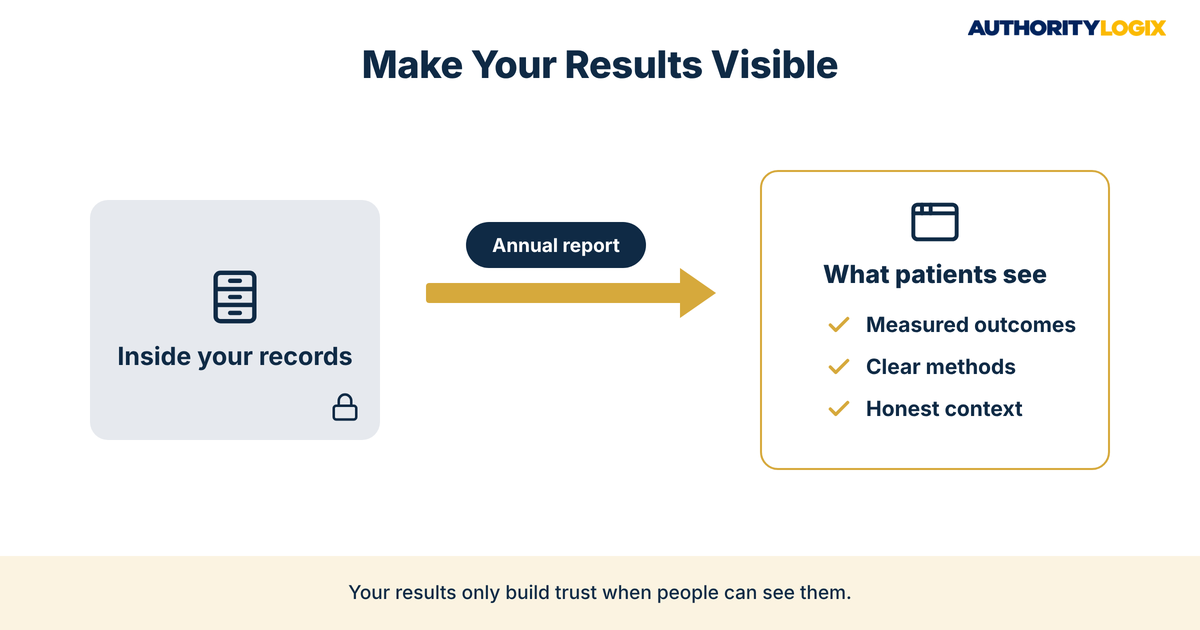
Physical therapy outcome data is the most credible thing your practice owns, and most practices keep it locked inside the EMR where no prospective patient or physician will ever see it. The market, meanwhile, sees a website that promises “patient-centered care” and “experienced clinicians,” the same words every competitor uses. That gap between what you know and what the market can see is a visibility problem, and it quietly weakens patient acquisition at every stage.
Practice owners who feel this gap most say some version of the same thing: we are the best practice in this area, but nobody knows we exist unless someone refers them. Published physical therapy outcome data is one of the few assets that answers that problem with evidence rather than adjectives. It shows how your practice measures its own work, which a star rating cannot do.
For prospective patients, the data answers a quiet question: does this practice take results seriously? For physicians, it answers a sharper one: will my patient be measured, reported on and returned with a clear picture of progress? Practices that report against their own practice benchmarks every year give both groups a reason to choose them that has nothing to do with being the closest clinic on the map.
Outcome reporting also signals something deeper about clinical authority. A clinic willing to define its measures, publish its numbers and explain their limits looks like a practice confident in its process. That confidence reads as expertise, and expertise is exactly what patients are trying to judge when they compare three clinics they have never visited.
None of this replaces the clinical work. Physical therapy outcome data simply makes that work visible, and visibility is the piece most practices have never built into their PT marketing. The rest of this article covers what to measure, how to package physical therapy outcome data into an annual report, where to publish it and how to keep every number compliant and honest.
The Physical Therapy Practice Authority Growth Blueprint shows where physical therapy outcome data fits inside a long-term plan for credibility, positioning and measured practice growth.
Why PT Data Transparency Builds Trust When Skepticism Is High
PT data transparency matters more now because audiences are less willing to take claims on faith. The 2026 Edelman Trust Barometer found that nearly 7 in 10 respondents fear institutional leaders are deliberately misleading the public, based on a survey of nearly 34,000 respondents in 28 countries. Healthcare marketing does not get a pass from that skepticism.
When patients have heard “personalized care” and “real results” from every clinic in town, those phrases stop working. What still works is evidence a reader can examine: how many patients were measured, what was measured, what changed between the first visit and discharge, and what the practice learned. Physical therapy outcome data gives you that evidence without a single superlative.
Search visibility points in the same direction. A published outcomes page is one of the clearest E-E-A-T signals a practice website can carry, because it demonstrates first-hand experience with specifics only your clinic can provide. It is original and no competitor can copy it, because no one else has your physical therapy outcome data.
Transparency also changes the conversation with referral sources and payers. A physician who receives a short annual summary of your results has something concrete to point to when a patient asks why they are being sent to you. When outcomes data needs to get in front of payers, a consistent yearly record gives your team something stronger to bring to a contract conversation than a brochure.
That reasoning explains why AuthorityLogix treats outcome reporting as infrastructure rather than a one-off campaign. The credibility already exists inside your charts. PT data transparency is the system that makes the market see it, year after year, on pages you own.
What to Include in a PT Outcome Reporting Framework
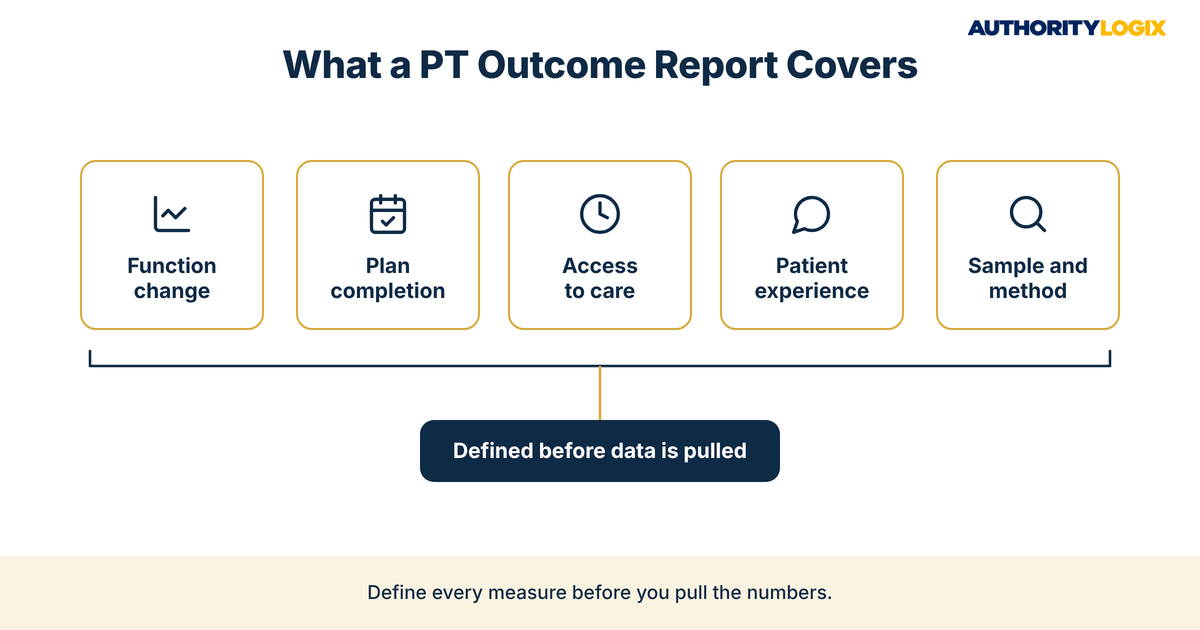
A PT outcome reporting framework decides, before any data is pulled, which measures you will publish, how each one is defined and how often it updates. Without that framework, an annual report becomes a scramble of whatever numbers look good this year, and readers notice. With it, your physical therapy outcome data tells the same honest story every year, which is what builds trust over time.
Start with measures your team already collects. Most outpatient practices record patient-reported function at intake and discharge with standardized questionnaires, track visits and cancellations, and survey patient experience. WebPT’s guide to outcomes tracking suggests a minimum of 25 patients before analyzing outcomes data, a useful reminder that small samples need care before they go public.
Which Physical Therapy Outcome Data Points Patients Understand
Patients do not read effect sizes. They understand plain statements: how much people reported their daily function changed, how many completed their plan of care, how quickly new patients were seen and how they rated the experience. Translate every measure into a sentence a prospective patient could repeat to a family member, and keep the technical definition one click away.
| Measure | What it shows readers | How to present it |
|---|---|---|
| Patient-reported function change | Whether patients reported better daily function at discharge than at intake | Average change by condition group, with the questionnaire named |
| Plan-of-care completion | How many patients finished the visits they and their therapist planned | Share of episodes completed, with the definition stated |
| Access to care | How soon new patients were seen after first contact | Typical days from first inquiry to evaluation |
| Patient experience | How patients rated communication, scheduling and care | Survey average with the number of responses |
| Sample and method | How much physical therapy outcome data stands behind each figure | Patient count, date range and what was excluded |
Every row in that table should come with its numerator, its denominator and the date range it covers. That discipline is what separates credible physical therapy outcome data from a marketing claim. It also makes the report easy to rebuild next year, because the definitions are already written and your content systems can pull the same structure into a new edition without starting over.
Keep the definitions somewhere permanent. A glossary page that explains each measure, each questionnaire and why the practice tracks it belongs inside a patient educational hub, where it also answers the questions prospective patients ask before booking.
How to Turn Physical Therapy Outcome Data Into an Annual Report
An annual report is the format that turns scattered physical therapy outcome data into a single credibility asset. It has a natural publishing date, a clear scope and an obvious reason to be shared.
Structure the report in five parts: a short letter from the owner on what the year looked like, the outcome measures with plain-language explanations, patient experience results, what the practice changed in response to the data, and a methods section. The “what we changed” section matters more than most owners expect. It shows a practice that uses its physical therapy outcome data, not one that only publishes the flattering parts.
Designing a Report Physicians Will Actually Read
Physicians and their staff will give your report a minute, not an afternoon. Lead with a one-page summary that shows the measures by condition group, the number of patients behind each and one sentence on what the practice is working to improve. Send the full report as a link, and bring the printed summary to referral visits.
Publish the full report as a page on your own site, not only as a downloadable PDF. A web page can be indexed, linked and updated, and it can appear in searches about your practice and the conditions you treat. Built with sound content SEO structure, the report keeps working long after release week.
Assign one owner, one data pull date and one review step each year. The process does not need to be complicated, but it has to be repeatable, which is why our process for practice content always starts with the system that produces a piece rather than the piece itself. A report that depends on one motivated staff member disappears the year that person leaves.
Not sure whether your website, profiles and published content give patients and physicians enough evidence to trust your practice? The assessment shows where physical therapy outcome data would close your credibility gap first.
Clinic Annual Report Marketing: Where to Publish and Promote Your Report
Clinic annual report marketing is the step most practices skip. They publish the report, post about it once and move on. The report earns its value through repetition: on your website, in referral conversations, in patient communications and across the channels where prospective patients compare clinics.
Start with your own properties. Link the report from your homepage, your about page and every relevant service page, and give it a permanent address that stays the same each year with past editions archived beneath it. Then send it directly to referral partners with a short personal note.
Repurposing the Report Across Search and Social
One annual report can supply a year of material. Each measure becomes a short post, each “what we changed” item becomes a story about how the practice works, and the methods section becomes a patient FAQ. Moving that material across email, LinkedIn and partner newsletters on a schedule is the job of authority distribution.
Your Google Business Profile deserves its own attention. A profile post announcing the report, with a link to the full page, puts physical therapy outcome data in front of people at the moment they are comparing practices on the map. That connection between proof and local visibility is where clinic annual report marketing pays off most, because the reader is already close to booking.

Keeping Outcome Reporting Compliant and Privacy Safe
Publishing physical therapy outcome data carries real obligations. Every number in a public report must be aggregated and de-identified, and no chart, quote or example may allow a reader to recognize an individual patient. Small groups are the main risk: a condition category with only a handful of patients can expose someone even without names, so combine or leave out any group too small to report safely.
Honesty rules matter as much as privacy rules. Reported outcomes describe what happened with past patients under your care; they never promise what will happen for the next one. State that plainly on the report page, and avoid words like “guaranteed” or “cure.” If you include patient stories, follow the same consent and privacy discipline used for outcome case studies, with written authorization and nothing identifying beyond what the patient approved.
Have your compliance advisor review the report before release, and document your methods so every figure can be traced back to its source data. A practice that shows its methods earns more trust than one with better-looking numbers and no explanation, and it protects itself if a figure is ever questioned.

FAQ: Questions Practice Owners Ask About Publishing Outcome Data
What is the purpose of outcomes disclosure in outpatient PT?
It gives prospective patients, physicians and payers evidence of how your practice measures and reports its own work. Physical therapy outcome data on a public page replaces generic claims with specific, checkable information. That matters most in local search results, where every listing looks similar until one of them offers something concrete.
What if our physical therapy outcome data is not impressive?
Publish it anyway, with context and with what the practice is doing about it. Readers trust a practice that reports honestly and shows steady improvement more than one that only shares its best year. Choosing your measures before you see the results keeps the report honest.
How is patient privacy maintained during data reporting?
Report only aggregated, de-identified results, combine or omit any group too small to protect anonymity, and never publish details that could identify an individual. Your compliance advisor should review the report before release. Any patient story requires written authorization.
How often should a practice publish outcome results?
Once a year is the right rhythm for a full report, with a short mid-year update if your patient volume supports it. A consistent schedule matters more than frequency. Practices that want to see how this fits a wider publishing plan can browse our PT resources for related guides.
Does publishing outcome data guarantee more new patients?
No. Outcome reporting is a credibility asset, not a promise of volume. It works alongside your website, reviews and referral relationships, and its value builds as each yearly edition adds to the record.
Ready to turn your physical therapy outcome data into an annual report, the pages that host it and the distribution that puts it in front of patients and physicians?
Making Annual Reporting a Repeatable Credibility Asset
Physical therapy outcome data becomes a credibility asset when it is published on a schedule, explained clearly and connected to everything else your practice puts in front of patients. One report is a document. Five consecutive reports are a public track record that no new competitor can match, because a track record can only be built over time.
That track record works best when it feeds a larger system. The report links to service pages, the service pages link to booking, and every edition gives your lead generation infrastructure fresh proof for people still deciding. AuthorityLogix built that kind of connected system first on BKDSCR.com, with 18 pillar pages, 7 interactive tools and 48 posts and zero paid ads, before building it for clients.
The honest assessment is that most practices already have the physical therapy outcome data they need. The missing piece is the structure that defines it, packages it, protects patient privacy and publishes it every year. Building that structure is what our services cover, so your clinical record finally becomes visible to the patients and physicians deciding where to go.