


Key Takeaways
- Physical therapy school partnerships put your practice in front of student athletes, parents and coaches, one of the most connected audiences in any town.
- The NFHS High School Athletics Participation Survey counted 8,260,891 high school sports participants in 2024-25, up 198,589 from the year before.
- Athletic directors renew partners who bring education, easy booking and clear boundaries, not vendors asking for a banner and a referral list.
- A PT sports team partnership should be written down: what the practice provides, what it never does, who owns the relationship and how families book.
- Physical therapy school partnerships build community authority only when the work becomes visible online through local content, press coverage and accurate listings.
- Track recognition with simple numbers, such as how many new patients name a school or team, so physical therapy school partnerships earn their place in the budget.
Table of Contents

Why Physical Therapy School Partnerships Build Community Authority
Physical therapy school partnerships give a practice something most marketing never reaches: a standing place in the weekly life of local families. You may have treated athletes for years, yet the parents in the bleachers still could not name your clinic. That gap is not about skill but about where your expertise shows up, and a steady school relationship is one of the most reliable ways to widen patient acquisition beyond a short list of referring physicians.
The audience is large, and it is still growing. According to the NFHS participation survey, 8,260,891 participants were involved in high school sports in 2024-25, up 198,589 from the previous year. Each of those athletes comes with parents, siblings, coaches and teammates, and every one of them is a potential patient or a potential recommendation for someone who is.
School sports also concentrate trust. A coach who tells a parent where to go when a player is hurting carries more weight than any ad, because the family already relies on that coach. Physical therapy school partnerships turn that trust into community presence, so your name is the one people hear at practice, in the stands and in the group chat after the game.
The cost of staying out is real. One referring doctor retires and the pipeline dries up overnight. Practices that depend on a few physician offices have no buffer, while practices with physical therapy school partnerships have a second source of direct-access interest built on relationships in the community. That second source belongs at the center of modern PT marketing because it reaches families long before anyone books a physician appointment.
Visibility still decides the outcome. A parent who hears your name at a game will often search for you that night, and what they find either confirms the coach’s recommendation or quietly undercuts it. Strong local visibility, meaning accurate listings, recent reviews and pages that speak to young athletes and their families, is what keeps physical therapy school partnerships from leaking interest at the moment it matters.
The Physical Therapy Practice Authority Growth Blueprint shows how community relationships, local search and content work together as one growth system, and where physical therapy school partnerships fit inside it.
How to Approach Physical Therapy Athletic Programs as a Partner, Not a Vendor
Most athletic directors have been pitched before, so partner-first outreach for physical therapy athletic programs starts with the director’s problems, not yours. Ask what wears on them during the season: parents with questions the coaching staff cannot answer, preseason education nobody has time to run, or no clear local option when a player needs an evaluation. Physical therapy school partnerships that answer one of those needs get a second meeting, while pitches that open with a sponsorship request rarely do.
Credentials matter more than enthusiasm in that first conversation. Bring the clinicians who would work with the program and show where families can read about them. A director is lending you the school’s reputation, and the clinical authority your website already shows is what makes that loan feel safe.
Respect the people already in place. If the school has an athletic trainer or a team physician, position your practice as a complement to their work, never a replacement, and ask how you can support the athletic training services they already run. Physical therapy school partnerships that start by competing with existing staff tend to end the same season they begin.
Finally, think in seasons, not single events. A partner shows up before the first practice, through the schedule and after the final game, unlike a vendor who appears once. That long view is part of why AuthorityLogix treats every relationship as infrastructure: consistent presence builds recognition that a one-off event cannot buy.

What a PT Sports Team Partnership Should Include
A PT sports team partnership needs a written scope, even when the relationship starts with a handshake. The document can be a single page, but it should say what the practice provides, how often, who the contact is on each side and how families reach the clinic. Writing it down protects the school, protects your practice and keeps physical therapy school partnerships from drifting into favors nobody tracks.
| Partnership element | What it looks like | Why it builds authority |
|---|---|---|
| Education | Preseason talks for athletes and parents, coach handouts | Puts your clinicians in front of families as trusted teachers |
| Scheduling access | A dedicated booking link and a named front-desk contact | Turns a coach’s recommendation into an evaluation without delay |
| Event presence | A table at home games, tournaments and booster nights | Makes the practice a familiar name in the school community |
| Shared content | Articles and guides the school can post or send to families | Gives the program useful material and gives your site local signals |
| Recognition | Program listing, game-day mention or website credit | Creates visible, local proof of physical therapy school partnerships |
| Season review | A meeting with the athletic director after each season | Keeps the partnership aligned with what the program needs |
Each line in the table should be something your team can deliver every season, not just the first. Building repeatable materials, such as slide decks, family handouts and a standing booking page, is the kind of work behind our services, because a PT sports team partnership is only as reliable as the system behind it.
Clear Boundaries That Keep the Partnership Marketing Focused
Boundaries are what make physical therapy school partnerships sustainable. Your practice educates, makes booking easy and shows up in the community; it does not diagnose athletes on the sideline, promise return-to-play timelines or tell coaches what treatment a player needs. Clinical decisions belong inside a proper evaluation, and keeping them there protects players, families and your practice.
Privacy is the second boundary. Never share a student’s care details with coaches or staff without the right consent, and never post athlete names or photos without written permission from a parent or guardian. Check any sponsorship or free-service arrangement with your compliance advisor before you sign.
Time is the third boundary. Decide how many events per season your team can staff and put that number in the scope, because overpromising is the fastest way to lose a director’s trust. Mapping commitments before the season starts mirrors our process with practices: plan the system first, then build only what the team can keep running.
Turning Physical Therapy School Partnerships Into Visible Local Content
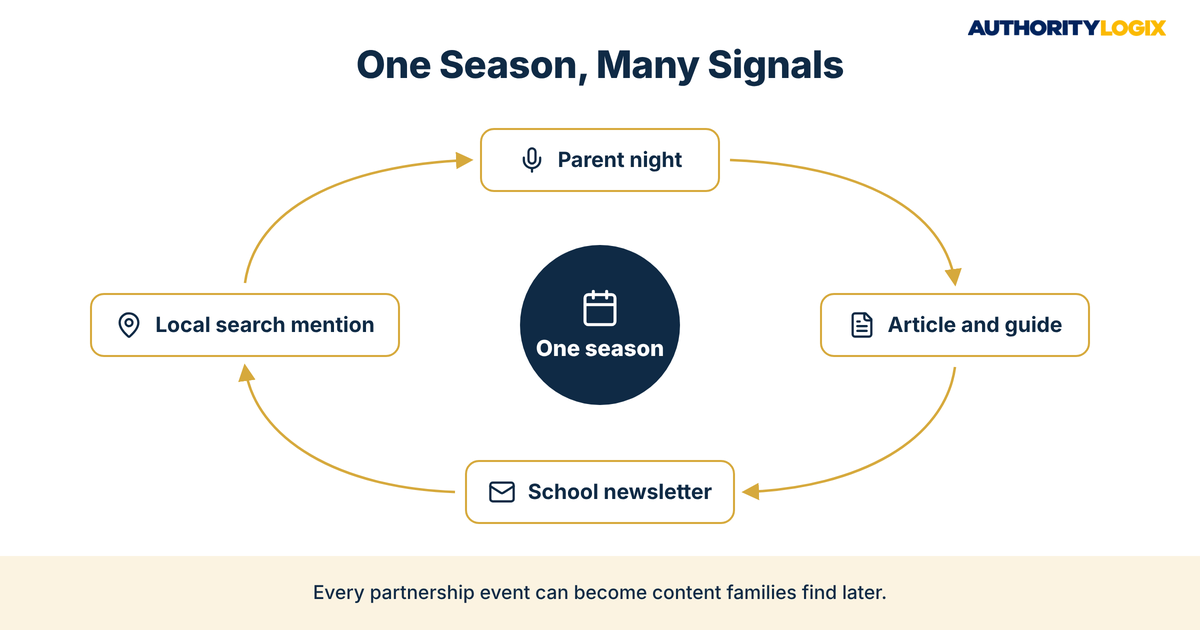
A partnership nobody can see online does half its job. The families at the game know you, but the parent new to town, the club coach in the next district and the adult runner searching for a sports clinic do not. Physical therapy school partnerships become community authority when the work is published, shared and easy to find.
Start with what the partnership already produces. A preseason talk becomes an article, a parent night becomes a short video and a guide, and a season recap becomes a post the school can share. Sending that material out through school newsletters, booster club emails and your own channels is the job of authority distribution, and it multiplies every hour your clinicians spend in the gym.
Physical Therapy School Partnerships and Local Search Signals
Search engines look for evidence that a business is part of its community. Mentions on a school athletics page, a booster club sponsor list or a local news story about a parent education night all support local search rankings for youth sports and athlete-focused queries. Physical therapy school partnerships create those mentions naturally, as long as someone on your team asks for the listing and confirms the link points to the right page.
Bigger milestones deserve wider coverage. The launch of a new partnership, a free community workshop or a full season of parent education are all fair subjects for press releases that local outlets and community sites can pick up. Keep each announcement factual, focus on what families gain and leave out any claims about treatment outcomes.
This is the same approach AuthorityLogix used on its own proof-of-concept build, BKDSCR.com, a real estate investment education platform rather than a PT practice. It was built with 18 pillar pages, 48 posts and zero paid ads, and every published piece supports the next one. Physical therapy school partnerships can work the same way, with each season adding content, mentions and recognition that stay online long after the final whistle.
Not sure whether your practice is visible enough for a school partnership to show up online? The assessment shows where physical therapy school partnerships would stall today and what to fix first.
PT Community Sports Outreach Beyond the Sideline
School teams are only one part of local sports. Youth clubs, recreation leagues, travel teams, running groups and adult leagues all serve people who move, train and sometimes get hurt. PT community sports outreach extends the reach of physical therapy school partnerships into these groups, often through the same parents and coaches who already know your practice from school events.
Not every outreach effort needs a contract. A screening day at a club, a tournament booth or a talk for a league’s coaches can all introduce your clinicians to new families. Practices that run free screens well treat them as education events with a clear next step, not as sales pitches.
Workshops and Education Nights for Families and Coaches
Education nights are often the most valuable thing a practice can offer a program. Parents and coaches want general guidance on supporting athletes through a busy season. Keep it educational, and invite anyone with a specific concern to book an evaluation rather than answering it from the front of the room.
Every workshop should end with a low-pressure way to stay in touch. A sign-up sheet, a QR code to a family guide or a booking link turns a room of listeners into future patients and referrals. That structure is what connects PT community sports outreach to lead generation instead of leaving it as goodwill nobody can measure.
Tracking Whether a Partnership Is Building Recognition
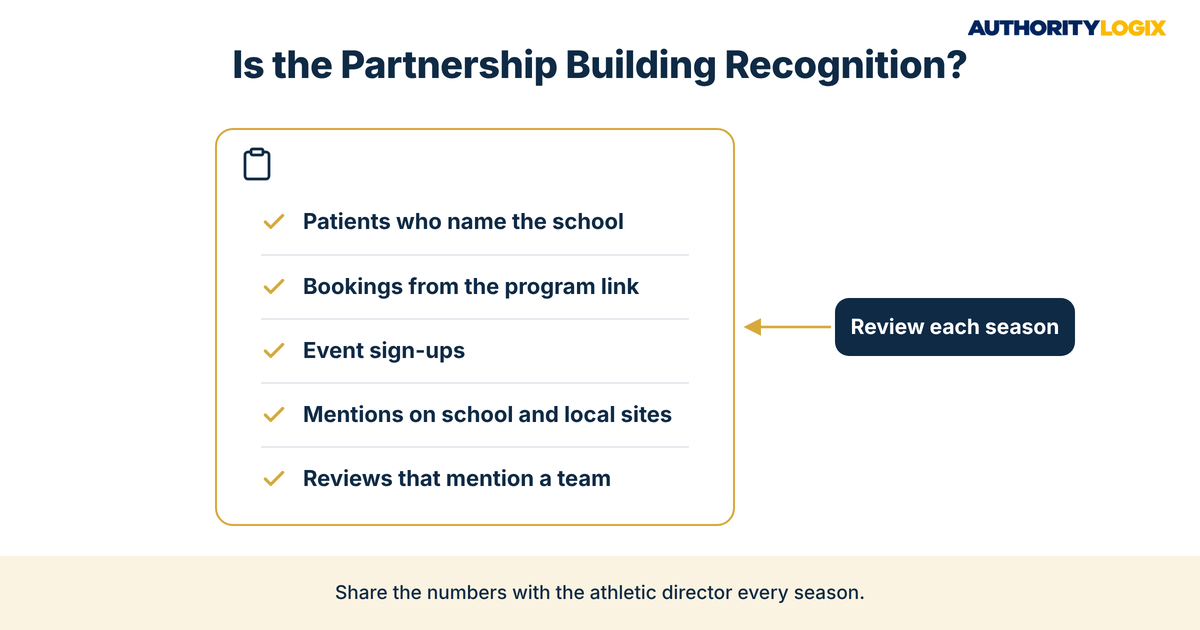
Physical therapy school partnerships deserve the same scrutiny as any other marketing investment. Time, staff hours and sponsorship dollars all have a cost, and the owner should know whether the relationship is building recognition or simply filling the calendar. The answer comes from a few simple numbers reviewed every season:
- New patients who name a school, team or coach when asked how they heard about you
- Bookings through each program’s dedicated link or code
- Workshop and event attendance, plus the sign-ups collected
- Mentions and links on school, club and local news sites
- Searches for your practice name during and after each season
- Reviews that mention a team, a program or a family event
Those numbers only appear if intake asks the right question and the content behind the partnership is organized. A repeatable set of program pages, event recaps and family guides, produced through content systems, makes it easy to see which schools send interest and which pages those families read before booking. Without that structure, the impact of physical therapy school partnerships stays anecdotal.
Review the results with the athletic director at the end of every season. Share what the practice provided, what families responded to and what you plan to change, and ask what the program needs next year. Physical therapy school partnerships reviewed this way are far easier to renew, because both sides can see the value in plain numbers.
FAQ: Questions About School and Team Partnerships
Can a physical therapy practice sponsor a high school sports team?
Yes, where the school’s policy and your state’s rules allow it. Sponsorship works best as one part of physical therapy school partnerships rather than the whole relationship. A banner earns a little recognition, while education, event presence and easy booking earn trust.
How do you market a physical therapy practice to local schools and coaches?
Lead with useful education, not promotion. Offer a preseason talk, a family guide or a coach handout, and host the same material on a patient educational hub so families can find it after the event. Physical therapy school partnerships built on education give the program a reason to keep inviting you back.
Does my child need a doctor’s referral to see the physical therapist who works with our team?
It depends on where you live. Direct access rules differ from state to state, so ask the practice how the rules apply in your state when you call to book.
How do I know a team-recommended practice is a good fit?
Look at the clinicians’ credentials, the conditions the practice treats and what recent reviews say about working with young athletes. A practice that publishes clear family guides makes that check easy before you call. Practice owners who want to build that kind of trust content will find the frameworks in the PT resources library.
Ready to build the program pages, family education content and tracking that turn school and team partnerships into lasting community authority?
Making Sports Partnerships Part of a Long-Term Authority Plan
Physical therapy school partnerships are not a one-season promotion. They place your practice inside the community’s weekly routine, where trust is built by showing up, teaching and making care easy to reach. The practices that gain the most treat each school and team as a long-term asset with an owner, a scope and a plan.
That plan works best when it connects to the rest of your visibility system. Program pages, event recaps and family guides should be built with the same search discipline described in the content SEO playbook, so the families who hear your name at a game find answers that match what the coach told them. Authority compounds.
The honest answer is that most practices already have the clinical credibility athletic programs are looking for. What is usually missing is the structure that makes physical therapy school partnerships visible, measurable and easy for a director to renew year after year.