Key Takeaways
- Physical therapy free screen workshop lead generation works when the event is the first step of a sequence — capture, follow-up and booking — not the whole effort.
- Workshops, free screens and free consultations answer different questions, so match the format to where each attendee is in their decision.
- For National Physical Therapy Month 2024, APTA published a guide to hosting a falls screening and assessment, and the CDC reports that 1 in 4 older adults report falling every year.
- Free services carry rules: the HHS Office of Inspector General’s 2016 nominal value policy and some state and payer rules apply, so review every event with a compliance advisor first.
- A free screen is an educational conversation, not a diagnosis — honest framing protects trust and makes the case for a full evaluation.
- Measure physical therapy free screen workshop lead generation by evaluations booked and attended, not by how many people filled the room.

Physical therapy free screen workshop lead generation is one of the few patient acquisition channels where a prospective patient meets your clinicians before they ever search your name. You may have run balance screens at the senior center, a back-care talk at the library and a booth at the local 5K, and still watched the evaluation calendar stay flat the following month. The events were rarely the problem — the missing piece is the
lead generation system that catches every attendee and moves them toward a booked evaluation.
That gap is what credible but invisible looks like offline. Your clinicians earned real trust in the room, but the moment the attendee walks out, nothing connects them back to the practice except a brochure. This article treats physical therapy free screen workshop lead generation as infrastructure: the format, the audience, the follow-up and the measurement, built so each event feeds the next one.
How Physical Therapy Free Screen Workshop Lead Generation Fills the Evaluation Calendar
Most practices still fill the schedule from physician referrals, and that dependence is fragile. One referring doctor retires and the pipeline dries up overnight. Community events are one of the most practical ways to build
direct access demand, because they put a licensed clinician in front of people who already have a question about how they move.
Physical therapy free screen workshop lead generation works when the event is the start of a sequence rather than the whole effort. A community workshop introduces a topic, a free screen gives the attendee a short individual conversation, and a follow-up message gives them a clear path to book. When one step is missing, interest fades before it becomes an appointment.
The calendar effect is cumulative. A practice that runs one well-planned event a month, captures contact details with consent and follows up within days builds a steady flow of first evaluations that does not hinge on any single referral source. That is the practical case for physical therapy free screen workshop lead generation — not a spike after one busy Saturday, but a channel that keeps adding direct-access patients month after month.
The Physical Therapy Patient Acquisition Playbook shows where free screens and community workshops sit inside a complete new-patient pipeline — from first contact to booked evaluation.
Acquisition Playbook →
PT Free Consultation Lead Generation: Screens, Consults and Where Each One Fits
Free screens, workshops and free consultations get lumped together, but they answer different questions for different people. PT free consultation lead generation usually happens one-on-one, for someone who already knows they want help and is deciding where to go. A free screen is shorter and happens at an event, for someone who is curious but not yet committed. A workshop speaks to a whole group, and all three belong in a physical therapy free screen workshop lead generation plan.
| Format |
Who It Reaches |
What the Attendee Wants |
Best Next Step |
| Community workshop |
Groups with a shared concern, such as runners, new parents or older adults |
Plain-language education on one topic |
Offer a free screen or consult before they leave |
| Free screen at an event |
Curious people who are not yet committed |
A short, individual conversation about how they move |
Book a full evaluation, with cost and coverage explained |
| Free consultation |
People already comparing practices |
Confidence that this clinic fits their situation |
Schedule the evaluation on the same call |
The right mix depends on where your patients come from and what your clinicians are known for. Service lines, locations and specialties shape which events make sense, which is why the
PT industry hub frames patient acquisition by practice type rather than as one template. A sports clinic and a pelvic health practice need different physical therapy free screen workshop lead generation calendars.
Whatever the format, physical therapy free screen workshop lead generation follows the same logic: capture the contact, set honest expectations and make the next step easy. Building that logic once — sign-in forms, consent language, follow-up messages, booking links — and reusing it at every event is part of
what we do for practices that have the clinical reputation but not the system behind it. Without it, every event starts from zero.

Physical therapy community workshop marketing starts with the audience, not the venue. A workshop on staying steady on your feet draws a different crowd than one on returning to running, and each crowd needs a different follow-up. Strong physical therapy free screen workshop lead generation depends on a topic your clinicians speak about with real authority and an audience you want more of on the schedule.
APTA has made falls-related events easier to run. For National Physical Therapy Month 2024, which focused on falls prevention, APTA provides a guide to hosting a falls
screening and assessment for PTs, PTAs and volunteers looking to get involved in their community. The CDC reports that over 14 million older adults, or 1 in 4, report falling every year, so falls are a concern many families already share.
Promotion is where most events fall short. Attendees find workshops the same way they find a practice, so the event page, the Business Profile post and every partner listing should point to one registration link. That connection is covered in the
local visibility guide.
Registration pages also earn their keep in
local search, because a page that names the topic, the neighborhood and the date answers exactly what nearby searchers type. Keep each event page live after the date with a short recap and a booking link. That way the page keeps working for physical therapy free screen workshop lead generation long after the room empties.
Partners widen your reach without extra ad spend. Senior centers, running clubs, gyms and employers all have audiences, and co-hosting puts your clinicians in front of people who already trust the host. That kind of
authority distribution — your expertise showing up where future patients already gather — gives physical therapy community workshop marketing reach well beyond your own mailing list.
A Compliance Check Before the First Event
Free services carry rules. The HHS Office of Inspector General’s December 2016 policy statement on gifts of nominal value treats free items and services as remuneration, and it sets nominal value at no more than $15 per item and $75 in the aggregate per patient per year for Medicare and Medicaid beneficiaries. Some states and commercial payers have their own rules on free screens, so review every physical therapy free screen workshop lead generation plan with your compliance advisor before you promote it.
Not sure whether your events are producing evaluations or just sign-in sheets? The PT Authority Gap Assessment shows where your follow-up, event pages and local search are leaking leads.
Authority Gap Assessment →
Turning a PT Free Assessment Into New Patients Without Pressure
The moment after a free screen decides whether a PT free assessment brings in new patients or just a polite thank-you. Attendees are wary of being sold to, and a hard close at a community event damages the trust the workshop just built. The goal is to make the next step clear and optional, then let the attendee choose it.
Keep the screen honest about what it is. A free screen is a short educational conversation, not a diagnosis and not a substitute for a full evaluation. That honesty protects the practice and keeps physical therapy free screen workshop lead generation trustworthy, while the evaluation makes its own case: the full visit is where a licensed clinician looks at the whole picture.
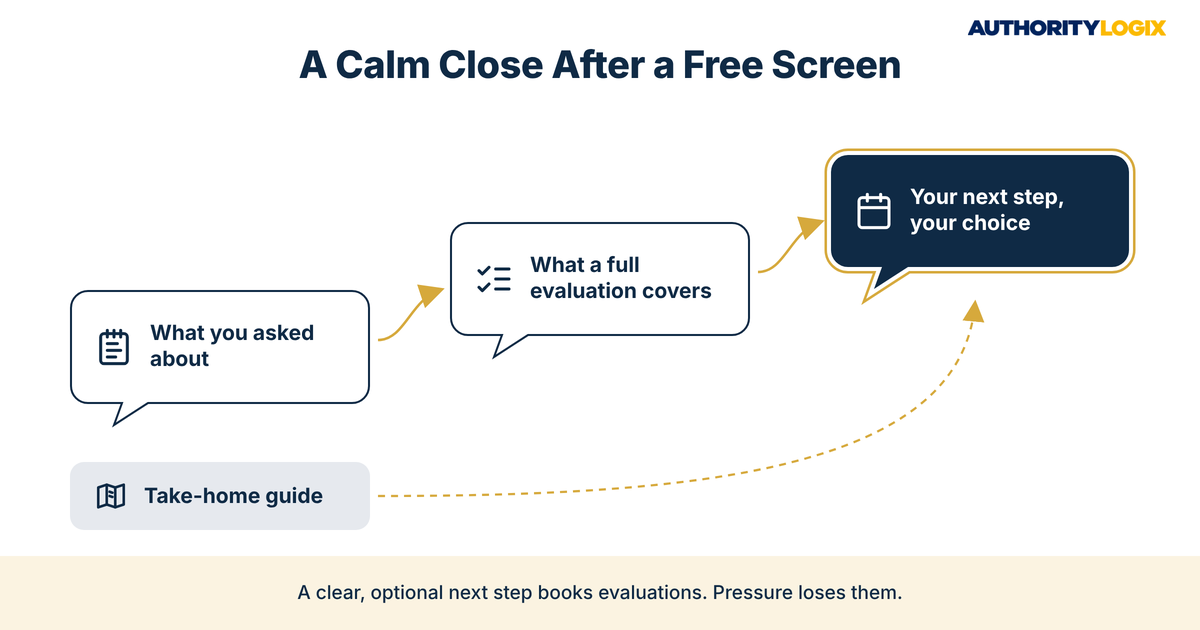
The Calm Close Behind PT Free Assessment New Patients
A calm close has three parts. Summarize what the attendee asked about, explain what a full evaluation would cover, and offer to hold a time with cost and coverage questions answered up front. Then hand over something to take home.
That take-home piece matters more than most practices expect. A one-page explainer on the workshop topic, written in your clinicians’ own words and shaped by the patient education approach in the
clinical authority guide, gives attendees a reason to remember who answered their question.
The same material should live on your website. When the workshop topics sit in an
educational hub as articles, FAQs and short videos, attendees can revisit the advice and physical therapy free screen workshop lead generation gets a second life in search.
Measuring Physical Therapy Free Screen Workshop Lead Generation Through Follow-Up and Bookings
Attendance is the easiest number to count and the least useful one. Measuring physical therapy free screen workshop lead generation means tracking each attendee from sign-in to booked evaluation, so you can see which events, topics and partners actually produce patients. A packed room that books nobody is a cost, not a success.
| Stage |
What to Track |
What It Tells You |
| Registration |
Sign-ups by source: partner, event page, map listing, email |
Which channels fill the room |
| Attendance |
Attendees as a share of registrations |
Whether reminders and timing are working |
| Contact capture |
Attendees who agreed to follow-up |
Whether sign-in and consent work at the door |
| Follow-up |
Messages sent and replies received in the first week |
Whether interest survives the drive home |
| Bookings |
Evaluations booked and attended per event, with PT free assessment new patients tagged by source |
Whether physical therapy free screen workshop lead generation is paying for itself |
The Follow-Up Window in Physical Therapy Free Screen Workshop Lead Generation
Interest fades quickly after an event. Send a thank-you within a day with the take-home material, a direct booking link and a reminder of what the evaluation covers, then follow up once or twice more over the next two weeks. A connected
lead funnel handles this automatically, so the front desk is not rebuilding the physical therapy free screen workshop lead generation list by hand after every Saturday.
Follow-up needs material to send, and that material has to come from somewhere other than a clinician’s spare evening. Well-run
content systems turn each workshop into reusable assets — the slides become an article, attendee questions become FAQs, the recap becomes an email. Each round of physical therapy free screen workshop lead generation then makes the next one easier to promote.

What Most PT Practices Get Wrong About Free Screens (and What Attendees Really Want to Know)
Practice owners and attendees tend to ask the same handful of questions about free screens. These are the ones that come up most often, with straight answers about what physical therapy free screen workshop lead generation can and cannot do.
Is a free screen the same as a physical therapy evaluation?
No. A free screen is a short educational conversation about how you move. It does not diagnose anything, and a licensed physical therapist completes a full evaluation before recommending any plan of care.
Do I need a doctor’s referral to book after a screen?
Often not. APTA reports that patients in all 50 states, the District of Columbia and the U.S. Virgin Islands have either provisional or unrestricted direct access to physical therapists. The details vary by state and by insurance plan, so ask what applies before you book.
Why do our events draw a crowd but not bookings?
Usually because physical therapy free screen workshop lead generation is treated as a one-day event rather than a sequence. Without contact capture, a take-home piece and a follow-up sequence, interest fades within days. Practices that publish their workshop topics as searchable pages, an approach laid out in the
content SEO playbook, give attendees a way back that does not depend on a flyer.
Will I be pressured to sign up for treatment?
You should not be. A well-run free screen ends with clear information and an optional next step. If an event feels like a sales pitch, that tells you something about the practice.
How often should a practice run free screens and workshops?
Consistency beats intensity. APTA recognizes National Physical Therapy Month every October, which makes a natural anchor, but a steady monthly or quarterly rhythm builds more familiarity than one big push. The
growth blueprint treats physical therapy free screen workshop lead generation as one recurring channel among several, measured by evaluations booked rather than heads counted.
What should we publish so people can find us after the event?
Publish what the workshop taught. Recaps, condition explainers and FAQ pages turn a one-hour event into material people can search for, share and return to. Practice owners who want examples of how that education is structured can browse the PT
resource library for formats that support physical therapy free screen workshop lead generation.
Ready to turn free screens and community workshops into a follow-up and booking system that keeps producing evaluations after each event?
Work With Us →
The Honest Close: Events Work When Your Website Backs Them Up
Free screens and workshops are one of the most human ways to meet future patients, and they still fall flat when nothing catches the people who walk out the door. The event earns attention. The follow-up, the event pages, the educational content and the booking path turn that attention into evaluations.
That sequence shapes
how we build patient acquisition systems for physical therapy practices: event pages and local listings first, then the follow-up and content that make each workshop reusable. The order matters, because a strong event with no infrastructure behind it is a one-time conversation.
AuthorityLogix proved this kind of system on its own build first. BKDSCR.com, a DSCR real estate education platform, was built from scratch with 18 pillar pages, 7 interactive tools and 48 SEO-optimized blog posts, and it generates inbound leads with zero paid ads. It is a different industry, but the same principle explains
why AuthorityLogix builds infrastructure instead of one-off campaigns.
The honest answer is that most practices already have clinicians who are excellent in a room full of people. What is missing is the physical therapy free screen workshop lead generation system that makes sure every one of those conversations has somewhere to go next.


