


Key Takeaways
- The physical therapy front desk is where marketing either becomes a booked evaluation or disappears, because the call is often the first real conversation a patient has with your practice.
- A missed new-patient call never shows up in a report, so missed calls clinic revenue is lost quietly.
- New patient call conversion can be measured with a few numbers: calls answered, new-patient calls, evaluations booked and evaluations attended.
- Physical therapy phone scripts should guide the call toward a booked time, answer cost questions honestly and never cross into clinical advice.
- In a March 10, 2026 MGMA Stat poll of 294 practice leaders, eligibility and prior authorization (45%) and scheduling (31%) were the most time-consuming phone tasks.
- The physical therapy front desk can only convert the inquiries that search visibility and content create, so call handling belongs inside the acquisition system.
Table of Contents
Why the Physical Therapy Front Desk Decides Whether Marketing Pays Off
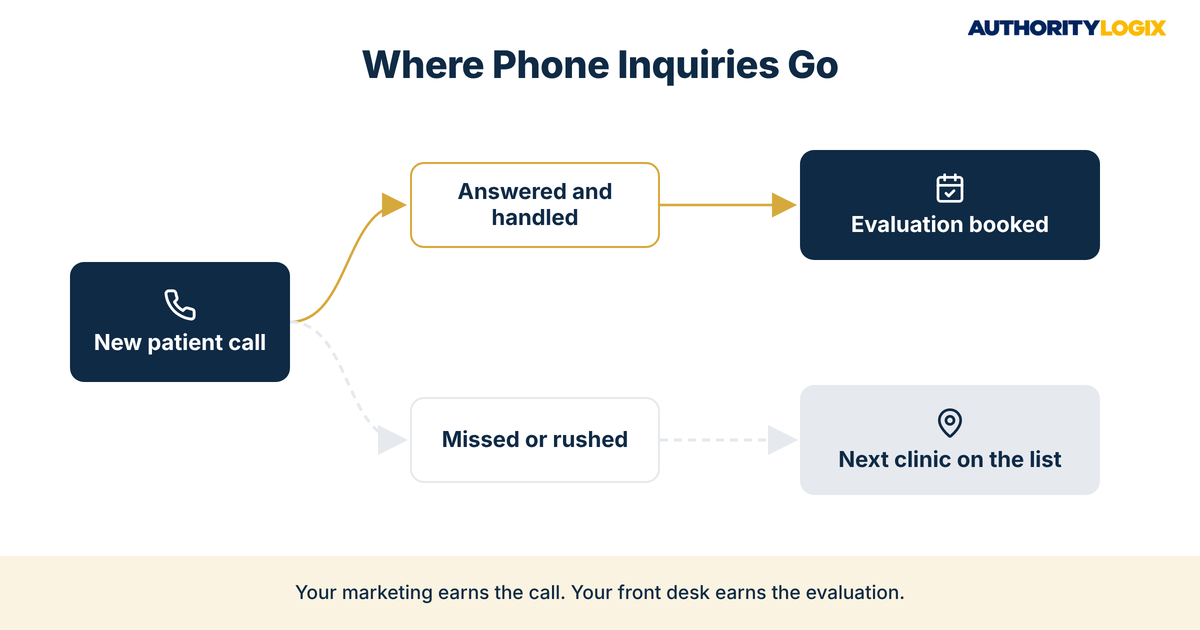
Your physical therapy front desk is the point where every dollar and hour spent on marketing either turns into a booked evaluation or quietly disappears. A prospective patient finds you on Google, reads a condition page, hears your name from a friend, and then picks up the phone. Clinically strong PT practices lose evaluations at exactly this moment without knowing it, because nobody measures what happens on the line.
This is the credible-but-invisible problem in a new place. You earned the clinical reputation, and your marketing may already produce inquiries. But if the caller reaches voicemail or waits on hold, the market never experiences the practice you actually run.
Most practices treat the front desk as administration and marketing as a separate project. That split is the mistake. Across the full scope of our services, call handling sits inside the patient acquisition system, because the phone is where demand you already paid for is captured or lost.
Think about what a strong lead generation system produces: a person with a problem, a phone number and a reason to choose you. The physical therapy front desk is the final stage of that system, and the only stage where one sentence can lose the patient. “We are booked out for a while” ends a call that cost real money to create.
Treating the phone as part of authority growth changes the questions owners ask. Instead of asking whether the clinic feels busy, the question becomes how many new-patient calls arrived this week and how many became evaluations. That shift is the foundation for everything that follows.
The Physical Therapy Patient Acquisition Playbook maps the full path from first search to first visit, including where physical therapy front desk call handling fits and how it connects to every channel that makes the phone ring.
What Unanswered Phone Inquiries Really Cost a Practice
An unanswered call costs more than the call. Every new-patient inquiry represents marketing that already worked: a ranking earned, a review read, a referral given. When that call goes to voicemail, the practice paid the full price of acquisition and collected nothing.
The caller’s next move matters most. Someone in pain may not wait for a call-back from a practice they have never visited, because one tap returns them to the search results and the next name. That is why speed to response is a patient acquisition issue, and why the physical therapy front desk needs a rule for every call not answered live.
The loss is also invisible. A missed call leaves no complaint and no line in the billing report. The schedule simply shows an open slot, and owners conclude that marketing is not working when the inquiries were never converted.
This hits hardest for practices that have invested in local visibility. The better your Google Business Profile performs, the more likely people are to tap the call button straight from the map listing while comparing several clinics. A slow phone hands those shoppers to whichever competitor picks up first.
Estimating missed calls clinic revenue
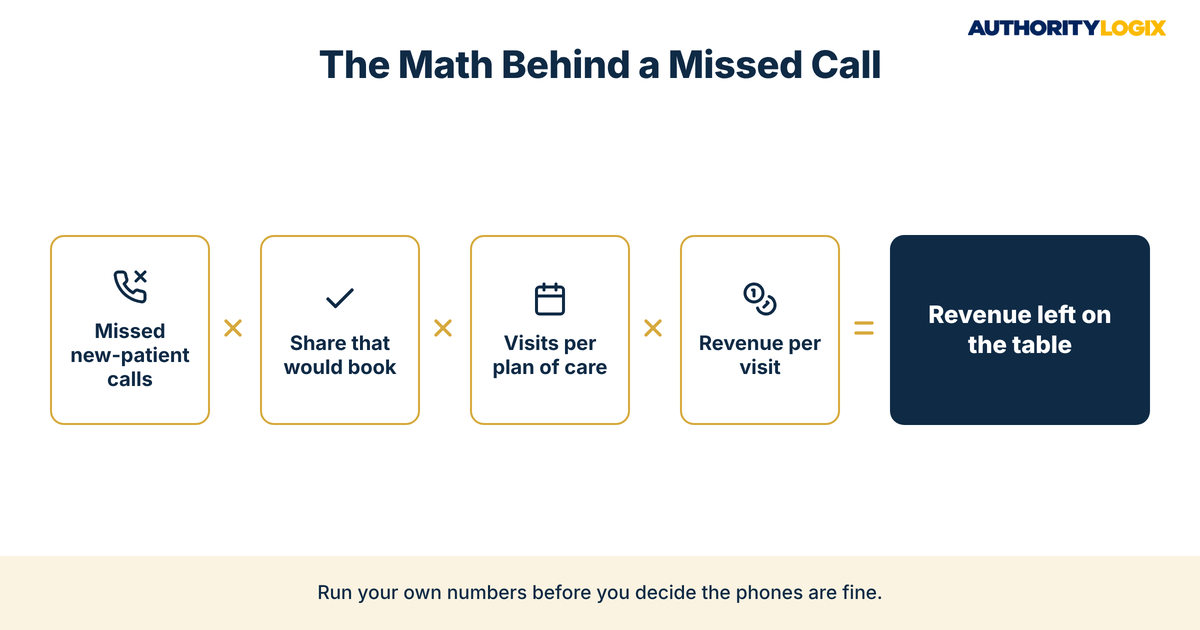
You do not need a consultant to put a number on missed calls clinic revenue. You need a handful of figures from your own practice, and most already live in your practice management system or phone reports.
| Input | What it means | Where to find it |
|---|---|---|
| Missed new-patient calls per month | Calls that reached voicemail, rang out or were abandoned on hold | Phone system or call-tracking report |
| Share that would have booked | Your normal new patient call conversion | Physical therapy front desk call log |
| Visits per plan of care | Average visits a new patient attends | Practice management system |
| Revenue per visit | Average collected revenue per visit | Billing report |
| Estimated monthly loss | The four inputs multiplied together | Your own calculation |
Multiply the first four lines and the result is a monthly estimate of visits that never happened. It is an estimate, not an invoice, but it gives the owner a number to weigh against the cost of better coverage. Run it every quarter and the physical therapy front desk becomes a line item you manage.
Measuring New Patient Call Conversion at Your Physical Therapy Front Desk
New patient call conversion is the share of calls from prospective patients that end with a booked evaluation. It is the most useful single number for judging your physical therapy front desk, and it is easy to miss, because phone systems report calls, practice management systems report visits, and nothing connects the two.
Start by separating new-patient calls from everything else. Existing patients rescheduling, physician offices checking on records and vendors all ring the same line, and blending them hides the calls that matter most. Once new-patient calls are counted on their own, the conversion gaps become visible: calls that ended with a promise to call back, calls that stalled on insurance, and calls that were never answered at all.
A short weekly scorecard is enough to begin. Track these numbers for every week and every location:
- Calls answered live versus missed, by hour of the day
- New-patient calls identified
- Evaluations booked on the first call
- Evaluations booked after a call-back
- Evaluations attended
Review the scorecard with the people who answer the phone. The goal is not to grade staff; it is to show where calls leak. When a physical therapy front desk misses calls at lunch, that points to a staffing gap, while answered calls that end without a booking point to a script gap.
Call tracking makes this easier. A tracking number on your website and each campaign shows which sources generate calls and which convert, the same measurement discipline built into our process for every acquisition system. When you see new patient call conversion by source, you stop guessing and start fixing the step where patients fall out.
Not sure how many new-patient calls your physical therapy front desk converts today? The assessment shows where inquiries stall between the first search and the booked evaluation, and what to fix first.
Physical Therapy Phone Scripts That Turn Inquiries Into Evaluations
Physical therapy phone scripts get a bad reputation because people picture staff reading lines like a call center. A good script is not a monologue; it is a sequence that makes sure every new-patient call covers the same essentials and ends with a clear next step. The words can flex to fit the caller, but the order should not.
- Greet with the practice name and your own name.
- Listen for the reason for the call and repeat it back.
- Explain briefly what happens at the first evaluation.
- Answer cost questions honestly, or say when you will have the answer.
- Offer two specific appointment times.
- Confirm the booking and send the details by text.
Scripts work best when the physical therapy front desk has real answers to the questions callers ask. What happens at the first visit and whether a referral is needed should have consistent answers that match what your patient education pages already say online. When the phone and the website tell the same story, callers trust both.
Draw a firm line around clinical questions. The physical therapy front desk should never guess at a diagnosis or promise results. The right response is warm and specific: the physical therapist will assess that at the evaluation, and here are two open times this week.
Handling insurance and cost questions on the first call
Cost and coverage questions are where many first calls stall. The caller asks whether you take their plan, the staff member is unsure, and the call ends with an offer to check and call back. Physical therapy phone scripts should treat this moment as the most important part of the call.
Give the front desk a current reference of the plans you work with, your self-pay rate if you offer one, and a plain explanation of how deductibles and copays generally apply. If verification is needed, hold a tentative evaluation time while the check happens. Never guarantee coverage on the phone; explain what you know and when the patient will hear the rest.
Many of the same questions arrive by phone again and again, which means they can also be answered before the call. A short insurance and first-visit FAQ, built and maintained through repeatable content systems, reduces the number of calls that stall and lets the physical therapy front desk spend more of each call on booking.

Training and Staffing the Physical Therapy Front Desk for Peak Call Times
The phones compete with everything else the physical therapy front desk does. In a March 10, 2026 MGMA Stat poll of 294 medical practice leaders, the most time-consuming phone tasks were eligibility and prior authorization (45%), scheduling (31%) and intake (9%), according to MGMA’s phone bottleneck report. The same report cites American Medical Association research in JAMA Internal Medicine finding nearly half of physicians work with an incompletely staffed team more than a quarter of the time.
The MGMA poll covers medical practices broadly, not physical therapy alone, but the pattern will look familiar to any PT owner. When one person verifies benefits, checks patients in and answers the phone, new-patient calls tend to lose to the person at the counter. Staffing the physical therapy front desk means deciding in advance which task wins.
Start by mapping your own call volume by hour. Find the peaks, then put a dedicated phone role, an overflow line or a trained backup in place for those windows. During peak hours, separate the phone from in-person intake work, even if one person handles calls for only an hour.
Training matters as much as headcount. New staff should hear recorded or role-played calls, practice the call flow, and know exactly what to say when a caller asks a clinical question. That kind of operational detail is part of our approach, because a visibility system that generates calls but ignores who answers them only does half the job.
Physical therapy front desk call-back rules
Some calls will always be missed, even with good staffing. Call-back rules decide whether those calls are recovered or lost, and they give the physical therapy front desk a clear standard to work against:
- Return every missed new-patient call the same business day, as quickly as possible.
- Send a short text after a missed call so the caller knows you saw it.
- Record every call-back attempt and its outcome in one shared log.
- Make a second attempt the next morning before marking a call as lost.
- Review lost calls weekly to spot staffing or script problems.
After-hours coverage is the other gap. An answering service or an AI phone answering system can capture the caller’s details while the office is closed, but those calls should go to a trained person first thing the next morning. Technology can extend coverage; it should not replace the conversation that books the evaluation.

Physical Therapy Front Desk FAQ
Why does the physical therapy front desk ask so many questions on the first call?
The questions help the practice book the right appointment length with the right therapist and check coverage before you arrive. A well-run front desk keeps them short and explains why each one matters.
What should I do if my call goes to voicemail?
Leave your name, number and the best time to reach you, and mention that you are a new patient. A practice with clear call-back rules should return the call the same business day.
How do I know a physical therapy practice is a good fit before I call?
Check the clinicians’ credentials, the conditions the practice lists and recent reviews on its Google profile. Practices that take local search seriously keep that information current, which makes it easier to compare options before you pick up the phone.
Can the physical therapy front desk tell me whether physical therapy will help my condition?
No, and a good front desk will not try. Questions about your condition belong with a licensed physical therapist at the evaluation, though many practices publish general guides in an educational hub you can read before the visit.
How quickly should a practice return a new-patient call?
As quickly as possible, and the same business day at the latest. The longer a prospective patient waits, the more time they have to call another practice instead.
Ready to build the call tracking, phone scripts and physical therapy front desk workflows that turn every new-patient inquiry into a booked evaluation?
Connecting Call Handling to Your Full Patient Acquisition System
Call handling is the last step of a chain. Search visibility produces the inquiry, educational pages build trust before the call, and the physical therapy front desk turns that trust into a booked evaluation. The content SEO that brings a caller to you and the script that greets them are parts of one system, and they should be measured together.
Volume without infrastructure is just noise. A practice can publish, post and advertise more, but if the phones are not answered and tracked, added distribution only creates more calls that leak. Fix the physical therapy front desk first, and every channel you add afterward has a working path to the schedule.
AuthorityLogix built this kind of connected infrastructure first for its own proof-of-concept, BKDSCR.com, with 18 pillar pages, 7 interactive tools and 48 posts that generate inbound inquiries with zero paid ads. The lesson carries over: visibility creates the inquiry, but a defined response process turns it into a booked visit.
The honest assessment is simple. Most practices already have the clinical credibility to win the patients who call; what they lack is a physical therapy front desk that is measured, scripted and staffed to convert those calls. The guides in our PT resources library cover each of the other pieces, but the phone is the step closest to the booked evaluation.
Your marketing earns the call. Your front desk earns the evaluation. Build both on purpose, and the practice the market sees finally matches the practice your patients already know.